
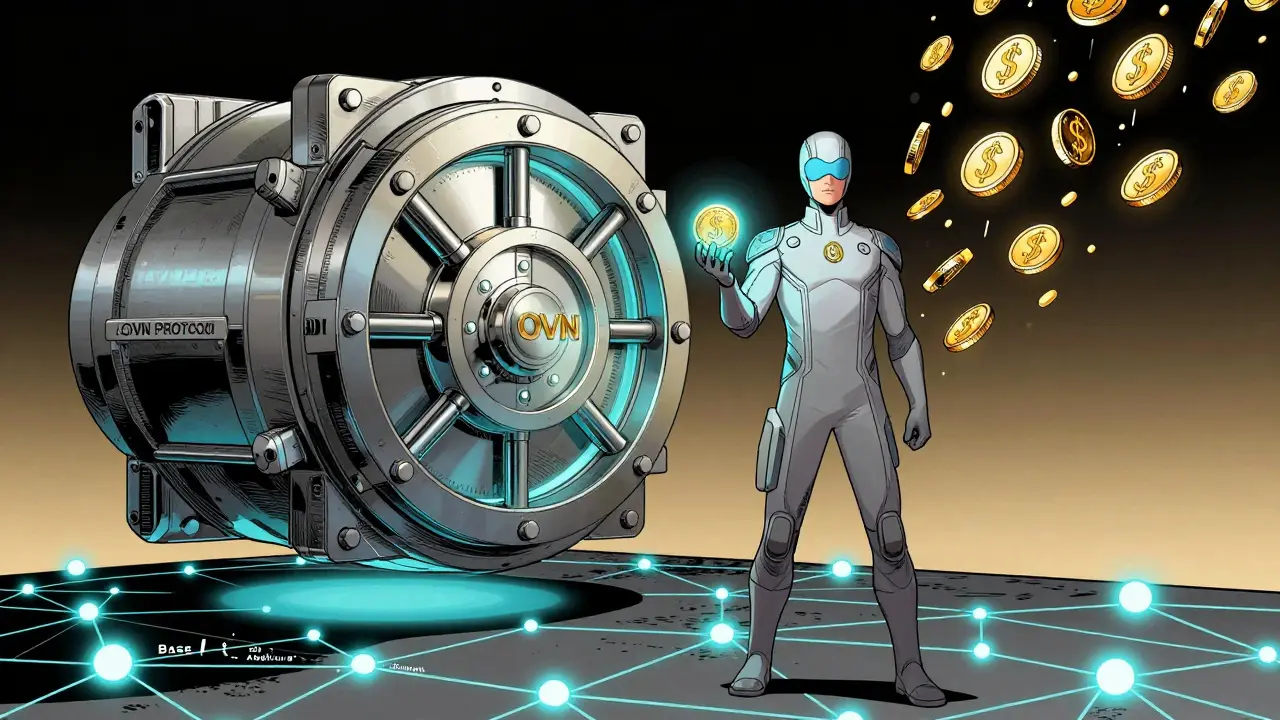
Most people know stablecoins like USDC or USDT as digital money that stays worth $1. But what if your stablecoin could pay you interest - automatically - just by holding it? That’s the idea behind Overnight (OVN), a crypto token built not to speculate, but to earn. Unlike other DeFi projects that chase wild returns with risky bets, Overnight focuses on one thing: steady, safe yield. And OVN is the engine that makes it all work.
What Exactly Is OVN?
OVN isn’t a currency you spend. It’s a governance token - think of it like a voting share in a small, quiet bank that only lends to trusted places. The protocol behind it, called Overnight, launched in 2021 and runs on chains like Base, Arbitrum, and Optimism. Its main product isn’t OVN itself, but USD+, a stablecoin that pays yield by increasing your balance every day - while still staying pegged to $1.
Here’s how it works: if you deposit $1,000 in USD+, you don’t get paid in extra dollars. Instead, your balance grows. After a year at 16% yield, you’d have 1,170 USD+ coins - each still worth exactly $1. No need to claim rewards. No complicated staking. The system just adds coins to your wallet automatically.
OVN’s job is to keep this system safe. It’s not used for trading or speculation. It’s used to vote on risk rules. If someone proposes a risky investment, OVN holders can vote it down. If the system needs more protection, OVN tokens are bought from the market and locked into an insurance fund. It’s a self-correcting system built on consensus, not hype.
How Does Overnight Make Yield?
Overnight doesn’t gamble on DeFi wild west bets. It doesn’t lend to unknown protocols or use leveraged positions. Instead, it does something boring - and that’s the point. It lends your collateral to established platforms like Aave and Compound. These are the same places where big players park their money. The interest earned from those loans is what feeds the yield for USD+, USDT+, and DAI+.
That’s why the yield is sustainable. It’s not based on printing new tokens to pay users (which crashes when the new tokens run out). It’s based on real interest from real loans. The protocol keeps a buffer - a safety net - and OVN holders decide how big that buffer should be. If a loan goes bad, the insurance fund kicks in. And that fund? It’s filled by buying OVN tokens from the open market using a portion of the daily yield.
This creates a loop: yield → buy OVN → lock OVN as insurance → protect users → keep yield flowing. It’s a rare design in DeFi: a system that rewards safety, not risk.
OVN Token Supply and Value
There are only 1 million OVN tokens in existence. That’s it. No more will ever be created. As of January 2026, OVN trades around $0.73 per token, giving it a market cap of roughly $730,000. That’s tiny compared to Bitcoin or even Ethereum, but for a niche DeFi protocol, it’s a solid start.
Trading happens mostly on Aerodrome (Base) and Aerodrome SlipStream, with a 24-hour volume of just over $2,000. Low volume means low liquidity - so don’t expect to buy or sell large amounts without moving the price. This isn’t a coin for day traders. It’s for long-term believers in stable, conservative DeFi.
What makes OVN valuable isn’t speculation. It’s utility. The more people use USD+, the more OVN is needed to govern and protect the system. The more OVN is locked into insurance, the safer the protocol becomes. And the safer it becomes, the more users are willing to trust it with their money.
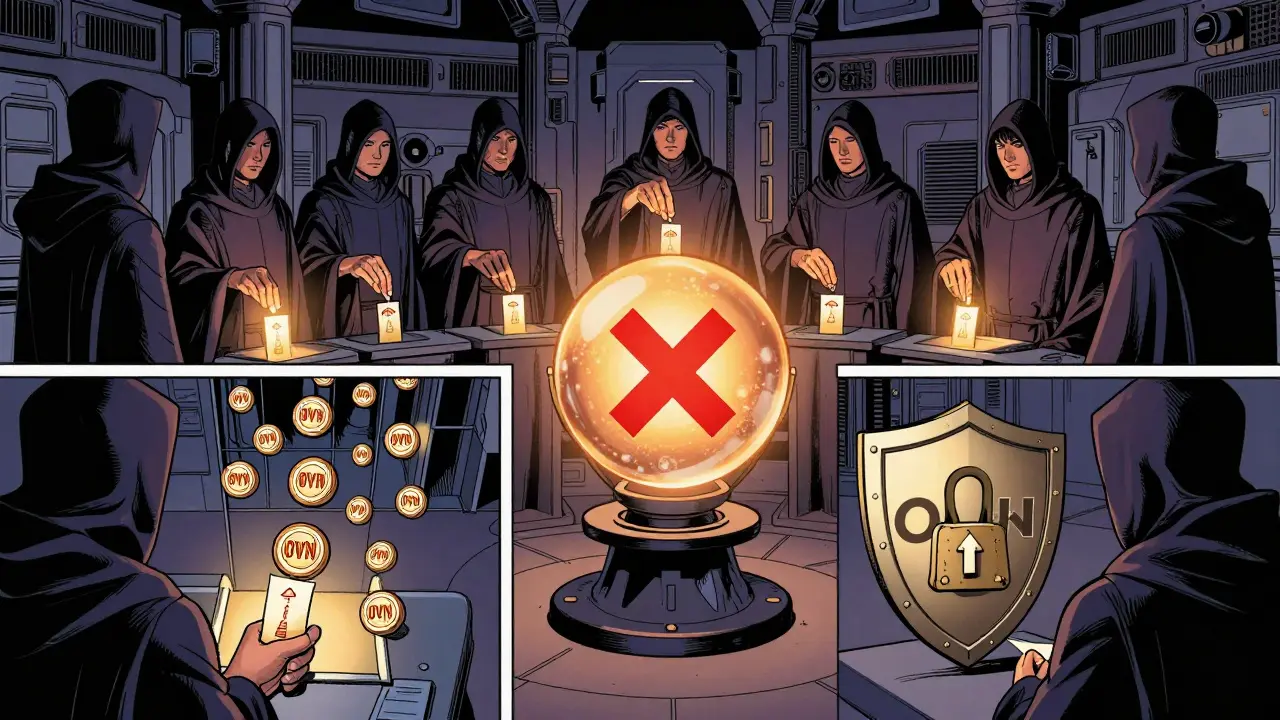
OVN vs. OVN+: The Staking Mechanism
OVN doesn’t just sit in your wallet. You can lock it up and get OVN+ in return - one for one. But OVN+ isn’t just a receipt. It’s a claim on future rewards.
Here’s the twist: 20% of the daily yield collected from USD+ pools on Base is used to buy OVN on the open market. Those bought tokens are then converted into OVN+ and distributed to people who locked their OVN. So if you hold OVN+, you’re getting a share of the protocol’s buybacks - paid out in more OVN+.
This is a clever incentive. It rewards people who believe in the protocol enough to lock up their tokens. It also reduces circulating supply, which can support price stability. It’s not a traditional staking reward. It’s a reward for helping the system stay secure.
How to Get Started with Overnight
You don’t need to be a crypto expert to use Overnight, but you do need a Web3 wallet - like MetaMask or Rabby - and some crypto on one of its supported chains: Base, Arbitrum, Optimism, Linea, or Blast.
First, go to overnight.fi. Connect your wallet. Then you can:
- Swap your USDC, USDT, or DAI into USD+, USDT+, or DAI+ using Odos - a decentralized router that finds the best price.
- Deposit into liquidity pools to earn yield. The Zapin feature lets you swap and deposit in one click.
- Stake your OVN to get OVN+ and earn a share of buyback rewards.
There’s also a Zapin NFT campaign. Do your first deposit? Get a Level 1 NFT. Do more? Get a Level 2 NFT that unlocks a private Discord with early access to features and direct chats with the team. It’s a small gamification touch - but it helps build community.

Why It’s Not for Everyone
Overnight isn’t the next Bitcoin. It won’t make you rich overnight. Its total value locked (TVL) is only $9.9 million. That’s less than 0.01% of the entire DeFi market. It’s not on Coinbase or Binance. You can’t buy OVN with a credit card. It’s not easy to find.
And yes, there’s risk. If the protocol gets hacked or a major collateral asset crashes, the insurance fund might not cover everything. It’s small. It’s unproven at scale. Experts warn that $9.9 million in TVL might not survive a major market panic.
But here’s the flip side: if you’re tired of DeFi projects that collapse after their token emissions stop, Overnight offers something rare: a system designed to last. It doesn’t need to pump. It doesn’t need hype. It just needs to be safe, steady, and smart.
Who Should Use Overnight?
Overnight is for people who want:
- Stable value (your USD+ stays $1)
- Passive yield (no claiming, no gas fees for rewards)
- Low risk (lending to Aave, not random tokens)
- Ownership (you vote on how the system runs)
It’s not for:
- Traders looking for 10x returns
- People who want to buy crypto with a credit card
- Those who need high liquidity or big exchange support
If you’re the type of person who puts money in a high-yield savings account instead of betting on crypto memes - Overnight is your DeFi version of that.
The Bigger Picture
The DeFi world is changing. After the crashes of 2022 and 2023, users are asking: "Can this last?" Overnight answers with a quiet "yes." It doesn’t need to grow fast. It doesn’t need to be everywhere. It just needs to be trustworthy.
Its multi-chain support shows it’s thinking long-term. Its fixed supply shows it’s not chasing short-term hype. Its governance model shows it’s building for the community, not just investors.
Right now, Overnight is a small experiment. But in a market full of noise, sometimes the quietest projects are the ones that survive.
Is OVN a good investment?
OVN isn’t an investment in the traditional sense. It doesn’t promise price growth. Its value comes from its role in keeping the Overnight protocol safe and running. If you believe in sustainable DeFi and want to help govern a low-risk yield system, holding OVN makes sense. If you’re looking for quick profits, look elsewhere.
Can I lose money with USD+?
Yes, but it’s unlikely under normal conditions. USD+ is fully backed by collateral. If the underlying assets (like USDC or Aave deposits) lose value, the protocol’s insurance fund - funded by OVN buybacks - steps in. However, if a massive, unexpected exploit occurs and the insurance fund is too small, losses could happen. The protocol’s small size is its biggest vulnerability.
How do I get OVN tokens?
You can buy OVN on decentralized exchanges like Aerodrome (Base) or Aerodrome SlipStream. You’ll need ETH or another supported token on Base, Arbitrum, Optimism, Linea, or Blast. Use a wallet like MetaMask, connect to the exchange, and swap for OVN. There’s no centralized way to buy it yet.
What’s the difference between USD+ and USDC?
USDC is a standard stablecoin that doesn’t pay yield. USD+ is a yield-generating version that increases your balance daily through rebasing, while keeping its $1 peg. USD+ earns yield by lending to platforms like Aave. USDC doesn’t. But USD+ is newer, less liquid, and only available on certain chains.
Is Overnight safe?
It’s one of the safer DeFi protocols because it avoids risky strategies. It uses proven platforms like Aave, has an insurance fund, and relies on community governance. But safety isn’t guaranteed. Its small TVL means it has less cushion than giants like Aave or Compound. Use only what you can afford to lose.
Aaron Poole
January 31, 2026 AT 23:12OVN is one of the few DeFi projects that actually makes sense. No crazy leverage, no rug pulls - just lending to Aave and Compound like a sensible bank. I’ve been holding USD+ for over a year and the yield compounds so smoothly you barely notice it. No need to claim, no gas fees for rewards. It’s like a high-yield savings account that doesn’t require a physical branch.
And the fact that OVN is used for governance, not speculation, is huge. Most tokens are just lottery tickets. This one’s a voting card for safety.
Low liquidity? Yeah, but that’s because it’s not meant for traders. It’s for people who want to sleep at night.
Ramona Langthaler
February 2, 2026 AT 14:46Sunil Srivastva
February 3, 2026 AT 07:55Really appreciate this breakdown. I’m from India and honestly didn’t think something like this existed outside the US. The fact that OVN is fixed supply and used for insurance instead of speculation is genius. Most DeFi projects here are just pump-and-dumps with whitepapers.
I started with $200 in USD+ last month. My balance went up by 0.8% this week - no action needed. Just leaves it there and forgets. Feels like magic but it’s just smart design.
Also, the Zapin NFT thing is cute. Not for the hype, but for the community access. Small touches like that matter.
Devyn Ranere-Carleton
February 5, 2026 AT 00:57Kevin Thomas
February 6, 2026 AT 21:34Let me break this down for the newbs: OVN isn’t a coin you trade. It’s a shield. Every time the protocol buys OVN to fund insurance, it’s buying protection for your USD+. That’s not speculation - that’s insurance. And guess what? You’re helping pay for it just by using the system.
Most people think DeFi is about getting rich quick. This is about not getting ruined slow. If you’re still using Aave or Compound without yield, you’re leaving free money on the table. OVN+ is the quiet upgrade no one talks about but everyone should be using.
Stop chasing memes. Start building wealth that doesn’t vanish when the next FTX happens.
Robert Mills
February 8, 2026 AT 18:12Jerry Ogah
February 9, 2026 AT 23:22YOU PEOPLE ARE BEING MANIPULATED. This isn’t innovation - it’s a psychological trap. They make you think you’re being safe, but you’re just locking your money into a black box run by a few devs on Discord.
And don’t even get me started on that NFT nonsense. "Oh, get a level 2 and chat with the team!" Like I care about some anonymous guy in a hoodie who coded this in his basement.
This is what happens when you take finance and give it a TikTok filter. It’s not banking. It’s theater.
Andrea Demontis
February 10, 2026 AT 07:02What’s fascinating here isn’t the yield - it’s the inversion of incentives. Most DeFi protocols reward speculation: the more you trade, the more you earn. Overnight rewards restraint. The more you lock, the safer the system becomes, and the more you benefit indirectly. It’s a feedback loop of prudence.
This is the closest thing we’ve seen to a decentralized credit union. It doesn’t scream. It doesn’t promise moonshots. It just quietly does the thing that banks used to do before they became hedge funds with apps.
I wonder if this model could scale beyond $10M TVL. Would the governance still hold? Or would the temptation to increase yield by relaxing risk rules become too strong? That’s the real test - not the APY.
Also, the fact that OVN is burned via buybacks instead of inflated is a quiet revolution. Most tokens are designed to dilute you. This one is designed to protect you. That’s philosophical, not technical.
Joseph Pietrasik
February 10, 2026 AT 12:08Raju Bhagat
February 12, 2026 AT 01:01Bro I tried this last week and my balance went up by 0.6% in 3 days. I was like what the actual f. I thought crypto was supposed to be wild but this is like getting paid to sleep. I told my cousin in Delhi and he laughed and said "you got scammed" but then he checked the contract and now he’s in too. The NFT is kinda dumb but the Discord is actually chill. We got a dev to answer a question once. Not bad for a $10M project.
Also no one talks about how the insurance fund is funded by buying OVN. That’s wild. It’s like the token pays for its own safety. Mind blown.
laurence watson
February 13, 2026 AT 05:16I’ve been in DeFi since 2020 and I’ve seen so many "safe" projects collapse. But this one… it feels different. Not because it’s big, but because it’s humble. No flashy ads. No influencers. Just a protocol that says "we’re not here to make you rich, we’re here to keep you from losing."
I think that’s rare. We’re so conditioned to chase returns that we forget safety is a return too. I keep $500 in USD+ just so I know it’s there, growing, quiet, and not going anywhere. It’s my emotional anchor in this chaos.
And the fact that you can vote on risk levels? That’s democracy. Not the kind with memes and polls - real, on-chain governance. That’s worth something.
Elizabeth Jones
February 14, 2026 AT 18:38The elegance of Overnight lies in its minimalism. It does not attempt to solve every problem - only one: how to generate yield without introducing systemic risk. By limiting exposure to audited, established protocols and using OVN as a governance and insurance mechanism, it avoids the common DeFi pitfalls of over-leveraging and token inflation.
The fixed supply of OVN is particularly noteworthy. Unlike most governance tokens that dilute holders through continuous emissions, Overnight’s scarcity creates a natural alignment: the more the protocol grows, the more valuable the token becomes as a safeguard - not as a speculative asset.
One might argue that its low TVL is a vulnerability, but it may also be its strength. Smaller systems are more agile, easier to audit, and less likely to attract malicious actors seeking large-scale exploits. Perhaps the future of DeFi isn’t in giants - but in quiet, well-constructed institutions.
Nickole Fennell
February 15, 2026 AT 17:03Edward Drawde
February 17, 2026 AT 00:49Richard Kemp
February 18, 2026 AT 20:53Been using this for 8 months. No drama. No alerts. No need to claim. Just wake up and see a little more in my wallet. The NFT is kinda dumb but the Discord is actually useful - got a tip on how to avoid gas traps on Base. Small win.
Low volume? Yeah. But I’m not selling. I’m not trading. I’m just holding USD+ like a digital savings account. If it breaks, I lose maybe $300. If it works? I get 15% a year. Not bad for something that doesn’t even need me to log in.
Aaron Poole
February 20, 2026 AT 15:27Replying to @1782 - great question. The peg stays because the protocol mints new USD+ coins at a rate tied to the interest earned, but it also adjusts the underlying collateral to maintain the $1 value. Think of it like a bank that gives you more bills every month but the value of each bill doesn’t drop because the vault (Aave/Compound) is still worth the same. The system rebases the balance, not the price.
It’s like if your $100 bill turned into 101 coins, but each coin is still worth $1. No inflation - just more coins. The magic is in the collateral backing, not the token supply.