

Most people think of cryptocurrency as a way to store value or trade speculative assets. But what if your wallet could also help host software for the world? That is exactly the promise behind Evernode. It is not just another token hoping for a quick pump. It is an attempt to build a global, permissionless network for hosting decentralized applications (dApps). If you have heard about the rise of decentralized physical infrastructure networks (DePIN), Evernode fits squarely into that category. It turns ordinary computers into nodes that provide real utility-hosting apps-in exchange for rewards.
The Core Concept: A Network of Networks
To understand Evernode (EVR), you first need to look at the problem it solves. Centralized cloud providers like AWS or Google Cloud dominate the market. They are powerful, but they are single points of failure and expensive. Evernode proposes a different model: a "network of networks." In this system, every dApp runs on its own mini-blockchain, often called an AppChain. These AppChains are made up of the hosts running them. This means the infrastructure for one app is distinct from another, yet all connected through the broader Evernode ecosystem.
This architecture relies heavily on the XRP Ledger. Specifically, Evernode operates as a Layer-2 solution built on top of the Xahau Network. The Xahau Network provides the base layer security and smart contract capabilities via Hooks. This relationship is crucial because it allows Evernode to leverage the speed and low cost of the XRP Ledger while adding specialized functionality for application hosting. You do not need to be a coding expert to join; anyone can download the software and start contributing compute power.
How the Membership Model Works
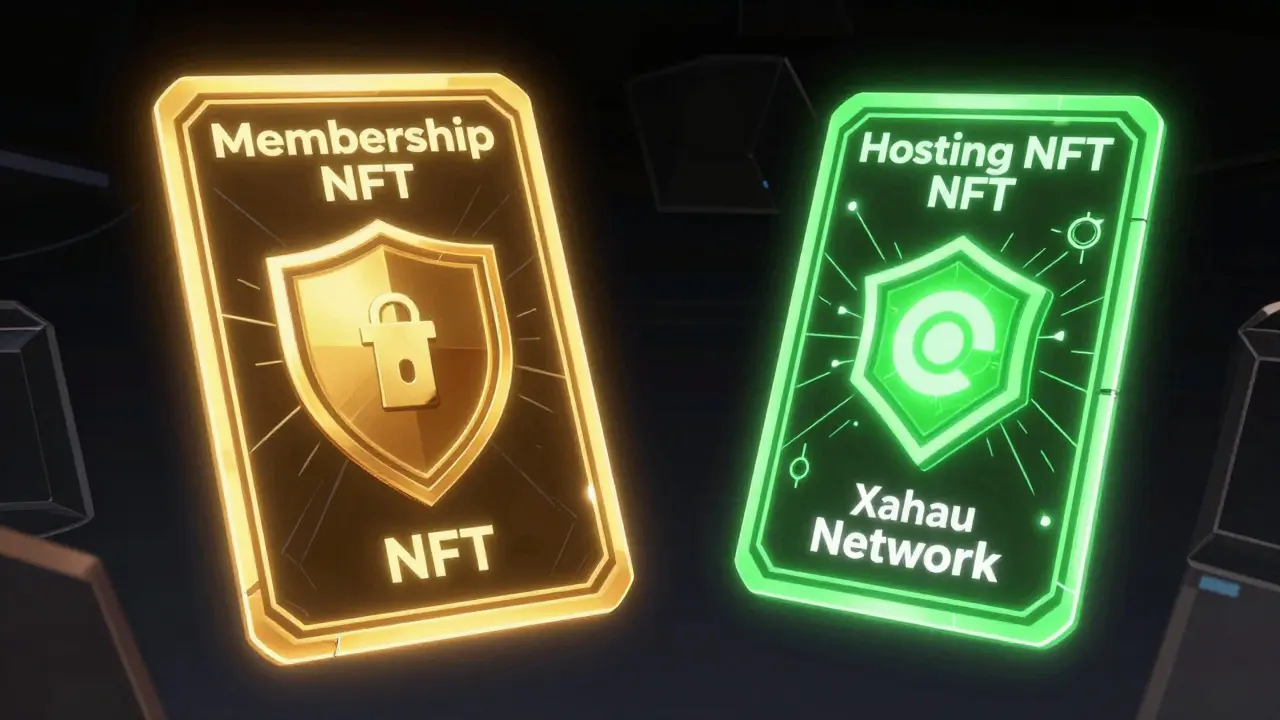
The way you join and operate within the Evernode network is unique compared to traditional Proof-of-Stake or Proof-of-Work systems. It uses a dual-NFT structure to manage access and incentives.
- Membership NFT: To become a host, you must purchase a Membership NFT from the Evernode Registry Hook. This acts as your license to run the software. It identifies you on the network and confirms your status as a member. Importantly, this is not a sunk cost. You can redeem this NFT at any time for 50% of the unrebated registration fee, providing a safety net for participants.
- Hosting NFT: Once you are a member, you mint Hosting NFTs. Each Hosting NFT represents an exclusive lease of a hosting slot. Clients pay hourly fees in Evers (the native token) to use these slots. These NFTs are tradable on the Xahau Network. The purchase price of a Hosting NFT covers the first hour of hosting. Hosts retain control over who gets their services by managing which clients receive these NFTs.
This mechanism ensures that the network remains decentralized. There is no central authority deciding who gets hosted. Instead, an automated account known as a Hook on the Xahau Network serves as the canonical registry. This means the protocol itself controls registrations, not a company or a foundation. It creates a trustless environment where supply and demand dictate hosting availability.
EVR Tokenomics and Supply Dynamics
The native currency of this ecosystem is the EVR token. Understanding its economics is vital for anyone considering using or investing in the platform. The total supply of EVR is fixed at 72,253,440 tokens. There is no inflationary pressure from new minting beyond this cap, which is a common feature in many modern cryptocurrencies designed to preserve long-term value.
As of early 2026, the circulating supply sits at approximately 36 million EVR. This means roughly half of the total tokens are currently in circulation. The fully diluted valuation (FDV)-which assumes all tokens are released-provides a theoretical ceiling for the project's market capitalization. For instance, if EVR trades at $0.15, the FDV would be around $10.8 million. Investors often watch the ratio between circulating supply and total supply to gauge potential sell pressure. With only 50% circulating, future unlocks could impact price stability if demand does not scale proportionally.
| Attribute | Value |
|---|---|
| Total Supply | 72,253,440 EVR |
| Circulating Supply | ~36,000,000 EVR |
| Base Layer | XRP Ledger / Xahau Network |
| Primary Utility | Paying for dApp hosting slots |
| Token Type | Layer-2 Utility Token |
Market Performance and Liquidity Reality
Let’s talk numbers. As of March 2026, EVR has shown significant volatility, which is typical for small-cap DePIN projects. Prices across exchanges varied, with reports ranging from $0.10 to $0.15 depending on the liquidity pool. CoinGecko aggregated data from four major exchanges, showing a market capitalization near $8.9 million. This places Evernode outside the top 1,000 cryptocurrencies by market cap, ranking it around #1835 globally.
The trading volume tells a more concerning story for short-term traders. Daily volumes have been reported as low as $23,000. Low liquidity means two things: high slippage when buying or selling large amounts, and extreme sensitivity to market sentiment. A single large order can move the price significantly. This is not a coin for day traders looking for deep pools. It is better suited for those interested in the long-term thesis of decentralized hosting.
Technical indicators paint a mixed picture. The Fear & Greed Index often registers in the "extreme fear" zone, suggesting retail investors are cautious. Moving averages show conflicting signals, with shorter-term EMAs occasionally flashing buy signals while longer-term trends remain bearish. The Relative Strength Index (RSI) typically hovers in neutral territory, indicating neither oversold nor overbought conditions. Predictions for late 2026 suggest a potential range between $0.08 and $0.32, highlighting the uncertainty surrounding the asset.
Why Does Evernode Matter?
You might ask, why bother with decentralized hosting when Amazon Web Services works fine? The answer lies in censorship resistance and cost efficiency for specific use cases. For censored regions or politically sensitive applications, relying on a centralized provider is risky. Evernode allows developers to deploy apps that cannot be taken down by a single entity. Additionally, by utilizing idle computing resources from volunteers worldwide, the cost per gigabyte of storage or processing power can theoretically drop below centralized rates.
The integration with the Xahau Network also opens doors for cross-chain compatibility. Since the XRP Ledger is increasingly being used for non-currency applications, Evernode benefits from this growing ecosystem. Developers writing in almost any language can create dApps that run on Evernode, lowering the barrier to entry for blockchain development.
Risks and Challenges
No technology is without risks. Evernode faces the classic "chicken and egg" problem of network effects. Hosts want to join if there are clients paying for hosting. Clients want to deploy if there are enough reliable hosts. Currently, the user adoption and developer activity remain relatively low. Transaction volumes are minimal, reflecting a nascent stage of development.
Another risk is technical complexity. Managing Membership and Hosting NFTs requires a level of understanding that goes beyond simple token swaps. Users must navigate the Xahau Network interface, manage hooks, and track redemption values. This friction can slow mass adoption. Furthermore, the reliance on the XRP Ledger means Evernode inherits any regulatory or technical risks associated with Ripple and the broader XRP ecosystem.
Is Evernode (EVR) a good investment in 2026?
Investing in EVR carries high risk due to its low market cap and limited liquidity. It is suitable only for investors who believe in the long-term potential of decentralized physical infrastructure networks (DePIN) and understand the volatility of small-cap altcoins. Always do your own research and never invest more than you can afford to lose.
How do I earn EVR tokens?
You earn EVR by becoming a host. First, you purchase a Membership NFT to join the network. Then, you mint Hosting NFTs and offer your computing resources to dApp developers. Clients pay hourly fees in EVR to use your hosting slots. You can also trade Hosting NFTs on the Xahau Network.
You earn EVR by becoming a host. First, you purchase a Membership NFT to join the network. Then, you mint Hosting NFTs and offer your computing resources to dApp developers. Clients pay hourly fees in EVR to use your hosting slots. You can also trade Hosting NFTs on the Xahau Network.
What is the difference between Evernode and traditional cloud hosting?
Traditional cloud hosting is centralized, meaning one company controls the servers. Evernode is decentralized, using a global network of individual hosts. This offers greater censorship resistance and potentially lower costs, but may have higher latency and less consistent uptime compared to enterprise solutions like AWS.
Can I redeem my Membership NFT?
Yes. The Membership NFT acts as a refundable license. You can redeem it at any time for 50% of the unrebated registration fee. This feature reduces the risk for hosts who decide to leave the network.
Where can I buy EVR tokens?
EVR is traded on several exchanges including Bitrue and Binance. However, liquidity is low, so prices may vary significantly between platforms. Always check multiple sources for the best rate and be aware of slippage fees.
Evernode represents a bold step toward true decentralization of internet infrastructure. While it faces challenges in adoption and liquidity, its innovative use of NFTs for resource allocation and its foundation on the Xahau Network make it a fascinating project to watch. Whether it becomes a mainstream alternative to big tech clouds depends on developer adoption and network stability in the coming years.