
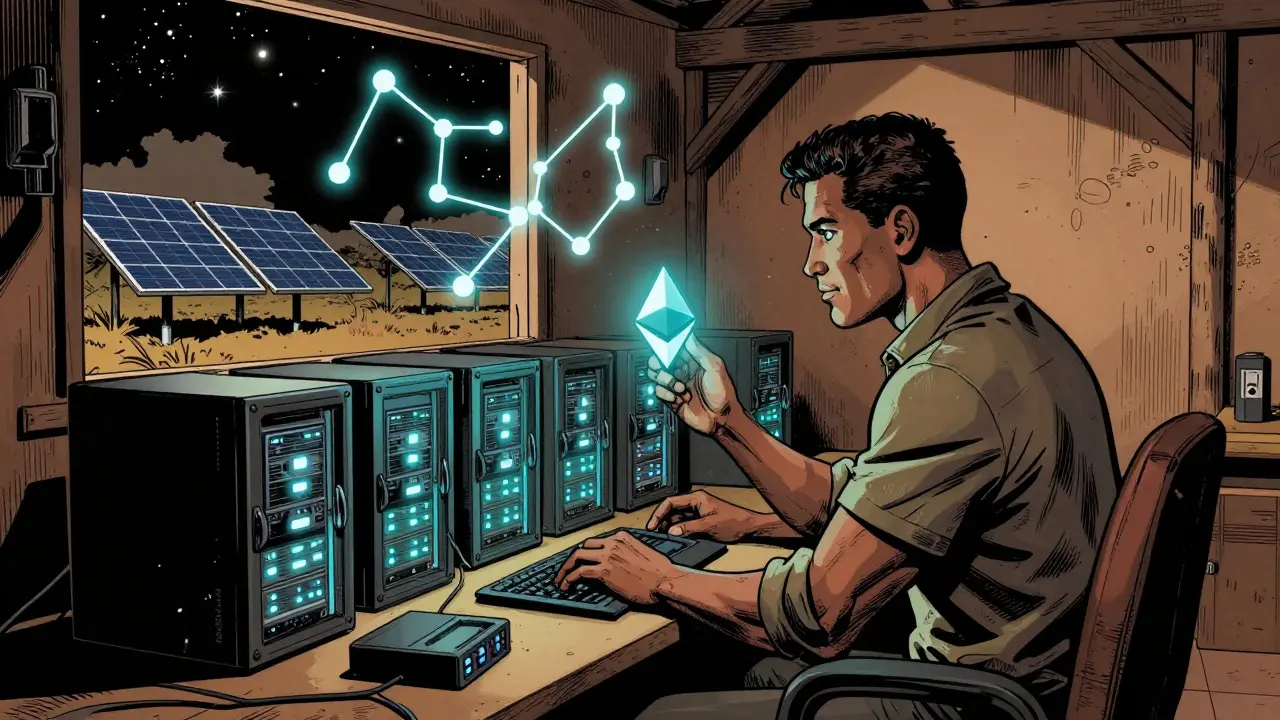
Element (ELMT) isn’t another crypto coin you can buy and hold like Bitcoin or Ethereum. It’s a reward system wrapped in blockchain tech, built for a very specific group of people: node operators in the Element ecosystem. If you’re wondering whether ELMT is worth your time, money, or attention, the truth is messy, complicated, and not what most crypto guides will tell you.
What ELMT Actually Is (And What It Isn’t)
ELMT is an ERC-20 token on the Ethereum blockchain. Its contract address is 0x600d601d8b9eb5de5ac90fefc68d0d08801bfd3f. But here’s the catch: it wasn’t launched through an ICO, a public sale, or a marketing campaign. It was created as a digital payout for people who run nodes on the Element Blockchain - a private network built by a company called Element United.
These nodes aren’t like Bitcoin miners. They don’t solve complex math problems to earn rewards. Instead, they host software that helps validate transactions on Element’s own blockchain. In return, node owners get ELMT tokens - typically around 500 per day, according to users in Element’s private Discord. That’s the entire purpose of the token: to reward infrastructure support, not to be traded.
Element United doesn’t promote ELMT. They don’t list it on exchanges. They don’t create liquidity. Their official stance, updated as recently as January 5, 2026, is blunt: “We do not provide support for token valuation or exchange-related issues.” That’s not a bug. It’s the design.
The Numbers Don’t Lie - ELMT Has Almost No Liquidity
Let’s talk numbers, because they tell the real story.
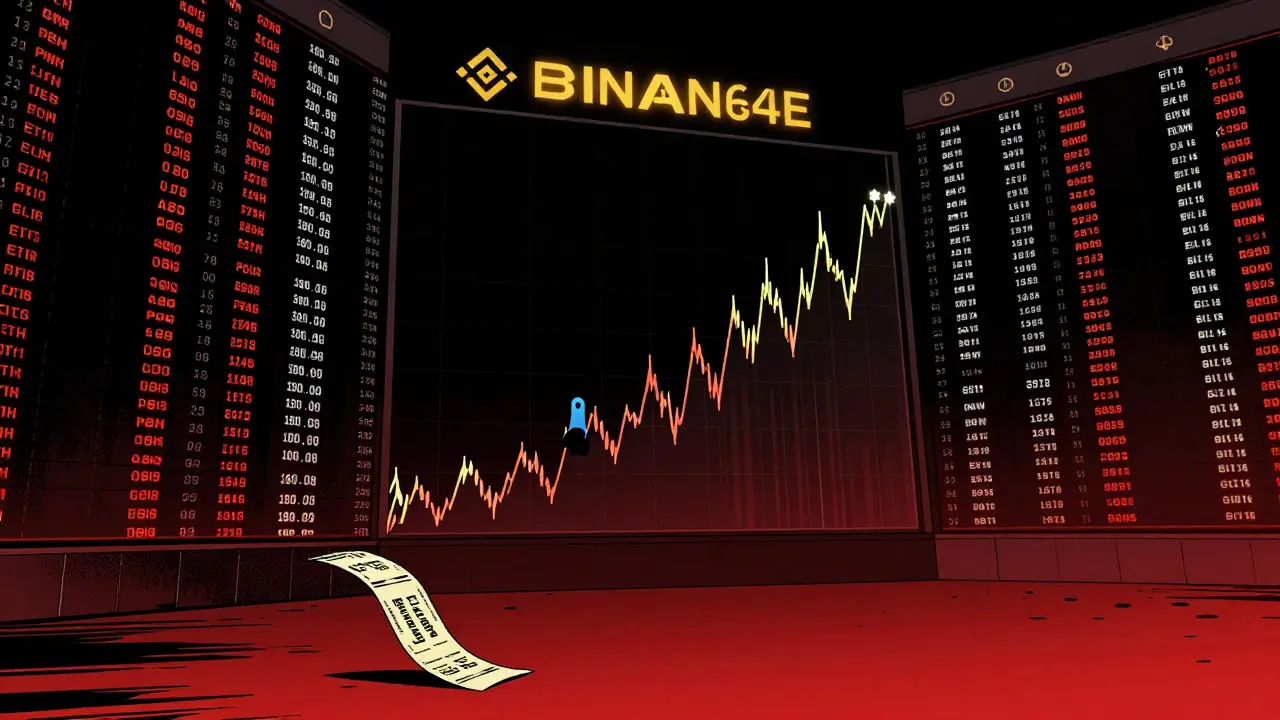
ELMT’s total supply is capped at 50 billion tokens. But only about 1.73 billion are circulating, according to CoinMarketCap. That sounds like a lot - until you look at trading volume. On Binance, the largest exchange in the world, ELMT shows $0 in 24-hour trading volume. Same on CoinMarketCap. Crypto.com reports $416. CoinStats shows $30.1. That’s not trading. That’s a whisper.
Compare that to Power Ledger (POWR), a similar environmental blockchain token. POWR trades over $10 million daily on Binance. ELMT? It’s barely registered. And the price? It’s all over the place. Binance says $0.000643. Crypto.com says $0.0003928. Ethplorer says $0.0004802. Why? Because there’s no consistent market. Prices are pulled from two or three tiny exchanges with almost no buyers or sellers.
It hit an all-time high of $0.245 in 2023. Today, it’s trading at less than 0.3% of that. That’s a 99.7% drop. And it’s not because the market crashed - it’s because nobody’s buying.
Who Holds ELMT? And Why?
There are about 8,908 wallet addresses holding ELMT, according to Ethplorer. Most of them belong to node operators - people who signed up to run hardware for Element United’s blockchain. These aren’t speculators. They’re participants in a private reward system.
On Reddit, users call ELMT “a dead token with no volume.” On Trustpilot, Element United has a 3.2/5 rating. One user wrote: “They created a token but won’t support it on exchanges - what’s the point?” That question echoes across every forum.
Meanwhile, in Element’s private Discord, node operators say they’re happy. One user from Tanzania says they earn 500 ELMT daily and have been for over two years. But here’s the problem: they can’t cash out. There’s no easy way to turn ELMT into USD, EUR, or even Bitcoin. You can’t use it to buy coffee, pay for hosting, or trade it for another coin without jumping through hoops on decentralized exchanges with 15% slippage.
Why ELMT Isn’t a Good Investment - Even If You Believe in the Mission
Element United’s goals are real. They’re working with mines in Tanzania and Indonesia to reduce environmental damage. They’re building NFTs for mining certification. They’re creating tokenized carbon offsets - and those could be valuable. But ELMT isn’t the vehicle for that. It’s a byproduct.
Think of it like this: if a coffee company gave you a coupon for free beans every time you bought their espresso machine, you’d be happy. But if you tried to trade that coupon on eBay and nobody wanted it, would you still call it valuable? Probably not.
ELMT has no utility outside the Element ecosystem. It’s not used in DeFi. It’s not listed on Coinbase, Kraken, or KuCoin. It doesn’t power any dApps. It’s not even accepted by any merchants. It exists only as a digital receipt for running a node.
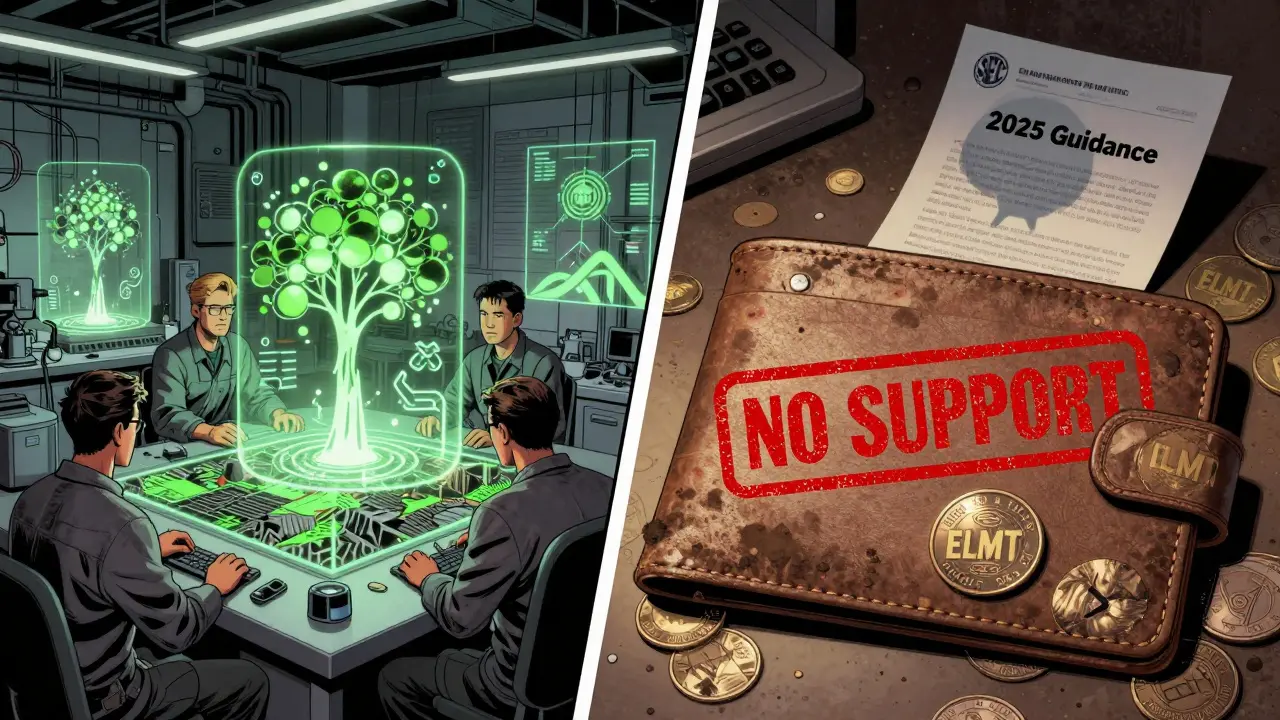
And here’s the kicker: the SEC’s 2025 guidance on reward-based tokens puts projects like this in legal gray zones. If ELMT were ever classified as a security, it could be frozen or delisted entirely. Element United says they’re compliant. But compliance doesn’t mean liquidity. It doesn’t mean value.
Can You Even Buy ELMT? And Should You?
Technically, yes. You can buy ELMT on a few small exchanges like Binance (with extreme caution), and on decentralized platforms like Uniswap. But you need to add the contract address manually to your wallet. MetaMask users have to input it by hand - no one-click add.
Here’s what happens if you try to trade it:
- Buy orders are thin. You might pay 15% more than the listed price just to get in.
- Sell orders? Almost nonexistent. You might wait hours for a buyer.
- Price swings of 90% in a day aren’t rare. Crypto.com reported a -93.66% drop in 24 hours.
- There’s no customer support from Element United if your trade fails.
It’s not gambling. It’s not investing. It’s like buying a lottery ticket for a game that hasn’t been drawn in years.
What’s Next for ELMT?
Element United’s Q4 2025 report didn’t mention ELMT at all. Instead, they announced partnerships with three Tanzanian mines to launch their carbon offset program in Q2 2026. That’s the future. Not the token.
Industry analysts at Messari and Coinbase Institutional Research predict that tokens like ELMT - with under $10,000 in daily volume - will become worthless within 18 months. That’s not speculation. It’s data. Of the last 50 tokens with similar liquidity, 43 vanished from exchanges or dropped below $0.00001.
ELMT might survive as a niche reward token. But as a cryptocurrency? It’s already dead.
Final Verdict: Is ELMT Worth It?
If you’re a node operator in the Element ecosystem - and you’re happy getting 500 ELMT daily - then keep it. It’s your reward. Don’t worry about the price.
If you’re a trader, investor, or anyone hoping to make money from ELMT - walk away. There’s no liquidity. No future roadmap for the token. No exchange support. No community demand. Just a company focused on building real environmental tools - and leaving the token behind.
ELMT isn’t a crypto coin you should own. It’s a digital badge for people who helped build something else. And right now, that badge has no market value.
Is Element (ELMT) a good investment?
No. ELMT has almost no trading volume, extreme price swings, and no support from major exchanges. Its value is tied only to node rewards, not market demand. It’s not a viable investment - it’s a utility token with no liquidity.
Can I buy ELMT on Binance or Coinbase?
You can find ELMT listed on Binance, but trading volume is $0. Coinbase does not list ELMT at all. Even on Binance, there are no meaningful buy or sell orders. It’s technically listed, but not tradable in any practical sense.
Why is ELMT’s price so volatile?
With only 1.7 billion tokens circulating and almost no buyers, even small trades can swing the price by 50% or more. Low liquidity means minimal order depth - so one large sell order can crash the price. That’s why Crypto.com reported a -93% drop in a single day.
How do I add ELMT to my MetaMask wallet?
Go to your MetaMask wallet, click "Add Token," then "Custom Token." Paste the contract address: 0x600d601d8b9eb5de5ac90fefc68d0d08801bfd3f. Confirm, and ELMT will appear. But remember: adding it doesn’t mean you can sell it.
Does Element United support ELMT holders?
No. Element United explicitly states they do not support token valuation, exchange listings, or trading issues. Their focus is on building blockchain products for mining sustainability - not managing the ELMT market. Support for ELMT is limited to community forums, which are small and inactive.
Is ELMT related to carbon credits?
Not directly. ELMT itself is not a carbon credit. But Element United is developing a tokenized carbon offset program set to launch in Q2 2026. That project may use a different token or system. ELMT is only used as a node reward, not for environmental tracking.
What happens if ELMT gets delisted?
If ELMT is delisted from the few exchanges that still list it, your only option will be to hold it in your wallet. There’s no guaranteed way to convert it to cash. You’d need to find a private buyer willing to trade for it - which is extremely unlikely given its current market conditions.
steven sun
January 21, 2026 AT 17:20Arielle Hernandez
January 22, 2026 AT 19:07Mathew Finch
January 24, 2026 AT 07:18Roshmi Chatterjee
January 25, 2026 AT 00:00Deepu Verma
January 26, 2026 AT 04:31MICHELLE REICHARD
January 27, 2026 AT 02:18Bonnie Sands
January 28, 2026 AT 05:00Jennifer Duke
January 29, 2026 AT 11:15Andy Marsland
January 29, 2026 AT 19:59Jeffrey Dufoe
January 29, 2026 AT 21:37Jonny Lindva
January 30, 2026 AT 07:54Jen Allanson
January 31, 2026 AT 20:23Dave Ellender
February 1, 2026 AT 00:41Adam Fularz
February 1, 2026 AT 13:01Adam Lewkovitz
February 2, 2026 AT 23:10Barbara Rousseau-Osborn
February 4, 2026 AT 05:55Arnaud Landry
February 4, 2026 AT 08:38george haris
February 5, 2026 AT 01:05Mark Estareja
February 6, 2026 AT 14:18David Zinger
February 8, 2026 AT 06:19Sara Delgado Rivero
February 10, 2026 AT 04:01Athena Mantle
February 10, 2026 AT 09:51