
| Attribute | Value |
|---|---|
| Blockchain Platform | Ethereum (ERC-20) |
| Launch Date | March 1, 2024 |
| Total Supply | 42 Million BLENDR |
| Circulating Supply | ~40 Million (approx. 95%) |
| Primary Use Case | Decentralized GPU Rendering & AI |
How the BLENDR Ecosystem Actually Works
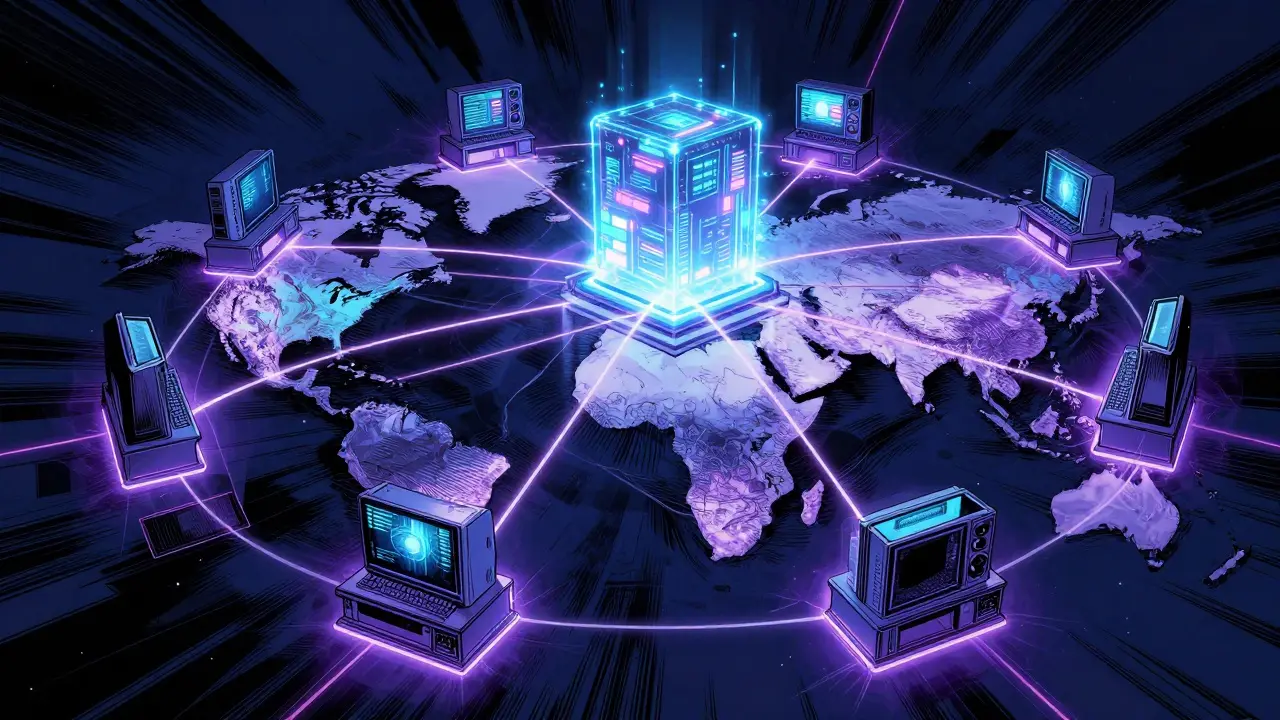
To understand the coin, you first have to understand the engine. The project isn't just a currency; it's a hybrid system combining Ethereum is a decentralized, open-source blockchain with smart contract functionality that serves as the foundation for the BLENDR token and a distributed network of hardware providers. When a user needs computing power, they request a task. The network then matches this request with a provider who has an available GPU. All of this is managed by Smart Contracts is self-executing contracts with the terms of the agreement directly written into lines of code, ensuring transparent resource allocation . These contracts handle the payment and verify that the work was actually completed, meaning you don't have to trust the provider blindly-the code handles the trust. The BLENDR token serves two roles. First, it acts as the payment method and incentive for people to share their GPUs. Second, it gives holders a say in how the protocol evolves. By removing the middleman (the big GPU farm owners), the network can theoretically offer lower prices to users and better payouts to providers.Market Reality: Price and Performance
If you're looking at the charts, the history of BLENDR is a bit of a rollercoaster. After launching in early 2024, the token saw a massive spike, hitting all-time highs between $3.80 and $4.36. However, the market shifted, and by April 2026, the price has settled into a much lower range. Depending on which exchange you check, you'll see prices hovering around $0.002 to $0.05. This volatility is common in early-stage infrastructure projects, but there's a specific challenge here: liquidity. The 24-hour trading volume is often quite low, sometimes ranging from just $60K to $300K. For a regular person, this means buying small amounts is fine, but if you try to move a huge amount of BLENDR at once, you might experience "slippage," where your own trade pushes the price down significantly.
Where to Trade and Store BLENDR
Since BLENDR is an ERC-20 token, it's compatible with almost any Ethereum wallet. Most users prefer MetaMask is a software cryptocurrency wallet used to interact with the Ethereum blockchain and other EVM-compatible networks because you can simply import the contract address (0x84018071282d4b2996272659d9c01cb08dd7327f) to see your balance. When it comes to exchanges, you'll find different levels of activity. CoinEx is a digital asset trading platform that currently hosts one of the most active BLENDR/USDT trading pairs tends to be more liquid. Others like Uniswap V2 is a decentralized exchange (DEX) protocol that allows users to swap tokens directly from their wallets provide a way to trade without a central authority. Just be careful-some platforms like Crypto.com might list the price for tracking but aren't always available for actual trading.The Risks and Red Flags
No investment is without risk, and Blendr Network has some specific hurdles. The most obvious one is the price drop from its 2024 peak. A 93% decline year-over-year suggests that the initial hype outweighed the actual adoption rate. Another concern is the competition. The decentralized computing space is getting crowded. Many projects are fighting for the same GPU providers and AI researchers. To survive long-term, Blendr needs to prove that its specific architecture is faster or more reliable than the alternatives. If the network doesn't attract enough high-paying tasks (like complex AI training), the incentive for providers to stay online drops, which could lead to a shrinking network.
Future Outlook: What to Watch
Technical analysts are currently split. Some models from firms like CoinCheckup suggest a neutral or slightly bearish outlook for May 2026, predicting a further dip. Others see the current low price as a potential base for a recovery. Whether you're a tech enthusiast or a trader, the real metric to watch isn't the price-it's the usage. If Blendr can announce more partnerships with AI startups or rendering studios, the demand for the underlying hardware will increase. That demand is what eventually drives the value of the token. Until then, it remains a high-risk, high-reward bet on the future of distributed computing.What exactly is the purpose of the BLENDR token?
The BLENDR token is used to pay for computing power on the network. It also rewards people who provide their GPUs to the network and allows token holders to vote on changes to the protocol.
Can I mine BLENDR tokens with my GPU?
Blendr isn't a "mineable" coin in the traditional sense like Bitcoin. Instead, you earn rewards by acting as a resource provider-essentially renting your GPU's processing power to users who need it for AI or rendering tasks.
Is BLENDR safe to hold in a wallet?
Since it is an ERC-20 token, it can be stored in any Ethereum-compatible wallet like MetaMask or Trust Wallet. While the wallet itself is safe, the token's value is highly volatile, which is the primary risk.
Why is the price so different across exchanges?
This happens because BLENDR has low liquidity. When there aren't many buyers and sellers on a specific exchange, a few large trades can swing the price significantly, creating a gap between the price on CoinGecko and the price on a specific exchange like Kraken.
How does Blendr Network compete with AWS or Google Cloud?
Blendr competes by offering a decentralized alternative. By using a distributed network of individual GPUs rather than massive centralized data centers, they aim to lower costs and remove the scalability bottlenecks imposed by a single corporation.
Next Steps and Troubleshooting
- For New Users: Start by setting up an Ethereum wallet. Do not send BLENDR tokens to an exchange address unless you've confirmed that the exchange supports ERC-20 deposits for this specific token.
- For Hardware Providers: Research the specific hardware requirements for the Blendr network to ensure your GPU is compatible and that the electricity cost doesn't exceed your potential earnings.
- For Traders: Check the 24-hour volume on CoinEx or Uniswap before making large trades to avoid extreme slippage.
Robert Smith
April 27, 2026 AT 19:18Sounds like a cool project! 🚀
Emily A
April 28, 2026 AT 10:32The volatility mentioned is practically an understatement. One must realize that a ninety-three percent decline is not merely a "rollercoaster," but a fundamental failure in value retention. It is quite naive to suggest that this is simply "common in early-stage projects" when the liquidity is so abysmal that a single mid-sized trade can wipe out the order book. Precision in financial analysis is required here; this is a high-risk speculative asset with minimal utility at present.
Alex Mazonowicz
April 29, 2026 AT 00:18This is exactly what the world needs!!! Imagine the possibilities for indie artists!!! Just incredible!!!
VIVEK SINGH
April 30, 2026 AT 16:31Oh, wonderful, another "decentralized" solution to a problem that centralized giants solved decades ago with actual efficiency. I'm sure renting a random guy's gaming rig in a basement is just peak security and reliability. Truly a masterpiece of modern financial engineering.
Arti Jain
April 30, 2026 AT 17:09India leads in tech. This is basic stuff.
Felix Eduardo Velasquez
May 1, 2026 AT 16:44From a technical standpoint, the real challenge here is latency. Distributed computing works well for "embarrassingly parallel" tasks like rendering frames or training certain types of AI models, but the overhead of managing a global network of heterogeneous hardware can be immense. To truly compete with AWS, Blendr needs a robust orchestration layer that can handle failure at the node level without crashing the entire job. If the smart contracts are the only thing ensuring trust, they still need a way to verify the quality of the output, otherwise, a provider could simply return a junk file and collect the reward. This is where a proof-of-computation mechanism becomes essential for any distributed GPU network to be viable.
Lloyd I
May 2, 2026 AT 17:36I really think we can all get behind the idea of democratizing hardware access! It's all about community growth. Let's keep pushing for these alternatives!
Veronica Bago
May 3, 2026 AT 20:49It's definitely an interesting concept. I'm just watching from the sidelines to see if it actually gains traction.
Harvey Alford
May 4, 2026 AT 13:48I need to know your setup.
Gabby Puche
May 6, 2026 AT 09:21Keep your heads up everyone! 🌟 The dip is just a chance to learn more about the tech! ✨
Lynne Teperman
May 7, 2026 AT 12:31wild vision of a shared brain for computers
Rachel S
May 8, 2026 AT 07:46It is absolutely harrowing to witness such a precipitous drop in value! 😱 One must exercise extreme caution when venturing into these uncharted waters! 📉
Jan Conrad
May 8, 2026 AT 09:03I wonder if the electricity costs for providers in different regions make some nodes completely unprofitable compared to others.
Rushell Perry
May 8, 2026 AT 09:54just take it slow and do your own research folks no need to rush in
its me
May 8, 2026 AT 12:22We all seek meaning in the machine. Perhaps this token is just a mirror of our own fragmented desires for power.
Ipsita Seal
May 10, 2026 AT 11:33too much reading for something that probably won't work.
Carli Bates
May 11, 2026 AT 15:33wow decentralized gpus because that definitely won't have any security issues at all lol
Jimmy vasquez
May 12, 2026 AT 06:39If you're trying to get started, definitely use a hardware wallet for the long term rather than just keeping it on the exchange!
Andrew Todd
May 13, 2026 AT 16:55USA will dominate this tech regardless of where it starts. Simple as that.