
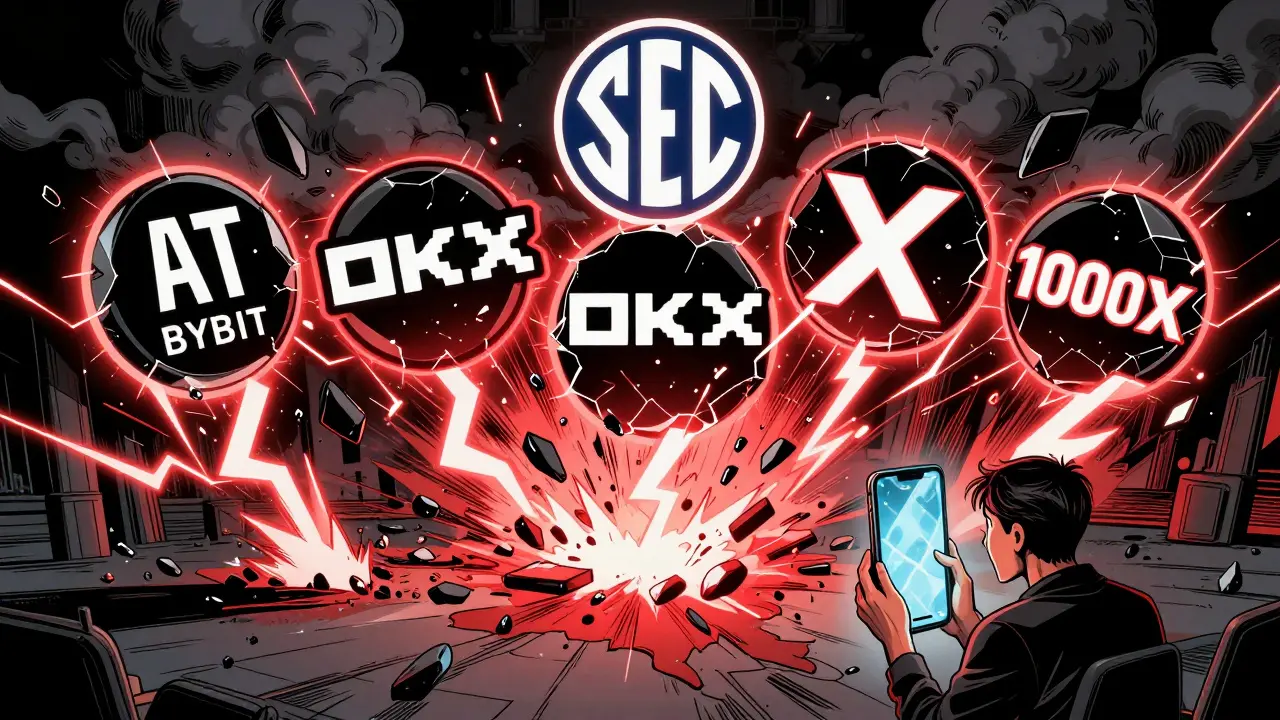
Thailand didn’t just tighten rules on crypto - it shut the door on foreign peer-to-peer (P2P) platforms entirely. By June 2025, five major exchanges were completely blocked from operating in the country. If you were using Bybit, OKX, CoinEx, XT.COM, or 1000X to trade crypto from Thailand, you lost access overnight. No warning. No grace period beyond a single month. This wasn’t a slow crackdown. It was a clean sweep.
Why Thailand Pulled the Plug
The Thai Securities and Exchange Commission (SEC) didn’t act because crypto was dangerous. It acted because unlicensed foreign platforms were becoming a playground for scammers. Money laundering, phishing scams, and fake investment schemes were booming on these sites. Thai users were losing life savings. The government saw a pattern: foreign crypto firms set up shop without registering, ignored Thai laws, and vanished when things got hot. The SEC’s goal? Protect everyday people. Not to kill innovation. Not to ban crypto. But to make sure every platform serving Thai users had to play by local rules. That meant licensing. That meant KYC checks. That meant reporting suspicious activity - just like banks do.The Legal Framework: Two Royal Decrees, One Message
On April 13, 2025, two emergency decrees dropped. They weren’t suggestions. They were orders. The first, Royal Decree on the Operation of Digital Asset Businesses (No. 2), said: if you’re a foreign crypto platform and you’re marketing to Thai users - even just through Instagram ads or YouTube influencers - you need a license from the SEC. No exceptions. No loopholes. If you didn’t apply, you were illegal. The second, Royal Decree on Measures to Prevent and Suppress Technology Crimes (No. 2), gave the Ministry of Digital Economy and Society (MDES) the power to block websites without a court order. No judge. No delay. Just a signal from MDES, and the internet providers cut access. Bybit, OKX, and the others went dark on June 28, 2025.Who Got Blocked? The Big Five
These weren’t obscure platforms. These were top-10 global exchanges:- Bybit - One of the largest derivatives traders in Asia.
- OKX - A giant with over 100 million users worldwide.
- CoinEx - Popular for low-fee trading and altcoins.
- XT.COM - Known for aggressive P2P promotions in Southeast Asia.
- 1000X - A newer platform that exploded in Thailand with influencer marketing.

Who Else Got Dragged Into This?
Thailand didn’t stop at crypto platforms. It went after the whole ecosystem. Commercial banks had to monitor transactions for signs of crypto-related fraud. If a customer sent money to a blocked exchange and it turned out to be a scam, the bank could be held liable if they didn’t flag it. Telecom companies like AIS and TrueMove H had to block access to the banned sites at the network level. If they didn’t, they risked fines. Even social media platforms like Facebook, TikTok, and Line were told: stop promoting these platforms. If your ad campaign led Thai users to Bybit, you could be fined. The rules now say: if you enable crime, you’re part of the crime.What About Thai Crypto Exchanges?
Here’s the twist: Thailand didn’t ban crypto. It just made it local. Platforms like Bitkub and Zipmex Thailand are still fully operational. They’re licensed. They follow Thai AML/KYC rules. They report every transaction. They even offer Thai baht deposits through local banks. Thai users can still trade Bitcoin, Ethereum, and dozens of other tokens - but only through these regulated exchanges. The government even plans to launch its own digital asset: the G Token. A government-backed token tied to bonds, worth 5 billion baht ($150 million), set to be issued in late 2026. This isn’t anti-crypto. It’s pro-control.
Santosh kumar
February 14, 2026 AT 10:43Claire Sannen
February 15, 2026 AT 17:20Crystal McCoun
February 17, 2026 AT 15:46kelvin joseph-kanyin
February 18, 2026 AT 10:34John Doyle
February 19, 2026 AT 20:37Desiree Foo
February 19, 2026 AT 21:53Christopher Wardle
February 21, 2026 AT 08:09SAKTHIVEL A
February 21, 2026 AT 10:25Keturah Hudson
February 22, 2026 AT 20:29Benjamin Andrew
February 24, 2026 AT 13:30Joe Osowski
February 25, 2026 AT 08:24Beth Trittschuh
February 26, 2026 AT 02:37Robbi Hess
February 26, 2026 AT 06:25