
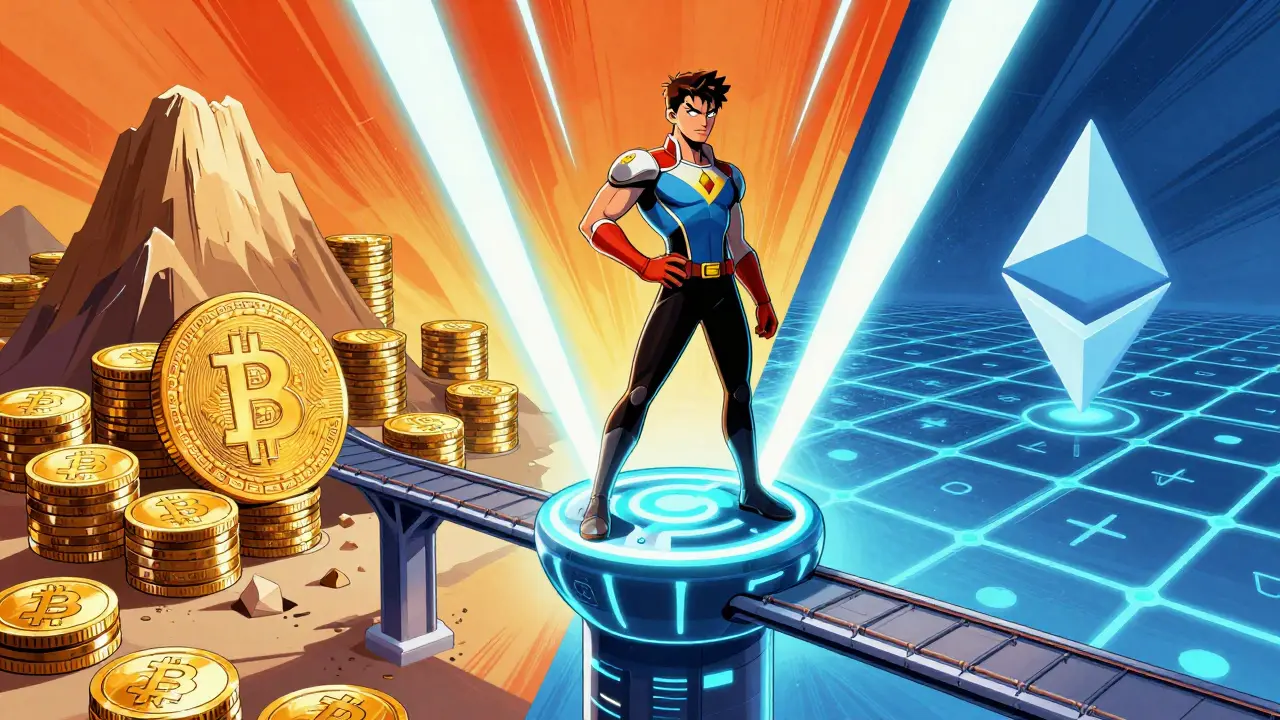
Teleport System Token is an ERC-20 utility token powering the TeleportDAO ecosystem, designed to create a trustless bridge between Bitcoin and Ethereum-compatible networks.
What is Teleport System Token (TST)?
TST is the native cryptocurrency of TeleportDAO, a decentralized protocol solving a critical problem: securely moving Bitcoin assets to other blockchains without relying on centralized intermediaries. Most Bitcoin bridges require trusted third parties to hold Bitcoin and issue wrapped tokens on other chains. TeleportDAO eliminates this risk by using Bitcoin light-client verification. This means the system independently checks Bitcoin blockchain data on other networks using mathematical proofs, not human trust. For example, when moving Bitcoin to Ethereum, TST ensures the bridge only processes valid Bitcoin transactions without needing a company to verify them.
How TST Powers the TeleportDAO Ecosystem
TeleportDAO operates through a network of Relayer nodes that submit Bitcoin block headers to target chains. These nodes earn TST rewards for honest behavior but face penalties (slashing) if they act maliciously. The token’s role is vital here: it creates economic incentives for network security. Without TST, there would be no way to reward nodes or punish bad actors, making the entire system vulnerable. The light-client verification process works by validating Bitcoin block headers against Bitcoin’s consensus rules. This ensures only legitimate Bitcoin transactions are bridged to EVM chains like Ethereum, Polygon, or Arbitrum. For instance, if someone tries to double-spend Bitcoin on another chain, the light-client verification will detect it instantly and reject the transaction.

Key Features and Use Cases
- TeleSwap: A decentralized protocol for bridging Bitcoin assets (including BRC-20 tokens) to EVM chains. Users can swap Bitcoin for ERC-20 tokens or wrap Bitcoin for DeFi applications like lending or yield farming. Unlike centralized bridges, TeleSwap uses TST to secure transactions without holding users’ funds.
- TeleOrdinal: The first cross-chain marketplace for Bitcoin NFTs (Ordinals). It allows users to buy and sell Ordinals using stablecoins from any EVM blockchain. For example, a Bitcoin NFT collector could sell an Ordinal on Ethereum and receive USDC directly, without trusting a middleman.
- Governance: TST holders vote on protocol upgrades, fee structures, and new features. This ensures the ecosystem evolves based on community input rather than a central team’s decisions.
- Transaction Fees: TST pays for bridge operations, like submitting Bitcoin block headers or processing cross-chain swaps. This creates a self-sustaining economy where users fund the network’s security.
Current Market Data
As of January 2024, TST has a circulating supply of 300 million tokens out of a maximum supply of 1 billion. Its market capitalization was $339,862, ranking #5425 on CoinGecko. The token price hovered around $0.000138 per TST across major exchanges like Binance ($0.000138) and Bybit ($0.00013484). Despite the low absolute price, TST showed strong resilience: it rose 41.10% in one week while the broader crypto market fell 12.10%. This indicates growing interest in Bitcoin interoperability solutions. However, its fully diluted valuation (FDV) of BTC9.6141 suggests significant room for growth if adoption increases.
Challenges and Adoption Status
TeleportDAO faces real-world hurdles. Its market cap is tiny-just 0.0003% of the total $1.2 trillion crypto market. Most users interact with TST for speculation rather than using its core features. Competition is fierce: bridges like Wormhole and Chainlink CCIP have far more integrations and higher market caps. Technically, light-client verification can slow down during Bitcoin network congestion, as processing block headers requires significant resources. Yet, TeleportDAO’s trustless design offers a unique advantage. Unlike centralized bridges (e.g., Wrapped Bitcoin), it doesn’t require custodians to hold Bitcoin, reducing counterparty risk. This makes it a compelling option for privacy-focused users or those wary of centralized custody. Adoption remains experimental, but growth in Bitcoin Ordinals and BRC-20 tokens could drive demand for TeleSwap and TeleOrdinal.
Frequently Asked Questions
What is Teleport System Token used for?
TST powers the entire TeleportDAO ecosystem. It secures cross-chain bridges via Relayer node rewards, pays transaction fees, enables governance voting, and fuels TeleSwap (for Bitcoin-to-EVM swaps) and TeleOrdinal (for Bitcoin NFT trading). Without TST, the system couldn’t operate securely or sustainably.
How does the Teleport bridge work?
The bridge uses Bitcoin light-client verification. Relayer nodes submit Bitcoin block headers to target chains, which are then validated against Bitcoin’s consensus rules. This proves Bitcoin transactions are legitimate without third parties. For example, when moving Bitcoin to Ethereum, the system checks the Bitcoin blockchain directly to confirm the transfer before issuing wrapped Bitcoin on Ethereum. This eliminates custodial risk.
Is TST a security token or utility token?
TST is a utility token. It has no investment promise or profit-sharing rights. Its value comes from its role in the ecosystem: paying fees, securing the network, and enabling governance. Unlike security tokens (e.g., some ICOs), TST doesn’t represent ownership in a company or future revenue.
Where can I buy TST?
TST is listed on major exchanges like KuCoin, Binance, and Bybit. You can trade it against stablecoins (USDT, USDC) or Bitcoin. Always check the exchange’s listing details first, as availability varies by region. For example, KuCoin lists TST/USDT and TST/BTC pairs as of January 2024.
What are the risks of using TST?
Key risks include extreme price volatility (TST trades at $0.000138, so small movements cause large percentage swings), limited liquidity (low trading volume), and technical risks like Bitcoin network congestion slowing bridge operations. Also, since TeleportDAO is new, smart contract bugs could expose funds. Always use trusted wallets and never invest more than you can afford to lose.
How does TST compare to other Bitcoin bridges?
Unlike centralized bridges (e.g., Wrapped Bitcoin), TeleportDAO is trustless-it doesn’t require custodians. Compared to Wormhole, which supports multiple blockchains but has faced hacks, TeleportDAO focuses exclusively on Bitcoin-to-EVM security. However, Wormhole has higher adoption and market cap. TST’s niche is its Bitcoin-specific design, but it lacks the ecosystem partnerships of larger bridges.
Can I use TST for governance?
Yes! TST holders vote on protocol decisions like fee changes, new chain integrations, or ecosystem upgrades. For example, a recent proposal added support for Polygon, allowing Bitcoin assets to move there via TeleSwap. Governance power scales with TST holdings, so larger holders have more influence.
What is the token supply for TST?
TST has a max supply of 1 billion tokens. As of January 2024, 300 million are in circulation (30%). The rest is locked in vesting schedules: team tokens unlock after 6 months with a 1-year cliff, investor tokens vest over 3 years, and community rewards are distributed gradually. This controlled release aims to prevent market flooding.
Matthew Ryan
February 8, 2026 AT 00:40TST's use of Bitcoin light-client verification eliminates the need for trusted third parties, making it a truly decentralized solution for bridging assets.
Brittany Novak
February 9, 2026 AT 05:10Actually, the 'trustless' bridge is a scam. The developers control the Relayer nodes, which means they can manipulate the system at will. This is a classic pump-and-dump scheme disguised as decentralization.
Sharon Lois
February 9, 2026 AT 14:01USA doesn't need this. Bitcoin should stay on Bitcoin. TST is just another scam.
orville matibag
February 11, 2026 AT 06:49While Bitcoin's native chain is important, interoperability is key for broader adoption. TST's bridge allows Bitcoin to integrate with DeFi ecosystems, which could benefit users globally.
Josh Flohre
February 11, 2026 AT 20:18Interoperability without security is meaningless. Light-client verification is vulnerable to Bitcoin network congestion, which makes this 'solution' unreliable. This is amateurish.
Danica Cheney
February 11, 2026 AT 22:06TST is a scam l0l
Michael Sullivan
February 12, 2026 AT 05:01TST is the future! 💥🚀 But also a scam. 😈
Reda Adaou
February 13, 2026 AT 14:54TST's governance model allows the community to shape the protocol. It's great to see decentralized decision-making in action.
perry jody
February 14, 2026 AT 12:11Absolutely! Governance is key for long-term success. 🌟 Let's all participate and make TeleportDAO better!
Paul Jardetzky
February 16, 2026 AT 04:51Exactly! Community involvement drives innovation. 🚀 Let's keep pushing for more integrations and upgrades. Together we can build a stronger ecosystem!
Paul Gariepy
February 16, 2026 AT 14:27TST is a great utility token! It's solving real problems with Bitcoin bridging. But, there's always risks! Always do your research! Don't just trust everything!
Udit Pandey
February 18, 2026 AT 00:07In India, we have a more robust approach to blockchain interoperability. TST's model is insufficient compared to our indigenous solutions.
Michelle Anderson
February 19, 2026 AT 16:16Another useless crypto token. TST is just another rug pull waiting to happen. No substance, just hype.
Alisha Arora
February 20, 2026 AT 04:53Exactly! They're all scams. No one should trust this. Just take your money and run.
Mrs. Miller
February 20, 2026 AT 23:02Sarcastic: 'Trustless' bridges? More like 'trust the code' bridges. But seriously, Bitcoin's future needs interoperability. Just hope it's not another failed experiment.
sachin bunny
February 22, 2026 AT 19:44Trustless? More like trust the devs. 🤨 The whole thing is a conspiracy to control Bitcoin. #StopTST
Kyle Pearce-O'Brien
February 23, 2026 AT 05:14Ah, the TST token-a quintessential embodiment of the metaprotocolic paradigm shift in blockchain interoperability. 🌌✨ Leveraging light-client verification for seamless cross-chain asset movement is the future of decentralized finance. However, the current market cap is a mere fraction of its potential. The real question is: will the ecosystem evolve beyond its nascent stage? 🤔
Nathaniel Okubule
February 24, 2026 AT 11:28Your insights are well-articulated. It's important to recognize both the potential and current limitations of TST. Continued development and community involvement will be key to its success.
Shruti Sharma
February 26, 2026 AT 06:57TST is a total joke. No one uses it. Just another crypto project that's gonna crash. lol
Robin Ødis
February 26, 2026 AT 23:58Actually, you're completely wrong. TST has real utility in bridging Bitcoin to EVM chains securely. The market cap is small now, but it's growing. Your lack of understanding is evident. Always check the facts before making such claims. The token's design is sound, and it's addressing a critical problem in the ecosystem. Ignorance is not bliss. The light-client verification process ensures that only legitimate Bitcoin transactions are bridged, which is a major advantage over centralized solutions. Moreover, TST holders participate in governance, which is crucial for decentralized protocols. The fact that you dismiss it without knowledge shows your ignorance. This project is still in its early stages, but the potential is enormous. Don't be so quick to judge something you don't understand. The ecosystem is evolving, and TST is part of that evolution. Trust me, I've done my homework.