

You built the perfect decentralized application. The code is clean, the logic is sound, and the user interface is intuitive. Then you hit deploy, and your wallet balance takes a nosedive. Or worse, your users abandon the app because paying $45 to mint a simple digital badge feels like robbery. This is the harsh reality of smart contract execution costs. In 2026, choosing the right blockchain isn't just about technology; it's an economic decision that determines whether your project survives or suffocates under its own operational expenses.
The landscape has shifted dramatically since the early days of Ethereum congestion. With the Dencun upgrade fully matured and new high-performance chains gaining traction, developers now have a spectrum of options ranging from sub-cent fees on Solana to enterprise-grade predictability on Hyperledger Fabric. Understanding these costs requires looking beyond the headline numbers and examining the trade-offs between speed, security, decentralization, and price.
How Blockchain Transaction Fees Are Calculated
To understand why one chain costs $0.00025 and another costs $50, you need to look at how they charge for computation. Most blockchains use a resource-based pricing model. On Ethereum, this is called gas. Every operation in your smart contract-adding two numbers, storing data, calling another function-has a fixed gas cost. You then multiply that by the current market price of gas (denominated in gwei) to get the final fee in ETH.
This system prevents spam. If someone tries to flood the network with infinite loops, they burn money doing it. However, it creates volatility. When demand spikes during a popular NFT drop or a DeFi crisis, the gas price skyrockets. Other chains handle this differently. Solana uses a fixed fee structure per signature and compute unit, which keeps costs stable regardless of network load, provided the network isn't congested to the point of failure.
The key variables affecting your bill are:
- Computational Complexity: Heavy math operations cost more than simple data transfers.
- Storage Requirements: Writing to the blockchain state is expensive. Reading is cheap. Minimizing storage writes is the #1 way to cut costs.
- Network Congestion: High demand drives up prices on auction-based models like Ethereum.
- Consensus Mechanism: Proof-of-Stake (PoS) networks generally offer lower base fees than older Proof-of-Work systems, though PoW is largely obsolete for new contracts.
Major Blockchains Compared: Cost, Speed, and Trade-offs
No single blockchain wins every category. Your choice depends on what your application prioritizes. Here is how the major players stack up as of mid-2026.
| Blockchain | Avg. Transaction Cost | Throughput (TPS) | Best For | Key Risk |
|---|---|---|---|---|
| Ethereum Mainnet | $5 - $50+ (volatile) | 15-30 | High-value DeFi, Institutional Security | Unpredictable spikes during congestion |
| Solana | $0.00025 | ~65,000 (up to 100k with Firedancer) | Gaming, Microtransactions, High-Frequency Trading | Occasional network outages |
| Polygon (PoS/L2) | < $0.01 | ~7,000 | Ethereum-compatible dApps needing low fees | Inherits some Ethereum security dependencies |
| Binance Smart Chain (BSC) | < $1.00 | ~100 | Cost-sensitive EVM apps, Memecoins | Centralization (fewer validators) |
| Hyperledger Fabric | Variable (Enterprise Contract) | Customizable | Private Enterprise Supply Chains | High initial setup cost ($25k-$100k) |
Ethereum remains the gold standard for security and decentralization, boasting approximately 8,800 active nodes globally. For a bank moving millions of dollars, the $50 fee is negligible compared to the risk of a hack. However, for a game where players buy $0.10 swords, Ethereum mainnet is economically unviable. That’s why Layer 2 solutions like Arbitrum and Optimism have become critical, leveraging Ethereum’s security while posting batches of transactions at a fraction of the cost.
Solana offers a different proposition: raw speed and negligible cost. With the launch of the Firedancer client in June 2025, Solana’s capacity increased significantly, aiming for 100,000 TPS. This makes it unbeatable for applications requiring thousands of transactions per second, such as high-frequency trading bots or multiplayer games. The trade-off? Stability. Solana experienced three network outages in Q2 2025 alone, totaling 17 hours of downtime. If your business cannot afford to be offline for even an hour, Solana requires careful architectural planning.
Polygon sits comfortably in the middle. It offers near-Ethereum developer experience (you can write Solidity code once and deploy to both) but with fees often below a penny. Its recent CDK stack allows for customizable fee markets, making it attractive for projects wanting their own branded chains without building from scratch.
Optimizing Your Code to Slash Gas Fees
Choosing the right chain is only half the battle. Poorly written code will bleed money on any platform. According to Gartner, 62% of DeFi projects fail to implement gas-efficient coding patterns, leading to unsustainable user economics. You don’t need to be a compiler expert to save costs, but you do need to follow best practices.
Here are the most impactful optimization strategies:
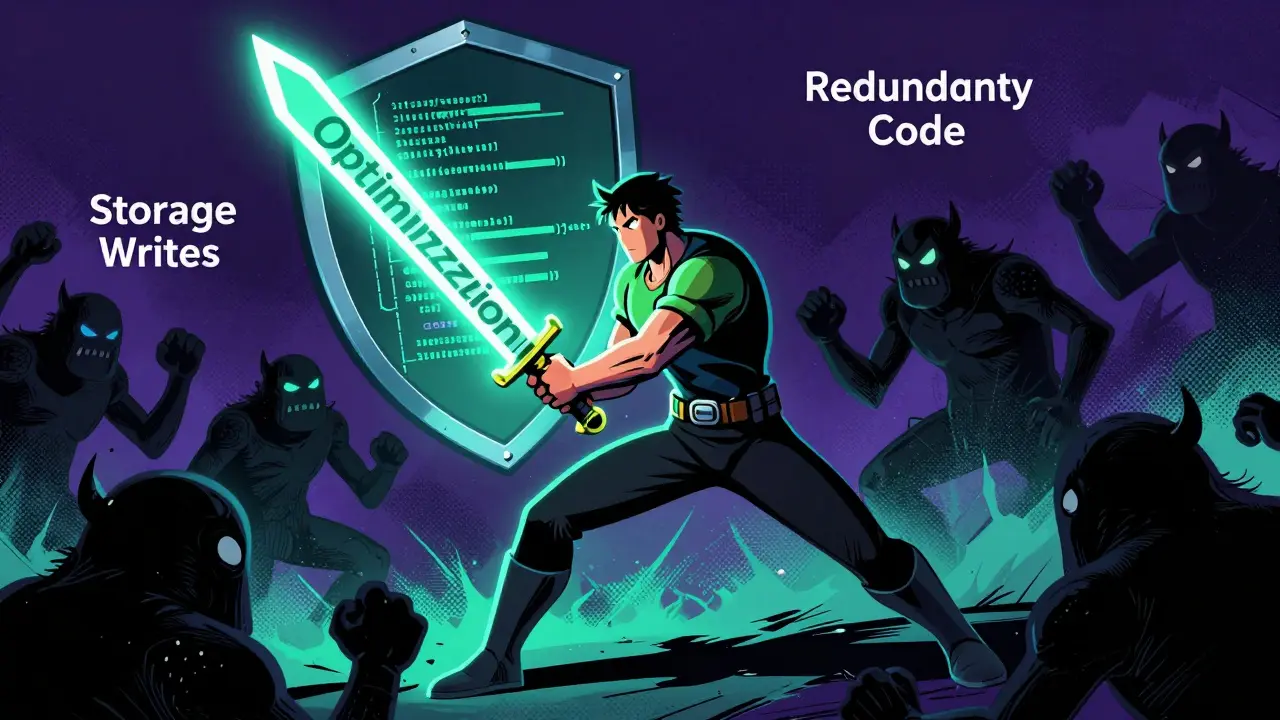
- Minimize Storage Writes: Storing data on-chain is the most expensive operation. A single storage slot write can cost 20,000 to 50,000 gas. Use memory variables for temporary calculations instead. Only store data that absolutely must persist on the blockchain.
- Batch Transactions: Instead of making five separate calls to update a user’s profile, combine them into one function call. This reduces the overhead of transaction initiation and external calls.
- Use Modular Design: Deploy large libraries separately and reference them via `DELEGATECALL`. This avoids redeploying common code for every instance, reducing deployment costs by 35-50%.
- Leverage Off-Chain Data: Don’t store images, audio, or large text files on-chain. Store them on IPFS or Arweave and save only the content hash (CID) on the blockchain. Audius, the music streaming protocol, used this approach to drastically reduce costs.
- Optimize Data Types: Using `uint8` instead of `uint256` when possible packs more data into a single storage slot, saving gas. This is known as "storage packing."
Tools like Slither and MythX can automatically audit your code for gas inefficiencies. Libraries like OpenZeppelin provide pre-audited, gas-optimized patterns that thousands of developers rely on weekly. Ignoring these tools is like driving a car with the handbrake on-you’re working harder for less result.
Enterprise vs. Public Chain Economics
If you are building for a corporation rather than the open web, the cost equation changes entirely. Public chains charge variable fees based on market demand. Enterprises hate unpredictability. This is where permissioned blockchains like Hyperledger Fabric come into play.
Hyperledger doesn’t have a public token or gas market. Instead, costs are determined by your infrastructure setup and service level agreements (SLAs). Deployment packages typically start at $25,000 and can exceed $100,000 for complex configurations. However, once running, the operational costs are fixed and predictable. Financial institutions favor this model because they can budget accurately. As of 2025, 41% of enterprise blockchain projects use Hyperledger, compared to startups who overwhelmingly choose low-fee public chains like Solana and Polygon (57% of new dApps).
The regulatory environment also impacts costs. The SEC’s May 2025 guidance requires transparent disclosure of transaction fee structures in tokenomics documentation. This adds a compliance layer, increasing legal and auditing costs by approximately $7,500 per project. For enterprises, this is a manageable line item. For small teams, it’s a significant hurdle.
Making the Right Choice for Your Project
So, which blockchain should you pick? There is no universal answer, but there is a clear framework for decision-making.
Ask yourself these three questions:
- What is the average transaction value? If users are sending $10,000, Ethereum’s $10 fee is acceptable. If they are sending $0.50, you need Solana or a Layer 2.
- How frequent are the interactions? High-frequency apps (games, feeds) require high throughput and low latency. Solana or Polygon Edge are ideal. Low-frequency apps (governance voting, asset registration) can tolerate Ethereum’s slower pace.
- What is the tolerance for downtime? If your app is mission-critical and cannot afford network partitions, consider a hybrid approach or a highly decentralized L2 like Arbitrum One, which inherits Ethereum’s robustness while offering better UX.
The trend for 2026 and beyond points toward modular architectures. Fewer projects are betting everything on a single chain. Instead, they are using cross-chain bridges and interoperability protocols to execute logic on the cheapest, fastest chain available while settling finality on the most secure one. This hybrid model captures the best of all worlds: low costs for users and high security for assets.
Don’t let fear of complexity paralyze you. Start with a prototype on a testnet. Measure the gas usage. Optimize the code. Then deploy to the mainnet that aligns with your economic model. The technology is mature enough to support almost any vision, provided you respect the economics of computation.
Why are Ethereum gas fees so volatile?
Ethereum uses an auction-based fee market. Users bid against each other to have their transactions included in the next block. When many people want to transact at once (high demand), the price goes up. When the network is quiet, prices drop. This ensures the network never runs out of space but leads to unpredictable costs for end-users.
Is Solana cheaper than Ethereum?
Yes, significantly. Solana’s average transaction fee is around $0.00025, whereas Ethereum mainnet fees often range from $5 to $50 or more. Solana achieves this through a unique consensus mechanism called Proof of History, which allows for much higher throughput and lower computational overhead per transaction.
What is the cheapest blockchain for smart contracts in 2026?
For public blockchains, Solana currently offers the lowest average execution costs at sub-cent levels. Among Ethereum-compatible chains, Layer 2 solutions like Polygon, Arbitrum, and Optimism offer fees often below $0.01. For private enterprise use, Hyperledger Fabric offers predictable costs but requires high upfront investment.
How can I reduce gas fees in my Solidity code?
Focus on minimizing storage writes, as they are the most expensive operations. Use memory variables for temporary data, batch multiple actions into single transactions, and pack data types efficiently (e.g., using uint8 instead of uint256 where possible). Tools like Slither can help identify inefficient code patterns.
Should I use Layer 2 solutions instead of Ethereum mainnet?
For most consumer-facing applications, yes. Layer 2s like Arbitrum and Optimism provide the security of Ethereum settlement while offering transaction speeds and costs comparable to alternative L1 chains. They are ideal if you want access to Ethereum’s liquidity and ecosystem but need a better user experience regarding fees.
Tobias Gjerlufsen
May 24, 2026 AT 07:37the entire premise of this article is flawed because it assumes that 'execution cost' is the primary metric for success in decentralized applications which it clearly isnt since security and decentralization are the actual pillars of value creation not just cheap transactions. you can have a transaction for $0.00025 on solana but if the network goes down or the validators are centralized then your application is worthless regardless of how cheap it is to run. people keep forgetting that ethereum's high fees are a feature not a bug because they prevent spam and ensure that only valuable transactions get processed by the most secure network in existence.
Samara McCallum
May 24, 2026 AT 23:23i feel like we're all just dancing around the real issue here which is that nobody actually wants to pay fees at all. the whole concept of gas is so 2021 and honestly it feels like we're stuck in a loop where developers complain about costs while users complain about complexity. maybe the solution isn't choosing between eth and solana but realizing that the current model of public blockchains is fundamentally broken for consumer apps anyway. why do i need to understand proof of history just to buy a digital sword? it's absurd really.
Sheldon Friesen
May 26, 2026 AT 09:01Look, I get the frustration! But let's be real; if you're building a game with $0.10 swords, Ethereum mainnet is literally economic suicide! You have to use an L2 or Solana, no matter what the purists say! The data doesn't lie! Polygon is basically the sweet spot for most devs right now! Just optimize your code, folks! Use memory variables! Stop writing to storage like it's free! It's not rocket science!
Ruben Michel
May 27, 2026 AT 12:47It is quite amusing to observe the sheer lack of sophistication in these arguments regarding enterprise blockchain adoption. Hyperledger Fabric is not merely an option; it is the only rational choice for any organization that values predictability over the chaotic whims of public markets. To suggest that a financial institution would risk its reputation on the volatility of Solana is not only incorrect but indicative of a profound misunderstanding of corporate risk management. The initial setup cost is negligible compared to the liability of downtime.
Gavin Wonnacott
May 28, 2026 AT 03:26I don't know who gave you permission to write this garbage but you clearly haven't deployed anything serious in production. Your analysis of Solana's outages is pathetic because you ignore the fact that Firedancer has largely solved those issues. Meanwhile Ethereum is still a bloated mess. You're just repeating old narratives because you don't understand the new architecture. It's embarrassing to see such shallow takes passed off as expert advice.
Jan Gilmore
May 29, 2026 AT 22:13Let me tell you something about gas optimization that nobody talks about. It's not just about packing uints. It's about the entire state bloat problem. If you don't minimize storage writes, your contract will eventually become too expensive to call even on L2s. I've seen projects fail because they stored every single user action on chain instead of using off-chain indexing. Learn from their mistakes. Use IPFS for metadata. Keep the chain lean. That's the golden rule.
Caique Muniz
May 30, 2026 AT 22:37honestly this article is just fluff. everyone knows solana is cheaper and eth is slow. whats the point of writing a novel about it? also your table is outdated because arithrum fees dropped again last week. lazy journalism at its finest imo.
Bradley Geldenhuys
May 31, 2026 AT 16:52yo listen up fam we gotta stop fighting over chains and start focusing on the code itself. its all about mindset man. if u r writing bad code then no amount of cheap gas will save u. u gotta think like a philosopher coder. embrace the void of the blockchain. also typos dont matter if ur logic is sound lol jk but seriously optimize ur storage usage bro.
robert Whitehead
June 1, 2026 AT 22:05The moral decay of this industry is evident in how we prioritize cost over integrity. By choosing low-fee chains, we are essentially subsidizing centralization and compromising the very ethos of decentralization. It is a sin against the original vision of Bitcoin and Ethereum. We should be paying premium prices for security because that is what true freedom costs. Those who seek cheap transactions are seeking cheap solutions, and they will reap cheap results.
Mike S
June 2, 2026 AT 22:14Oh wow, another listicle telling us what we already know. Groundbreaking stuff. I bet you spent hours researching this instead of just coding. Typical academic take. In the real world, we just pick whatever chain has the most liquidity and pray the bridge doesn't get hacked. Good luck with your 'framework' buddy.
H F
June 4, 2026 AT 15:23Bloody brilliant breakdown! I've been wrestling with this exact decision for our startup. The trade-off between Solana's speed and Ethereum's security is a nightmare! But you're absolutely right about the hybrid approach! Using cross-chain bridges is the way forward! It's exciting to see the tech maturing like this! Let's build some amazing stuff together!
Michael Berggren
June 6, 2026 AT 05:28This is a fantastic resource! 🚀 I love how you broke down the gas calculation mechanics. It really helps clarify why simple operations can still be expensive. Don't forget to mention that tools like Slither are essential for auditing! 🔍 Also, the part about storage packing is gold! 💎 Thanks for sharing this wisdom! Let's keep optimizing! 📉
Kiran CS
June 6, 2026 AT 21:43How utterly pedestrian. One would assume that by 2026, developers would have grasped the nuances of enterprise-grade blockchain implementation rather than fixating on retail-level transaction fees. The mention of Hyperledger is barely adequate given its dominance in the corporate sector. This article lacks the depth required for serious consideration by professionals.
Bijan Das
June 7, 2026 AT 07:41look i dont care about your fancy charts. solana is better period. if ur app needs more than 100 tps then ur doing it wrong. also hyperledger is for losers who cant afford real decentralization. simple as that. stop overcomplicating things.
Ashley Rodriguez
June 9, 2026 AT 02:08i think what you said about minimizing storage writes is really important because i have seen so many projects fail just because they did not pay attention to the small details in their smart contracts and it is sad when that happens because they could have saved so much money if they had just taken the time to learn about gas optimization techniques early on in the development process instead of waiting until after deployment when it is too late to make significant changes without redeploying everything
Bridget Coogle
June 10, 2026 AT 11:44great points here. i agree that layer 2s are the future for most dapps. we need to support each other in learning these best practices. thanks for sharing this info it really helps clear up the confusion about which chain to choose. lets keep the community positive and helpful.
Zara Zaman
June 11, 2026 AT 02:03Foreign chains like Solana and Polygon are infiltrating our digital infrastructure with their unstable networks. We need American-led blockchain standards that prioritize security and reliability over cheap fees. Ethereum may be expensive but it is built on solid foundations unlike these foreign experiments that crash whenever there is high demand. Support domestic tech.
Shelby Cantu
June 12, 2026 AT 08:57You nailed it! The key is finding the balance between cost and security for your specific use case. Great insights!