

When you're trying to buy your first Bitcoin in a country where banks won't touch crypto, Remitano might be the only option that actually works. It's not the flashiest exchange out there-no fancy charts, no margin trading, no hundreds of coins-but for millions of people in Africa, Southeast Asia, and Latin America, it’s a lifeline. Founded in 2014, Remitano operates as a peer-to-peer (P2P) crypto exchange, meaning you're trading directly with other people, not a central order book. The platform acts like a middleman: it holds your crypto in escrow until it confirms you’ve paid, then releases it. Simple. Safe. And surprisingly effective.
How Remitano Works (No Fluff, Just the Steps)
You don’t need to be a tech expert to use Remitano. Here’s how it actually works in real life:
- Sign up with an email and password. No ID required right away, though they’ll ask for it later if you want to trade more than $500.
- Choose whether you want to buy or sell crypto. The platform shows you live ads from other users-like a marketplace.
- Select an ad. You’ll see the price, payment method, and seller’s rating. Most sellers accept bank transfers, mobile money, or even PayPal.
- Send the payment using the method agreed upon. Don’t release the payment until you’re sure.
- Wait for Remitano to verify the payment. This usually takes minutes to a few hours, depending on your country.
- Once verified, the crypto is released to your wallet. Done.
It’s not automatic like Binance or Coinbase. You’re doing manual trades. But that’s the point. This system works where automated exchanges fail-places where banks block crypto deposits, where PayPal doesn’t support crypto, or where government regulations are unclear.
Cryptocurrencies You Can Trade
Remitano supports only five coins: Bitcoin (BTC), Ethereum (ETH), Litecoin (LTC), Ripple (XRP), and Tether (USDT). That’s it.
Compare that to Binance, which offers over 350 coins, or KuCoin with 800+. If you want to trade Solana, Dogecoin, or Polkadot, Remitano isn’t the place. But if you’re just trying to get into Bitcoin or stablecoins like USDT to send money across borders, these five are enough. USDT is especially popular because it’s pegged to the dollar and lets people avoid currency controls.
Why only five? Remitano’s team has said they focus on coins with high liquidity and low volatility-coins people actually use to move value, not gamble with. It’s a trade-off. Less choice, more reliability.
Fees: What You Really Pay
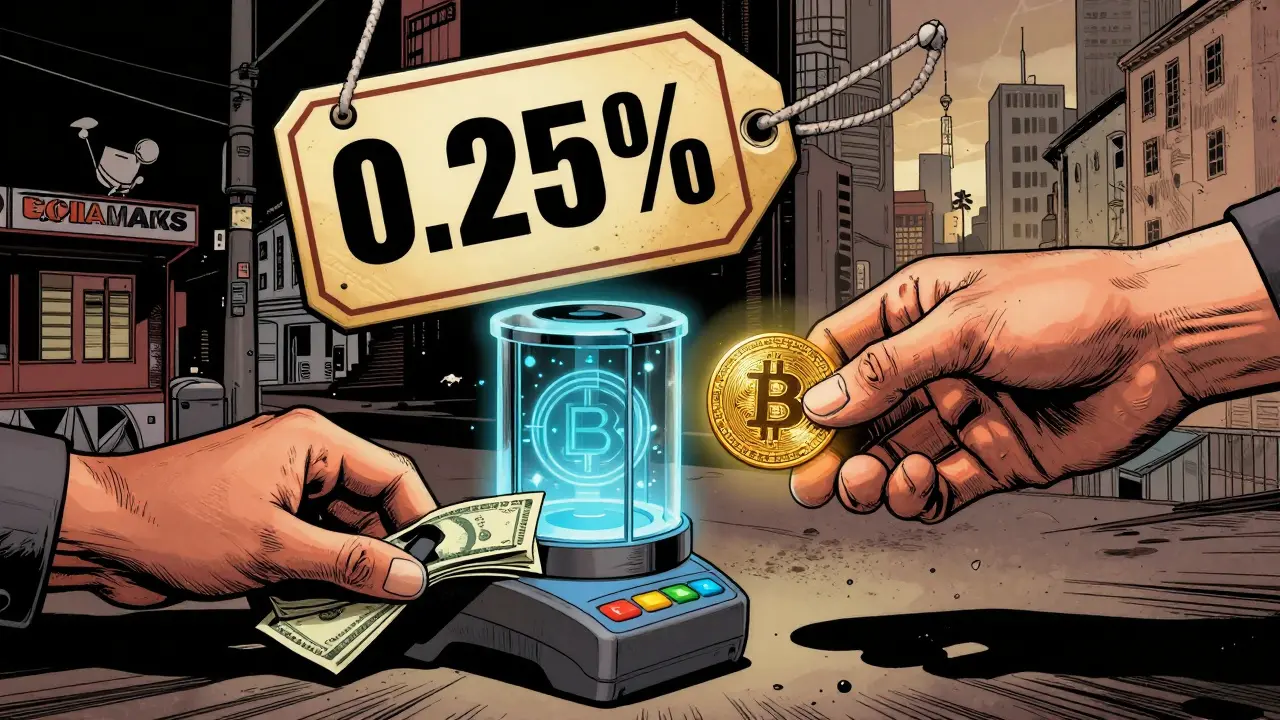
Some sites say Remitano has 0% fees. That’s misleading. The truth? It’s 0.25% for both buyers and sellers on every trade. No discounts. No volume tiers. No promotions.
That’s higher than centralized exchanges like Binance (which can be as low as 0.1% with BNB discounts) or Kraken (0.16% for makers). But here’s the catch: on centralized exchanges, you’re trading against a pool. On Remitano, you’re trading with real people. The 0.25% covers the escrow system, dispute resolution, and payment verification-all of which take real human and technical resources.
For users in Nigeria, Kenya, or Vietnam, where local payment methods are messy and risky, that 0.25% is worth it. You’re not just paying a fee-you’re paying for safety.
Security: Trust Built on Escrow, Not Regulation
Remitano doesn’t have a license from the SEC, the FCA, or any major regulator. It’s not audited. It doesn’t publish Proof of Reserves. And in 2023, it got hacked.
That last part matters. A breach in 2023 exposed user data and led to temporary service outages. It shook trust. But here’s what most reviews miss: the hack didn’t steal crypto from escrow wallets. The platform’s core security-the escrow system that holds your coins until payment clears-remained intact. That’s because the escrow is separate from the main hot wallets.
Remitano’s real security strength is its escrow system. When you buy BTC from someone, the coins are locked in a wallet controlled by Remitano. You send your payment. They verify it. Only then do they release the crypto. If you don’t pay, the seller gets nothing. If the seller doesn’t deliver, you get your money back. No middleman, no chargebacks, no scams.
This system has been praised by users in over 50 countries. Even after the 2023 breach, dispute resolution success rates stayed above 95%. That’s not luck-it’s design.
Who Is Remitano Really For?
Remitano isn’t for traders. It’s not for people who want to swing trade Ethereum or use leverage. It’s for:
- People in countries where banks block crypto purchases
- Those who need to send money internationally using crypto
- First-time buyers who want a simple, no-jargon way to get Bitcoin
- Users who rely on mobile money, bank transfers, or local payment apps
Over 76% of its users come from Africa, Southeast Asia, and Latin America. In Nigeria, where the central bank banned crypto transactions in banks, Remitano became one of the few ways to buy Bitcoin legally. In the Philippines, users use it to send remittances home using USDT. In Brazil, people trade BTC for Pix payments.
If you’re in the U.S., Canada, or Europe, and you have a bank account that accepts crypto, Remitano might feel clunky. You’ll be better off with Coinbase or Kraken. But if you’re outside the financial mainstream, Remitano is one of the few platforms that actually speaks your language.

What’s Missing? The Real Drawbacks
Let’s be honest: Remitano has gaps.
- No advanced trading tools-no limit orders, no stop-losses, no charting.
- Only five coins-you can’t diversify beyond BTC, ETH, LTC, XRP, and USDT.
- Minimum deposit of $50-you can’t dip your toes in with $10.
- Slow customer support-live chat exists, but response times vary. Email can take 24-48 hours.
- No mobile app-you have to use the website. No native iOS or Android app.
And yes, the 2023 hack is a red flag. The platform hasn’t fully addressed it. No public audit. No Proof of Reserves. That’s a problem in an industry where trust is everything.
How It Compares to Paxful and LocalBitcoins
Remitano’s biggest rivals are Paxful and LocalBitcoins. All three are P2P. But here’s how Remitano stacks up:
| Feature | Remitano | Paxful | LocalBitcoins |
|---|---|---|---|
| Cryptocurrencies Supported | 5 | 6 | 1 |
| Payment Methods | Bank, mobile money, PayPal, Apple Pay, Google Pay, SEPA | Bank, PayPal, gift cards, cash deposit | Bank, PayPal, cash deposit |
| Country Coverage | 50+ | 40+ | 30+ |
| Fees | 0.25% | 0.5%-1% | 0.5%-1% |
| Escrow System | Yes (automated) | Yes | Yes |
| Mobile App | No | Yes | No |
| 2023 Security Incident | Yes | No | Yes (2019) |
Remitano wins on lower fees and broader country coverage. Paxful has a better app and more payment options. LocalBitcoins is outdated and shrinking. For most users, Remitano is the sweet spot.
Final Verdict: Should You Use It?
If you’re in a country with limited banking access, and you need to buy or sell crypto without getting shut down by your bank-yes, use Remitano. It’s one of the most reliable P2P platforms out there. The escrow system works. The interface is clean. The support, while slow, usually gets the job done.
If you’re in the U.S., EU, or Australia, and you have access to Coinbase, Kraken, or Binance? Skip it. The fees are higher, the options are fewer, and the experience is clunkier.
Remitano isn’t trying to be the biggest exchange. It’s trying to be the most accessible. And for millions of people who’ve been left out of the crypto boom, that’s everything.
Is Remitano safe to use?
Remitano is relatively safe for P2P trading because it uses an escrow system that holds crypto until payment is confirmed. It’s not immune to hacks-in 2023, it suffered a data breach-but the escrow wallets weren’t compromised. It lacks regulatory oversight and doesn’t publish Proof of Reserves, which are red flags for advanced users. For beginners in emerging markets, it’s one of the safest options available.
Can I buy Bitcoin on Remitano with PayPal?
Yes. Remitano supports PayPal as a payment method in many countries. Sellers set their own terms, so you’ll need to find a seller who accepts PayPal. Be cautious-PayPal chargebacks are common, so only trade with highly rated sellers. The escrow system helps protect you if the seller doesn’t deliver.
Does Remitano have a mobile app?
No, Remitano does not have a native mobile app. You can only use it through a mobile browser. This is a major downside compared to competitors like Paxful or Binance, which offer full-featured apps. The website is mobile-friendly, but it lacks push notifications, biometric login, and offline features.
What’s the minimum deposit on Remitano?
The minimum fiat deposit is $50. You can’t start with $10 or $20. This makes it less ideal for people who want to test the waters. But it also helps reduce fraud and low-value scams, which are common in P2P markets.
Why does Remitano only support five cryptocurrencies?
Remitano focuses on coins with high liquidity and real-world use in emerging markets: BTC, ETH, LTC, XRP, and USDT. These are the most traded and accepted for payments, remittances, and savings. Adding more coins would increase complexity and risk without serving its core user base. It’s a deliberate choice to prioritize usability over variety.
Felicia Eriksson
February 21, 2026 AT 16:12Tracy Whetsel
February 22, 2026 AT 11:04Ifeanyi Uche
February 22, 2026 AT 19:11Jeff French
February 24, 2026 AT 04:07Elana Vorspan
February 24, 2026 AT 19:22Danny Kim
February 26, 2026 AT 06:09Felicia Eriksson
February 26, 2026 AT 22:29Phillip Marson
February 28, 2026 AT 19:50Patrick Streeb
March 2, 2026 AT 06:36Brian Lemke
March 2, 2026 AT 18:18Tracy Whetsel
March 4, 2026 AT 08:46Leslie Cox
March 6, 2026 AT 02:25Dana Sikand
March 7, 2026 AT 06:23John Fuller
March 8, 2026 AT 19:34Lucy Simmonds
March 9, 2026 AT 17:28Samantha Stultz
March 11, 2026 AT 01:21Andrew Hadder
March 12, 2026 AT 10:41Lilly Markou
March 14, 2026 AT 04:43Molley Spencer
March 15, 2026 AT 10:16Arya Dev
March 17, 2026 AT 01:28precious Ncube
March 19, 2026 AT 01:18Robert Conmy
March 19, 2026 AT 13:51Deborah Robinson
March 20, 2026 AT 21:13