
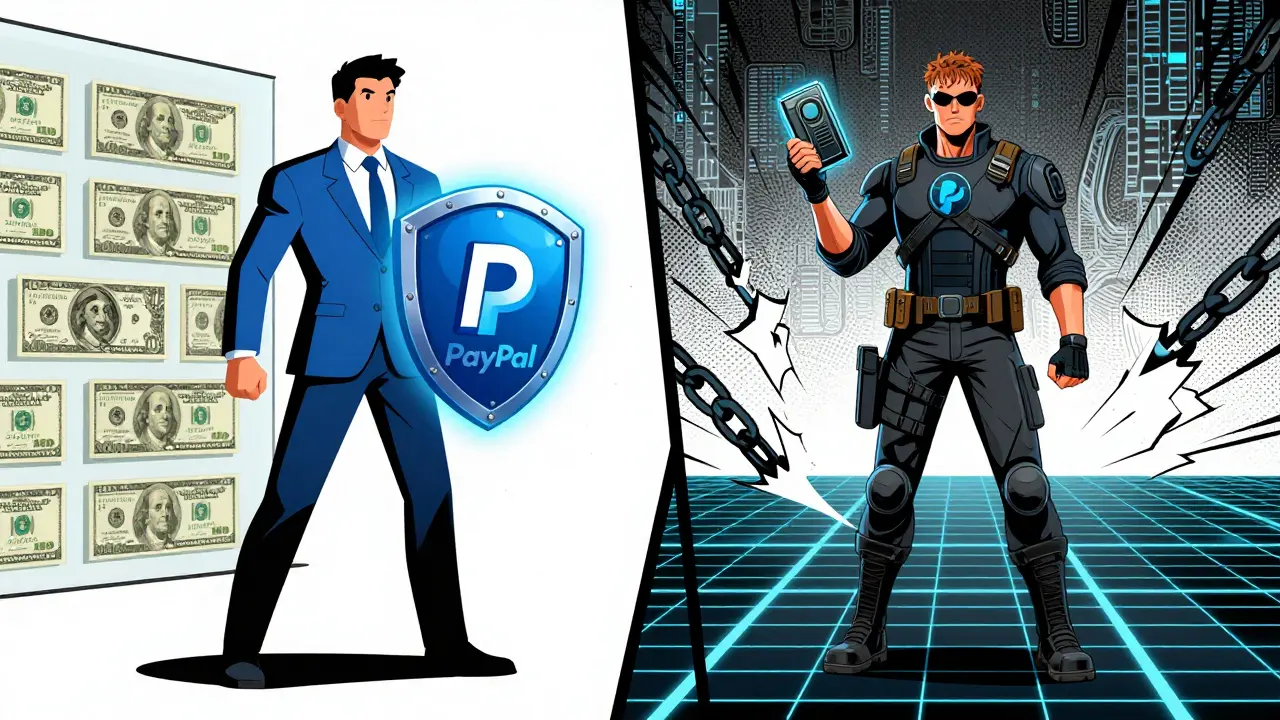
You want to accept cryptocurrency from your customers. You have two main paths in front of you. One is the easy button: PayPal Crypto, a custodial service where users pay with crypto but you get paid in fiat currency. The other is the sovereignty path: direct-to-wallet non-custodial billing, where funds move straight from your customer’s wallet to yours on the blockchain.
This isn't just a technical difference; it changes how you run your business, who can buy from you, and whether you actually own the money coming in. Let's break down exactly how these models work, what they cost you, and which one fits your specific situation.
The Core Difference: Who Holds the Keys?
To understand this comparison, you need to grasp the concept of custody. In the crypto world, control equals keys. If someone else holds the private keys to your funds, they control them.
Custodial wallets, like those used by exchanges or payment processors, hold your private keys for you. This means you are trusting a third party to manage and secure your assets. On the flip side, Non-custodial wallets give you direct ownership. You store the keys locally on your device or hardware, meaning no intermediary can freeze or access your funds without your permission.
PayPal Crypto falls squarely into the custodial category. When a user buys Bitcoin or Ethereum inside PayPal, they don't receive a private key or a blockchain address they control. Instead, PayPal records their balance off-chain. For merchants, this means when a customer checks out using "Crypto," PayPal sells that crypto instantly and pays you in standard fiat currency (USD, EUR, etc.). You never touch the actual coins.
Direct-to-wallet billing operates differently. It relies on self-sovereign setups. Merchants use tools like BTCPay Server, an open-source payment processor launched in 2017 that lets you run your own node and wallet, or specialized gateways. In this model, the customer sends crypto directly to an address generated by your wallet. No middleman touches the funds. You keep the crypto, or you decide later to sell it yourself.
User Experience and Integration Complexity
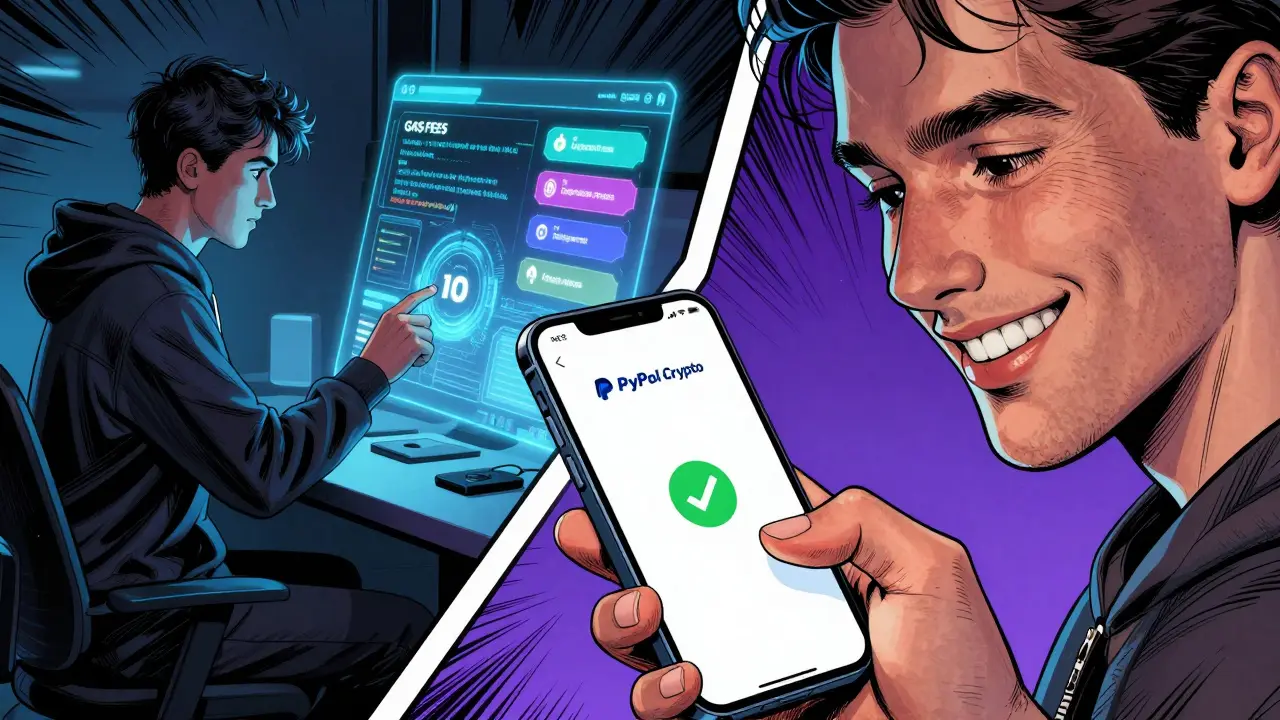
If your priority is making things as simple as possible for mainstream consumers, PayPal wins hands down. Most people already have a PayPal account. They don't know what a seed phrase is, and they certainly don't want to deal with gas fees or network confirmations.
For a merchant, integrating PayPal Crypto requires zero extra work if you already use PayPal. You simply enable the feature, and eligible customers see the option at checkout. The transaction feels identical to a credit card payment-fast, familiar, and backed by buyer protection policies.
Direct-to-wallet billing has a steeper learning curve. Your customers need their own non-custodial wallet, like MetaMask or a hardware wallet. They must understand how to send funds, select the right network, and attach enough gas fees to get the transaction confirmed. If they send ETH to a BTC address, the money is gone forever. There is no support team to call.
However, the technology is improving. Modern gateways like TxNod, a non-custodial multi-chain gateway designed for solo founders and indie hackers, simplify this significantly. By connecting extended public keys (xpubs) from hardware wallets like Ledger or Trezor, TxNod generates unique addresses per invoice while keeping funds strictly outside its custody. This allows developers to ship a working crypto checkout quickly without becoming infrastructure experts, bridging the gap between complex blockchain tech and user-friendly interfaces.
Fees and Economic Efficiency
Money talks, so let's look at the costs. PayPal charges standard merchant fees for transactions funded by crypto, typically ranging from 1.9% to 3.5% plus a fixed fee depending on your country. While there is no explicit "crypto surcharge," you are paying for the convenience of fiat settlement and fraud protection.
Consumers also face hidden costs. PayPal applies a spread-the difference between the market price and the price they quote-which can add up, especially on smaller purchases.
With direct-to-wallet billing, the economics shift. Customers pay network fees directly to miners or validators. These fees fluctuate wildly. During high congestion on Bitcoin or Ethereum, fees can spike to tens of dollars, making small purchases impractical. However, on cheaper chains or Layer-2 solutions, fees can be fractions of a cent.
Merchants generally avoid percentage-based processing fees in non-custodial models. Some gateways charge a flat subscription instead of taking a cut of every sale. For example, services like TxNod operate on a flat monthly subscription model with a 0% take-rate on payment volume. This structure is particularly attractive for high-ticket B2B invoices or businesses with high transaction volumes, as your costs remain predictable regardless of sales size.
| Feature | PayPal Crypto | Direct-to-Wallet (Non-Custodial) |
|---|---|---|
| Custody | Custodial (PayPal holds keys) | Non-Custodial (Merchant holds keys) |
| Settlement Currency | Fiat (USD, EUR, etc.) | Crypto (BTC, ETH, USDT, etc.) |
| Merchant Fees | Percentage-based (~2-3.5%) | Network fees only / Flat subscriptions |
| Chargebacks | Possible via PayPal disputes | Impossible (On-chain finality) |
| KYC Requirements | Strict identity verification | Minimal or none (varies by gateway) |
Risk, Fraud, and Regulatory Compliance
This is where the trade-offs become stark. PayPal offers robust buyer protection. If a customer claims they didn't receive a digital product, they can open a dispute. PayPal may reverse the payment, clawing back funds from your account. For merchants, this introduces chargeback risk, similar to credit cards.
Direct-to-wallet billing eliminates this risk entirely. Blockchain transactions are irreversible. Once the confirmations hit, the money is yours. No chargebacks, no payout holds, and no account freezes based on arbitrary policy reviews. This structural finality is a massive advantage for selling digital goods, software licenses, or services where proof of delivery can be subjective.
However, this freedom comes with responsibility. With PayPal, you benefit from their regulatory compliance framework. They handle Anti-Money Laundering (AML) and Know Your Customer (KYC) checks for you. With non-custodial billing, you assume more of the compliance burden. While the wallets themselves often require no KYC, you still need to adhere to local tax laws and financial regulations regarding crypto income.
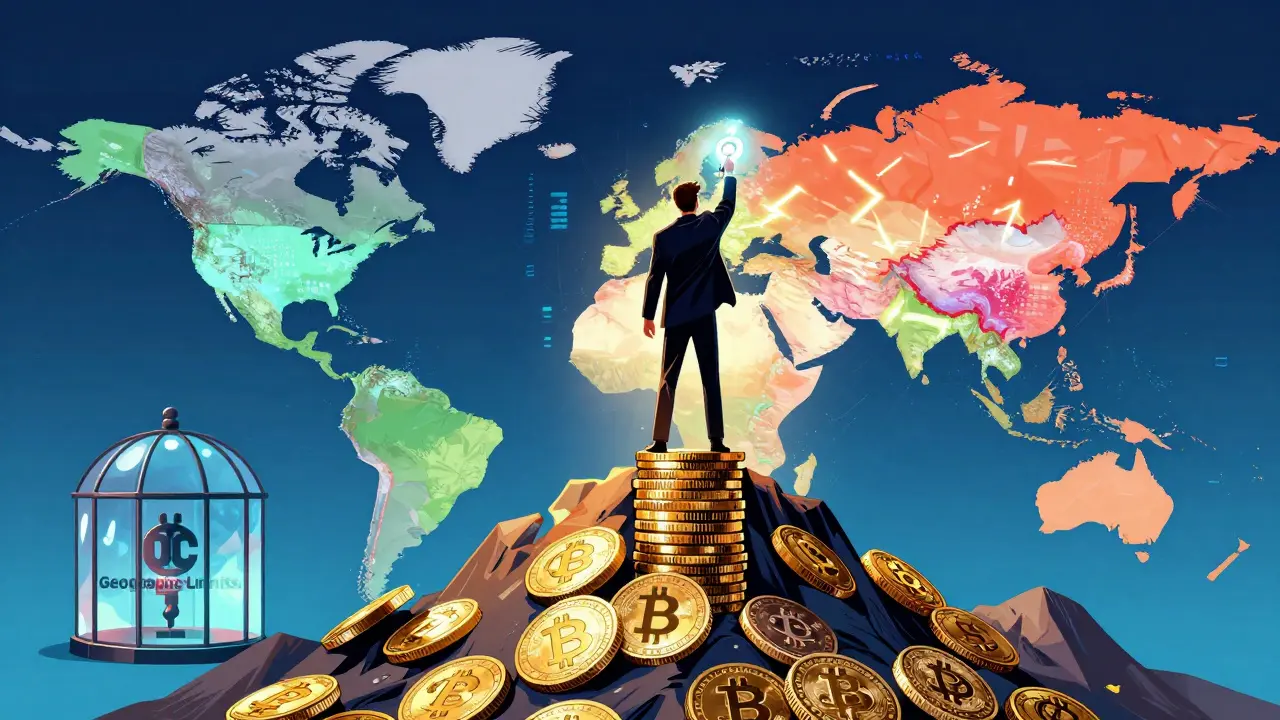
Furthermore, geographic reach differs. PayPal Crypto is limited to specific countries where they have obtained licenses. Direct-to-wallet billing is global. As long as your customer has internet access and a compatible wallet, they can pay you from anywhere in the world, bypassing traditional banking restrictions.
Which Model Should You Choose?
Your decision depends on your target audience and your tolerance for complexity.
Choose PayPal Crypto if:
- Your customers are mainstream users who prefer familiar interfaces.
- You want to avoid volatility by settling immediately in fiat.
- You rely on buyer protection mechanisms to build trust with new customers.
- You do not want to manage any crypto-related technical infrastructure.
Choose Direct-to-Wallet Non-Custodial Billing if:
- You prioritize sovereignty and want full control over your funds.
- You want to eliminate chargeback risks and account freezes.
- You serve a global audience, including regions with restricted banking access.
- You are comfortable managing crypto assets or converting them manually.
- You are a solo founder or indie hacker looking for lower overhead costs without percentage fees.
For many modern builders, especially those in the indie hacker space, the non-custodial route is gaining traction. Tools that offer AI-agent-ready integrations and schema-first SDKs make the setup process surprisingly fast. You can go from idea to live invoice in under an hour, accepting stablecoins like USDC or native assets like BTC directly into your hardware wallet.
Does PayPal convert crypto to fiat automatically?
Yes. When a customer uses PayPal Crypto to check out, PayPal instantly sells the cryptocurrency for fiat currency and deposits that amount into your PayPal balance. You never receive the actual crypto tokens.
Can I get chargebacks with direct-to-wallet crypto payments?
No. Blockchain transactions are irreversible once confirmed. Unlike credit cards or PayPal, there is no central authority to reverse a payment. This protects merchants from fraudulent chargebacks but requires clear refund policies since refunds must be initiated manually by the merchant.
What are the typical fees for non-custodial crypto billing?
Customers pay network transaction fees (gas), which vary by blockchain congestion. Merchants typically pay no percentage fees on the transaction itself. Some gateways charge a flat monthly subscription, while others charge nothing beyond the network fees.
Is non-custodial billing safe for my business?
It is safe if you manage your private keys correctly. Using hardware wallets like Ledger or Trezor adds a layer of security. Since you control the keys, you are immune to platform hacks or account freezes, but you are responsible for backing up your recovery phrases securely.
Do I need a registered company to use non-custodial gateways?
Many non-custodial gateways, such as TxNod, do not require a registered company or extensive KYC documentation for onboarding. This makes them accessible to solo founders, freelancers, and individual developers who want to start accepting payments immediately.
beti macedo
May 22, 2026 AT 23:01I think this is a very intresting topic and i belive that the non custodial way is better for everyone in the long run. It gives you so much more freedom and control over your own money which is what crypto was supposed to be about from the start. I have been using PayPal for years but now i am looking into setting up my own wallet because i do not want any company to hold my keys anymore. The fees on PayPal are also getting quite high if you ask me so it makes sense to switch.
It might seem complicated at first but once you learn how to use a hardware wallet it is actually quite simple. You just need to be careful with your seed phrase and never share it with anyone. I hope more people will realize this soon and take back their financial sovereignty.
Michelle Bonahoom
May 23, 2026 AT 12:48why bother with all this tech nonsense when we have banks that work perfectly fine here in the united states. paypal is safe and secure and does not require you to become a computer scientist just to buy a coffee. these crypto guys always trying to complicate things that do not need complicating. keep your money where it belongs in regulated institutions not some random server somewhere.
also who has time to deal with gas fees and network confirmations every time they want to pay for something. it is ridiculous and only benefits the scammers out there. stick to fiat and stay safe
Matt Davis
May 25, 2026 AT 06:30You are absolutely missing the point of the entire argument here. The whole premise of cryptocurrency is decentralization and removing intermediaries, yet you suggest sticking to the very system that exploits consumers through hidden fees and lack of transparency. It is almost laughable how disconnected from reality this perspective is.
Furthermore, the idea that banks are 'safe' is a comforting illusion that collapsed in 2008 and continues to crumble with each new scandal. Non-custodial solutions offer true ownership, something no bank can ever provide. If you cannot grasp the fundamental shift in power dynamics, perhaps you should refrain from commenting on topics you clearly do not understand.
Albert Lee
May 25, 2026 AT 12:12I completely agree with the original post! This is such a crucial distinction that many merchants overlook until it is too late. I remember when I first started selling digital products online, I used PayPal exclusively because it seemed easier. But then I got hit with a chargeback for a product I had already delivered, and it was an absolute nightmare to resolve.
Switching to a non-custodial solution changed everything for me. Yes, there was a learning curve, but the peace of mind knowing that my funds were truly mine and that no one could reverse a transaction without my consent was worth every minute spent learning. Plus, the savings on fees add up significantly over time. Highly recommend exploring BTCPay Server or similar tools if you are serious about protecting your business.
Ankush Pokarana
May 27, 2026 AT 07:07the essence of sovereignty lies in the possession of keys and those who delegate this responsibility to others surrender their autonomy to the whims of corporate entities. it is a philosophical stance as much as it is a technical one. when we accept payments via traditional channels we participate in a system designed to extract value from us at every turn. however by embracing non-custodial methods we reclaim our agency and align ourselves with the original vision of decentralized finance. this transition requires patience and education but the reward is ultimate control over one's economic destiny. let us not forget that trust is a finite resource and should be distributed wisely among those who prove themselves worthy rather than blindly given to institutions that prioritize profit over principle.
Bianca Vilas Boas Lourenço
May 27, 2026 AT 22:38Oh wow another article pretending like using MetaMask is easy for normal people 😂 Please. Try explaining to your grandma how to check her gas fees before she sends money to the wrong address and loses her life savings. It’s cute that indie hackers love this stuff but real businesses need reliability not adventure stories about losing funds forever. 🙄💸
Yash Lodha
May 29, 2026 AT 14:21The surveillance state is watching your every move through these centralized platforms. They collect data on your spending habits and sell it to the highest bidder while pretending to protect you. With non-custodial wallets, you retain privacy and anonymity, shielding yourself from the prying eyes of Big Brother. It is not just about money; it is about freedom. Do not let them track you. Take back your power before it is too late. The algorithms are already predicting your next purchase. Break the cycle.
Jesse Alston
May 30, 2026 AT 05:22Great breakdown! 👍 For those interested in TxNod, I’ve found it incredibly user-friendly for integrating into existing web apps. The documentation is solid, and the support team is responsive. One thing to note is that while it simplifies the checkout process, you still need to educate your customers slightly about wallet connections. But compared to the hassle of KYC and chargebacks, it’s a small price to pay. 🚀
Sarah C
May 30, 2026 AT 08:14This is really helpful information thank you for sharing. I have been thinking about switching my freelance business to accept crypto but was worried about the complexity. Seeing the comparison table makes it much clearer. I think I will start with a hybrid approach maybe accepting both for now until I get more comfortable with managing private keys myself. It feels safer to have options available.
Kimberly Herbstritt
May 31, 2026 AT 02:41Actually I disagree with the part about PayPal being easier. Setting up PayPal takes forever with all the verification steps and account holds. Once you have a non-custodial wallet set up it is literally just copy paste an address and done. No waiting for approval no freezing of funds. People complain about technology but they ignore the bureaucracy that slows down traditional banking even more. Give it a try you might surprise yourself.
Sharada Vakkund
May 31, 2026 AT 15:33Welcome everyone to this discussion! It is great to see such diverse perspectives on this important topic. Whether you are a seasoned crypto enthusiast or just starting out, understanding the difference between custodial and non-custodial solutions is key to making informed decisions. Let us continue to learn from each other and support one another in navigating this evolving landscape. Feel free to share your experiences and questions below!
Sudarshan Anbazhagan
June 1, 2026 AT 07:41it is imperative to consider the regulatory implications carefully as laws regarding cryptocurrency vary significantly across jurisdictions. while non-custodial solutions offer greater autonomy they also place the burden of compliance squarely on the shoulders of the merchant. one must ensure that their operations adhere to local tax regulations and anti-money laundering guidelines to avoid legal repercussions. ignorance of the law is no excuse and failure to comply can result in severe penalties including fines and imprisonment. therefore thorough research and possibly consultation with legal experts is advisable before fully transitioning to non-custodial billing methods.
John Gonzalez Bentham
June 2, 2026 AT 01:34lol nobody reads these long articles anyway. just use paypal and stop wasting time reading about blockchain nonsense. its all a scam anyway designed to make rich people richer. why would you want to deal with volatile assets when you can just get paid in dollars like a normal person. crypto bros always talking about freedom but they cant even manage their own passwords properly. typical.
Ellie Riddell
June 2, 2026 AT 07:27Sarcasm aside, the fee structure is the real killer here. Paying 3.5% plus fixed fees eats into margins fast, especially for low-ticket items. I switched to USDC on Polygon for my SaaS and the difference in net revenue is night and day. Plus, instant settlement means I don’t have to wait days for bank transfers. If you’re running a business, math doesn’t lie. 📉➡️📈
Destiny Kilby
June 3, 2026 AT 09:15i understand the appeal of lower fees but the risk of losing access to funds due to lost keys is terrifying. i prefer the safety net of customer support even if it costs more. not everyone has the technical expertise to recover a wallet and one mistake can mean total loss. for most small business owners peace of mind is worth the extra percentage points charged by processors like paypal.
Bridget Coogle
June 3, 2026 AT 22:21You got this! Taking control of your finances is empowering. Start small and learn as you go. There is a huge community ready to help if you get stuck. Don't let fear stop you from exploring better options for your business. Every step forward counts towards greater independence.
Zara Zaman
June 5, 2026 AT 07:02American businesses should stick to American systems. Foreign currencies and unregulated crypto exchanges pose national security risks. We need strict oversight and accountability. PayPal provides that. These offshore crypto schemes undermine our economy and allow criminals to operate freely. Support domestic infrastructure and keep our money within our borders where it belongs.
Larry Port
June 7, 2026 AT 00:31I wonder if the average consumer really cares about custody as long as the payment goes through. Most people just want convenience. Maybe the solution is better UX around non-custodial wallets so they feel as seamless as PayPal. Education is key here. If we can simplify the interface, adoption might skyrocket. What do you think?
Jocelyn Garcia
June 7, 2026 AT 05:33From a dev perspective, integrating Web3 SDKs is becoming much easier. Libraries like Wagmi and Viem abstract away a lot of the boilerplate code. Combined with gateways like TxNod, you can spin up a checkout flow in hours. The jargon is heavy but the actual implementation is cleaner than dealing with Stripe webhooks sometimes. Definitely worth the refactor for high-volume shops.
Amit Varpe
June 8, 2026 AT 20:24India needs more awareness about self-sovereign finance. Too many people rely on banks that freeze accounts arbitrarily. Crypto offers a lifeline for freelancers and exporters facing remittance issues. Let us spread the word and empower our community with knowledge. Together we can build a more inclusive financial future. 🇮🇳✨
Bronwen Butler
June 8, 2026 AT 23:26Everyone says non-custodial is better but nobody mentions the tax reporting headache. Tracking cost basis for hundreds of micro-transactions is a nightmare. Custodial services provide nice reports. Non-custodial leaves you digging through blockchain explorers. Convenience has a cost whether in fees or time. Choose wisely.
Pauline Larocco71
June 10, 2026 AT 04:29As someone living in Brazil i know how hard it is to receive international payments. Banks take weeks and charge huge fees. Crypto changed my life allowing me to get paid instantly from clients in the US and Europe. Yes it takes some learning but the freedom is priceless. Thank you for writing this guide it helped clarify many doubts i had about security and best practices.