
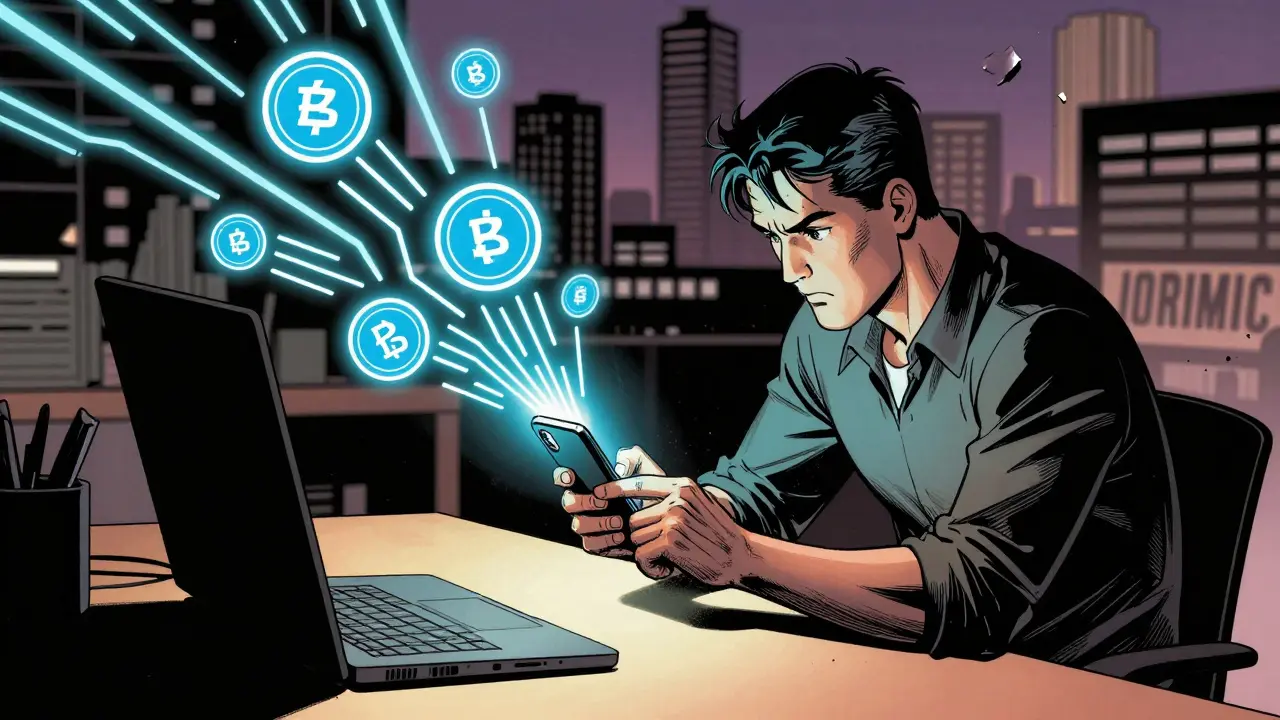
Imagine reading a blog post and paying 2 cents for it. Not a subscription. Not an ad. Just a quick tap to support the writer. That’s the promise of blockchain micropayments for digital content. No middlemen. No waiting weeks for PayPal to clear. Just instant, tiny payments straight from reader to creator - powered by blockchain.
This isn’t science fiction. It’s already happening. But most people don’t know it because the system isn’t smooth yet. The idea is simple: instead of forcing users into monthly subscriptions or bombarding them with ads, creators let readers pay a few cents per article, video, or song. Blockchain makes this possible by cutting out banks and payment processors that charge too much for small transactions. But here’s the catch - it’s still clunky for everyday users.
How Blockchain Micropayments Actually Work
At its core, blockchain micropayments use digital tokens to move value. These aren’t Bitcoin or Ethereum you trade on exchanges. They’re lightweight tokens built on top of blockchains like Ethereum, Solana, or even custom chains designed for speed and low fees. Creators issue their own tokens - think of them as digital coins specific to their content ecosystem.
When you read a newsletter, watch a video, or listen to a podcast, you spend a fraction of a token. That token is instantly sent from your wallet to the creator’s. No bank. No Stripe. No 30-day payout cycle. The transaction happens in seconds. Smart contracts handle everything automatically - splitting revenue if there are co-authors, paying editors, or even rewarding commenters who add value.
There are three main types of tokens in play:
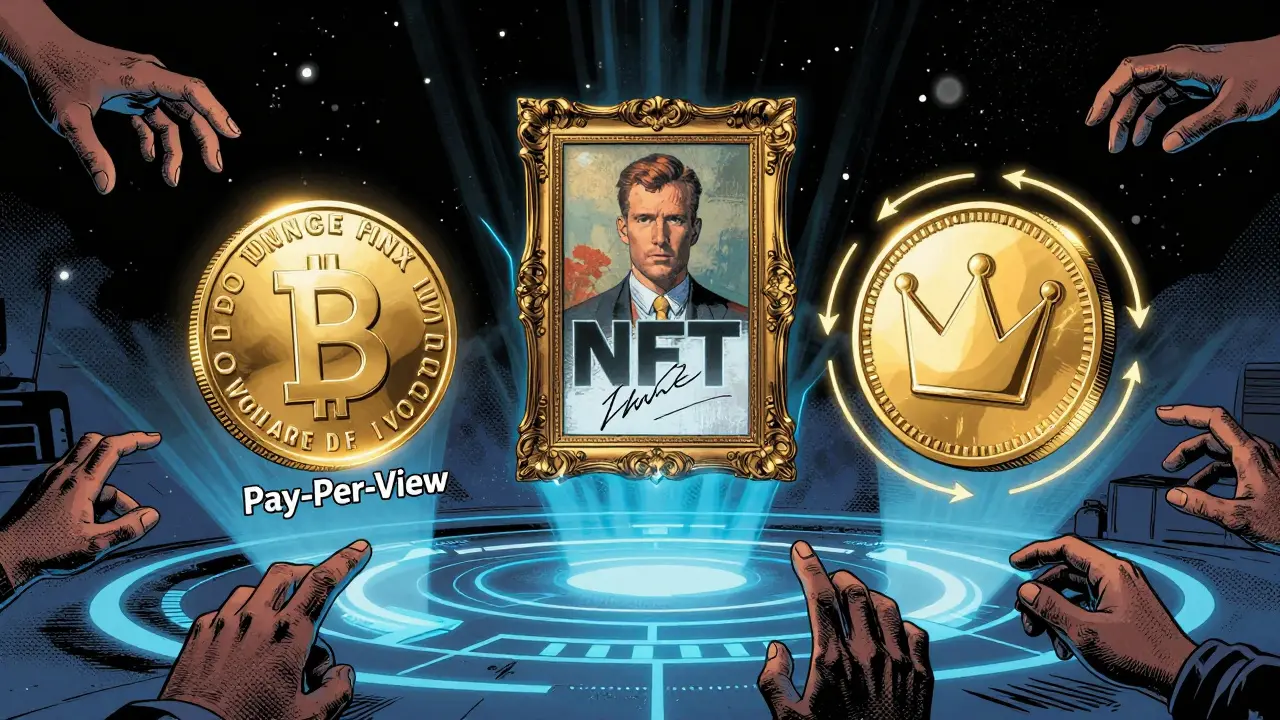
- Fungible tokens - these are like digital cash. You can exchange one for another, and they’re used for pay-per-view, tips, or access to premium content.
- Non-fungible tokens (NFTs) - these are unique. Think of them as collectible editions of an article, a signed digital photo, or a video with exclusive commentary. Owning one gives you bragging rights and sometimes future perks.
- Governance tokens - these let fans vote on what content gets made next. Should the creator do a deep dive on AI ethics? Or focus on local food trends? Token holders decide.
This isn’t just about money. It’s about building a community where readers aren’t just consumers - they’re stakeholders.
What Kind of Content Works Best?
Not every type of content is suited for micropayments. You can’t realistically charge 5 cents for a news headline. But for niche, high-value content? It’s perfect.
- Long-form journalism - independent reporters writing deep dives on climate policy or labor rights can get paid directly by readers who care.
- Independent podcasts - creators who don’t want to sell ads or chase sponsors can let listeners pay per episode.
- Technical tutorials - a 10-minute video explaining how to set up a decentralized app? Charge 10 cents. 500 people watch? That’s $50 in minutes.
- Digital art and photography - artists sell single images for pennies. Collectors buy them not just for the file, but for the provenance and ownership record on the blockchain.
- E-books and newsletters - instead of a $10/month Substack, you pay 3 cents per issue. Read 10 a month? That’s 30 cents.
The key is value density. If the content saves time, solves a problem, or gives you insight you can’t get elsewhere, people will pay - even if it’s just a few cents.
Why Traditional Systems Fail at Micropayments
PayPal, Stripe, and credit card networks were never built for tiny payments. They charge fixed fees - often $0.30 per transaction - plus a percentage. So if you charge 10 cents, you lose money. That’s why most platforms force you to hit a $10 or $20 threshold before paying out.
Even Google Ads and YouTube’s ad revenue model only pay out once you hit $100. That’s months of grinding for many creators. And you’re at the mercy of algorithms, policy changes, and demonetization.
Blockchain removes these barriers. No minimum payout. No middlemen. No delays. But here’s where it falls apart in practice.
The Big Roadblocks
For all its promise, blockchain micropayments aren’t ready for mass adoption - yet.
1. Wallets are too complicated. Most people don’t know what a private key is. Setting up a wallet feels like installing a crypto mining rig. If you have to download an app, back up a 12-word phrase, and understand gas fees just to pay 5 cents for an article - you won’t do it.
2. Crypto volatility kills usability. If Bitcoin drops 15% overnight, the 10-cent article you paid for yesterday now costs 12 cents. That’s not a payment system - that’s gambling.
3. Exchange fees eat the profit. Coinbase charges $0.99 to buy $10 of crypto. That means if you want to pay 5 cents for a blog post, you’re paying 20 times more in fees than the content costs. It’s absurd.
4. No seamless integration. You can’t just click a button in your browser like you do with Apple Pay. There’s no universal micropayment layer. Every creator uses a different system. You need a different wallet for each one.
Right now, the only people using these systems are crypto natives - a tiny fraction of internet users. For everyone else, it’s too much friction.
Who’s Doing It Right?
Some platforms are making progress by hiding the complexity.
Superfluid lets creators stream payments in real time. A reader pays 0.01 cents per second while watching a video. The money flows continuously - no lump sums, no waiting.
Brave Browser integrates a built-in crypto wallet (BAT tokens). You opt in to view privacy-respecting ads, and you get paid in BAT. You can then tip creators directly with that same wallet. It’s one of the few systems that feels almost normal.
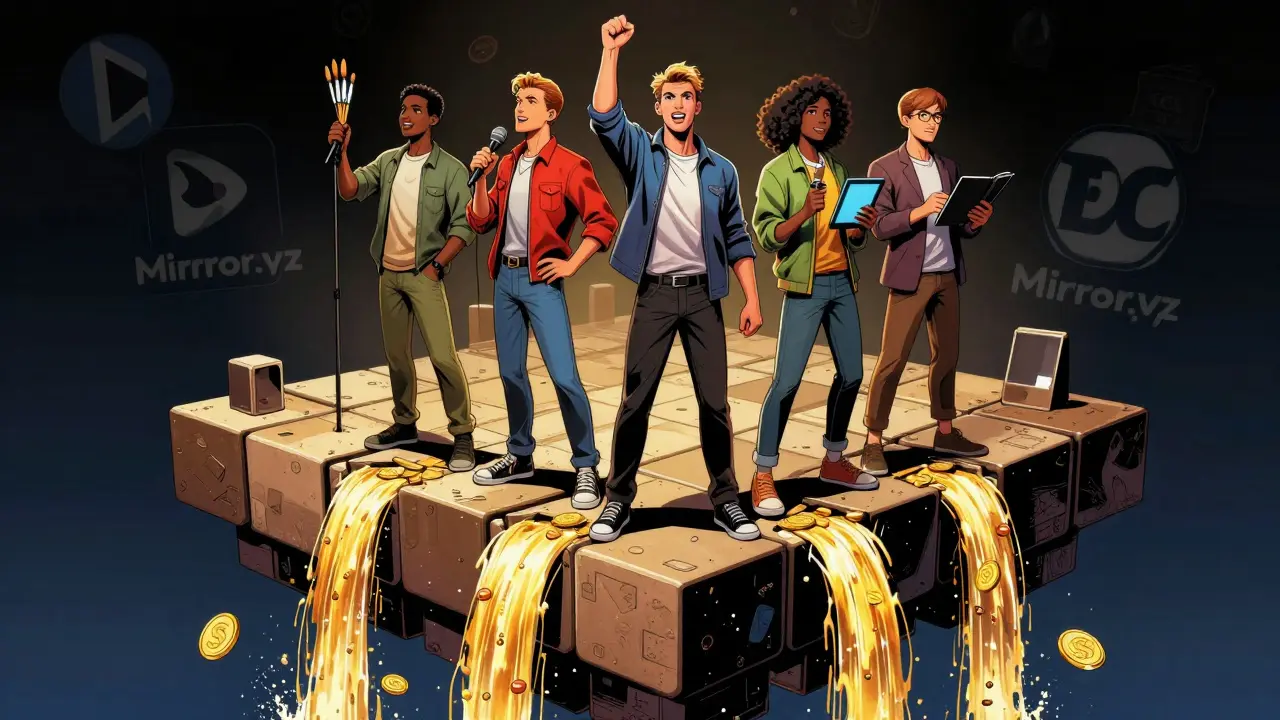
Mirror.xyz lets writers publish articles on the blockchain and accept payments in ETH or USDC. Readers pay with a single click. The writer gets paid instantly. No bank account needed.
Even Patreon and Ko-fi are testing crypto payouts. They’re not fully decentralized, but they’re trying to bridge the gap.
The Future: What Needs to Change
For blockchain micropayments to go mainstream, three things must happen:
- Wallets must become invisible. Imagine paying for content like you pay for a coffee - just tap your phone. The wallet should be built into your phone, browser, or even your email provider. No keys. No seed phrases. Just a passcode.
- Stable value is non-negotiable. Payments need to be pegged to real-world value. USDC, a stablecoin tied to the U.S. dollar, is the best candidate. No one wants to pay 5 cents for an article and wake up to find it costs 7 cents because crypto crashed.
- One system to rule them all. We need an open standard - like email or HTTP - where any creator can accept payments from any wallet, and any reader can pay any creator without switching platforms.
Some startups are building this. Projects like Lightning Network for Bitcoin and Tokenized Content Protocol aim to create low-cost, fast, interoperable micropayment rails. But they’re still in early stages.
Why This Matters
Right now, the internet’s content economy is broken. Big platforms take 45-50% of ad revenue. Algorithms decide what you see. Creators are treated like content factories. Readers are treated like data points.
Blockchain micropayments flip that model. They put power back in the hands of creators and readers. You support the work you value. No ads. No algorithms. No middlemen.
It’s not about replacing YouTube or Substack. It’s about giving creators another path - one where they’re not dependent on corporate platforms for survival.
If you’re a writer, artist, podcaster, or educator - this isn’t just a payment tool. It’s a way to reclaim your work from the attention economy.
If you’re a reader who values quality over noise - you have more power than you think. A few cents here and there can keep independent voices alive.
What You Can Do Today
You don’t need to wait for the perfect system. Here’s how to get started now:
- Find creators using Mirror.xyz or Brave Rewards and tip them with crypto.
- Use Ko-fi with crypto payouts enabled - it’s simple and works with PayPal or USDC.
- Try reading articles on Substack with the “Pay with Crypto” option turned on.
- If you’re a creator, set up a wallet and start accepting USDC. Even if only 10 people pay 5 cents, that’s 50 cents - and it’s real support.
It’s not about getting rich. It’s about building a sustainable culture where content isn’t free - but fair.
Natalie Kershaw
January 8, 2026 AT 17:45Okay but imagine if your wallet just auto-paid 2 cents every time you read something worth it-no taps, no crypto jargon, just seamless value exchange. This is the future of creator economy, not some niche crypto fantasy. We’re talking about real autonomy here.
Forget subscriptions. Forget ads. This is direct human-to-human support. And yeah, wallets are clunky now-but so were smartphones in 2007. We’ll get there.
Stablecoins like USDC are the real MVP. No one wants to gamble on whether their 5-cent article now costs 8 cents because Bitcoin threw a tantrum. Pegged value = usability.
Also, governance tokens? Genius. If I fund your deep-dive on labor rights, I should get to vote on your next topic. That’s not just payment-it’s partnership.
Brave Browser’s BAT system is the closest thing we’ve got to mainstream-ready. Built-in wallet, no extra apps, no seed phrases. Just privacy-respecting ads that pay you back. Why isn’t everyone using this yet?
Ritu Singh
January 8, 2026 AT 20:21Blockchain micropayments are just the latest elite tech cult trick to make poor people feel guilty for not owning crypto while billionaires get richer
They want you to pay 2 cents for an article but won’t tell you that 90% of the value is in the data they harvest from your clicks
It’s not liberation it’s just a new form of surveillance capitalism wrapped in decentralized hype
Who really benefits here The reader or the devs selling wallet apps and gas fee arbitrage tools
Wake up the system is rigged even if it uses blockchain
Rahul Sharma
January 10, 2026 AT 03:41Dear all,
Blockchain micropayments are technically feasible and economically rational.
However, user experience remains the critical bottleneck.
Wallets must be abstracted away.
Stablecoins must be mandatory.
Interoperability must be standardized.
Without these three pillars, adoption will remain below 0.5% of internet users.
Brave Browser and Mirror.xyz are promising.
But we need Apple and Google to integrate this at the OS level.
Otherwise, it remains a hobbyist experiment.
Thank you for your attention.
🙏
Gideon Kavali
January 10, 2026 AT 12:56Oh wow. So now we’re supposed to trust some anonymous devs in a Discord server to handle our payments because “blockchain”?
Let me guess-next they’ll say “just use a private key” like it’s normal to memorize 12 words instead of your damn password.
Meanwhile, in the real world, PayPal handles billions in microtransactions daily-without requiring users to become blockchain engineers.
This isn’t innovation-it’s arrogance disguised as decentralization.
And don’t even get me started on “governance tokens.” So now you’re voting on what your favorite writer writes? That’s not community-it’s mob rule.
We don’t need crypto. We need better business models.
And no, “USDC” doesn’t fix the fact that your wallet is still a nightmare.
🇺🇸
Brittany Slick
January 11, 2026 AT 21:33I’ve been tipping indie writers with USDC for six months now. It’s not about the money-it’s about the vibe.
When someone writes a 2000-word piece on urban beekeeping and you pay 3 cents? You feel seen.
Like you’re not just scrolling-you’re participating.
And honestly? The fact that I can send 5 cents to a poet in Lagos and they get it instantly? That’s magic.
Yeah, wallets suck. But I use Phantom now. Took me 10 minutes to set up. One time.
And now? I just tap. Like tipping a barista.
It’s not perfect. But it’s better than ads.
And better than silence.
greg greg
January 12, 2026 AT 20:36Let’s take a step back and examine the underlying economic assumptions here. The premise is that readers will voluntarily pay for content at a per-unit level, which assumes a level of economic literacy and behavioral consistency that simply doesn’t exist in the general population.
Human beings are loss-averse, and the cognitive overhead of deciding whether a 2-cent article is worth it introduces a friction that scales exponentially with the number of sites you visit.
Even if the transaction cost is near zero, the psychological cost is not.
Moreover, the notion that users will maintain wallets across multiple platforms contradicts the entire history of digital consumer behavior-where convenience trumps ideology every time.
And yet-there’s something beautiful about the aspiration here. The idea that a reader could directly, transparently, and immediately reward a creator without intermediaries taking 45%-that’s a vision worth fighting for.
But we’re not talking about technology.
We’re talking about culture.
And culture changes slower than blockchain forks.
LeeAnn Herker
January 13, 2026 AT 05:30Oh so now you’re telling me the answer to ads is… more ads? Just with crypto instead of Google?
And let me guess-you’re also the kind of person who thinks NFTs are art and that “decentralization” means you get to yell at people on Twitter about private keys.
Meanwhile, real journalists are getting laid off while some guy in Austin gets 50 cents for a Medium post about “how to use Solana.”
It’s not empowerment-it’s performative activism with a wallet.
Also, why is everyone so obsessed with “no middlemen”? You still need servers. You still need devs. You still need moderation.
And guess who pays for them? The same people who used to pay for ads.
Wake up. This is just capitalism with extra steps.
Andy Schichter
January 14, 2026 AT 00:32So you’re telling me the solution to corporate exploitation is… more tech bros with wallets?
How poetic.
Let me just sit here and cry into my overpriced oat milk latte while I pay 0.0003 ETH to read a blog about why blockchain micropayments are the future.
Meanwhile, the real creators-the ones who don’t have a Discord server or a Twitter thread-are still getting paid in exposure.
This isn’t liberation. It’s a luxury accessory for people who already have money.
Also, I didn’t ask for a governance token. I just wanted to read the damn article.
Denise Paiva
January 15, 2026 AT 15:07Stablecoins are the only way this works
USDC not Bitcoin
And no one cares about governance tokens
Just let me pay 2 cents and read
Why are you making this so complicated
People don’t want to vote on your next post
They want to read it
And leave if it sucks
That’s how markets work
Not DAOs
Meenakshi Singh
January 16, 2026 AT 05:57Bro I paid 10 cents for a 5-minute video on how to set up a Solana wallet
It was garbage
But I still sent it
Because the creator had a dog in the background and said “yo” at the end
That’s not economics
That’s vibes
And honestly
That’s the future
🫶
Emily Hipps
January 16, 2026 AT 23:57Hey everyone-just wanted to say this isn’t about tech.
It’s about trust.
When you pay someone 3 cents for their writing, you’re saying: I see you. I value you. I believe in you.
That’s powerful.
And if you’re a creator reading this? Start small.
Set up USDC. Put a tip button on your Substack.
Even if 5 people pay you 5 cents? That’s 25 cents.
And that’s 25 cents more than you’d get from ads.
Don’t wait for the perfect system.
Build the small one first.
You’ve got this.
💛
Jacob Clark
January 17, 2026 AT 07:48Let me just say this: if you think blockchain micropayments are the future, you’ve never had to explain to your grandma why she needs a wallet to read the news.
And if you think “USDC fixes everything,” you’ve never seen what happens when a stablecoin depegs.
Also, “governance tokens”? So now I have to vote on whether my favorite podcaster covers AI or cats?
NO.
Just… no.
This isn’t democracy.
This is a cult with a whitepaper.
And I’m not joining.
Period.
Jon Martín
January 17, 2026 AT 12:33Y’all are overcomplicating this
It’s not about blockchain
It’s about respect
When I pay 2 cents to a writer who spent 8 hours on a piece
That’s not a transaction
That’s a handshake
And yeah wallets suck
But so did email in 1995
And we got used to it
So will we
Trust me
The future isn’t ads
The future is direct
And it’s beautiful
🔥
Mollie Williams
January 17, 2026 AT 18:40There’s a quiet poetry here that gets lost in the noise.
What if paying for content wasn’t about consumption-but connection?
What if the act of sending 3 cents wasn’t a transaction, but a quiet acknowledgment: I read you. I heard you.
And what if that small gesture, repeated across thousands of readers, became a lifeline for someone who writes because they have to-not because they want to be viral?
It’s not a payment system.
It’s a ritual.
And rituals take time to grow.
They don’t need to be perfect.
They just need to be real.
Tiffani Frey
January 18, 2026 AT 21:47As someone who works in fintech in Silicon Valley, I’ve seen dozens of “revolutionary” payment systems come and go.
This one has legs.
Why? Because it solves a real pain point: creators are starving while platforms get rich.
The UX is terrible? Yes.
The volatility? A problem.
But the core idea-direct, transparent, instantaneous value transfer-is fundamentally sound.
And unlike previous attempts, this time it’s backed by real infrastructure: Layer 2s, stablecoins, embedded wallets.
It’s not ready for your mom.
But it’s ready for the next generation.
And that’s enough.
kris serafin
January 19, 2026 AT 04:09Just tried Mirror.xyz today.
Wrote a 500-word thing on analog photography.
Got 12 tips. 11 of them were 5 cents.
That’s 60 cents.
For 3 hours of work.
And I didn’t have to beg for sponsors.
Or sell my data.
Or deal with YouTube demonetization.
Just… people who liked it, paid.
It felt… human.
🚀
Caitlin Colwell
January 21, 2026 AT 02:07I read it.
It made sense.
Now I’m going to go pay a poet in Nigeria.
2 cents.
That’s all.
Charlotte Parker
January 23, 2026 AT 00:19So you’re telling me the solution to capitalism is… more capitalism?
With crypto.
And wallets.
And “governance.”
Wow.
Just wow.
Let me guess-you also think NFTs are art and that “decentralized” means you get to be a jerk on Twitter without consequences.
This isn’t liberation.
This is a tech bro fever dream wrapped in a whitepaper.
And you’re all just dancing around the fact that most people don’t care.
They just want to read the article.
Without the lecture.
Without the wallet.
Without the blockchain.
Just the words.
And maybe a coffee.
That’s it.
Sarbjit Nahl
January 23, 2026 AT 23:10Blockchain micropayments are not a solution
They are a symptom
Of a system that has failed to create sustainable models for digital content
And instead of fixing the root cause
We are building a new temple
To worship complexity
While the creators bleed
And the readers scroll
And the platforms profit
As always
Paul Johnson
January 24, 2026 AT 21:38Look I’m not here to be a hater but if you think people are gonna pay 2 cents for an article you clearly haven’t met anyone who uses the internet
People want free stuff
And if they have to do anything more than click an ad theyll just close the tab
Also who even has a crypto wallet anymore
Its like 2017 all over again
And no i dont want to learn what a private key is
Just let me read the damn thing
Kelley Ramsey
January 26, 2026 AT 10:51Wait-so if I pay 2 cents per article, does that mean I can read 100 articles for $2?
And if I read 1000, it’s $20?
That’s cheaper than Netflix.
And I’m not getting ads.
And I’m not giving up my data.
And I’m supporting real people.
Why isn’t this everywhere?
Why are we still stuck in the ad economy?
Is it because the platforms don’t want us to have control?
Or because we’re too lazy to change?
Just… think about it.
Michael Richardson
January 28, 2026 AT 06:06Blockchain? No thanks.
Let me know when it works on my toaster.
Sabbra Ziro
January 30, 2026 AT 04:25Everyone’s so focused on the tech.
But what if the real win is the feeling?
The quiet pride of knowing your words mattered enough for someone to pay.
The warmth of a 5-cent tip from a stranger who stayed until the end.
That’s not a transaction.
That’s connection.
And maybe that’s worth the hassle.
Just sayin’.
Natalie Kershaw
January 31, 2026 AT 04:17Wait-did someone say USDC? I just used it to pay a journalist in Ukraine $0.05 for a 300-word update on the frontline. She got it in 8 seconds.
No bank. No delay. No questions.
That’s not crypto.
That’s humanity.
Emily Hipps
February 1, 2026 AT 17:34That’s exactly it.
That’s the moment.
That’s what we’re building.
Not a system.
A heartbeat.
Gideon Kavali
February 1, 2026 AT 20:32So now you’re crying about Ukraine? That’s not a payment system-that’s performative virtue signaling.
And you still didn’t fix the wallet problem.
Still just a glorified tip jar with extra steps.
And your “humanity” still requires a 12-word passphrase.
Good luck explaining that to your grandma.