
For a long time, gaming was something you did for an hour or two and then "quit" to return to the real world. But the metaverse changes that. It creates a sense of true presence-that feeling of being authentically "there." It's the difference between watching a video of a concert and actually standing in the front row of a virtual stadium with thousands of other people. With the market projected to hit over $100 billion, this isn't just a trend for tech enthusiasts; it's a fundamental shift in how we spend our free time.
The Gear Making It Happen
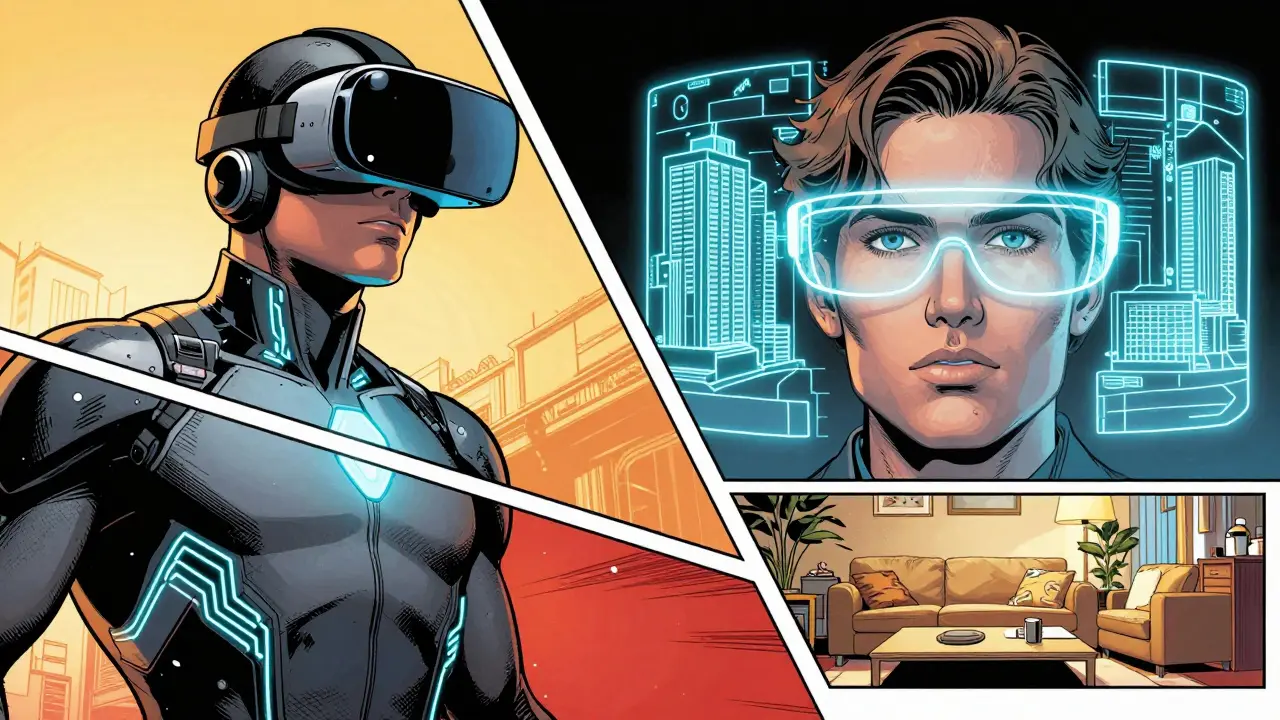
You can't have a truly immersive world without the right tools. The bridge between our living rooms and these digital realms is built on a mix of heavy-duty hardware and invisible software. To get that "embodied" feeling, players are moving past the mouse and keyboard.
- VR Headsets: These block out the physical world to place you entirely inside the simulation.
- Haptic Feedback Suits: These allow you to actually "feel" impact or texture in the game, moving the experience from visual to physical.
- AR Glasses: Unlike VR, these overlay digital elements onto your real environment, blending the two worlds.
- Cloud Gaming: This is the secret sauce that lets you run high-end games on a cheap tablet or phone by doing the heavy lifting on powerful remote servers.
When these tools work together, you stop manipulating an avatar with a joystick and start moving your own body to interact. It turns gaming from a task of coordination into an experience of existence.
From Consoles to Persistent Social Spaces
We've come a long way from the days of 8-bit pixels and text-based adventures. Today, we see a massive convergence where consoles, PCs, and mobile devices all feed into the same ecosystems. But the real magic happens when a game stops being a series of levels and starts being a place to hang out.
Look at platforms like Roblox, a global platform where users create and play games in immersive 3D worlds and Fortnite. These aren't just battle royales anymore; they are social hubs. People go there to attend live concerts, build houses, or just catch up with friends. These are persistent spaces, meaning the world keeps existing and evolving even after you log off. This is the foundational infrastructure of the metaverse-a place where play, networking, and collaboration happen simultaneously.
| Feature | Traditional Gaming | Metaverse Gaming |
|---|---|---|
| User Role | Controlling an avatar | Embodying an identity |
| World State | Resets or pauses | Persistent and evolving |
| Ownership | Items owned by developer | Assets owned by player (via Blockchain) |
| Interaction | Game-loop driven | Social and economic driven |
Blockchain: The Engine of Digital Ownership
Here is where things get interesting for those of us following the blockchain space. In a traditional game, if the developer shuts down the servers, your rare sword or expensive skin vanishes. In the metaverse, Blockchain is used to ensure that you actually own your digital assets. This is made possible through NFTs (Non-Fungible Tokens), which act as digital deeds of ownership.
This shift has birthed the "Play-to-Earn" (P2E) model. Instead of just spending money on micro-transactions, players can earn tokens or unique assets that have real-world value. Imagine spending your weekend designing a virtual piece of clothing in a world like Decentraland and then selling that design to another player for a profit. The blockchain provides the transparency and security needed to make these virtual economies work without a central authority controlling every transaction.
By tokenizing assets, the metaverse turns digital items from mere pixels into actual capital. This attracts not just gamers, but entrepreneurs and designers who see these worlds as new frontiers for business.
New Careers in the Virtual Frontier
As these worlds expand, the job market is shifting. We aren't just looking for "game designers" anymore. Companies like Microsoft are integrating tools like Mesh and developing specific AR chipsets to make these experiences smoother. This is creating a demand for roles that didn't exist a decade ago.
If you're looking to break into this space, the opportunities are diverse. We need AI engineers to create believable non-player characters, AR/VR architects to design the physics of virtual cities, and business development experts who understand how to bridge the gap between a physical brand and a virtual storefront. It's a gold rush of talent where the ability to blend technical skill with creative world-building is the most valuable asset.
The Roadblocks Ahead
It's not all sunshine and virtual rainbows. There are some serious hurdles we have to clear before the metaverse becomes a daily reality for everyone. First, there's the issue of privacy. If a headset can track your eye movements and heart rate, who owns that data? The potential for surveillance in an immersive world is a massive concern.
Then there's the accessibility gap. High-end VR gear and lightning-fast internet aren't available to everyone. If the metaverse becomes the new "internet," we risk leaving behind millions of people who can't afford the hardware. Finally, the sheer amount of computing power required to simulate thousands of people in one high-fidelity space is staggering. We need more efficient edge computing and better bandwidth to avoid the "lag" that ruins immersion.
Is the metaverse the same as VR gaming?
Not exactly. VR gaming is a technology used to experience a game. The metaverse is a larger concept-a persistent, interconnected network of 3D virtual worlds. You can access the metaverse via VR, but you can also enter it through a smartphone, a PC, or AR glasses.
How do NFTs actually work in metaverse games?
NFTs act as certificates of authenticity. When a game item is an NFT, it is recorded on a blockchain. This means the player, not the game company, holds the key to that asset, allowing them to sell or trade it on external marketplaces regardless of the game's internal store.
What is Play-to-Earn (P2E)?
P2E is a gaming model where players are rewarded with cryptocurrency or NFTs for their achievements and time spent in the game. These rewards can then be traded for other cryptocurrencies or converted into real-world currency (fiat).
Can I enter the metaverse without a headset?
Yes. Many metaverse platforms like Roblox or Decentraland are accessible via standard web browsers or mobile apps. While a headset increases immersion, it isn't a requirement for participation.
Who is leading the development of these worlds?
It's a mix of tech giants like Microsoft and Meta, and decentralized communities building on blockchain networks. Each approach differs-some favor centralized control for stability, while others favor decentralization for user ownership.
What's Next?
If you're a gamer, start exploring a few different platforms. Try a centralized one like Roblox and then dive into a decentralized one like Decentraland to see the difference in ownership and feel. If you're an investor or a developer, focus on the intersection of AI and 3D environments; that's where the most explosive growth is happening. The line between our physical lives and our digital ones is blurring, and the best way to prepare is to start participating now.
Veronica Bago
May 1, 2026 AT 14:20This all sounds pretty cool and I can't wait to see where it goes!
Emily A
May 2, 2026 AT 15:56The author fails to acknowledge that the current iteration of these "metaverses" is largely devoid of actual substance. Most of these platforms are merely glorified chat rooms with rudimentary 3D assets. Furthermore, the claim that blockchain ensures "ownership" is a semantic trick; you own a token that points to a file on a server, not the intellectual property itself. It is high time we stopped conflating speculative financial instruments with actual technological progress.
Ryan Nakielny
May 3, 2026 AT 11:54Oh sure, because wearing a plastic bucket on your head and pretending to be a blocky person is exactly how I want to spend my remaining waking hours. Truly the peak of human evolution right here.
Andrew Todd
May 4, 2026 AT 22:15USA is making this stuff and we are the best at it. Anyone else trying to do it is just copying us. This is our game and we win.
Arti Jain
May 6, 2026 AT 03:44India will lead this. US tech is overrated. We have the real brains here.
Ralph Espinosa
May 7, 2026 AT 08:25I actually work in VR development!!! The haptic suits mentioned are getting so much better!!!! You should definitely look into the Teslasura prototypes for real-time tactile feedback!!!! It is a total game changer!!!!
Gabby Puche
May 7, 2026 AT 22:21Omg I just love the idea of virtual concerts! 🌟 Imagine the outfits we can wear! ✨ Totally here for it 💖
Felix Eduardo Velasquez
May 9, 2026 AT 17:31The shift toward persistent digital worlds raises a fundamental ontological question: if our emotional experiences in a simulated environment are indistinguishable from those in the physical world, does the distinction between "real" and "virtual" actually hold any objective meaning. We are essentially transitioning from a biological-first existence to a data-driven existence where the primary currency is no longer labor, but attention and presence. The blockchain element is a clumsy attempt to replicate scarcity in a realm defined by infinite reproducibility, which is a paradox that will likely lead to a massive economic correction once the hype cycle collapses and users demand actual utility over speculative assets.
VIVEK SINGH
May 10, 2026 AT 13:11Ah, the "democratization" of gaming through blockchain. How lovely. I'm sure the corporate overlords are just thrilled to let you "own" your pixels while they still own the entire platform and the air you breathe in the simulation. It's a beautiful irony that we're building digital prisons and calling them frontiers.
Rain Richardsson
May 10, 2026 AT 23:32Sounds promising. Very interesting.
Harvey Alford
May 12, 2026 AT 03:13I'm so lonely and this is the only way I can feel people. Please tell me how to join.
Carli Bates
May 13, 2026 AT 02:39wow we are really just paying to live in a simulation because the real world is a dumpster fire lol we are so advanced
Lynne Teperman
May 13, 2026 AT 18:02wild vibes here just a neon kaleidoscope of dreams
Rushell Perry
May 14, 2026 AT 17:20you guys can totally do this if you just start small and maybe try a few free apps first no need to spend a fortune on gear right away
its me
May 16, 2026 AT 06:26I feel like the soul is being traded for a JPG. We are losing our humanity in the pursuit of a digital ghost.
Ipsita Seal
May 17, 2026 AT 06:24Too much reading for something that is basically just Second Life with a different name.
Lloyd I
May 18, 2026 AT 19:03Let's all jump in and learn together! It is a great way to build new skills and meet people from all over the world!