

Margin trading isn’t just for Wall Street anymore. With crypto markets open 24/7 and leverage ratios often reaching 5x, 10x, or even 100x on some platforms, margin trading has become one of the most powerful - and dangerous - tools for experienced crypto investors. But unlike traditional stocks, where Regulation T limits leverage to 2:1, crypto exchanges let you borrow far more. That means bigger profits… and much bigger losses if things go wrong.
What Is Margin Trading in Crypto?
Margin trading lets you borrow funds from a crypto exchange to open a position larger than your account balance. If you have $1,000 and use 5x leverage, you can control a $5,000 position. When Bitcoin moves 10% in your favor, your profit isn’t $100 - it’s $500. But if it drops 10%, you lose $500 - half your account. That’s the double-edged sword of leverage.
Most crypto exchanges call this “isolated margin” or “cross margin.” Isolated margin limits your borrowed funds to one trade - if it fails, only that position is liquidated. Cross margin uses your entire account balance as collateral. One bad trade can wipe out everything. Many beginners don’t realize the difference until it’s too late.
The Four Core Margin Strategies in Crypto
There are four main ways experienced traders use margin in crypto markets. Each has its own risk profile, timing needs, and technical demands.
1. Long Position with Leverage
This is the most common strategy: betting that a coin will rise. You borrow USDT or BTC, buy more of the asset, and sell later at a higher price. It’s simple - but only works if the market actually goes up.
For example, if you believe Ethereum will hit $4,000 next month and you’re using 3x leverage on a $2,000 deposit, you control $6,000 worth of ETH. If ETH hits $4,000, your $2,000 becomes $6,000 - a 200% return. But if ETH drops to $3,300, your position is liquidated. That’s a 16.7% drop wiping out your entire stake.
2. Short Selling on Margin
Shorting means betting a coin will fall. You borrow BTC from the exchange, sell it immediately, and buy it back later at a lower price to return the loan. The difference is your profit.
Shorting is riskier than going long. When you buy, the worst case is the asset goes to $0 - you lose 100%. But when you short, the asset can theoretically rise forever. If you short BTC at $60,000 and it hits $120,000, you lose double your money. And if it hits $200,000? You’re bankrupt.
Most successful short sellers use tight stop-losses, avoid holding shorts over weekends, and only trade during high-volume periods like U.S. market open or major news events.
3. Margin Pyramiding
This is where things get dangerous. Margin pyramiding means adding to a winning position using profits from earlier trades as collateral. You start with $1,000, go long on SOL, it goes up 20%, you use your $200 profit to open another $2,000 position. Then it goes up another 20% - you add another $4,000. Soon you’re controlling $10,000 with $1,000 of your own money.
It sounds like free money. But one 15% reversal and your entire pyramid collapses. You don’t just lose your profits - you lose your original capital too. This strategy is like stacking Jenga blocks. The higher you go, the faster it falls.
4. Event-Driven Margin Trading
This is the strategy used by pros who watch calendars, not charts. Major events - Bitcoin halvings, ETF approvals, Fed rate decisions, or regulatory crackdowns - cause wild price swings. Margin traders use leverage to ride these spikes.
For example, when the SEC approved the first spot Bitcoin ETF in January 2024, BTC jumped 25% in 48 hours. Traders who went long on margin with 5x leverage made 125% returns. But those who shorted lost everything. Timing matters more than prediction.
Margin Calls: The Silent Killer
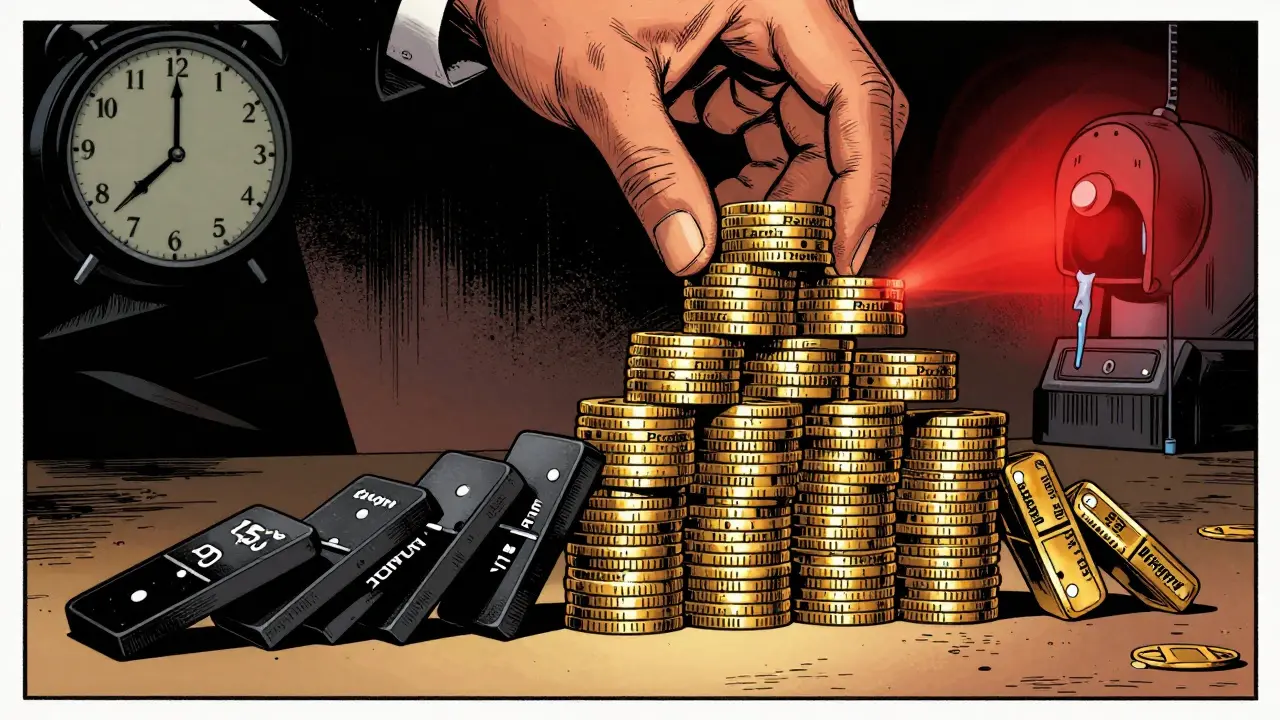
Every margin trader fears the margin call. It’s when your account equity falls below the exchange’s required minimum. The platform automatically sells your assets to cover the loan - often at the worst possible price.
On Binance, the liquidation price for a 10x long position on BTC might be 10% below your entry. On Bybit, it could be 8%. On some decentralized exchanges, liquidation happens instantly with no warning. You don’t get a phone call. You don’t get an email. Your position just vanishes.
Most traders fail because they ignore maintenance margins. They think, “I’ll just hold through the dip.” But if the dip is bigger than your buffer, you’re gone. Smart traders set their own stop-losses 2-3% above the liquidation price. That way, they control the exit - not the exchange.
Costs You Can’t Ignore
Margin isn’t free. Every exchange charges interest on borrowed funds - often daily. Rates vary from 0.01% to 0.1% per day, depending on the coin and demand. That’s 3.65% to 36.5% annually.
On a $10,000 position held for 30 days at 0.05% daily interest, you pay $15 in fees. Sounds small? Now do that on a $100,000 position. That’s $150. And if you’re holding for weeks? It adds up fast.
Worse, during market stress - like the 2022 Terra collapse or the 2023 Silvergate bank run - interest rates spike. Some platforms charged 5% daily for stablecoin loans. That’s 1,825% annualized. If you’re leveraged and caught in that, you’re not just losing on price - you’re bleeding interest too.
Why Most Traders Lose
Studies from CoinMetrics show that over 87% of retail margin traders on major exchanges lose money within six months. Why?
- Over-leveraging: Using 20x or 50x leverage on volatile coins like DOGE or SHIB. A 2% move kills you.
- No stop-loss: Hoping the market will bounce back - while the exchange is already selling your assets.
- Ignoring fees: Forgetting that interest eats into profits over time.
- Trading emotionally: Doubling down after a loss instead of cutting it.
One trader on Reddit described it perfectly: “I thought margin was a rocket. Turns out it’s a landmine with a timer.”
How to Trade Margin Safely
Margin trading isn’t for everyone. But if you’re experienced, disciplined, and understand the risks, here’s how to do it right:
- Start with 2x or 3x leverage. Never go above 5x until you’ve traded for over a year.
- Never use more than 10% of your portfolio on margin. If you have $50,000, don’t risk more than $5,000 in leveraged trades.
- Set your own stop-loss 3-5% above liquidation price. Take control. Don’t wait for the exchange to act.
- Track interest rates daily. Use tools like MarginWatch or CoinGlass to see real-time borrowing costs.
- Avoid holding positions over weekends. Markets can gap 10-20% in 48 hours. That’s liquidation territory.
- Only trade high-liquidity coins. BTC, ETH, SOL, and XRP have tight spreads and deep order books. Altcoins? Avoid them on margin.

Brokerage Comparison: Where to Trade Margin
Not all exchanges are built the same. Here’s how the top platforms stack up:
| Platform | Max Leverage | Min Initial Margin | Interest Rates (Daily) | Stop-Loss Tools | Education Resources |
|---|---|---|---|---|---|
| Binance | 125x (isolated) | 0.8% (125x) | 0.01%-0.05% | Advanced | Extensive guides, webinars |
| Bybit | 100x | 1% | 0.01%-0.08% | Good | Basic tutorials |
| OKX | 100x | 1% | 0.01%-0.1% | Advanced | Medium |
| Bitfinex | 10x | 10% | 0.02%-0.07% | Excellent | Professional-grade |
| Phemex | 100x | 1% | 0.01%-0.1% | Basic | Limited |
For beginners, Binance and OKX offer the best balance of tools and safety. For advanced traders, Bitfinex gives more control and transparency. Avoid platforms with over 50x leverage unless you’re a professional.
The Future of Margin Trading
Margin trading is getting smarter. New tools now auto-adjust leverage based on volatility. Some platforms use AI to warn you before a liquidation. Decentralized protocols like dYdX are introducing insurance funds to protect traders from extreme price gaps.
But the core truth hasn’t changed: leverage magnifies both your skill and your mistakes. The best margin traders aren’t the ones who take the biggest risks - they’re the ones who avoid ruin. They know when to walk away. They know when to take profits. And they never, ever trade with money they can’t afford to lose.
Is margin trading legal in crypto?
Yes, margin trading is legal on most major crypto exchanges globally, but regulations vary. In the U.S., platforms like Binance.US and Kraken offer margin trading under strict SEC guidelines. In the EU, MiCA rules require exchanges to provide clear risk warnings. In Asia, exchanges like Bybit and OKX operate under local licenses. Always check your jurisdiction’s rules - some countries ban leverage entirely.
Can you lose more than you invest in margin trading?
On most regulated exchanges, no. Platforms like Binance and Bybit have negative balance protection - if your position is liquidated, you won’t owe more than your deposit. But on some decentralized platforms or unregulated brokers, you can end up in debt. Always read the terms. Never trust a platform that doesn’t guarantee zero negative balances.
What’s the safest leverage ratio for beginners?
Start with 2x or 3x. That gives you enough room to ride normal market swings without getting wiped out by a 10% correction. Many new traders think higher leverage means faster profits - but it actually means faster losses. The goal isn’t to win big on one trade. It’s to survive long enough to make consistent gains.
How do I know when to close a margin position?
Set your exit plan before you enter. Ask yourself: What’s my target profit? What’s my maximum loss? If the market hits either, close the trade. Don’t wait for a sign. Don’t hope. Don’t wait for “just one more percent.” Margin trades are not long-term holds. They’re tactical moves. Treat them like that.
Do I need to pay taxes on margin trading profits?
Yes. In most countries, profits from margin trading are treated as capital gains. Even if you trade BTC for USDT and then use USDT to buy ETH on margin, each trade is a taxable event. Keep detailed records. Use crypto tax tools like Koinly or CoinTracker. Ignoring taxes can lead to penalties - especially since exchanges now report user activity to tax authorities in over 100 countries.
Final Thought: Margin Is a Tool, Not a Crutch
Margin trading can turn a modest portfolio into a significant one - if used right. But it’s not a shortcut. It’s not a lottery ticket. It’s a high-precision instrument. Use it without understanding, and you’ll break it. Use it with discipline, and it can serve you for years. The best traders don’t chase big wins. They protect their capital. They wait. They scale in. They exit cleanly. That’s how you win in crypto - not by being the loudest, but by being the last one standing.
Shaun Beckford
January 20, 2026 AT 03:05Let me tell you something about margin trading - it’s not trading, it’s Russian roulette with a loaded gun and a 100x multiplier. I’ve seen guys with six-figure portfolios turn into street performers begging for spare change after one bad ETH dump. Leverage doesn’t make you smart - it just makes your losses *spectacular*. And don’t even get me started on those ‘pyramid’ idiots thinking they’re Warren Buffett with a crypto wallet. You’re not building wealth. You’re building a funeral pyre.
Sarah Baker
January 21, 2026 AT 19:56Okay but hear me out - if you approach this like a disciplined gardener, not a gambler, margin can be *beautiful*. I started with 2x, tracked my interest like a hawk, and only traded during high-volume windows. I lost my first $500? Yeah. But then I made $2,200 in three weeks. It’s not about the leverage. It’s about your mindset. You don’t need to be a genius. You just need to be consistent. And patient. And humble. 💪
Pramod Sharma
January 21, 2026 AT 23:16Leverage is just a mirror. It shows you who you are. Not who you want to be.
Liza Tait-Bailey
January 22, 2026 AT 02:44i just tried margin for the first time last week and i swear i thought i was gonna be rich by tuesday. then my sol position got liquidated and i cried in the shower. like actual tears. now i just hodl btc and pretend i’m a crypto monk. also i think exchanges are secretly rigged but i dont know how to prove it 😅
Nishakar Rath
January 23, 2026 AT 05:47Everyone’s scared of leverage because they’re weak. If you can’t handle 50x then you shouldn’t be on the internet. I made 800% in 4 hours on DOGE with 100x and the exchange didn’t even blink. Stop coddling newbies. The market doesn’t care if you cried. It eats fear for breakfast.
kristina tina
January 24, 2026 AT 17:09Hey everyone - I just want to say thank you to the person who wrote this. I’ve been trading for 3 years and this is the first time I’ve read something that didn’t feel like a sales pitch. The part about weekend gaps? That saved me last month. I’m not a pro, but I’m learning. And I’m still here. That’s the win.
Anna Gringhuis
January 26, 2026 AT 08:45Oh look, another ‘how to not lose everything’ guide. How original. Meanwhile, the real traders are using private OTC desks, off-chain settlements, and zero leverage. They don’t need to scream about 5x or 10x because they’re not playing in the kiddie pool. You’re all just rearranging deck chairs on the Titanic while the real players are building submarines.
Dustin Secrest
January 27, 2026 AT 10:39There’s a philosophical truth here: leverage doesn’t amplify market movements - it amplifies the trader’s psychological flaws. The 87% failure rate isn’t because the market is rigged. It’s because most people mistake volatility for opportunity. They confuse motion with progress. Margin trading is less about finance and more about self-mastery. The real asset isn’t BTC. It’s your emotional regulation.
Bill Sloan
January 27, 2026 AT 17:46Just did my first 3x long on ETH and it went up 12% in 12 hours! 😍 I used stop-loss at 5% below entry like the article said and it worked! I’m so hyped I’m gonna go make a pizza and celebrate. Also I think we should start a subreddit called r/MarginMasters. Who’s in? 🍕🔥
Callan Burdett
January 29, 2026 AT 07:59Man I used to be one of those guys with 20x on Shiba. Now I just buy BTC on the dips and sleep like a baby. Margin is like a hot sauce - great in tiny doses. Too much and you’re crying on the toilet. I’m not rich. But I’m not broke either. And I still have my dignity. That’s the real ROI.
Anthony Ventresque
January 30, 2026 AT 02:37What’s the point of all this if you’re just chasing short-term gains? I mean, if you’re not thinking 5+ years out, are you even in the game? Leverage feels powerful until the next bear market hits and you realize you’ve been gambling with someone else’s money. I’d rather own 0.1 BTC outright than 1 BTC on 10x leverage and owe $30k in interest.
Katherine Melgarejo
January 30, 2026 AT 08:19so i read this whole thing and now i feel like i should’ve just bought bitcoin in 2020 and eaten ramen for 4 years. instead i’m here watching my 5x SOL position get wiped out by a tweet. i’m not mad. just… tired. 🥱
Patricia Chakeres
February 1, 2026 AT 04:05Did you know the SEC is quietly backing these exchanges to trap retail investors? The ‘negative balance protection’? A lie. They use algo-trading bots to trigger liquidations right before major news. And the interest rates spike? Coincidence? No. It’s a wealth transfer mechanism disguised as ‘free market.’ Wake up. This isn’t finance. It’s psychological warfare.
Lauren Bontje
February 2, 2026 AT 17:50USA only. Everyone else is just borrowing our market structure. If you’re not trading on Binance.US or Kraken you’re playing in the third world crypto version of a carnival game. Leverage is only safe if you’re American. The rest of you? You’re just feeding the machine.