
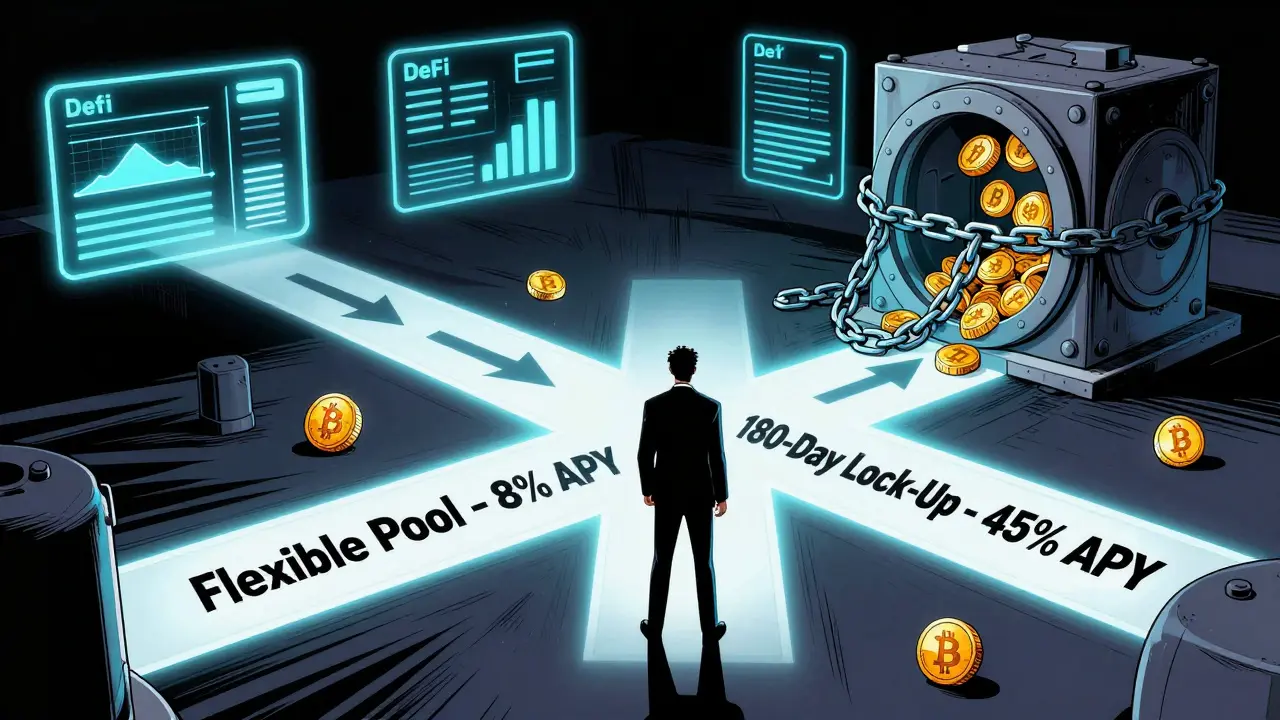
When you stake your crypto in a liquidity pool, you’re not just earning rewards-you’re making a bet on time. The longer you lock up your tokens, the higher the returns. But how long is too long? And what happens if the price crashes while your funds are stuck? Liquidity mining duration and lock-ups aren’t just technical details-they’re the hidden rules that decide whether you walk away with profits or losses.
What Exactly Is Liquidity Mining?
Liquidity mining is how decentralized exchanges like Uniswap, SushiSwap, and Curve pay you to lend your crypto. You deposit two tokens-say, ETH and USDC-into a pool. The pool lets traders swap between them. In return, you get a share of trading fees and extra tokens as rewards. Simple, right? But here’s the catch: not all pools are created equal. Some let you pull your money out anytime. Others force you to wait weeks, months, or even years.Why Do Protocols Use Lock-Ups?
Think of a liquidity pool like a shared car. If everyone drives in and out whenever they want, the car breaks down. Same with DeFi. If users flood in when rewards are high and leave when they drop, the pool becomes unstable. Prices swing wildly. Traders get bad rates. The whole system loses trust. Lock-ups fix that. By requiring you to keep your funds in for a set time, protocols ensure steady liquidity. That means smoother trades, lower slippage, and more predictable rewards. It also gives the protocol time to grow without sudden cash grabs. Some platforms, like Curve Finance, took this further. They created veTokenomics-a system where locking up tokens doesn’t just boost your rewards, it gives you voting power. The longer you lock, the more influence you have over protocol changes. It’s not just about earning-it’s about owning a piece of the system.Types of Duration Models
Not all liquidity mining works the same. There are three main models you’ll see:- Flexible pools: No lock-up. You can withdraw anytime. These are common on Uniswap and PancakeSwap. Rewards are lower, but you keep control.
- Time-weighted rewards: Your rewards increase the longer you stay. For example, after 30 days, you get 1.5x your normal APY. After 90 days, it jumps to 3x. This rewards patience without forcing commitment.
- Fixed-term pools: You pick a lock-up period-7 days, 30 days, 180 days-and get a guaranteed higher APY. If you leave early, you lose most or all of your rewards.
How Much More Do You Earn With Lock-Ups?
The difference can be huge. A flexible pool might offer 8% APY. A 180-day locked pool? 45%. Some niche tokens on newer chains have hit 120%+ APY for year-long locks. But here’s what no one tells you: those high rates don’t last. They’re designed to attract users fast. Once the pool is full, the rewards drop. That’s why timing matters. Getting in early on a new pool with a long lock-up can mean big gains. Getting in late? You’re just paying gas fees to earn peanuts. The math isn’t just about APY. You have to factor in:- Gas fees (especially on Ethereum)
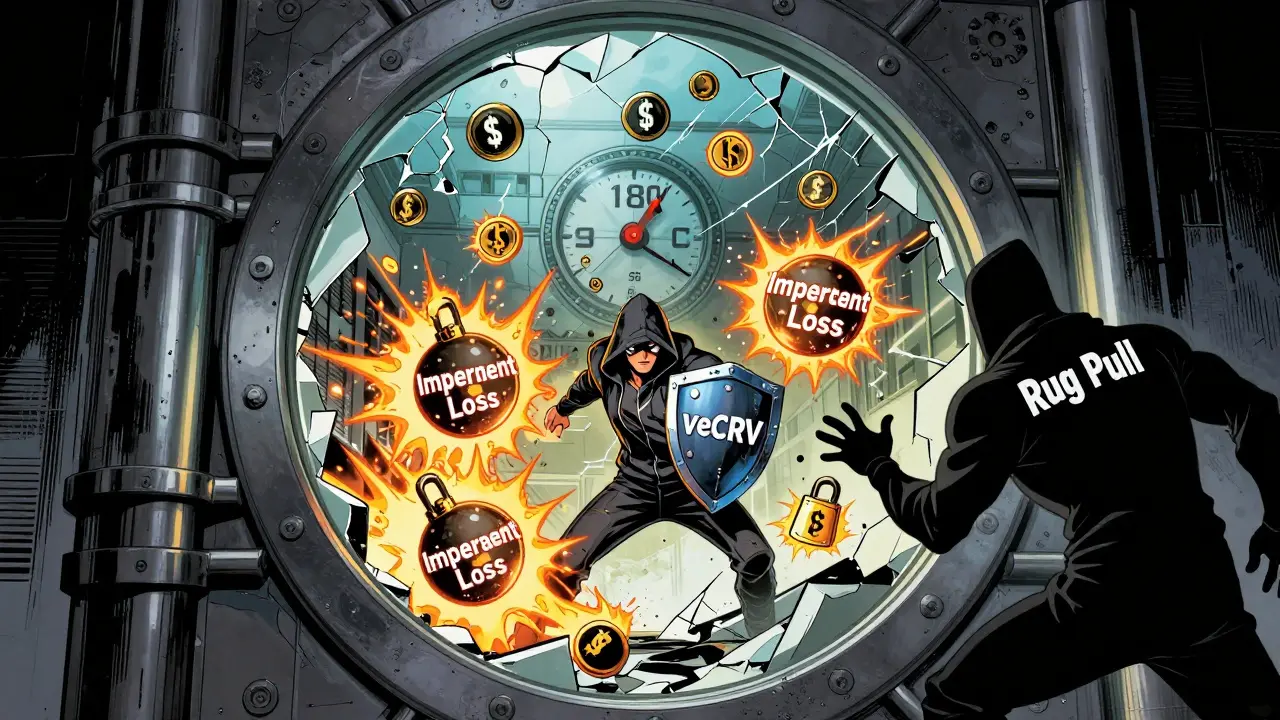
- Impermanent loss risk
- Token price volatility
Impermanent Loss and Lock-Up Trade-Offs
Impermanent loss is the silent killer of liquidity miners. It happens when the price of one token in your pair moves sharply compared to the other. Say you deposit 1 ETH and 2,000 USDC. If ETH doubles in value, you end up with less ETH than if you’d just held it. The pool rebalances to keep the ratio even-and you lose out. Lock-ups don’t prevent this. They just make you live with it longer. Some protocols, like Curve, have built-in impermanent loss protection-but only after 30 to 60 days of continuous participation. Others offer insurance pools or fee-sharing models to offset losses. But these are exceptions, not the rule. The real trade-off? Flexibility vs. reward. If you think prices will be volatile, you want short-term pools. If you believe in the long-term growth of the tokens, lock-ups give you better returns. But you’re betting on two things: the price staying stable or rising, and the protocol not collapsing.Which Chains and Protocols Do This Best?
Not all blockchains handle lock-ups the same way.- Ethereum: High gas fees make short-term lock-ups (under 7 days) not worth it. Most serious players use 30-day+ commitments. Curve Finance’s veCRV is the gold standard here.
- Binance Smart Chain (BSC): Low fees mean you can jump in and out more often. PancakeSwap offers daily, weekly, and monthly pools with decent yields. Great for active traders.
- Polkadot, Solana, Avalanche: Newer chains are experimenting with dynamic lock-ups. Some adjust reward rates automatically based on TVL (Total Value Locked). If liquidity drops, rewards go up to attract more.
What Happens If the Protocol Changes?
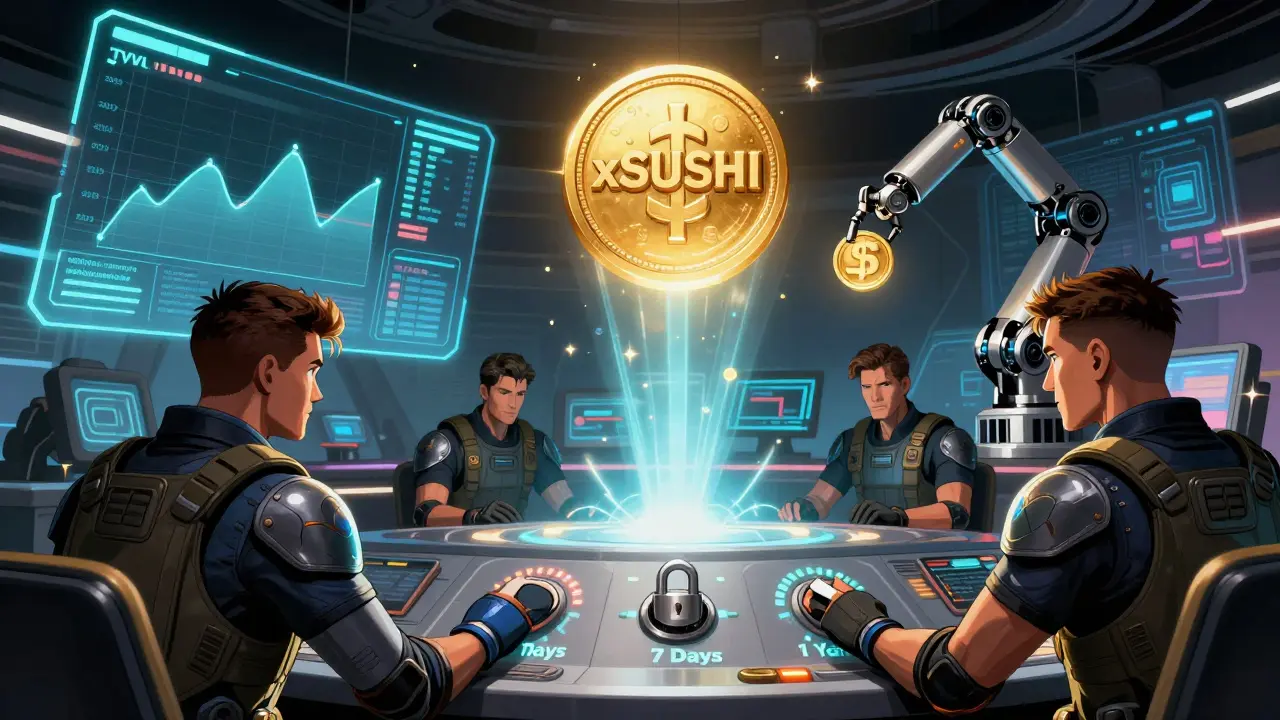
This is the scary part. You lock your tokens for 6 months. Two weeks in, the team decides to cut rewards in half. Or worse-they change the tokenomics so your locked tokens become worthless. You can’t exit. You’re stuck. This has happened. In 2021, a DeFi project called “YieldFarmingDAO” slashed rewards by 80% after users locked in $200M. No one could withdraw. The community revolted, but the code didn’t care. Smart contracts don’t have mercy. That’s why you need to check:- Is the protocol audited? (Look for CertiK, SlowMist, or PeckShield reports)
- Is governance decentralized? Or do 3 wallets control 70% of votes?
- Is there a treasury? A reserve fund that can cover losses if things go wrong?
How to Choose the Right Duration
There’s no one-size-fits-all answer. But here’s how to decide:- Know your risk tolerance. If you panic when prices drop, stick to 7-30 day locks.
- Check the token’s history. Has it been stable? Or does it crash every time the market dips?
- Compare APYs across durations. Is the jump from 30 to 90 days worth it? Sometimes 1.5x APY isn’t worth losing access to your cash for 60 extra days.
- Look at TVL trends. If a pool’s locked value is dropping fast, rewards might be cut soon.
- Don’t lock more than you can afford to lose. Even the safest protocols can fail.
What’s Next for Liquidity Mining?
The next wave is automation and integration. Some protocols are starting to offer:- Auto-compounding lock-ups that reinvest your rewards without you lifting a finger
- Flexible lock-ups that let you partially withdraw (e.g., unlock 50% after 30 days)
- Lock-up insurance backed by decentralized pools
- Integration with traditional finance: think “6-month CD” but in crypto
What happens if I withdraw my liquidity before the lock-up ends?
Most protocols penalize early withdrawal. You’ll lose a portion of your rewards-sometimes all of them. Some platforms use a sliding scale: if you leave after 10 days of a 30-day lock, you might get 30% of your rewards. Others have a cliff: you get nothing until day 30. Always check the contract details before depositing.
Are longer lock-ups always better?
Not always. Longer locks mean higher APYs, but they also mean more exposure to impermanent loss and smart contract risk. If a token crashes or the protocol gets hacked, you’re locked in with no escape. Only lock up what you’re confident in. Many top DeFi users keep a mix: short-term for flexibility, long-term for yield.
Can I lose money even with high APYs?
Yes. High APYs can be misleading. If the price of your deposited tokens drops 40% and your rewards are only 30% APY, you’re still down overall. Always calculate your total return in USD terms, not just token rewards. Track both price changes and reward earnings together.
What’s the difference between lock-up and staking?
Staking usually means locking up a single token to support a blockchain’s security (like ETH 2.0 or SOL). Liquidity mining involves depositing two tokens into a trading pool on a DEX. Staking rewards come from inflation or transaction fees. Liquidity mining rewards come from trading fees and token emissions. The risks are different too-liquidity mining has impermanent loss; staking doesn’t.
Is liquidity mining safe?
It’s not safe-it’s risky. Smart contracts can have bugs. Tokens can crash. Projects can vanish. Even big names like Uniswap or Curve have had exploits. Only use audited protocols. Never deposit more than you’re willing to lose. Treat it like investing in a startup, not a bank account.
Mujibur Rahman
January 7, 2026 AT 17:31Lock-ups aren't just about APY they're about governance power. veTokenomics is the real game changer here. If you're not locking for voting rights you're leaving free money on the table. Curve's veCRV model isn't optional it's mandatory for serious players. Short-termers are just yield farmers with no skin in the game.
Becky Chenier
January 7, 2026 AT 19:06I appreciate how thorough this breakdown is. It's easy to get caught up in the high APYs without considering the underlying risks. The point about impermanent loss being amplified by lock-ups is critical. Many new users don't realize they're essentially betting on price stability.
Staci Armezzani
January 7, 2026 AT 23:21For beginners I always recommend starting with 30-day locks on established protocols like Curve or Sushi. You get a nice boost in rewards without being locked in too long. And always check the tokenomics - if the rewards are dropping fast after a week it's a red flag. Don't chase 120% APYs unless you're ready to lose everything.
Surendra Chopde
January 9, 2026 AT 23:13Interesting how different chains handle this. On BSC you can flip positions daily but on Ethereum you need to think like a bond investor. The gas cost makes short-term mining pointless. I've seen people lose 20% in fees trying to farm 15% APY on ETH. It's not math it's madness.
Tre Smith
January 11, 2026 AT 19:01Everyone talks about APY like it's gospel but nobody mentions that 90% of these pools are rug pulls in disguise. That 120% APY? It's designed to attract dumb money. Once the TVL hits $50M they dump their tokens and vanish. You think you're earning rewards you're just the last sucker holding the bag.
Valencia Adell
January 12, 2026 AT 14:22I lost $45k in a 180-day lock on some random Solana farm. The team disappeared after 3 weeks. My tokens are still locked. I cry every night. Why do people keep falling for this? The whole system is a casino with worse odds than Vegas.
Sarbjit Nahl
January 13, 2026 AT 00:33The premise is flawed. Liquidity mining is not investing it's rent-seeking. You're not creating value you're parasitizing trading volume. The real innovation is in protocol-owned liquidity not user-funded pools. Lock-ups are just psychological manipulation to delay the inevitable collapse.
Paul Johnson
January 13, 2026 AT 18:08Yall act like lockups are some genius invention but its just a way to trap people. I saw a guy lock his ETH for a year and then the team rug pulled. He cried like a baby. You think you're smart but you're just a sheep. If you dont know how to hodl then dont even touch DeFi.
Meenakshi Singh
January 14, 2026 AT 15:09Check this out 📈 I made 87% in 2 weeks on a new Avalanche pool with a 7-day lock. Then I pulled out and reinvested in something else. Thats how you do it. Long locks are for losers who cant time the market. Why lock your money when you can compound daily? 🚀
Kelley Ramsey
January 14, 2026 AT 20:44This is such an important topic!! I'm so glad someone broke this down clearly!! I've been learning about DeFi for months and this finally made sense to me!! I'm going to start with 30-day locks and slowly increase as I get more comfortable!! Thank you for sharing your wisdom!! 💖
Michael Richardson
January 16, 2026 AT 18:32US users think they're smart farming DeFi. Meanwhile China and India are building real infrastructure. You're gambling with your savings while the rest of the world moves on. Wake up.
Natalie Kershaw
January 17, 2026 AT 23:54Love this breakdown. I've been doing this for 3 years and the key is diversification. I keep 60% in flexible pools for liquidity 30% in 90-day locks for yield and 10% in year-long veToken locks for governance. That way I'm earning while still having room to react. And always keep emergency cash outside DeFi.
Jacob Clark
January 19, 2026 AT 13:54Okay but have you considered the ethical implications of participating in a system that's essentially a pyramid scheme disguised as finance? I mean the way these protocols incentivize greed and lock people into risky positions... it's almost predatory. And don't even get me started on how the gas fees are just a tax on the poor. I'm not even mad I'm just disappointed.
Jon Martín
January 20, 2026 AT 01:15THIS IS IT. THIS IS THE BLUEPRINT. Lock-ups are the future. veTokenomics is the revolution. You think you're just earning yield but you're building a decentralized democracy. Every locked token is a vote. Every day you hold is power. Don't be a renter be an owner. The old ways are dying. This is your chance to be part of something bigger than yourself.
Danyelle Ostrye
January 21, 2026 AT 08:09Just chill. I've been in DeFi since 2020. Lock-ups? Meh. I flip in and out. Some days I win some days I lose. It's not rocket science. If you're stressing over APY you're already too deep.
Dennis Mbuthia
January 22, 2026 AT 07:08Let me tell you something about these so-called 'experts' who talk about veTokenomics like it's the second coming. They don't even know what a Merkle root is. Lock-ups are just a distraction. The real power is in the treasury. Who controls the treasury? Who's on the multisig? If you can't answer that you're not investing you're just donating to some guy in a Discord server who says he's 'decentralized'. And don't even get me started on how Ethereum gas fees are a scam. I mean seriously. You're paying $150 to earn $10 in rewards? That's not DeFi that's robbery. And don't even get me started on the environmental impact. I'm not even mad. I'm just disappointed. Again.