
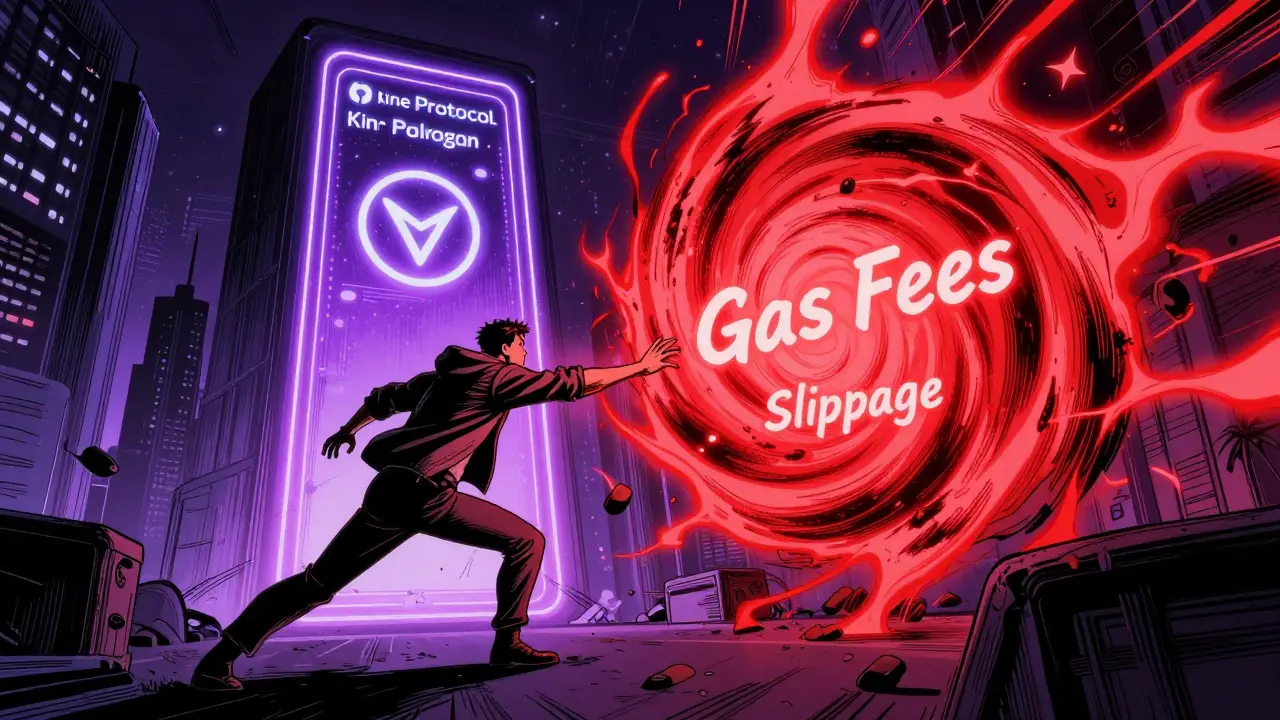
Trading derivatives in the crypto world usually feels like a battle against two things: massive gas fees and the dreaded slippage. If you've ever tried to open a high-leverage position on Ethereum mainnet during a price spike, you know exactly how painful that is. Kine Protocol is a decentralized peer-to-pool derivatives trading platform that allows users to trade perpetual contracts without needing a counterparty. By moving onto Polygon, it attempts to kill off the friction that makes DeFi trading a headache for the average person.
The Core Idea: Peer-to-Pool vs. Traditional Order Books
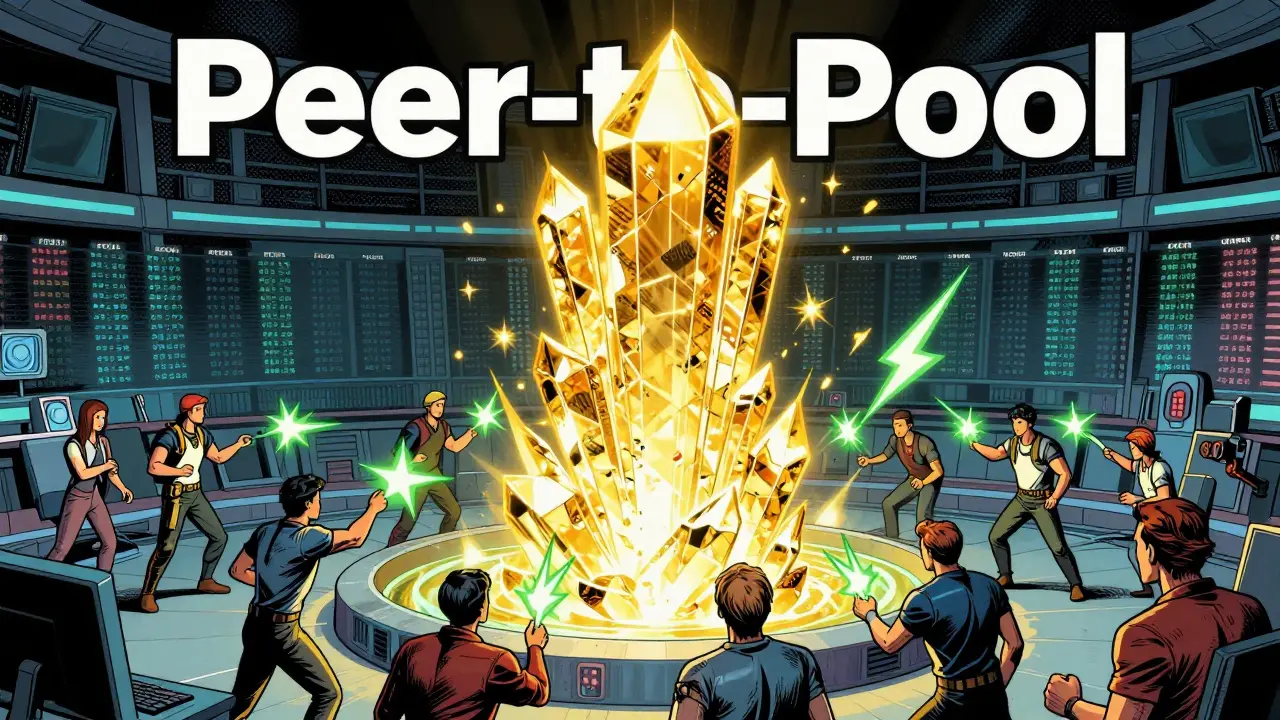
Most exchanges use an order book, which means you need someone else willing to take the opposite side of your trade. If there's no one there, you get slippage-you buy higher or sell lower than you wanted. Kine does things differently. It uses a peer-to-pool model. Instead of matching you with another trader, you trade against a liquidity pool that is over-collateralized.
What does this actually mean for you? It means instant execution. Because the pool is always there, you don't have to wait for a match. In real-world usage, reports show slippage staying below 1%, which is a huge win for anyone moving large volumes. It effectively turns the liquidity pool into a "virtual counterparty" that is always available, regardless of how volatile the market gets.
Why the Polygon Integration Matters
Running a complex derivatives engine on Ethereum is expensive. That's why the shift to Polygon is the real game-changer here. Polygon is a layer 2 scaling solution for Ethereum that provides faster transactions and drastically lower fees. By leveraging this infrastructure, Kine can offer a zero-gas-fee trading model. You aren't paying a fee every time you tweak your stop-loss or adjust your margin.
Beyond just costs, being on Polygon lets you stay within a massive ecosystem. You can move your assets between Kine and other heavy hitters like Aave or Sushiswap without the long, expensive bridge journeys. This composability makes it much easier to manage a diversified DeFi portfolio.
| Feature | Value/Detail |
|---|---|
| Max Leverage | Up to 100x (some assets up to 200x) |
| Trading Fees | 0.1% fixed (0.8% for specific tokens like OKB, WOO) |
| Gas Fees | Zero (via Layer 2 infrastructure) |
| KYC Requirements | Optional (DEX version is No-KYC) |
| Supported Networks | Polygon, Ethereum, BSC, Avalanche |
Breaking Down the User Roles
Kine isn't just for traders. The ecosystem is split into three distinct jobs, and depending on your risk appetite, you can play any of these roles:
- Traders: These are the users opening perpetual contracts. You get professional-grade tools, from trailing stops to advanced technical indicators, and you can use cross-margin to manage multiple positions.
- Stakers: If you prefer passive income over active trading, you can provide the collateral that backs the pools. Essentially, you are the house, earning rewards for providing the liquidity that traders use.
- Liquidators: This is for the sharks. Liquidators monitor the system for insolvent positions. When a trader's margin drops too low, liquidators step in to close the position, keeping the pool healthy and earning a fee for the service.
The Trading Experience: Professional Tools vs. DeFi Simplicity
One of the biggest surprises is the interface. Many DEXs look like a simplified calculator, but Kine feels like a professional terminal. You get detailed data charts that update automatically, a full suite of drawing tools for technical analysis, and the ability to set precise take-profit and stop-loss levels.
For those who aren't pro traders, the copy-trading feature is the highlight. It lets you mirror the moves of successful traders, which is a great way to get skin in the game without spending ten hours a day staring at candlesticks. Because the platform supports wallets like MetaMask, getting started takes about thirty seconds-just connect your wallet and you're in.

The Trade-offs: What's the Catch?
No platform is perfect. While the derivatives side is polished, Kine isn't a one-stop shop. The most glaring omission is the lack of spot trading. If you want to simply buy and hold a coin without leverage, you'll need to use another exchange. Additionally, the list of available trading pairs is smaller than what you'd find on a giant like Binance. You're trading a wider variety of assets for the benefit of better liquidity and lower fees on a select few.
There is also the regulatory gray area. While the DEX version allows you to skip KYC, the CEX version requires personal ID. This hybrid approach shows Kine is trying to play both sides-attracting the privacy-focused DeFi crowd while staying attractive to institutional players who need compliance.
Is Kine Protocol Right For You?
If you are a day trader who is tired of losing 20% of your profit to gas fees and slippage, this is a no-brainer. The combination of Kine Protocol and Polygon's speed creates an environment that feels more like a centralized exchange but keeps the security of smart contract governance. However, if you're a long-term HODLer who just wants a spot market for 500 different altcoins, you'll find the selection too limiting.
Does Kine Protocol require KYC?
It depends on which version you use. The DEX version allows you to trade by simply connecting a compatible crypto wallet (like MetaMask) with no personal identification required. The CEX version does require KYC details.
How high is the leverage on Kine Protocol?
Kine typically offers leverage up to 100x for most assets, though some specific sources indicate that leverage can go as high as 200x depending on the asset and current risk parameters.
What are the trading fees?
The platform generally charges a fixed trading fee of 0.1% per order. However, certain tokens like HT, OKB, and WOO carry a higher fee of 0.8%.
Which blockchains does Kine support?
Kine Protocol is multi-chain and currently operates on Polygon, Ethereum, Binance Smart Chain (BSC), and Avalanche.
What is the peer-to-pool mechanism?
Instead of matching two traders (peer-to-peer), Kine uses a liquidity pool as the counterparty. This ensures that your trade is executed instantly regardless of whether another trader is available to take the other side.
Nishant Goyal
April 17, 2026 AT 20:20Zero gas is a huge win for the community.
Robert Preston
April 18, 2026 AT 16:14Peer-to-pool is the only way to actually scale derivatives without the slippage nightmares of traditional books. Most people don't realize that the pool acts as a constant shock absorber, which is critical when you're playing with 100x leverage. It removes the need to hunt for a specific counterparty, making the execution feel almost like a CEX while keeping the non-custodial benefits. If you're serious about high-frequency adjustments, the Polygon integration is practically mandatory to avoid bleeding out on fees. Just keep an eye on the collateralization ratios of the pools to ensure the system stays solvent during extreme volatility. It's a solid architecture for anyone who actually knows how to manage risk.
Joshua Salwen
April 19, 2026 AT 04:40LMAO a 0.8% fee for some tokens?? That is literally robbery!!! 😱 Why would anyone use this over a real exchange if they're just gonna gouge you on specific pairs? Absolute joke!
Ian Chait
April 19, 2026 AT 15:44Zero gas is a lie... just a front for the central bank digital currancy push. They use Polygon to hide the trail. All these "pools" are just algos run by the elites to liquidate the little guy using MEV bots. Wake up people, the smart contract is just a fancy way to say "we own your keys now" lol.
Sandeep Bhoir
April 19, 2026 AT 20:06Oh sure, "zero gas" is just a great way to attract people who can't read a whitepaper. I'm sure the hidden fees are just invisible magic.
Abhinav Chaubey
April 21, 2026 AT 00:21The technical architecture here is fundamentally superior to the sluggish systems the West keeps trying to push. The integration with Polygon shows a level of efficiency that most American devs can't even wrap their heads around. It's a perfect example of why the current DeFi shift is necessary.
siddharth narula
April 22, 2026 AT 12:17One must contemplate the morality of 200x leverage. Is it truly trading, or is it merely a sophisticated form of digital gambling that erodes the spirit of the investor? 🧘♂️
Gaurav Undirwade
April 23, 2026 AT 17:11It is utterly reprehensible that such high leverage is permitted without strict oversight. The lack of mandatory KYC in the DEX version encourages a culture of anonymity that is antithetical to a stable financial system. I find it appalling that the industry celebrates this lack of accountability.
Chintu Parikh
April 24, 2026 AT 18:34I believe we can all agree that the peer-to-pool model is a fantastic step forward for inclusivity in trading! It provides a great opportunity for those who are new to derivatives to experience a smoother entry point without the intimidation of traditional order books. Let us support these innovations together!
Mark Pfeifer
April 26, 2026 AT 03:19I'm curious about the actual liquidator incentives. If the pool is over-collateralized, is the incentive high enough to attract enough liquidators to keep the system healthy during a flash crash?
Andrew Southgate
April 28, 2026 AT 02:16To build on that, the liquidator role is actually a very important part of the ecosystem's health and safety. For those who aren't familiar, liquidators are basically the cleanup crew that ensures no one's bad bet can crash the entire pool. While it seems aggressive, it's actually a protective measure for the stakers who are providing the liquidity. I've seen similar models in other protocols where a small set of efficient liquidators can keep the whole system running smoothly even in high volatility. It's definitely worth looking into the specific reward tiers if you have the bots to handle it. Generally, it's a great way to earn a steady stream of income if you have the technical setup to monitor the chain in real-time. I'd recommend anyone interested in the "shark" role to read the full documentation on the liquidation thresholds first.
Keri Pommerenk
April 29, 2026 AT 13:14copy trading is such a good way to learn the ropes without losing everything on day one
Shantal Sanjur
May 1, 2026 AT 02:51Copy trading is just a fancy way to lose money while following someone else's mistakes. Please, tell me more about how "safe" it is to mirror a random person on the internet with 100x leverage. Absolute madness!
Trudy Morse
May 2, 2026 AT 04:10Leverage is just a tool, not a sin. Use it right or don't use it.
Yuhan Mo
May 2, 2026 AT 22:17The composability with Aave and Sushiswap on Polygon is a significant value add. Leveraging the L2 stack for high-throughput derivatives trading really optimizes the capital efficiency for the end user.
Alex Long
May 2, 2026 AT 23:14too basic. no spot trading? waste of time.
Adam Mann
May 4, 2026 AT 05:55I just love how these platforms are making it so much easier for everyone to get involved regardless of where they are in the world! It's so inspiring to see the barrier to entry drop, especially for people who can't afford the high fees of the main Ethereum chain. Even though the asset list is smaller, it's still a wonderful starting point for anyone who wants to learn about the future of finance in a friendly and accessible environment. I think we're moving toward a world where these tools will be common for everyone, and that's just a beautiful thought to have as we grow together as a global community of learners and traders.
Mike Kempenich
May 4, 2026 AT 17:24The zero-gas model is definitely the way to go, though I'm sure some will complain about the limited pairs. It's a fair trade-off for speed.
Shannon Kelly Smith
May 6, 2026 AT 00:46Get those pools filled! 🚀 The passive income for stakers is where the real magic happens! 💰💎
Gillian Kent
May 7, 2026 AT 15:45i laov how the interfac feels like a real terminal, it just makes it feel more legit even if i still make typos in my order amounts haha
Kim Smith
May 9, 2026 AT 03:39there is something almost poetic about the way these liquidity pools mirror the ebb and flow of human desire and fear in the market... its like a digital tide that never truly stops rushing in and out of the contracts, leave it to the machines to track our greed so precisely while we just click buttons on a screen and hope for the best in this strange new world of finance...
Ian Chait
May 9, 2026 AT 08:32Exactly!! It's a laandgrab by the shadow gov to track our wallets through the CEX side while pretending the DEX is a safe haven. Total psyop.