
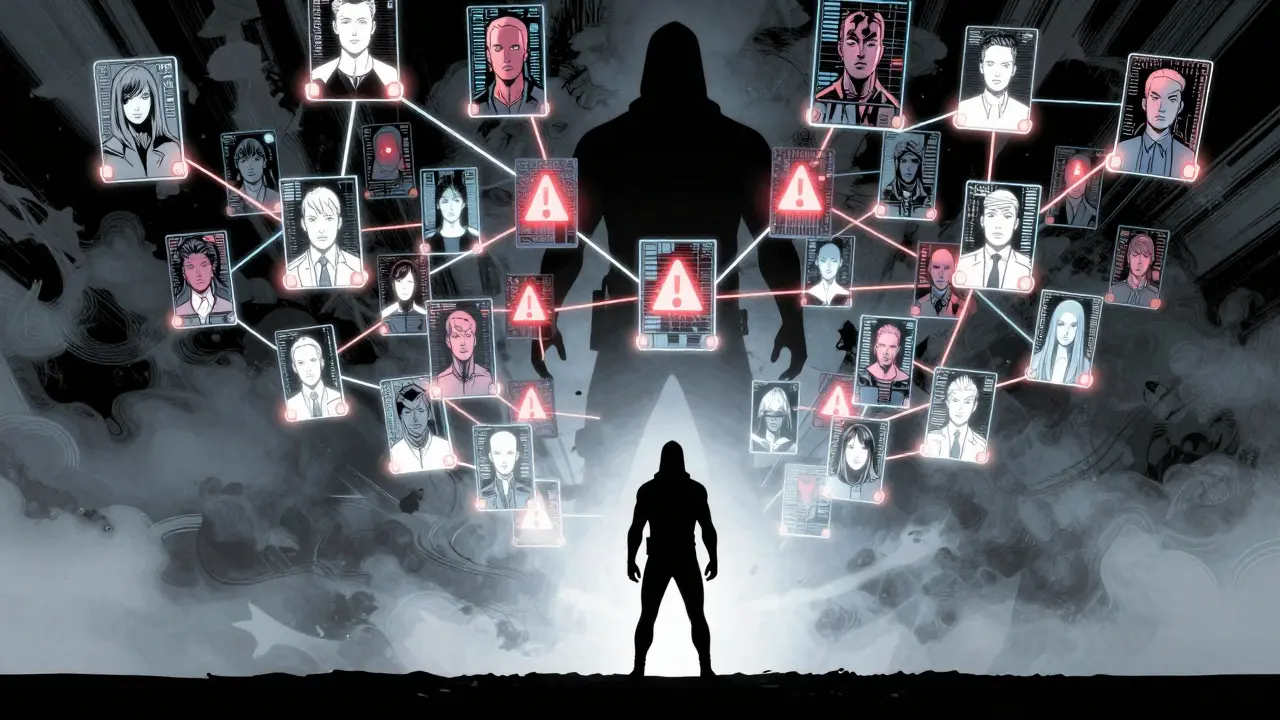
Imagine a blockchain network where one person controls hundreds of fake identities - each pretending to be a separate validator, voter, or participant. They vote together to hijack governance, drain airdrop funds, or crash the network. This isn’t science fiction. It’s a Sybil attack, and it’s one of the most dangerous threats facing decentralized systems today.
The term comes from a 2002 paper by researchers at the University of Massachusetts, named after the woman in the book Sybil who had 16 personalities. In blockchain, a Sybil node is a single attacker running multiple fake identities to gain control over a network. These attacks don’t require massive computing power like a 51% attack. They just need someone to spin up dozens of nodes - cheaply and anonymously.
Why Sybil Attacks Matter More Than You Think
Sybil attacks aren’t just theoretical. In January 2019, Ethereum Classic was hit by a Sybil attack that led to a full 51% takeover. Attackers created hundreds of fake nodes, flooded the network with malicious transactions, and reversed hundreds of blocks. The damage? Over $1 million stolen before the network recovered.
DeFi protocols have been hit even harder. In 2022 alone, there were 37 documented Sybil attacks targeting airdrops and voting systems, with an average loss of $2.8 million per incident. Optimism’s retroactive airdrop in 2022 nearly collapsed under fake claims - until they deployed 14 detection filters that slashed fraudulent claims from 68% down to just 8.3%, saving $142 million in token value.
It’s not just about money. Sybil nodes can break governance. If one person controls 30% of voting power through fake identities, they can push through bad proposals, freeze funds, or even shut down a DAO. Without detection, decentralization becomes a myth.
How Sybil Nodes Work: The Mechanics of Fake Identity
Sybil attacks exploit the core design of permissionless blockchains: anyone can join. No ID required. No background check. No verification. That’s great for openness - but terrible for security.
Here’s how it plays out:
- An attacker creates hundreds of wallet addresses using automated scripts.
- They distribute these wallets across multiple IP addresses and devices to avoid detection.
- Each fake node joins the network as if it’s a legitimate participant.
- They then coordinate votes, stake small amounts of tokens, or flood the network with traffic.
In proof-of-work chains like Bitcoin, Sybil attacks are harder because nodes need real computational power to be heard. But in proof-of-stake or delegated proof-of-stake networks, where influence comes from token holdings, attackers can create many low-stake identities to dilute real users’ power.
Monero, a privacy-focused chain, saw a Sybil attack in 2021 where attackers controlled 42% of network nodes - not by owning more coins, but by flooding the network with fake identities. Privacy made detection nearly impossible.
Five Proven Methods to Detect Sybil Nodes
There’s no single silver bullet. But combining multiple techniques can cut Sybil attacks by over 90%. Here are the five most effective methods used today:
1. Social Trust Graphs
This method treats nodes like people in a social network. Real users tend to connect with other real users. Sybil nodes cluster together in isolated groups with no ties to the main network.
Researchers at IEEE found that analyzing connection density and path lengths between nodes can spot Sybil clusters with 86.3% accuracy. Ethereum’s research team uses this in their node discovery layer - if a new node only connects to other new nodes with no history, it’s flagged.
2. Identity Validation
Some networks ask users to prove they’re real humans. Coinbase’s retail products reduced fake wallet creation by 74% using phone verification, and 89% with credit card checks. But there’s a catch: these methods exclude people without bank accounts or phones - about 28% of the global population, according to the World Bank.
Worldcoin’s Orb uses iris scanning to verify one person = one identity. As of August 2023, they’d verified 2.3 million users. But it’s not perfect. Critics say biometrics create new privacy risks, and fully permissionless chains can’t force users to scan their eyes.
3. Reputation Systems
Instead of trusting new nodes, give them time to prove themselves. Chainlink’s oracle network assigns reputation scores based on past behavior. A node must run for 90 to 180 days with zero downtime, correct responses, and timely updates to earn full trust.
It’s slow - but that’s the point. A Sybil attacker can’t wait six months. They need quick wins. Reputation systems turn Sybil attacks from a low-cost hack into a long-term investment that rarely pays off.
4. Economic Cost Mechanisms
Proof-of-work and proof-of-stake aren’t just consensus algorithms - they’re Sybil defenses.
Bitcoin’s proof-of-work forces attackers to spend real money on hardware and electricity. As of July 2023, controlling 51% of Bitcoin’s hashrate cost $1.4 million per hour. That’s not a hack - it’s a bankruptcy plan.
Ethereum’s shift to proof-of-stake made it even harder. To become a validator, you need 32 ETH - worth $89,600 at $2,800 per ETH in late 2023. You can’t spin up 100 validators for free. You need $8.9 million. Ethereum Foundation reported a 99.8% drop in Sybil vulnerability after the Merge.
5. Personhood Protocols and Zero-Knowledge Proofs
The next frontier is proving you’re a unique human - without revealing who you are.
zkSync’s testnet used zero-knowledge proofs to verify wallet uniqueness with 99.2% accuracy. The system didn’t know your name, phone, or location - it just confirmed you weren’t a duplicate. This is the holy grail: security without sacrificing privacy.
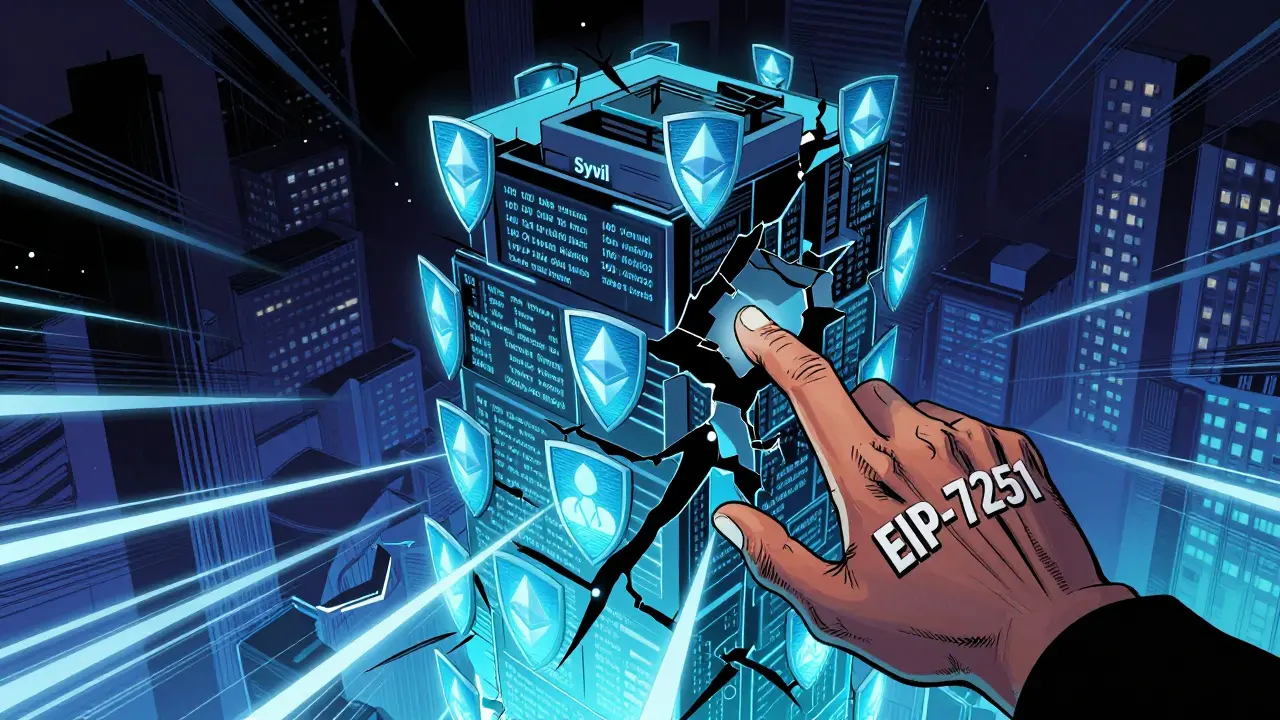
Ethereum’s upcoming Pectra upgrade (Q1 2025) will include EIP-7251, which improves how validator identities are linked to staked ETH, making it harder to split stakes across fake identities.
Trade-Offs: Security vs. Accessibility
Strong Sybil detection isn’t free. Every layer adds friction.
Chainlink’s reputation system adds 8-12% latency to transactions. JPMorgan’s Onyx team saw a 23% increase in onboarding time after adding multi-factor identity checks. And in Optimism’s airdrop, legitimate users spent weeks fighting false positives - one person needed 17 days and eight support tickets to prove they weren’t a bot.
There’s also a growth penalty. DappRadar found networks with advanced Sybil detection had 32.7% fewer bot accounts - but also 14.3% slower user growth. The more you lock the door, the fewer people walk in.
That’s why some experts argue: Don’t try to eliminate all Sybil nodes. Just make them too expensive to be worth it.
What Works Best? A Quick Comparison
Here’s how major networks stack up:
| Network | Method Used | Sybil Reduction | Drawbacks |
|---|---|---|---|
| Bitcoin | Proof-of-work | High (economic barrier) | High energy use, slow, not ideal for smart contracts |
| Ethereum | Proof-of-stake + reputation | 99.8% | High capital requirement, centralization risk |
| EOS | Delegated PoS (21 producers) | High | Low decentralization (5.8/10 score) |
| Optimism | 14 detection filters | 8.3% fraud rate (down from 68%) | False positives, user frustration |
| Monero | Privacy-first (no identity) | Low | 42% of nodes were Sybil in 2021 attack |
| zkSync | Zero-knowledge personhood | 99.2% | Still in testnet, not widely adopted |
Real-World Implementation: What Developers Say
A 2023 survey of 1,243 blockchain developers showed that 68.7% consider Sybil detection “critically important but technically challenging.” The top three roadblocks?
- Maintaining user privacy - cited by 74.2%
- Computational overhead - 68.9%
- False positives - 63.1%
One developer on Reddit, u/EthereumSecurityExpert, spent months building a custom Sybil filter for their DAO. It cut false positives from 22% to 4.3% - but increased infrastructure costs by 37%.
Open-source tools like SybilRank (867 GitHub stars) are popular, but many developers complain they’re too heavy for small networks. “It works great on Ethereum,” one user wrote, “but my private chain has 20 nodes. Running SybilRank on that is like using a tank to dig a garden.”
What’s Next? The Future of Sybil Detection
The next wave of detection isn’t just about stopping bots - it’s about understanding behavior.
Stanford’s Center for Blockchain Research introduced a new metric called “trust entropy” in March 2023. It measures how predictable a node’s behavior is over time. Real validators act consistently. Sybil nodes behave erratically - switching addresses, timing, and voting patterns. Their system achieved 93.1% accuracy in tests.
Meanwhile, the World Economic Forum predicts that combining decentralized identity (DID) with AI-driven behavioral analysis will identify Sybil clusters with 96.8% accuracy while preserving 98.3% user privacy.
Regulation is catching up too. The EU’s MiCA rules, effective June 2024, require all blockchain networks operating in Europe to have “robust Sybil attack prevention.” The U.S. SEC’s proposed Digital Asset Security Framework (September 2023) demands “industry-standard Sybil detection” by 2026.
By 2027, Gartner predicts networks without these protections will fail at 73% higher rates. Sybil detection is no longer optional. It’s infrastructure.
Getting Started: What You Need to Do
If you’re building or running a blockchain network, here’s a practical roadmap:
- Analyze your network - Look at node connections, transaction patterns, and wallet behavior. Are there clusters of new wallets acting the same way?
- Start with economic barriers - Even a small staking requirement can deter most attackers. You don’t need 32 ETH - even 0.1 ETH can be enough for a private chain.
- Add reputation scoring - Give nodes time to earn trust. Reward consistency, not just participation.
- Test with real data - Use historical transaction logs to simulate attacks. See what your filters catch - and what they miss.
- Balance privacy and control - Don’t force phone numbers on global users. Explore zero-knowledge solutions or social graph analysis first.
Implementation takes time. Basic systems need 3-5 weeks. Advanced ones? 8-12 weeks. But the cost of not doing it? Millions. Or worse - a broken network.
Frequently Asked Questions
What exactly is a Sybil node?
A Sybil node is a single attacker running multiple fake identities on a blockchain network to gain unfair influence. These nodes appear as separate participants but are controlled by one person or group, often to manipulate voting, steal airdrops, or disrupt consensus.
Can Sybil attacks happen on Bitcoin?
Yes, but they’re extremely expensive. Bitcoin uses proof-of-work, so each node must contribute real computing power. To control enough nodes to launch a successful attack, an attacker would need to spend over $1.4 million per hour on electricity and hardware as of 2023 - making it economically unfeasible.
Why is proof-of-stake better against Sybil attacks than proof-of-work?
Proof-of-stake makes identity acquisition costly. In proof-of-work, you buy hardware. In proof-of-stake, you buy tokens. To control 100 validators on Ethereum, you need 3,200 ETH - worth over $8 million at $2,800 per ETH. That’s not just hard - it’s a massive financial risk. If you’re caught, your stake is slashed. In proof-of-work, you can just walk away.
Do privacy coins like Monero have Sybil problems?
Yes - and they’re worse. Monero prioritizes anonymity, so it doesn’t track identities or require verification. In 2021, attackers exploited this by controlling 42% of its nodes using fake identities. Without any identity layer, detection was nearly impossible.
Can zero-knowledge proofs solve Sybil attacks?
They’re one of the most promising solutions. zkSync’s testnet used zero-knowledge proofs to verify that each wallet belonged to a unique person - without revealing any personal data. Accuracy hit 99.2%. This means you can stop Sybil nodes without violating privacy, which is the holy grail for decentralized systems.
Are Sybil detection systems required by law?
Yes, in many places. The EU’s MiCA regulation, effective June 2024, requires all blockchain networks operating in Europe to have “robust Sybil attack prevention.” The U.S. SEC’s 2023 proposal also mandates “industry-standard Sybil detection” for public blockchains by 2026. Compliance is becoming mandatory, not optional.
What’s the biggest mistake developers make when building Sybil detection?
Trying to block every single fake node. That leads to false positives - legitimate users getting locked out. The best systems don’t aim for 100% detection. They make Sybil attacks too expensive, slow, or risky to be worth it. Focus on economic disincentives and reputation, not perfection.
Shruti Sinha
December 17, 2025 AT 05:20Sybil detection isn't just technical-it's a social contract. The moment you start requiring identity verification, you're no longer building a permissionless system. You're building a gated community with a bouncer at the door.
And let's be honest: if your blockchain can't handle Sybil attacks without turning into a KYC nightmare, maybe decentralization isn't your real goal.
Heather Turnbow
December 17, 2025 AT 10:45The ethical implications of biometric identity systems like Worldcoin cannot be overstated. While the technical achievement is impressive, the normalization of iris scanning as a prerequisite for digital participation sets a dangerous precedent for global digital rights.
Decentralization should empower the unbanked-not subject them to surveillance capitalism under the guise of security.
Terrance Alan
December 19, 2025 AT 08:54Amy Copeland
December 20, 2025 AT 21:28Oh look, another whitepaper that treats blockchain like a corporate HR department. Let’s verify your iris, check your credit score, and wait 90 days to prove you’re not a bot. How very Silicon Valley of you.
Meanwhile, the real Sybil attack is the one where venture capitalists buy up all the governance tokens and call it ‘decentralized’.
Patricia Amarante
December 21, 2025 AT 09:35Donna Goines
December 22, 2025 AT 23:01They’re not just Sybil nodes-they’re part of a global surveillance network. The same people pushing zero-knowledge proofs are the ones selling your data to defense contractors under the guise of ‘privacy tech’.
Remember when they said Bitcoin was anonymous? Now we have Chainalysis. This is just the next phase. They want to track every wallet, every vote, every keystroke.
Don’t fall for it. The real security is obscurity. If you can’t trace it, you can’t attack it.
Greg Knapp
December 24, 2025 AT 06:03Cheyenne Cotter
December 24, 2025 AT 13:22Let’s not romanticize social trust graphs. Real people don’t have clean, linear social networks. They have messy connections-family, coworkers, exes, crypto Twitter friends. A Sybil node can easily mimic that by seeding fake connections to real ones.
And don’t get me started on reputation systems. They reward consistency, yes-but they also punish new users who aren’t already embedded in the ecosystem. That’s not security, that’s gatekeeping dressed up as due diligence.
The real problem isn’t Sybil nodes. It’s that we’re trying to apply Web2 solutions to Web3 problems. You can’t fix anonymity with KYC. You can’t fix decentralization with centralized reputation scores.
What we need is not more detection. We need less reliance on identity altogether. Maybe instead of asking ‘who are you,’ we should ask ‘what are you doing?’ Behavior-based detection is the only path forward that doesn’t sacrifice the core value of blockchain: pseudonymity.
And yes, I know this sounds idealistic. But the alternative is a blockchain that looks like your bank’s app with more crypto jargon.
Sean Kerr
December 25, 2025 AT 16:17Jesse Messiah
December 25, 2025 AT 20:35One thing people forget: Sybil resistance isn’t about eliminating every fake node. It’s about making the cost of launching one higher than the potential gain.
Think of it like spam emails. We don’t stop every single one-we make it so expensive to send them that spammers go broke. Same principle.
That’s why even a small staking requirement-like 0.1 ETH-can work wonders on private chains. It’s not about being perfect. It’s about being economically rational.
Also, please stop calling it ‘decentralized’ if you’re running 5 nodes and all of them are yours. That’s not a DAO. That’s a solo project with a fancy name.
George Cheetham
December 26, 2025 AT 04:50There’s a deeper philosophical question here: What is identity in a decentralized world?
If we define identity as a unique human, we risk recreating the very hierarchies blockchain was meant to dissolve.
If we define identity as a unique address, we open the door to Sybil.
Perhaps the answer isn’t in proving who you are-but in proving what you contribute. Reputation without identity. Value without verification.
The most resilient networks won’t be the ones that detect the most Sybil nodes. They’ll be the ones that don’t care if you’re real or fake-as long as your actions serve the network.
That’s not security. That’s wisdom.
Sue Bumgarner
December 26, 2025 AT 14:28Kayla Murphy
December 27, 2025 AT 14:39Dionne Wilkinson
December 27, 2025 AT 22:03