

When the FATF put Iran on its blacklist in 2019, no one expected cryptocurrency to become the country’s financial lifeline. But today, with international banks cut off and SWIFT inaccessible, millions of Iranians are turning to Bitcoin and Ethereum not because they believe in crypto ideology-but because they have no other choice. The FATF blacklist didn’t just restrict Iran’s banking access. It forced an entire population into a digital underground economy, where every crypto transaction is a gamble between survival and surveillance.
What the FATF Blacklist Actually Means for Iran
The Financial Action Task Force (FATF) doesn’t just issue warnings. When a country lands on its blacklist-officially called the "Call for Action"-global financial institutions are required to treat all transactions involving that country as high-risk. For Iran, this meant banks worldwide were forced to cut off correspondent relationships. By 2025, Iran had only three left, down from 28 in 2018. No more dollar transfers. No more euro payments. No more access to the global financial system. This isn’t theoretical. A 2025 report from KPMG confirmed that Iranian businesses can no longer make legitimate international payments through conventional channels. The result? A vacuum. And in that vacuum, cryptocurrency rushed in.Crypto Adoption Soared-Not by Choice, But by Necessity
In 2024, Iran accounted for $9.2 billion of the $15.8 billion in cryptocurrency transactions received by all sanctioned countries combined. That’s 58% of the total. For context, Russia, with a much larger economy, sent only $4.1 billion. Iran’s crypto usage isn’t just growing-it’s exploding. Why? Because it’s the only way out. Iranians aren’t mining Bitcoin for fun. They’re selling it to buy medicine, food, and parts for industrial machinery that international sanctions have blocked. Chainalysis data shows 61% of Iranian crypto transactions are used to pay for imports of goods that are officially banned. This isn’t crime. It’s survival. Between January and December 2024, transaction volume on Iranian centralized exchanges like Nobitex and Wallex jumped 63%. Monthly outflows rose from $290 million to over $480 million. People aren’t investing. They’re fleeing.Bitcoin Rules-But Not Because It’s Better
Bitcoin makes up 78% of all crypto activity in Iran. Why? Because it’s the most resistant to censorship. Unlike stablecoins or centralized tokens, Bitcoin doesn’t need a bank to move. It doesn’t need approval. You just need a private key and an internet connection. Ethereum comes second at 14%, mostly used for DeFi bridges and cross-border smart contracts. Monero and other privacy coins make up just 5%-not because people want anonymity, but because most exchanges block them outright. The real story isn’t about privacy coins. It’s about accessibility.The Paradox: Compliance Makes You a Target
Here’s the cruel twist: to send crypto internationally, Iranian users have to use global exchanges like Binance or Bybit. But those platforms follow FATF’s "travel rule," which requires them to collect and share user identity data. So users register with their real names, ID numbers, and even selfies. And then? Their accounts get frozen. A September 2025 survey by Nobitex found that 33% of Iranian users on global exchanges had accounts frozen after just a few small transactions. One user on Reddit, "TehranTrader," lost $8,200 after three transfers under $1,500 each. The exchange flagged it as "suspicious activity under FATF guidelines." But the user wasn’t laundering money-they were trying to pay for a family member’s cancer treatment. Meanwhile, Iranian authorities are watching too. The government requires SIM card registration for internet access. It monitors mobile wallets. It tracks blockchain addresses. So whether you’re using a global exchange or a local one, you’re being watched from both sides.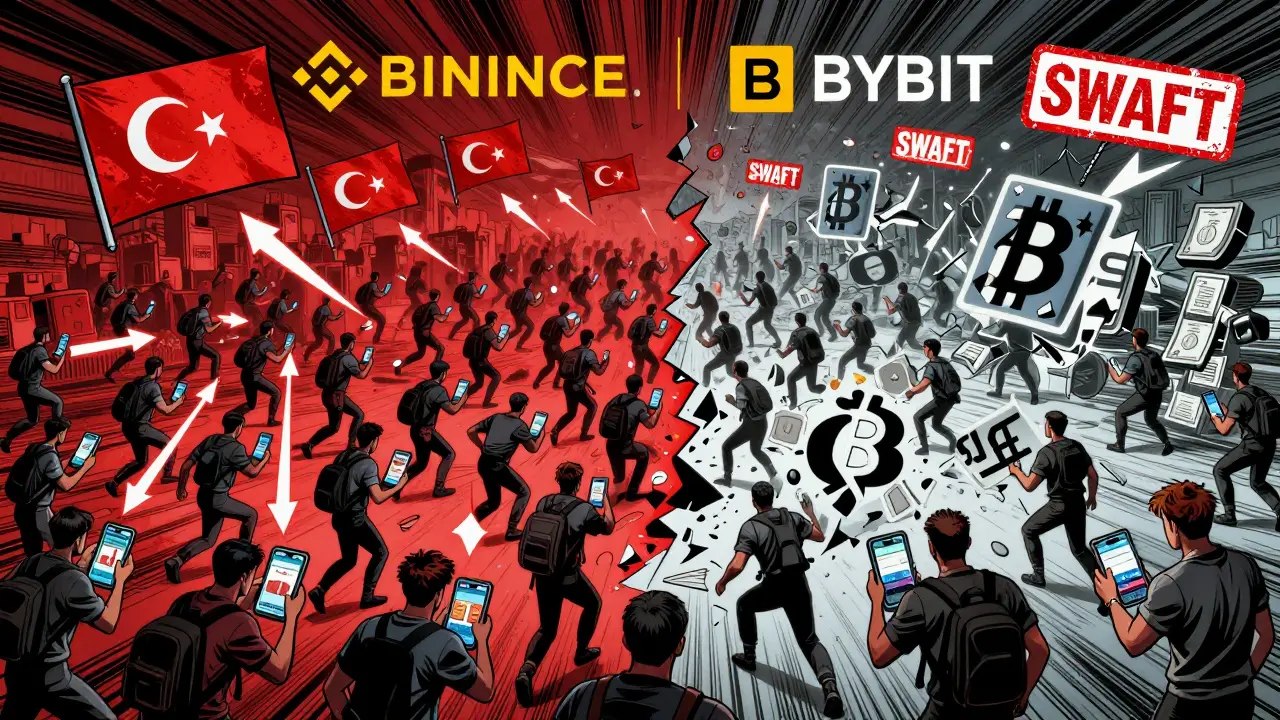
How Iranians Are Adapting-And What It Costs
People have learned to work around the system. Here’s what’s working:- Peer-to-peer (P2P) trading: Platforms like LocalBitcoins and Telegram-based groups let users trade directly. Success rate: 78%. But premiums average 22%-meaning you pay $1.22 for every $1 worth of crypto.
- Decentralized exchanges (DEXs): PancakeSwap and Uniswap are used to bypass KYC. Success rate: 63%. But slippage hits 15% because there’s not enough liquidity.
- Atomic swaps: A few tech-savvy users are using multi-hop atomic swaps to move Bitcoin directly to Turkey or Armenia without touching any exchange. One user reported moving 2.3 BTC to Turkey in 17 minutes. But these methods require technical skill and cost 15-20% in fees.
- Mobile wallets: Trust Wallet and Exodus are the most popular. 92% of Iranian crypto activity happens through them. Average transaction size? Under $1,500. Why? To avoid detection thresholds.
The Halal Stablecoin Experiment-And Why It’s Failing
In August 2025, Iran’s Central Bank launched a gold-backed stablecoin called HSC (Halal Stablecoin). It was supposed to be a bridge to the global economy. In its first month, 4.2 million users transacted $280 million. Sounds promising? But here’s the catch: HSC is trapped inside Iran. No international exchange lists it. No foreign bank accepts it. FATF hasn’t approved its framework. So while Iranians use it to pay for local goods, it can’t help them buy anything from outside the country. KPMG called it "isolated from global liquidity pools." In other words, it’s a digital currency with no international value.The Human Cost: Frozen Accounts, Lost Money, and Broken Trust
In July 2025, a UAE-based exchange called Rain suspended all Iranian accounts after FATF issued a public warning. 317 users lost a combined $4.1 million. Some had been saving for years. Others were paying medical bills. No one was notified. No one was refunded. Telegram channels like @IranCryptoAlert show daily outages. 74% of users report transaction failures between 8-10 PM Tehran time, when the Central Bank throttles internet traffic to block crypto traffic. The government doesn’t ban crypto-it just makes it unreliable. Reddit’s r/CryptoIran has over 12,400 members. In a recent sentiment analysis, 68% of users said exchanges were unreliable. But 82% said crypto was their only option.
Drago Fila
March 6, 2026 AT 07:47It’s wild how a policy meant to stop crime ended up creating a whole underground economy just to keep people alive.
Iranians aren’t trying to game the system-they’re trying to breathe.
Every Bitcoin transaction is a quiet act of resistance.
And honestly? The world needs to see this for what it really is: not a loophole, but a lifeline.
Steven Lefebvre
March 7, 2026 AT 19:07Wait so let me get this straight-FATF says ‘no banking’ and suddenly Iran’s entire population becomes crypto engineers overnight?
That’s not innovation, that’s desperation with Wi-Fi.
Also, 78% Bitcoin? Makes sense. It’s the only coin that doesn’t ask for your firstborn.
Christina Young
March 8, 2026 AT 17:08So you’re telling me the solution to sanctions is using a decentralized ledger that’s been used by ransomware gangs and darknet markets?
Let me know when you want to explain why this isn’t a disaster waiting to happen.
nalini jeyapalan
March 9, 2026 AT 13:06Christina, you’re missing the point entirely.
It’s not about whether crypto is ‘good’-it’s about whether people get to eat.
If you think freezing bank accounts is ethical, maybe you should try living under sanctions for a year.
Then come back and tell me how ‘responsible’ this system is.
Jane Darrah
March 10, 2026 AT 04:29Okay but like… imagine being a mom in Tehran who has to send her kid insulin through a blockchain.
Not because she wants to be a crypto bro, but because the world decided her life is too risky to fund.
And now we’re debating whether Bitcoin is ‘legit’?
Bro.
It’s 2025.
We’ve turned human survival into a compliance flowchart.
And we’re proud of it.
Denise Folituu
March 12, 2026 AT 02:13They say ‘no banks’ and suddenly everyone becomes a crypto hacker.
It’s poetic.
Like a dystopian TED Talk where the only thing keeping people alive is a private key.
And yet, we’re still surprised when the system breaks?
Who designed this? A committee of accountants with no soul?
jack carr
March 13, 2026 AT 21:59You know what’s wild? Not that Iranians use crypto-but that we’re still surprised they do.
When you cut off a river, people dig their own channels.
It’s not rebellion.
It’s biology.
And if you think this is going to stop… you haven’t met a parent who needs medicine.
They’re not ‘adapting’.
They’re surviving.
And we’re watching from our couches.
Eva Gupta
March 14, 2026 AT 03:13As someone from India, I’ve seen how sanctions reshape economies.
But this? This is next level.
People aren’t speculating-they’re trading meals.
And yes, the HSC stablecoin is useless internationally-but at least it’s a start.
Maybe if FATF focused on human impact instead of compliance checkboxes, we wouldn’t be here.
Ken Kemp
March 15, 2026 AT 15:23Man, I just read this whole thing and I’m exhausted.
Imagine having to figure out atomic swaps just to buy your kid’s asthma inhaler.
And then the exchange freezes your account because ‘FATF guidelines’?
That’s not finance.
That’s cruelty with a website.
Also, I typoed ‘wallet’ as ‘walley’-sorry, brain is fried.
Julie Potter
March 17, 2026 AT 11:46So let me get this straight-people are risking arrest, account freezes, and surveillance just to pay for insulin?
And you’re telling me the solution is… more blockchain?
NO.
THE SOLUTION IS TO REMOVE THE SANCTIONS.
NOT TO MAKE PEOPLE INTO TECHNICAL GENIUSES JUST TO STAY ALIVE.
WE’RE TALKING ABOUT HUMAN BEINGS HERE.
NOT NODES.
Leah Dallaire
March 18, 2026 AT 06:31What if this is all a psyop?
What if FATF *wants* Iran to go crypto so they can track every transaction?
What if the real goal isn’t to stop money laundering-but to create a digital surveillance state under the guise of ‘compliance’?
Think deeper.
Who benefits when every Iranian wallet is logged?
Not the people.
Always the system.
prasanna tripathy
March 18, 2026 AT 18:08There’s something beautiful here, honestly.
People who’ve never touched crypto before are now learning how to use DEXs, set up cold wallets, and do P2P trades just to keep their families alive.
This isn’t a tech revolution.
This is a human one.
And we’re all just bystanders watching it unfold.
Let’s not pretend we’re neutral.
James Burke
March 20, 2026 AT 12:06Let’s not romanticize this.
Yes, crypto is a lifeline.
But it’s also unstable, expensive, and dangerous.
People are paying 22% premiums just to move money.
They’re getting their accounts frozen for $1,500 transfers.
And the government is watching every move.
This isn’t freedom.
This is survival under duress.
And we should be screaming about the policy that made this necessary-not the tool they’re using to cope.
Jonathan Chretien
March 21, 2026 AT 20:22It’s almost Shakespearean, isn’t it?
Power tries to control the flow of capital… and the people invent a new one.
Bitcoin becomes the new currency of the oppressed.
Not because it’s perfect.
But because it’s free.
And freedom-even in the smallest form-is the last thing sanctions can take.
Also, 🤝
Bill Pommier
March 21, 2026 AT 20:41While I appreciate the anecdotal evidence presented, the empirical data lacks sufficient statistical rigor to support the assertion that crypto adoption is a direct consequence of FATF policy rather than broader macroeconomic instability.
Furthermore, the reliance on anecdotal Reddit testimonials and unverified exchange data from non-audited platforms introduces significant selection bias.
One must consider the possibility of endogeneity in the relationship between sanctions and crypto usage.
Until peer-reviewed econometric modeling is presented, this narrative remains speculative.
Olivia Parsons
March 22, 2026 AT 03:18Just a quick note: the 63% increase in transaction volume on Nobitex and Wallex? That’s huge.
But what’s not mentioned is how many users are now using mobile wallets without KYC.
That’s the real story.
They’re not avoiding regulation because they’re criminals.
They’re avoiding it because the system is rigged.
And they’re doing it with $1,200 transactions to stay under the radar.
That’s not crypto.
That’s a survival algorithm.
Nick Greening
March 23, 2026 AT 22:31Everyone’s acting like this is a new phenomenon.
It’s not.
Sanctions have been forcing people into gray markets for decades.
From Cuba to North Korea to Venezuela.
Bitcoin just made it faster.
And cheaper.
And harder to track.
So now we’re shocked?
Newsflash: when you cut off a country’s arteries, it finds a new heartbeat.
It’s not crypto’s fault.
It’s yours.
Issack Vaid
March 24, 2026 AT 10:58Let’s be clear: this isn’t about finance.
This is about power.
FATF doesn’t care about money laundering.
They care about control.
And Iran? They refused to kneel.
So they were punished.
And now, the world watches as a nation turns its desperation into code.
That’s not a failure of policy.
That’s a victory of humanity.
And it’s beautiful.
Shawn Warren
March 25, 2026 AT 19:58Iranians using crypto is not a story of innovation
It is a story of failure
Of policy
Of diplomacy
Of the West
Refusing to adapt
And now
People are dying
Because no one had the courage
To change the rules