
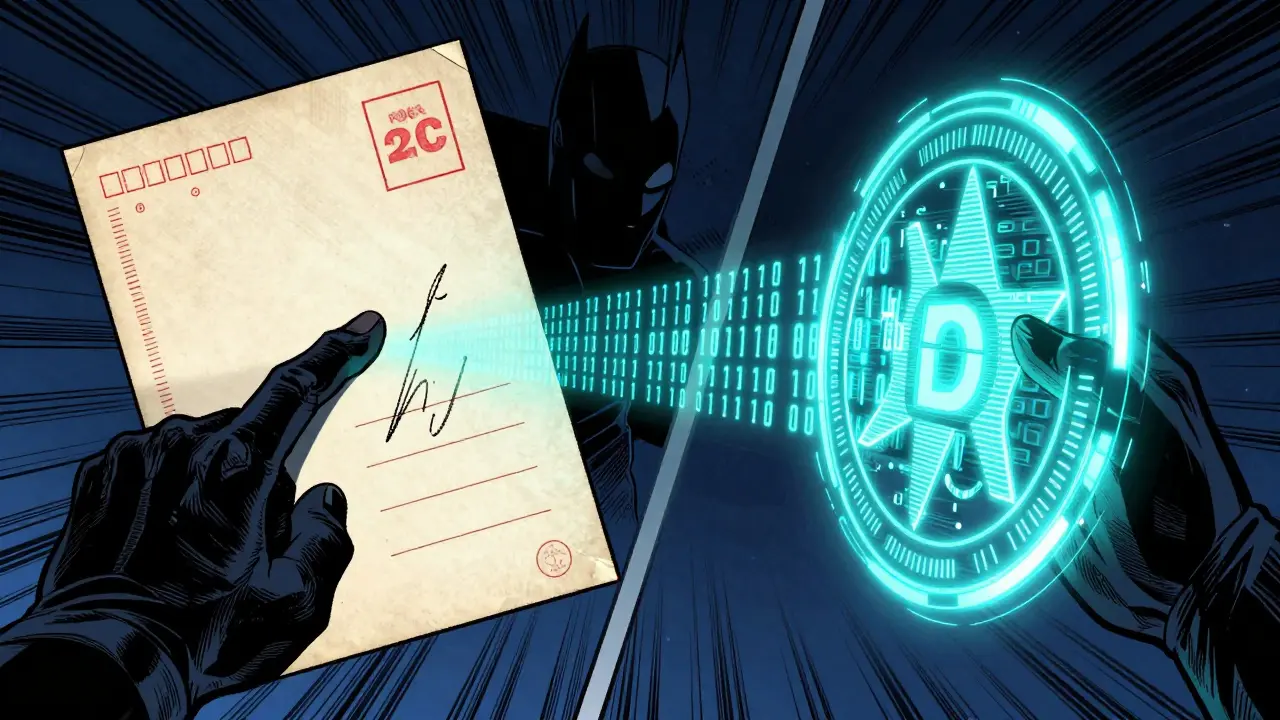
Imagine trying to send a legal contract across the world via a postcard. Anyone could read it, and anyone could scribble a fake signature on it before it reaches the destination. In the digital world, especially with money, that's a nightmare scenario. This is why digital signatures are the unsung heroes of the crypto world. They aren't just "electronic versions" of a pen-and-ink signature; they are complex mathematical proofs that make it impossible for a hacker to spend your funds or change the amount of a transaction while it's traveling across the network.
The Core Logic: Public and Private Keys
To understand how this works, we have to look at Asymmetric Cryptography is a cryptographic system that uses pairs of keys: public keys which may be known by everyone, and private keys which are known only to the owner . Think of it like a mailbox. Anyone who knows your address (the public key) can drop a letter through the slot, but only you have the key (the private key) to actually open the box and take the mail out.
In a blockchain, your Private Key is a secret alphanumeric string that allows a user to access their blockchain funds and authorize transactions . If you lose this, your funds are gone. If someone steals it, they own your money. Your Public Key is like your account number-it's what you give to someone so they can send you Bitcoin or Ether. The magic happens when these two keys interact to create a signature that proves you authorized a spend without you ever having to show the world your secret private key.
How the Signing Process Actually Works
When you click "send" in your wallet, a few things happen behind the scenes in milliseconds. First, the wallet creates a Transaction Hash is a unique digital fingerprint of the transaction data created using a cryptographic hashing function . This hash contains all the details: who is sending, who is receiving, and exactly how much (e.g., 0.002 BTC).
Next, the wallet uses your private key to "sign" that hash. This doesn't just slap a name on the end; it performs a mathematical operation that binds your identity to that specific transaction. If even one character of the transaction data is changed-say, changing 0.002 BTC to 0.02 BTC-the signature becomes invalid immediately. It's like a wax seal that shatters if anyone tries to peek inside the envelope.
| Feature | RSA (Traditional) | ECDSA (Blockchain Standard) |
|---|---|---|
| Key Size | Very Large (e.g., 2048-bit) | Small (e.g., 256-bit) |
| Efficiency | Slower, requires more bandwidth | Fast, highly scalable |
| Security Level | High, but requires huge keys | Equivalent security with smaller keys |
| Primary Use Case | Web SSL/TLS Certificates | Bitcoin, Ethereum, Cardano |
The Heavy Lifter: ECDSA
Most major blockchains, including Bitcoin and Ethereum, rely on the Elliptic Curve Digital Signature Algorithm is a variant of the Digital Signature Algorithm which uses elliptic curve cryptography to provide high security with small key sizes , or ECDSA. Why use this instead of older methods like RSA? Because blockchain networks need to be fast and lean.
Imagine every transaction on the Bitcoin network needing a massive 2048-bit RSA key. The blockchain would grow in size exponentially, and nodes would struggle to keep up with the data. ECDSA allows the network to maintain a massive security wall while keeping the "paperwork" (the transaction size) small. This efficiency is what allows thousands of nodes across the globe to verify millions of transactions without the entire system grinding to a halt.
The Three Pillars of Blockchain Security
Digital signatures don't just stop theft; they provide three specific guarantees that make a decentralized network possible without a middleman like a bank.
- Authentication: It proves you are who you say you are. Because only the owner of the private key could have generated that specific signature, the network knows the transaction is legitimate.
- Integrity: It proves the message wasn't messed with. Since the signature is tied to the transaction hash, any attempt to alter the destination address or the amount would cause the verification process to fail.
- Non-repudiation: This is a fancy way of saying you can't take it back. Once you sign a transaction and it's added to a block, you can't claim you didn't send it. The mathematical proof is permanent.
The Verification Loop: How Nodes Agree
Here is a real-world scenario: Alice wants to send Bob 1 BTC. Alice's wallet signs the transaction using her private key. This signed transaction is then broadcast to the network of Nodes are computers that maintain a copy of the blockchain and validate new transactions .
The nodes don't ask Alice for her private key. Instead, they take the signature, the transaction data, and Alice's public key. They run them through a verification formula. If the math checks out, the node knows Alice definitely authorized the transfer. If a hacker tried to forge Alice's signature, the math simply wouldn't balance, and the nodes would reject the transaction as spam. Only after this verification is a transaction passed to the Miners are participants who group verified transactions into blocks and add them to the blockchain through a consensus process to be permanently etched into the ledger.
Beyond Simple Payments: Smart Contracts and Identity
Digital signatures aren't just for moving coins. They are the trigger for Smart Contracts are self-executing contracts with the terms of the agreement directly written into lines of code . For example, in a multi-signature (multisig) wallet, a contract might require three out of five different private keys to sign a transaction before funds can be released. This is used by companies to ensure no single employee can run away with the treasury.
We're also seeing this evolve into Decentralized Identity. Instead of giving a website your passport or social security number, you can provide a digital signature from your private key to prove you own a certain credential or asset. You prove ownership without actually revealing your sensitive data, which is a huge win for privacy.
Common Pitfalls and Risks
Even though the math of digital signatures is virtually unbreakable, the human element is the weak link. The most common way "digital signatures" are compromised isn't through a flaw in ECDSA, but through private key theft. Phishing sites, fake wallet apps, and unsecured "seed phrases" are how hackers bypass the security. Remember: the signature is secure, but the key that creates it is only as safe as where you store it.
Can a hacker guess my private key to forge a signature?
Mathematically, it's nearly impossible. The number of possible private keys in a 256-bit system is so vast (2^256) that even the world's most powerful supercomputers would take billions of years to guess a specific key by brute force. Your real risk isn't guessing; it's phishing or malware stealing the key from your device.
What happens if I lose my private key?
If you lose your private key, you lose the ability to generate the digital signature required to move your funds. Since there is no "Forgot Password" button on a decentralized blockchain, those funds become permanently inaccessible (often called "burned" coins).
Is a digital signature the same as an electronic signature (like DocuSign)?
No. Electronic signatures are often just a visual representation of a name. Blockchain digital signatures are cryptographic proofs. While DocuSign uses some encryption for audit trails, blockchain signatures are fundamentally tied to the transaction data itself using asymmetric cryptography.
Why is ECDSA preferred over RSA for blockchain?
The main reason is efficiency. ECDSA provides the same level of security as RSA but with much smaller keys. This means smaller transaction sizes, less data for nodes to store, and faster verification times, which is critical for a network scaling to millions of users.
Can someone see my private key if I share my public key?
No. The mathematical relationship between a public key and a private key is a "one-way street." You can easily derive a public key from a private key, but it is computationally impossible to reverse the process and find the private key starting from the public key.
Next Steps for Better Security
If you're worried about the security of your signatures, move away from "hot wallets" (apps connected to the internet) and toward Hardware Wallets. These devices keep your private keys offline, meaning the digital signature is generated inside the device and only the resulting signature is sent to the internet. This prevents malware from ever seeing your private key, ensuring that your digital signatures remain yours and yours alone.
Jason Davis
April 13, 2026 AT 10:08Hardware wallets are def the way to go here. I've seen too many peeple lose their whole portfolio because of a simple phishing link that looked legit. Always double check the adresses before you hit send!
Aaliyah BROTHERS
April 15, 2026 AT 01:43WAKE UP PEOPLE!!! The government is just waiting for the right moment to backdoor these "secure" curves!!! It's all a trap to track every single cent we move!!! Absolute madness!!!!
daniella davis
April 15, 2026 AT 17:48omg please tell me you're not actually trying to explain ECDSA to beginners like this. it's literally so basic that i can't believe anyone finds this a "deep dive" lol. like, maybe try explaining the actual secp256k1 curve if you want to be actually helpful?? just a thought 💅
Samson Selleck
April 17, 2026 AT 07:39The reductionist approach to asymmetric cryptography presented here is frankly tedious. While the mailbox analogy suffices for the layperson, it completely ignores the nuances of the discrete logarithm problem. One must acknowledge that the security of ECDSA relies on the computational hardness of the elliptic curve discrete log problem, which is far more sophisticated than a simple "one-way street." The lack of mention regarding the potential for quantum computing to render these signatures obsolete via Shor's algorithm is a glaring omission. We are discussing the very foundation of trustless systems, yet the discourse remains at a surface level. It is an exercise in futility to discuss blockchain security without addressing the post-quantum cryptographic transition. The asymmetry is not merely about keys, but about the precarious balance between current efficiency and future vulnerability. Only those with a rigorous mathematical background can appreciate the precariousness of this infrastructure. The superficiality of this explanation is almost as offensive as the current state of layer-2 scaling solutions. I find it exhausting to witness such simplistic interpretations of complex modular arithmetic. Truly an amateur hour of a technical breakdown.
7stargee Emmanuel Obani
April 18, 2026 AT 08:02too long didn't read. just use a ledger lol :)
Emily H
April 19, 2026 AT 12:56It is truly commendable that such complex cryptographic principles are being shared in an accessible manner. Ensuring the integrity of decentralized transactions is a vital step toward global financial inclusivity.
Swati Sharma
April 21, 2026 AT 05:34Exactly! Integrating multisig setups really optimizes the trustless architecture by mitigating single-point-of-failure risks in the private key management lifecycle. Total game changer for DAO governance!
Adam Auksel
April 22, 2026 AT 17:37Love the energy here! 🚀 Getting a handle on your own keys is the first step to true ownership. Keep learning, everyone! 💎🙌
jennelle williams
April 23, 2026 AT 20:49simple math keeps us safe
william manes
April 24, 2026 AT 22:20USA first 🇺🇸 Stop trusting these weird curves! Just hold gold! 💰🤡
Tyler Webb
April 26, 2026 AT 13:20I appreciate the reminder about the dangers of hot wallets. Stay safe everyone :)
James Bone
April 27, 2026 AT 23:00Funny how everyone talks about "unbreakable" math until they get phished by a fake airdrop. People are just lazy and pretend the tech is the problem when they're just bad at basic security.
Heather Warren
April 29, 2026 AT 07:43This is a great way to learn the basics. If anyone is confused, just remember that your seed phrase is basically the master key to everything!