
Bitcoin mining isn’t magic. It’s not some mysterious black box controlled by tech elites. It’s a simple, brutal, and brilliant system built on competition, math, and electricity. Every time you send or receive Bitcoin, someone had to verify that transaction. That someone? A miner. And here’s exactly how they do it.
What Bitcoin Mining Actually Does
Bitcoin mining has two jobs. First, it confirms transactions. Second, it introduces new Bitcoin into circulation. These aren’t separate tasks-they’re the same process. Miners bundle up dozens or hundreds of unconfirmed transactions, verify they’re real, and lock them into a block. That block gets added to the blockchain-the public, unchangeable record of every Bitcoin ever sent.
Without mining, Bitcoin doesn’t work. There’s no bank. No central server. No authority. Just a network of computers, all racing to solve the same puzzle. Whoever solves it first gets rewarded. That’s the whole system.
The Proof of Work Puzzle
At the heart of Bitcoin mining is something called Proof of Work (PoW). It’s a way to force miners to do real work before they can add a block. The puzzle? Find a number-called a nonce-that, when combined with the block’s data and run through a mathematical function, produces a hash with a specific pattern.
The function used is SHA-256. It takes any input-whether it’s a word, a sentence, or a whole block of transactions-and turns it into a 64-character string of letters and numbers. It’s one-way: you can’t reverse it. Even changing one letter in the input creates a completely different output. That’s what makes it secure.
The target? A hash that starts with a certain number of zeros. For example: 0000000000000000057e29f1b57c1a9d5b90a6b7f1b4f0c9e2b0a1d3e4f5c6d7. The network doesn’t care what the rest of the hash looks like. It only cares about the leading zeros. The more zeros required, the harder the puzzle.
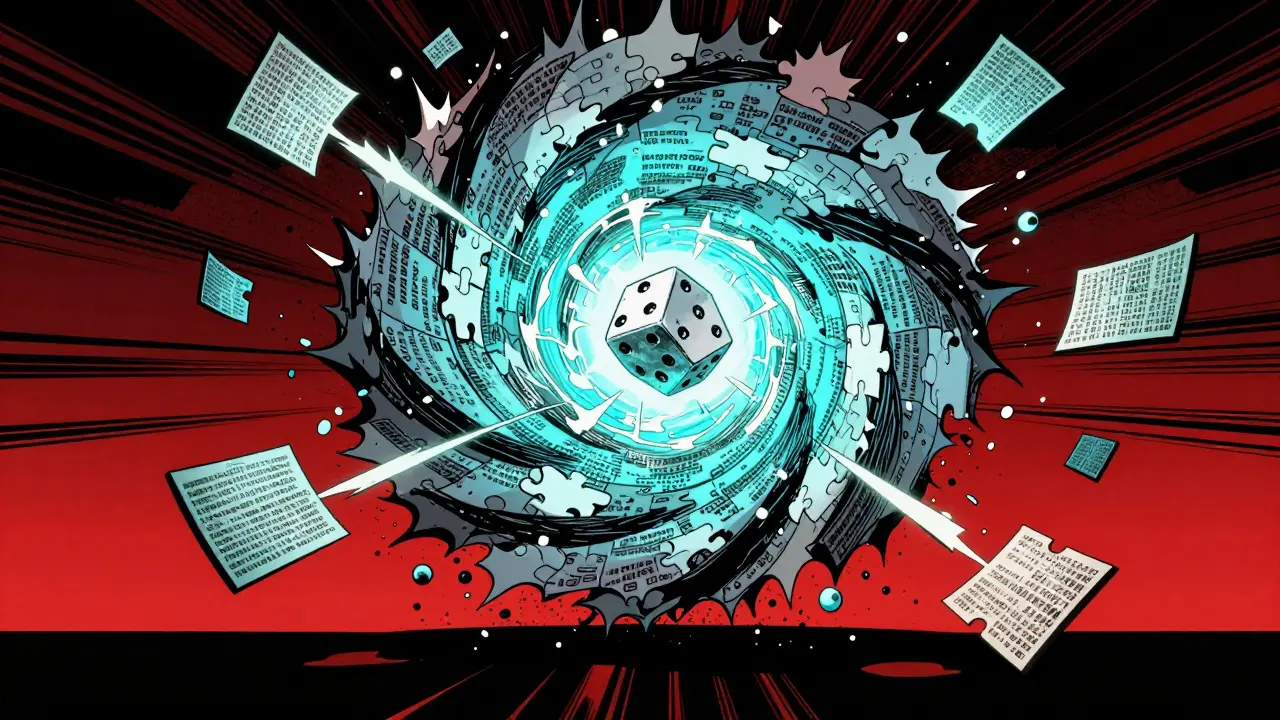
Miners don’t guess the hash. They guess the nonce. They change it over and over-millions of times per second-until the output hash matches the target. It’s like rolling a dice with trillions of sides. You keep rolling until you hit the right number. There’s no trick. No shortcut. Just brute force.
How a Block Is Built
Before mining even starts, miners have to build the block. They pull transactions from the mempool-a temporary holding area for unconfirmed Bitcoin payments. They pick transactions with the highest fees first because those pay more. Then they assemble the block header with five key pieces:
- Previous Block Hash-links this block to the last one, forming the chain.
- Merkle Root-a single hash made from all the transactions in this block. It’s like a fingerprint of the whole set.
- Timestamp-when the miner started working on the block.
- Difficulty Target-how many leading zeros the hash must have.
- Nonce-the number miners change to find the right hash.
Once the header is built, the miner runs SHA-256 on it. If the result doesn’t have enough leading zeros, they change the nonce and try again. This repeats until they get lucky.
Hardware: From CPUs to ASICs
In 2009, Bitcoin mining was done on regular computers. A simple CPU could find blocks. Today? Forget it. The difficulty has increased so much that even the fastest home PC would take centuries to find one block.
Now, mining is dominated by ASICs-Application-Specific Integrated Circuits. These are chips built for one thing only: solving SHA-256 puzzles as fast as possible. Companies like Bitmain and MicroBT produce them. A single ASIC miner today can do over 100 trillion guesses per second. That’s 100 terahashes per second (TH/s).
Miners don’t just buy hardware-they buy power. Electricity costs make or break profitability. A miner in New Zealand might pay 25 cents per kilowatt-hour. One in Kazakhstan might pay 3 cents. That difference decides whether they stay in business.
GPUs and even old CPUs are useless now. The only way to compete is with ASICs. And even then, you need to be in a large operation. Solo mining is nearly impossible. Most miners join pools.
Miner Pools: Why No One Mines Alone
Imagine you’re playing the lottery. The prize is $10 million, but you only have one ticket. Your chances are tiny. Now imagine 10,000 people pool their money, buy 10,000 tickets, and split the prize. That’s what mining pools do.
A mining pool is a group of miners who combine their computing power. When the pool finds a block, the reward is split based on how much work each miner contributed. You might not win big every time, but you get paid regularly-often daily. This smooths out the income and makes mining viable for smaller operators.
Pools like F2Pool, Antpool, and Poolin control most of the network’s hash rate. They’re not controlling Bitcoin. They’re just helping miners earn consistently.
Rewards: Bitcoin and Fees
When a miner successfully adds a block, they get two things:
- New Bitcoin-this is the block reward.
- Transaction fees-the sum of all fees from the transactions in that block.
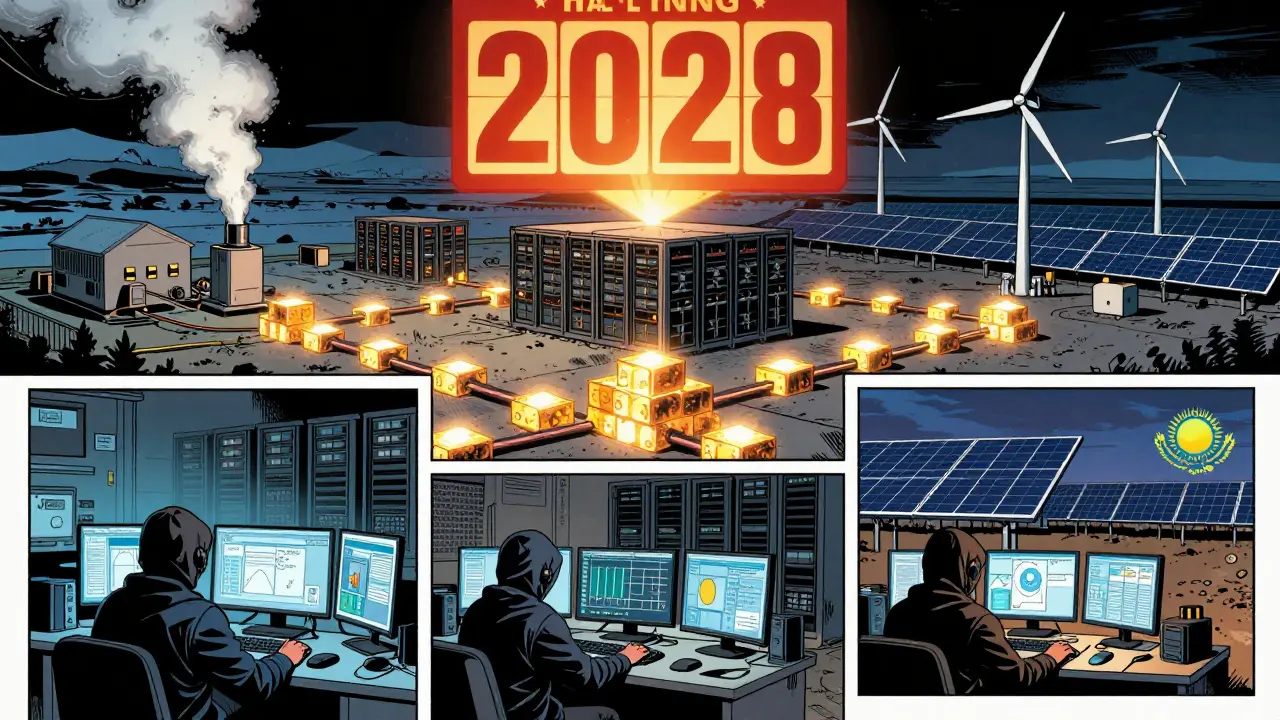
Right now, the block reward is 3.125 BTC. That’s about $200,000 at current prices. But here’s the catch: it halves every four years. This is called the Bitcoin halving. The last one happened in April 2024. The next one is due in 2028. After that, the reward drops to 1.5625 BTC. Eventually, the block reward will hit zero. Then miners will rely entirely on transaction fees.
That’s why fees matter more than ever. As Bitcoin gets busier, users pay more to get their transactions confirmed fast. Miners chase those fees. On busy days, fees can make up over half the reward.
Difficulty Adjustment: Keeping the 10-Minute Clock
Bitcoin’s design is elegant. It doesn’t care how many miners are online. It doesn’t care if 100 people join or 10,000 leave. It adjusts automatically.
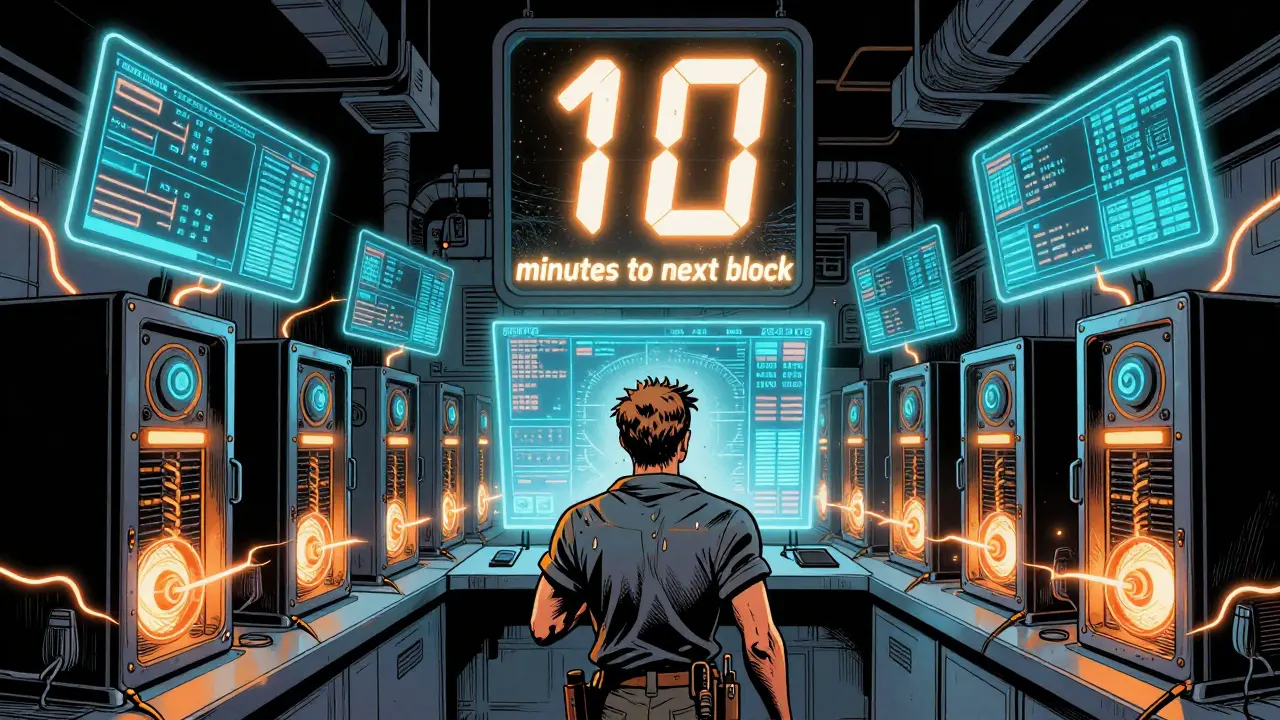
Every 2,016 blocks-roughly every two weeks-the network checks how long it took to mine those blocks. If it took less than 20,160 minutes (14 days), the difficulty goes up. If it took longer, the difficulty drops. The goal? Always 10 minutes per block.
This keeps Bitcoin predictable. No matter how powerful the hardware gets, the system adapts. It’s self-correcting. It’s why Bitcoin has lasted over 15 years without breaking.
Energy and the Environmental Debate
Bitcoin mining uses a lot of electricity. Estimates vary, but it’s likely between 90 and 130 terawatt-hours per year. That’s more than some countries. Critics say it’s wasteful. Supporters say it’s efficient.
Here’s the reality: most mining now uses renewable energy. In 2025, over 60% of Bitcoin mining ran on sustainable power, according to the Bitcoin Mining Council. Miners set up near hydroelectric dams in Canada, geothermal plants in Iceland, or wind farms in Texas. They use stranded energy-power that would otherwise go to waste.
It’s not perfect. But it’s not the villain it’s made out to be. Bitcoin mining doesn’t create demand for new power plants. It uses excess capacity. And it’s one of the few industries that actively seeks out low-cost, clean energy.
Why It Matters
Bitcoin mining isn’t just about making new coins. It’s about security. Every time a miner solves a block, they’re locking the blockchain tighter. The more computing power on the network, the harder it is to attack. To change a past transaction, you’d need to redo every block since then-and outpace every miner on Earth. That’s impossible with current technology.
Miners are the guards of Bitcoin. They don’t get paid to be heroes. They get paid to do the math. But their work is what makes Bitcoin trustless, censorship-resistant, and truly decentralized. Without them, Bitcoin is just a ledger. With them, it’s a revolution.
Can I mine Bitcoin with my home computer?
No. Modern Bitcoin mining requires ASIC hardware. Even the most powerful gaming PC today would take over 100 years to find one block. The network’s difficulty is too high. You’ll spend more on electricity than you’d earn. Mining with a CPU or GPU is a relic of 2009.
How much does it cost to mine one Bitcoin?
It varies wildly. In places with cheap electricity like Iran or Venezuela, it might cost $10,000. In Europe or the U.S., it’s often $25,000-$30,000. That’s because ASICs are expensive, and power bills add up. If Bitcoin’s price drops below your cost to mine, you stop. That’s how the market self-regulates.
What happens when all Bitcoin is mined?
There will never be more than 21 million Bitcoin. The last one is expected around 2140. After that, miners won’t get new coins. But they’ll still earn transaction fees. As Bitcoin becomes more widely used, fees will rise. Miners will still be paid to secure the network-just differently.
Is Bitcoin mining legal?
Yes, in most countries. Some ban it outright-like China (since 2021) or Egypt. Others regulate it, like the U.S. and EU. In New Zealand, it’s fully legal. You just need to pay taxes on mining income and follow energy regulations. Always check local laws before setting up a rig.
Do I need a Bitcoin wallet to mine?
Yes. You need a wallet to receive your mining rewards. Most mining pools let you set your own wallet address. Use a non-custodial wallet-like Electrum or Ledger-so you control your keys. Never let a pool hold your Bitcoin. If they shut down, you lose everything.
Derek Lynch
March 15, 2026 AT 22:13Dionne van Diepenbeek
March 17, 2026 AT 05:31shreya gupta
March 18, 2026 AT 22:02Katrina Smith
March 20, 2026 AT 08:06rajan gupta
March 20, 2026 AT 17:06Billy Karna
March 21, 2026 AT 13:24Lauren J. Walter
March 21, 2026 AT 20:36Jerry Panson
March 23, 2026 AT 17:53Arlene Miles
March 24, 2026 AT 11:03Anastasia Danavath
March 26, 2026 AT 00:37Gene Inoue
March 26, 2026 AT 13:25Ricky Fairlamb
March 27, 2026 AT 07:06Derek Lynch
March 27, 2026 AT 12:06Cheri Farnsworth
March 29, 2026 AT 01:56Carol Lueneburg
March 29, 2026 AT 12:40Jessica Beadle
March 30, 2026 AT 11:05