
Ethereum Gas Fee Calculator
Transaction Cost Estimator
Calculate your estimated Ethereum transaction costs based on network conditions and Layer 2 options
Estimated Costs
Layer 2 solutions reduce costs by bundling transactions off-chain. Fees for mainnet transactions can vary significantly based on network congestion.
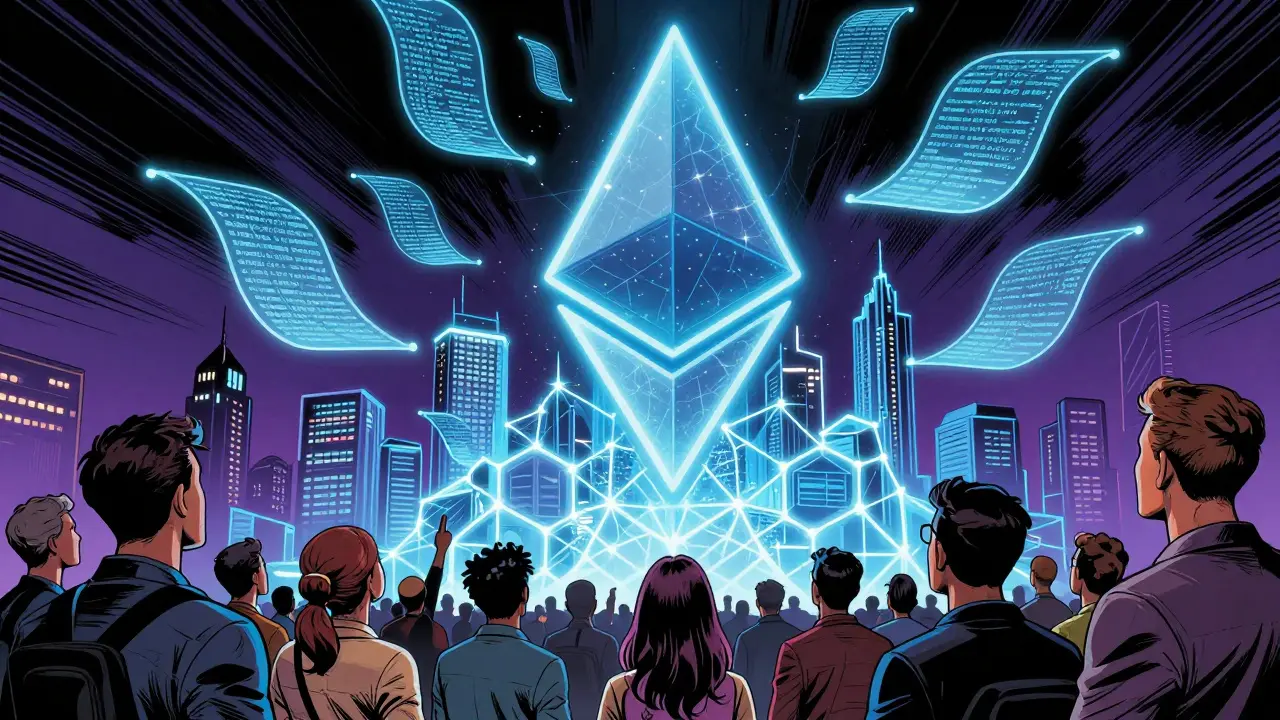
When Bitcoin first came out, it was just a way to send money without banks. But Ethereum changed everything. It didn’t just move coins-it started running programs on the blockchain. These programs, called smart contracts, can do everything from trading tokens to managing loans, voting in organizations, or even storing digital art. By 2025, Ethereum isn’t just one blockchain among many-it’s the foundation for almost every major decentralized application in use today.
What Makes Ethereum Different?
Most blockchains are limited. They can check if a transaction is valid, but that’s about it. Ethereum introduced something revolutionary: a full computer inside the blockchain. This is called the Ethereum Virtual Machine, or EVM. It runs code written in Solidity, a language built for blockchain that feels familiar to web developers. You don’t need to learn assembly or low-level cryptography. If you’ve written JavaScript, you can start writing smart contracts within weeks.That accessibility created a snowball effect. By 2025, over 44 million smart contracts have been deployed on Ethereum. That’s more than all other blockchains combined. These contracts power decentralized finance (DeFi), non-fungible tokens (NFTs), DAOs, and enterprise tools used by Fortune 500 companies. No other platform comes close in terms of real-world usage.
The Shift to Ethereum 2.0
In 2022, Ethereum switched from Proof of Work to Proof of Stake. That meant miners with giant rigs were replaced by validators who lock up ETH to secure the network. The change cut energy use by over 99%. It wasn’t just green-it was smarter. Validators now earn rewards for staying online and following rules, not for brute-force computing.The Shanghai upgrade in 2023 made it even better. Before, if you staked ETH, you couldn’t withdraw it. Now you can. That unlocked billions in locked-up capital and gave users real control over their assets. Today, more than 30% of all ETH is staked. That’s not just participation-it’s commitment.
How Smart Contracts Actually Work
A smart contract is just code stored on the blockchain. Once deployed, it can’t be changed. That’s the point. If you send ETH to a contract that says “pay $100 when the price of Bitcoin hits $70,000,” it will do exactly that-no middleman, no delays, no excuses.Contracts are written in Solidity, compiled into bytecode, and given a unique address. That address is generated using the sender’s wallet and a number called a nonce. The whole thing gets hashed with keccak-256, a cryptographic function that ensures the contract’s identity is fixed forever. Once live, anyone can interact with it. No permission needed.
But mistakes are permanent. In 2023, one developer lost $2.3 million in a single day because of a logic error in their contract. There’s no customer support. No undo button. That’s why testing on testnets like Sepolia is mandatory. You need to simulate real conditions before touching real money.

Gas Fees and Scalability
Ethereum’s biggest complaint? Cost. In 2021, a simple transaction could cost $50. Today, it’s around $1.27. That’s better-but still too high for small payments. Why? Because the base layer can only handle about 1,200 transactions per second. Visa does 7,400.That’s where Layer 2s come in. Platforms like Arbitrum, Optimism, and Polygon sit on top of Ethereum. They bundle hundreds of transactions off-chain, then submit one proof to the main chain. The result? Fees drop to pennies, speeds jump to thousands of transactions per second, and security stays intact because everything still ties back to Ethereum’s main ledger.
By late 2025, over 80% of Ethereum-based activity happens on Layer 2s. That’s not a workaround-it’s the new normal. The upcoming Dencun upgrade in early 2024 will make this even cheaper by introducing proto-danksharding, a way to store data more efficiently. This isn’t theory. It’s already live in test networks.
Token Standards: ERC-20 and ERC-721
Ethereum didn’t just create smart contracts-it created the language for digital assets. ERC-20 is the standard for fungible tokens. That’s what most cryptocurrencies on Ethereum are built on. USDT, USDC, DAI-all ERC-20. You can swap them instantly, use them in lending apps, or stake them for yield.ERC-721 is for non-fungible tokens-unique digital items. That’s how CryptoPunks, Bored Apes, and digital real estate exist. Each token has a unique ID, ownership history, and metadata. These standards are so widely adopted that even non-blockchain companies now use them for loyalty points, event tickets, and digital collectibles.
Who Uses Ethereum Today?
It’s not just crypto natives. JPMorgan runs its own Ethereum-based payment network. The U.S. Treasury has tested tokenized bonds on Ethereum. Walmart uses it to track food supply chains. Even the French government has explored Ethereum for public records.Why? Because it’s transparent, tamper-proof, and global. You don’t need to trust a bank or a government database. You just need to verify the code. And with over 78% of Fortune 500 companies experimenting with Ethereum-based tools, it’s clear: this isn’t a fad. It’s infrastructure.
Competition and Challenges
Solana is faster. Cardano is more formally verified. Polygon is cheaper. But none of them have Ethereum’s network effect. Developers learn Solidity once and can build anywhere. Exchanges list ETH-based tokens by default. Wallets support ERC standards out of the box. That’s the moat.Still, risks remain. Regulatory uncertainty around whether ETH is a security lingers. The SEC hasn’t given a clear answer. Quantum computing could one day break the cryptography Ethereum relies on. And if scalability improvements stall, users might leave for faster chains.
But Ethereum’s roadmap is clear: The Surge, Verge, Purge, and Splurge. These are not buzzwords-they’re technical milestones. Sharding will increase capacity. Code bloat will be cleaned up. User experience will improve. Every upgrade is building toward one goal: 100,000 transactions per second on the base layer, with Layer 2s handling the rest.
Getting Started with Ethereum
If you want to build on Ethereum, start here:- Learn Solidity through Ethereum.org’s free tutorials
- Use Remix IDE to write and test contracts in your browser
- Deploy on Sepolia Testnet using free test ETH from a faucet
- Study real contracts on Etherscan to see how others solved problems
- Once confident, move to a Layer 2 like Arbitrum Nova for low-cost testing
You don’t need a PhD. You don’t need a mining rig. You just need patience, curiosity, and the willingness to learn from mistakes. The tools are there. The community is huge. And the platform? It’s already running the future.
Is Ethereum still the best blockchain for smart contracts?
Yes, as of 2025, Ethereum remains the most widely used and trusted platform for smart contracts. It has the largest developer community, the most mature tools, the highest total value locked in DeFi, and the strongest network effects. While other chains like Solana or Aptos may be faster or cheaper for simple tasks, none match Ethereum’s combination of security, decentralization, and ecosystem depth.
Can I make money just by holding ETH?
Yes, through staking. After Ethereum switched to Proof of Stake, holders can lock up 32 ETH to become validators and earn rewards-currently around 3-5% annually. Smaller holders can join staking pools with as little as 0.01 ETH through exchanges or services like Lido and Rocket Pool. It’s not trading-it’s earning passive income by helping secure the network.
Are Ethereum smart contracts really immutable?
Yes, once deployed, smart contracts cannot be changed. That’s by design. But there are workarounds. Developers often use proxy contracts that point to upgradable logic, or they build in emergency pause functions. Still, the underlying code on the blockchain stays unchanged. Any “fix” requires a new contract and user migration-not a patch.
Why do gas fees vary so much on Ethereum?
Gas fees are determined by demand. When lots of people are trading NFTs or using DeFi apps, the network gets congested, and fees rise. During quiet times, fees drop. The base fee burns a portion of ETH, making transactions deflationary. Layer 2s solve this by handling most activity off-chain, keeping fees low while still benefiting from Ethereum’s security.
What’s the difference between Ethereum and Bitcoin?
Bitcoin is digital cash. Ethereum is a programmable computer. Bitcoin’s scripting language is limited-it can’t run complex apps. Ethereum’s EVM can run any code you write, as long as you pay for the computation. Bitcoin stores transactions. Ethereum runs applications. One is a ledger. The other is a platform.
Is Ethereum safe from hacks?
The Ethereum network itself has never been hacked. But smart contracts built on top of it have-over 100 times since 2016. The blockchain is secure; the code written on it isn’t always. That’s why audits, testing, and using well-vetted libraries like OpenZeppelin are critical. The platform is safe. The apps? You have to check them yourself.
What’s next for Ethereum after 2025?
Ethereum’s roadmap includes full sharding to reach 100,000 TPS, improved data availability layers, and better user interfaces to onboard mainstream users. The goal is to become the underlying infrastructure for everything from global payments to AI agent coordination. If successful, Ethereum won’t just be a blockchain-it’ll be the backbone of the decentralized internet.
Final Thoughts
Ethereum isn’t perfect. It’s slow. It’s expensive. It’s complex. But it’s the only platform that’s proven it can scale, adapt, and attract billions in value over a decade. No other blockchain has built this kind of trust, this many users, this deep a developer base. It’s not just the leading smart contract platform-it’s the only one that matters at scale.Whether you’re building an app, investing in tokens, or just trying to understand the future of the internet, Ethereum is where it’s happening. The rest are trying to catch up.
Annette LeRoux
December 5, 2025 AT 00:06Vincent Cameron
December 5, 2025 AT 23:37Noriko Robinson
December 7, 2025 AT 18:09Yzak victor
December 8, 2025 AT 09:14Holly Cute
December 9, 2025 AT 19:34Josh Rivera
December 10, 2025 AT 01:27Neal Schechter
December 11, 2025 AT 04:43Chris Jenny
December 11, 2025 AT 18:06Thomas Downey
December 13, 2025 AT 09:36Madison Agado
December 15, 2025 AT 08:08Tisha Berg
December 15, 2025 AT 22:23Billye Nipper
December 17, 2025 AT 02:39Roseline Stephen
December 17, 2025 AT 02:50Jon Visotzky
December 18, 2025 AT 03:39Isha Kaur
December 19, 2025 AT 23:40