
You spent months creating that digital artwork. You minted it as an NFT is a non-fungible token representing ownership of a unique digital asset on a blockchain. You watched the price soar in secondary sales. And then you checked your wallet. Zero royalties. This isn’t just bad luck; it’s a systemic failure in how most marketplaces handle creator payments today. The promise of Web3 was that creators would earn automatically from every resale. Instead, many platforms treat royalties as optional suggestions rather than enforceable rules.
The good news? The technology to fix this exists. We are moving past the era where you have to trust a marketplace to pay you. By understanding on-chain royalty enforcement is the process of using blockchain code to automatically guarantee creators receive payments from secondary sales without relying on marketplace goodwill., you can protect your income streams. Whether you are an artist, a musician, or a developer building the next big collection, knowing how these mechanisms work is no longer optional-it’s essential for survival in the current market.
The Standard That Changed Everything: EIP-2981
To understand enforcement, we first need to look at the standard that made on-chain royalties possible: EIP-2981 is an Ethereum Improvement Proposal that defines a standardized method for specifying royalty fees within NFT smart contracts. Before EIP-2981, if you wanted royalties, you had to hardcode them into your specific contract logic, which often meant different marketplaces couldn’t read or respect them. It was a wild west of incompatible systems.
EIP-2981 changed this by introducing a universal language for royalties. It allows any compliant marketplace to query your smart contract and ask, “What percentage should I pay the creator?” The contract responds with the exact fee and the recipient address. This standard supports multiple recipients, meaning you can split royalties between collaborators, stakeholders, or even charity addresses directly in the code.
However, here is the catch: EIP-2981 is a standard, not a law. It tells marketplaces what the fee should be, but it doesn’t force them to pay it. If a marketplace decides to ignore the standard-and many did-you get nothing. This gap between “what the code says” and “what the marketplace does” is where the real battle for enforcement lies.
Blocklists vs. Allowlists: The Creator’s Dilemma
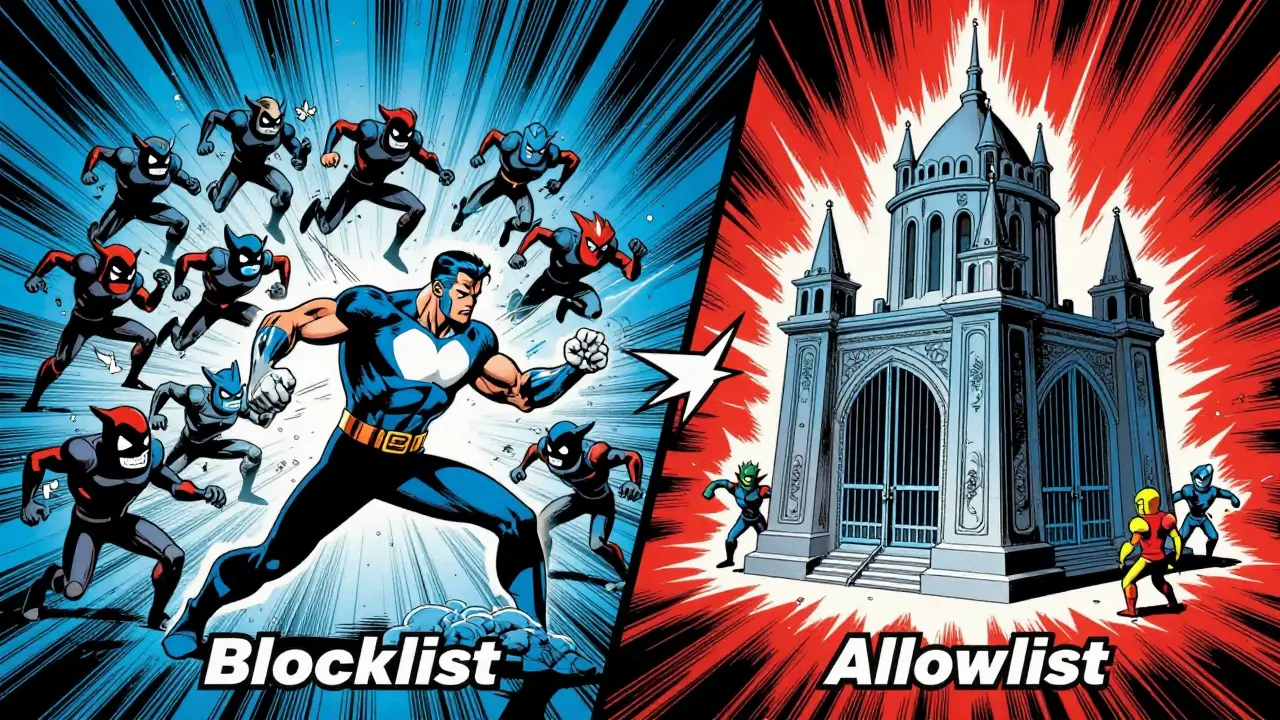
Since marketplaces won’t always play nice, creators have turned to two main technical strategies to enforce their rights: blocklists and allowlists. Both methods modify the smart contract itself to restrict who can buy or sell your NFTs. But they come with very different trade-offs.
Blocklists act like a firewall. You update your smart contract to include a list of specific wallet addresses or smart contracts (like rogue marketplaces) that are banned from interacting with your NFTs. If someone tries to buy your art on a platform that ignores royalties, the transaction fails. The benefit? Your NFT remains tradable on all other major platforms. The downside? It’s a game of whack-a-mole. Bad actors simply create new, unblocked marketplaces. You must constantly monitor the blockchain for new contracts and add them to your list, which requires ongoing technical maintenance.
Allowlists take the opposite approach. Instead of banning the bad guys, you only permit the good ones. Your NFT can only be transferred via specific, pre-approved marketplaces that honor your royalties. This is stricter and more effective at preventing theft. However, it severely limits composability. If a new, innovative platform launches tomorrow, your NFTs can’t be traded there unless you manually update the contract to allow it. This creates friction for buyers and sellers, potentially lowering liquidity and demand for your collection.
| Feature | Blocklist Approach | Allowlist Approach |
|---|---|---|
| Primary Goal | Prevent trading on non-compliant platforms | Restrict trading to compliant platforms only |
| Liquidity Impact | Moderate (most platforms remain open) | High (limits where users can trade) |
| Maintenance Effort | High (must constantly add new bad actors) | Low (only add new trusted partners) |
| Circumvention Risk | Medium (new markets launch frequently) | Low (but off-chain deals still possible) |
| User Experience | Better (fewer restrictions for buyers) | Poorer (buyers may find transactions rejected) |
The Rise of Embedded Blockchain Solutions
Recognizing that application-level fixes (blocklists/allowlists) are flawed, the industry has moved toward embedding royalty enforcement directly into the blockchain layer. This is the holy grail of on-chain enforcement: making royalties impossible to bypass because the network itself enforces them.
In January 2024, the RARI Foundation is a nonprofit organization focused on advancing royalty standards and infrastructure in the NFT ecosystem. launched its mainnet, an Ethereum Virtual Machine (EVM)-compatible chain with royalties embedded into its node software. On this chain, if a transaction attempts to move an NFT without paying the defined royalty, the block itself is considered invalid. No marketplace can opt-out because the consensus layer rejects the transaction.
Similarly, Enjin is a blockchain platform that provides tools for developers to build games and applications with integrated royalty enforcement. released its mainnet with native royalty support. These solutions remove the burden from creators. You don’t need to maintain a blocklist. You don’t need to worry about whether OpenSea or Blur will respect your terms. The protocol handles it.
This shift represents a fundamental change in architecture. Instead of royalties being a feature of the marketplace, they become a feature of the network. For creators, this offers true security. For traders, it ensures a fairer ecosystem where artists are compensated, which ultimately sustains the creative economy.
Marketplace Wars: OpenSea vs. Blur
The tension between creator rights and trader convenience has played out visibly in the marketplace wars. Blur is a professional NFT trading platform known for offering high-speed aggregation and optional royalty settings. positioned itself as a trader-first platform, allowing users to set royalties to zero. This drove massive volume but sparked outrage among creators who saw millions in potential earnings vanish. Data from Nansen showed royalties on Ethereum hitting historic lows in mid-2023 as this trend accelerated.
In response, OpenSea is one of the largest NFT marketplaces, which has implemented tools to enforce on-chain royalties and block non-compliant transfers. introduced features to help creators enforce royalties by integrating blocklist functionality directly into their interface. They also announced plans to block trades from platforms that ignore royalties. This created a fragmented landscape: some places pay you, others don’t. Navigating this requires active management by creators, who must decide where to promote their work and how to protect their assets.
Cross-Chain Challenges and Legal Realities
Enforcement gets even trickier when you leave Ethereum. An NFT minted on Ethereum with EIP-2981 compliance might lose its royalty information when bridged to Solana or Polygon. Different chains use different standards. Without a unified cross-chain protocol, royalties can disappear during transfers. While bridges exist, they don’t always carry over the royalty metadata correctly, leading to lost income.
Legally, things are equally murky. Smart contracts are code, not courts. If a buyer disputes a transfer or a jurisdiction doesn’t recognize digital property rights, enforcing payment becomes difficult. Blockchain anonymity complicates dispute resolution. While on-chain enforcement solves the technical problem, it doesn’t solve the legal one. Creators must still operate within existing intellectual property laws, which vary wildly by country.
Actionable Steps for Creators
If you want to protect your royalties today, you need a proactive strategy. Here is what you can do right now:
- Audit Your Contract: Ensure your NFT uses EIP-2981. If you minted before this standard, consider upgrading your contract or migrating to a newer version that supports it.
- Choose Your Enforcement Model: Decide if you prefer blocklists (more liquidity, higher maintenance) or allowlists (stricter control, lower liquidity). Implement this via a trusted tool or developer.
- Monitor New Markets: Use analytics tools to track new smart contract deployments. If a new marketplace launches that ignores royalties, add it to your blocklist immediately.
- Explore Embedded Chains: Consider minting future collections on chains like RARI or Enjin where royalties are enforced at the protocol level. This removes the need for constant monitoring.
- Communicate Clearly: Inform your community about your enforcement stance. Transparency builds trust and reduces confusion when transactions fail due to blocklists.
Can I enforce royalties on NFTs already minted?
Yes, but it depends on your smart contract. If your contract is upgradeable, you can deploy a new version that includes EIP-2981 or blocklist functionality. If it’s immutable, you cannot change it. In that case, you may need to migrate to a new contract or rely on marketplace-specific enforcement tools.
What happens if a buyer pays the seller off-chain?
If a buyer and seller agree to transfer the NFT for $0 on a compliant marketplace while paying privately, you still lose your royalty. On-chain enforcement cannot stop private agreements. This is why legal frameworks and community norms are important supplements to technical solutions.
Is EIP-2981 supported on all blockchains?
No. EIP-2981 is an Ethereum standard. Other chains like Solana, Polygon, or Avalanche have their own royalty standards or lack standardized support entirely. Always check the documentation for the specific chain you are using.
How do embedded chains like RARI enforce royalties?
Embedded chains include royalty checks in their consensus layer. When a transaction is proposed, the network validates that the correct royalty amount is paid. If not, the transaction is rejected before it is added to the block. This makes bypassing royalties technically impossible on that network.
Do blocklists hurt my NFT’s value?
Potentially. Some buyers may view blocklists as restrictive and avoid purchasing your NFTs due to reduced liquidity. However, many collectors appreciate supporting creators fairly. The impact varies by community and collection reputation.