
Digital Currency Trade-off Calculator
Select your priorities to see how they affect your digital currency experience
Key Takeaways
e-CNY provides seamless integration with China's financial ecosystem but limits privacy. Bitcoin offers global freedom but lacks state-backed convenience. Your choice depends on what matters most: control, privacy, or usability.
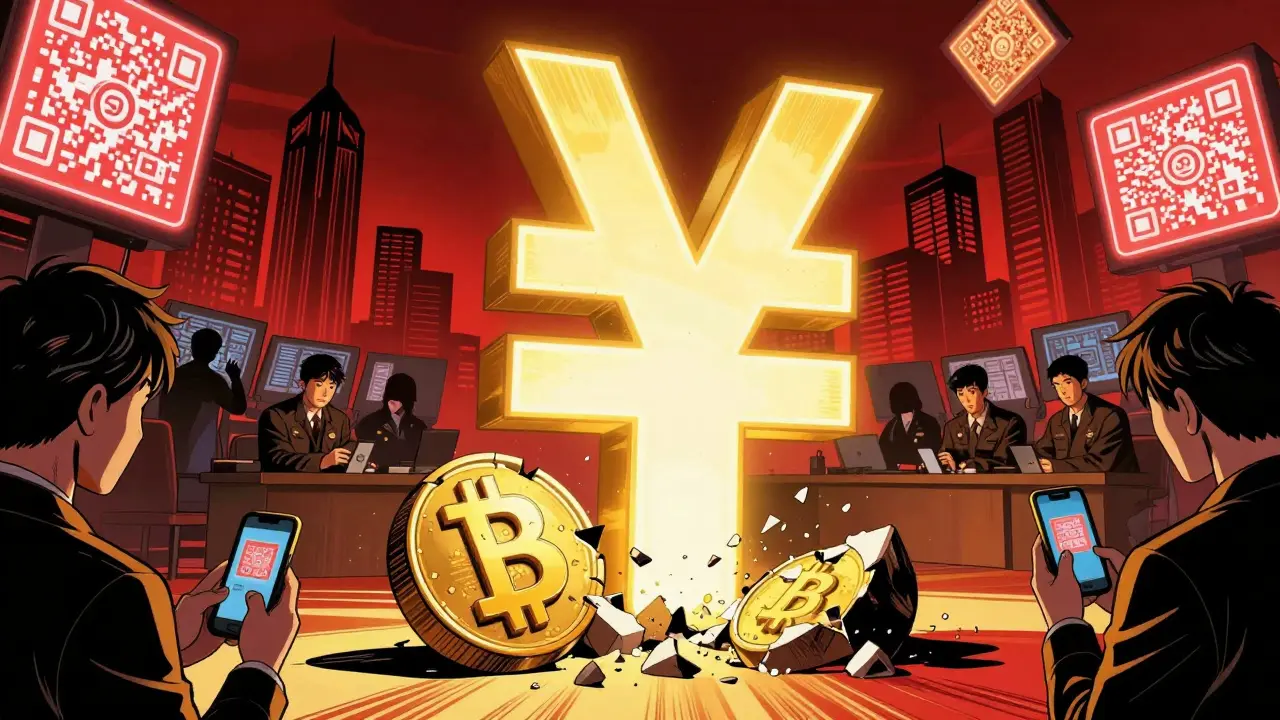
China doesn’t want you to use Bitcoin. Not because it’s too volatile, or too risky, but because it can’t control it. That’s the core of its digital currency strategy - replace decentralized crypto with something the government can track, limit, and steer. The e-CNY, or digital yuan, isn’t just another payment app. It’s the state’s answer to the rise of Bitcoin and other cryptocurrencies, built to make private digital money obsolete inside China’s borders.
What Is the E-CNY, Really?
The e-CNY is not a cryptocurrency. It’s the Chinese yuan, but digital. Issued and managed entirely by the People’s Bank of China, it’s the same money you use to buy noodles or pay rent - just in app form. Unlike Bitcoin, which runs on a public blockchain with no owner, the e-CNY is locked inside China’s financial system. Every transaction is recorded, monitored, and can be paused or reversed by authorities.
By July 2024, over 7.3 trillion yuan ($1 trillion USD) had moved through the e-CNY system. That’s not small change. It’s the daily spending of millions of people - from street vendors to government workers. Cities like Beijing, Shanghai, and Shenzhen have fully integrated it into public transport, utility bills, and even civil servant salaries. You don’t need a bank account to use it. Just download the official app, link your ID, and scan a QR code.
How Bitcoin Works - and Why China Hates It
Bitcoin is the opposite of the e-CNY. It’s decentralized. No bank. No government. No central point of control. Transactions happen peer-to-peer across a global network of computers. The total supply is capped at 21 million coins. That’s intentional. It’s designed to be scarce, like gold, not printed at will by a central bank.
But that’s exactly why China sees Bitcoin as a threat. If people can move money without the state knowing, they can bypass capital controls. They can pay for goods overseas. They can hide wealth from regulators. And if enough people start using it, the yuan loses power. That’s not acceptable in a country where the state controls nearly every financial flow.
Bitcoin’s blockchain is public, yes - but pseudonymous. You can’t easily tie a wallet to a real name unless you use an exchange that requires KYC. The e-CNY? Every user is registered with their real identity. The government sees who you paid, how much, and when.
The Ban: No Mining, No Trading, No Exceptions
Since 2021, China has shut down Bitcoin mining operations - the massive data centers that power the network. Thousands of machines were shut off. Miners fled to Kazakhstan, the U.S., and other countries. In 2023, trading platforms like Binance and OKX were blocked from operating in China. Even peer-to-peer trading through apps like LocalBitcoins is actively monitored and cracked down on.
Law enforcement uses on-chain analytics to track suspicious wallets. If your wallet sends money to a known crypto exchange, or if you use a VPN to access foreign platforms, you could be flagged. The government doesn’t just block websites - it tracks behavior. They watch how often you use crypto apps, how much you transfer, and whether you’re trying to move funds abroad.
China follows the Financial Action Task Force (FATF) Travel Rule. That means every digital wallet must be registered to a real person. No anonymous transfers. No untraceable payments. The goal isn’t just to stop crime - it’s to make crypto useless for everyday life.

Why the E-CNY Wins in China - But Not Everywhere
Inside China, the e-CNY has a huge advantage: convenience. People already use Alipay and WeChat Pay every day. The e-CNY just replaces those apps with a state-backed version. No fees. Instant settlements. Works offline via NFC. Even elderly users who never used crypto adapted quickly.
But outside China? The story changes. Bitcoin has over 580 million users globally. In 2025, crypto trading volume hit $5.4 trillion in the first quarter alone. Institutions like BlackRock and Fidelity now offer Bitcoin ETFs. The e-CNY? It’s mostly domestic. It can’t be exchanged for foreign currencies. It’s not meant for global trade - yet.
China is trying to change that. Through the mBridge project with the Bank for International Settlements, it’s testing cross-border payments between China, Thailand, Hong Kong, and the UAE. The idea? Let countries bypass the U.S. dollar and Western banking systems. Use the digital yuan instead. That’s the real endgame: De-Dollarization 2.0.
Privacy vs. Control: The Trade-Off No One Talks About
Most people in China don’t complain about the e-CNY. They like the speed, the reliability, the discounts. But behind the scenes, the surveillance is total. The government can freeze a wallet if you buy something they don’t like - say, a book from an overseas publisher, or a subscription to a foreign news site. They can limit how much you spend in a day. They can track your spending habits down to the minute.
Compare that to Bitcoin. You can’t be tracked unless you link your wallet to your identity. You can’t be frozen. You can’t be censored. But you also can’t get a refund if you send money to the wrong person. There’s no customer service. No chargebacks. No safety net.
China chose control. Most users don’t mind - for now. But a 2025 survey found that 26% of ETF investors in Greater China still plan to buy crypto ETFs. That’s not a small number. It means people know what they’re missing. They’re just waiting for a loophole.

The Bigger Picture: China’s Global Digital Currency Push
China isn’t just building a digital yuan for its own citizens. It’s building a new financial system for the world - one that doesn’t rely on SWIFT, the dollar, or Western banks.
Through the Belt and Road Initiative, China is pushing e-CNY adoption in countries like Pakistan, Kazakhstan, and across Africa. These nations often have weak financial infrastructure. The digital yuan gives them a ready-made payment system - with strings attached. The data flows back to Beijing. The control stays with China.
Hong Kong, now fully aligned with mainland policy, passed new stablecoin laws in August 2025. All stablecoins tied to the Hong Kong dollar must be fully backed by reserves. That’s a direct jab at unregulated crypto. It’s not about innovation - it’s about control.
Meanwhile, the global stablecoin market is projected to hit $2 trillion by 2028. Illicit crypto laundering hit $21.8 billion in 2024. China uses these numbers to justify its ban. But the truth is simpler: Bitcoin threatens the state’s monopoly on money. And in China, that’s not a risk they’re willing to take.
Can the E-CNY Really Replace Bitcoin?
Inside China? Yes. Already has. Bitcoin is effectively dead there. No mining. No trading. No wallets. No future.
Outside China? No. Not even close. Bitcoin’s global user base is growing. Its market cap sits above $500 billion. It’s held by pension funds, hedge funds, and everyday people who value freedom over convenience.
The e-CNY is a tool of state power. Bitcoin is a tool of individual sovereignty. One is designed to monitor. The other is designed to resist control.
China’s strategy works - for now. But history shows that when you ban something people want, they find a way around it. The e-CNY might replace Bitcoin in China. But it won’t kill Bitcoin globally. It just makes the world more divided.
What Comes Next?
China will keep expanding the e-CNY. More cities. More integration. More international pilots. It will push its model as the "correct" way to do digital money - centralized, traceable, and state-controlled.
Meanwhile, Bitcoin will keep growing in places where freedom matters more than control. The U.S., Europe, Latin America, Southeast Asia - these regions won’t follow China’s lead. They’ll build their own systems, or stick with crypto.
The future isn’t one digital currency. It’s two. One for the state. One for the people. And the world is choosing sides.
Stanley Machuki
December 10, 2025 AT 08:36The e-CNY isn't just digital cash it's digital surveillance with a side of convenience
People in China don't mind because they've never known anything else
But outside? Try telling someone in Argentina or Nigeria they can't use Bitcoin because a government says so
That's not progress that's colonialism with a QR code
Caroline Fletcher
December 11, 2025 AT 08:04They're tracking your noodle purchases now lol
Candace Murangi
December 11, 2025 AT 21:52I remember when people thought the internet would make governments more transparent
Turns out it just gave them better tools to watch us
China's just ahead of the curve
And honestly? Most people there are fine with it
Convenience beats privacy when you're just trying to get through the day
But I get why outsiders panic
We've been sold this myth that freedom means being untraceable
Maybe it just means having options
Lynne Kuper
December 12, 2025 AT 10:27Bitcoin isn't about money it's about refusing to be owned
And China knows that
They're not scared of crypto they're scared of what it represents
People who don't need permission to exist
That's why they're burning mining rigs like they're witchcraft
And yet... still 26% of Chinese ETF investors want crypto
Guess freedom isn't dead yet
Sue Gallaher
December 13, 2025 AT 11:42China is building the future and you people are crying about privacy
Get over it
Our system works
People get paid on time
No crypto scams
No frozen bank accounts from some anonymous guy in the cloud
What's your problem again
Jessica Eacker
December 14, 2025 AT 21:44My grandma uses e-CNY to pay for her medicine
She doesn't care about blockchain or decentralization
She cares that the app works when the power flickers
And that she doesn't have to stand in line at the bank
Maybe the real question isn't control
But who gets to decide what 'freedom' looks like
Kim Throne
December 16, 2025 AT 09:44While the e-CNY is a state-controlled instrument designed to enhance financial oversight and monetary policy implementation
Bitcoin operates as a decentralized asset with a fixed supply mechanism that resists inflationary pressures
These are not merely competing technologies
They represent fundamentally divergent philosophical frameworks regarding sovereignty
One centralizes authority
The other distributes it
The outcome will not be determined by technological superiority alone
But by societal values and the perceived trade-offs between security and autonomy
Ian Norton
December 17, 2025 AT 04:3826% still want crypto
That's not a loophole that's a ticking bomb
China's system is brittle because it relies on compliance
But human beings don't like being told what they can't do
Especially when they know what they're missing
And guess what
They're already finding ways
Just wait till someone cracks offline mesh payments
Then watch the whole house of cards wobble
Andy Walton
December 17, 2025 AT 16:26Imagine if your mom could freeze your wallet because you bought a book about democracy 😭
That's not a currency that's a parent who never lets you grow up
And yet... I get it
Some people need that safety net
But why does the whole world have to live in their kindergarten?
Bitcoin is the middle finger to control
And I'm not sorry
❤️🔥
John Sebastian
December 18, 2025 AT 03:49It's fascinating how quickly people accept surveillance when it's wrapped in convenience
China didn't have to force this
They just made it easier
And now no one remembers what they gave up
It's not evil
It's just efficient
And that's the scariest part
Jeremy Eugene
December 18, 2025 AT 20:01The comparison between e-CNY and Bitcoin is not merely technical but ideological
One represents the consolidation of state authority over economic activity
The other embodies the libertarian ideal of financial self-sovereignty
Neither is inherently superior
Each reflects the values of the society that birthed it
The challenge lies not in which system prevails
But whether humanity can tolerate coexistence between these opposing paradigms
Nicholas Ethan
December 19, 2025 AT 12:07China's digital currency strategy is a masterclass in statecraft
They didn't ban Bitcoin they made it irrelevant
By offering a better alternative wrapped in control
They didn't need to fight ideology
They just made the alternative unappealing
That's not oppression
That's strategic dominance
And the West is still asleep
Kathy Wood
December 20, 2025 AT 08:25They're watching EVERYTHING!!!
Who decides what you can buy???
What if you want to read something they don't like???
It's DYSTOPIA!!!
They're turning China into a giant phone app with no escape!!!
And people are just... OK with it???
WHAT IS HAPPENING TO THE WORLD????
Toni Marucco
December 22, 2025 AT 06:23The e-CNY is not the end of Bitcoin
It's the beginning of a new kind of financial cold war
One where the battlefield isn't territory or weapons
But the architecture of trust
China is betting that efficiency and control will win
But Bitcoin's believers are betting that autonomy and resilience will outlast
History doesn't favor the most powerful state
It favors the most persistent idea
And right now
There are two ideas
And the world is choosing