
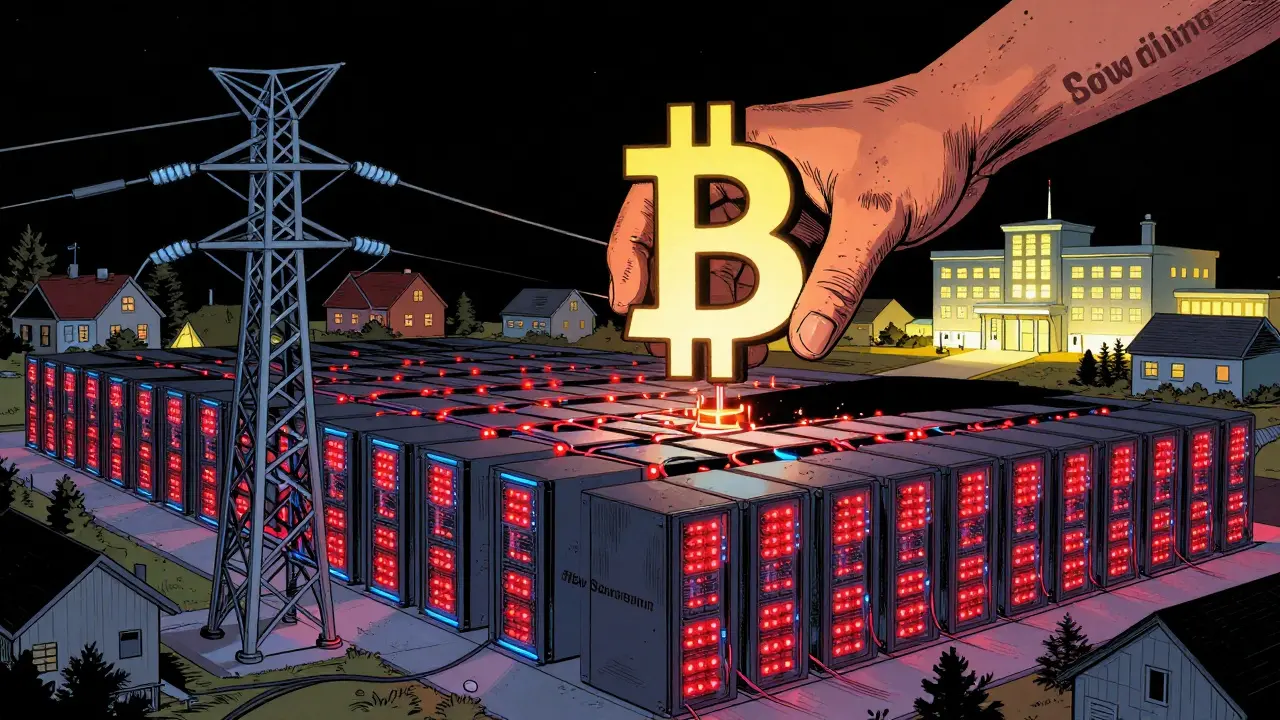
When New Brunswick put a stop to new cryptocurrency mining operations in 2023, it wasn’t just shutting down a trendy industry-it was protecting the province’s entire electricity system. The move didn’t come out of nowhere. It was the result of years of rising demand, growing pressure on the grid, and a clear choice: prioritize homes and hospitals over Bitcoin mines.
How the Moratorium Started
The ban didn’t happen overnight. It began on March 1, 2022, when the provincial government ordered NB Power, the Crown-owned utility, to stop accepting new electricity requests from crypto mining companies. At first, it was called a "pause." But by November 2023, that pause became a full moratorium. No new connections. No expansions. No exceptions. This wasn’t about stopping small-time miners with a few rigs in their garage. This was about stopping industrial-scale operations that could pull hundreds of megawatts of power-enough to light up entire towns. One estimate showed that if every crypto company that had asked for power in the previous 16 months got connected, it would have added 4,600 megawatts to Manitoba’s grid. That’s more than two-thirds of the province’s total capacity at the time. New Brunswick faced the same threat. NB Power now refuses to give any new crypto mining facility access to the grid. Even existing operations can’t increase their power usage. If you’re a miner in New Brunswick, you’re stuck at your current level-no growth, no upgrades.Why Electricity Is the Issue
Crypto mining, especially Bitcoin mining, uses Proof of Work. That means computers solve complex math problems nonstop, 24/7. Each machine draws as much power as a small refrigerator. When you put thousands of them together in a warehouse, you’re talking about power use that rivals a small city. In New Brunswick, nearly all electricity comes from hydroelectric dams. Clean, renewable, and limited. The province doesn’t have extra capacity to spare. Adding crypto mines meant one thing: higher bills for everyone else. Think about it. If a mining farm uses 50 megawatts, that’s enough to power 40,000 homes. Who pays for that? Ratepayers. And when utilities are forced to buy more power or upgrade infrastructure just to keep mines running, those costs get passed on. That’s why NB Power and the provincial government drew the line.How This Compares to Other Provinces
New Brunswick isn’t alone-but it’s one of the strictest. - Manitoba paused new connections in late 2022 and extended the ban until April 2026. They’re watching, but they might reopen. New Brunswick hasn’t said when-or if-they’ll change course. - British Columbia passed a law in 2023 (Bill 24) that lets BC Hydro limit power to crypto miners. They even won a court case against a company trying to get 2.5 million megawatt-hours of power. The court agreed: public interest comes first. - Hydro-Québec raised rates for miners and capped their usage. They didn’t ban them outright, but they made it expensive. - Alberta is the opposite. With deregulated power and a pro-mining government, it’s become Canada’s crypto mining hotspot. Companies are moving there fast. New Brunswick’s approach is the most final. No end date. No review schedule. Just a hard stop.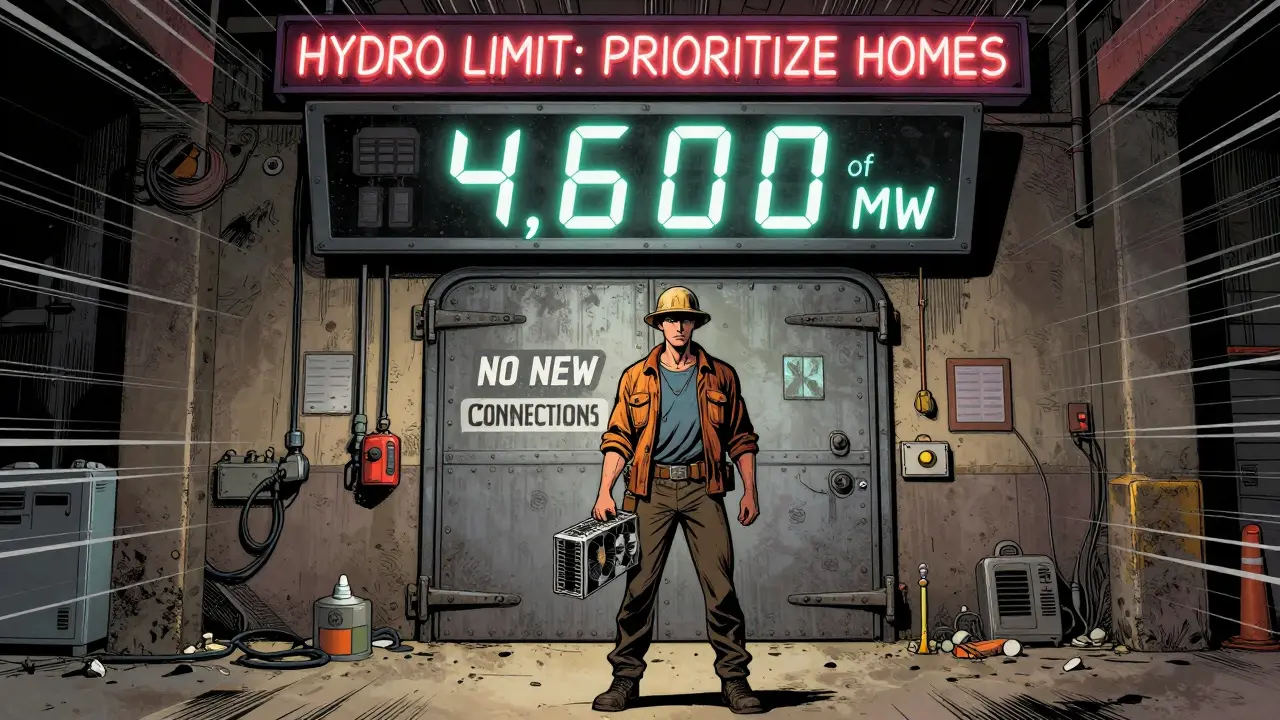
What’s Happening to Miners Now?
Miners who were already operating before the ban can keep going-but they can’t grow. If your facility runs on 10 megawatts, you’re stuck at 10. No more machines. No new cooling systems. No expansion. New applicants? Denied. Full stop. That’s forced companies to look elsewhere. Alberta is the main winner. Texas, too. Even parts of the U.S. Midwest are seeing a surge in mining operations because they offer cheap power and no restrictions. Some miners tried to argue they could use renewable energy or backup generators. But NB Power doesn’t care. The rule is simple: if you’re mining crypto, you can’t connect to the provincial grid-no matter how "green" you claim to be.Environmental and Economic Impact
The moratorium isn’t just about electricity bills. It’s about priorities. Governments are starting to ask: Should we use our clean energy to power Bitcoin machines-or electric buses, heat pumps, and EV chargers? The answer, in New Brunswick, is clear. China banned crypto mining in 2021 and shut down nearly 75% of the world’s Bitcoin operations overnight. Canada’s provinces are now doing the same thing, just slower. The global trend is shifting. Countries are realizing that mining Bitcoin with fossil fuels or strained grids doesn’t make sense anymore. New Brunswick’s move is a signal: if your business uses more power than a town, and there’s no clear public benefit, you don’t get access.
Will the Ban Last?
Right now, there’s no plan to lift the ban. No committee. No timeline. No public review. That’s unusual. Most government bans come with a review date. New Brunswick didn’t do that. That tells you something: they don’t see crypto mining as a temporary issue. They see it as a threat to long-term grid stability. If electricity demand keeps rising because of EVs, home electrification, and industrial growth, adding crypto mines will become even less acceptable. The province’s energy plan is focused on reliability and affordability-not catering to a volatile, energy-hungry industry.What This Means for the Future
New Brunswick’s moratorium is a blueprint. Other provinces are watching. If New Brunswick’s grid stays stable and rates don’t spike, other regions may follow. It also shows that regulation doesn’t always come from federal laws. Sometimes, it comes from a single utility company-and a government that tells it to say no. For miners, the message is clear: if you need cheap, abundant electricity, go somewhere else. New Brunswick won’t be that place. For residents, it means peace of mind. Their lights won’t go out because a mining farm took too much power. Their bills won’t jump because a handful of companies demanded more than the grid could handle. This isn’t a ban on technology. It’s a decision about who gets to use the power we all share.Is crypto mining completely banned in New Brunswick?
Yes-for new operations. Existing crypto mining facilities that were connected before November 2023 can still operate, but they cannot expand their electricity use. No new mining operations can connect to the NB Power grid at all.
Why did New Brunswick ban crypto mining?
New Brunswick banned new crypto mining operations because large-scale mining farms were demanding massive amounts of electricity-enough to risk grid instability and raise power bills for homes and businesses. The province relies on hydroelectric power, which has limited capacity, and officials decided to protect public energy needs over energy-intensive mining.
Can crypto miners use renewable energy or generators to bypass the ban?
No. The moratorium applies regardless of how the power is generated. Even if a mining operation uses solar panels or diesel generators, it cannot connect to NB Power’s grid. The ban is about grid access, not energy source.
What happens if a mining company tries to connect illegally?
NB Power monitors connections closely. Any unauthorized connection would be shut down immediately. Companies that attempt to bypass the ban risk legal action, fines, and permanent disconnection. Enforcement is strict.
Are other Canadian provinces doing the same thing?
Yes, but differently. Manitoba has a pause until 2026. British Columbia limits power through law. Hydro-Québec raised rates and capped usage. Only Alberta actively encourages mining. New Brunswick’s ban is the most permanent and comprehensive.
Could the ban be lifted in the future?
There is no official plan to lift the ban. The government has not set a review date, and officials have not indicated any intention to change the policy. Unless electricity supply expands dramatically or mining technology becomes far more efficient, the moratorium is likely to remain indefinitely.
JOHN NGEH
March 22, 2026 AT 13:01Just think about it - we’re talking about using clean hydro power to run machines that exist purely to validate digital ledgers. Meanwhile, rural schools in NB can’t afford new HVAC systems. This isn’t anti-tech - it’s pro-common-sense.
My cousin runs a solar farm in Maine. He told me they turned away three crypto firms last year. Same story. Energy isn’t infinite. Priorities matter.
Justin Credible
March 23, 2026 AT 02:23frankly i dont get why people are shocked. if your rig is using more power than my whole block, you dont get to be here. nb did the right thing. period.
Nicolette Lutzi
March 23, 2026 AT 19:57oh so now the government’s the bad guy for protecting the grid? lol. next they’ll ban people from using air conditioners because ‘it’s too much power’. this is just the start of the crypto crackdown. mark my words - they’re coming for your mining rigs next. #govtcontrol
Domenic Dawson
March 23, 2026 AT 23:15I’ve been following this since the pause in 2022. What’s wild is how many people still think mining is some kind of innovation. It’s not. It’s a power-hungry lottery with zero social return.
My buddy used to run a 2MW facility in Fredericton. He switched to Alberta last year. Said the vibe there is ‘go big or go home’ - no questions asked. Meanwhile, NB’s grid is stable, rates haven’t spiked, and kids aren’t freezing in winter. That’s a win.
Sam Harajly
March 25, 2026 AT 10:11It’s interesting how the same people who champion renewable energy often ignore the fact that crypto mining isn’t renewable - it’s just a different kind of consumption. Hydro isn’t infinite. It’s finite, managed, and shared. When you prioritize speculative mining over basic infrastructure, you’re not being pro-innovation - you’re being pro-risk.
Alice Clancy
March 26, 2026 AT 10:32americans are so weak. we let china take over mining and now we’re whining because canada says no. get over it. nb did what america should’ve done years ago. stop the madness. #makecanadagreatagain
Dominic Taylor
March 26, 2026 AT 18:04From a grid resilience standpoint, this is textbook demand-side management. The marginal cost of incremental mining load far exceeds the marginal benefit - especially when you factor in opportunity cost of displaced residential/commercial load. NB Power’s decision aligns with ISO 50001 principles for energy efficiency prioritization.
Neil MacLeod
March 27, 2026 AT 05:59They didn’t ban mining. They banned stupidity. Imagine if every town in NB had a warehouse full of ASICs running on the same grid that powers hospitals and fire stations. This isn’t regulation - it’s basic public safety. The fact that people still defend this is why we’re in trouble.
kavya barikar
March 27, 2026 AT 18:44Electricity is a public good. Not a commodity for private profit. New Brunswick chose people over profit. Simple. Wise.
aravindsai pandla
March 28, 2026 AT 12:44This decision reflects long-term thinking. Many countries chase short-term gains. New Brunswick chose sustainability. That is leadership.
namrata singh
March 30, 2026 AT 05:28I just cried reading this. My grandma in Miramichi gets her oxygen machine from the grid. I can’t imagine her life if a mining farm took her power. This isn’t about Bitcoin. It’s about dignity. It’s about not letting greed win.
Andrea Zaszczynski
March 30, 2026 AT 21:54Wait, so if I install solar panels on my roof and mine crypto, I can still connect? Like… what if I use my own power? They can’t stop me, right? I mean, it’s my property, right? I’ve got 12 rigs and a Tesla Powerwall. This is censorship.
Cordany Harper
April 1, 2026 AT 14:16As someone who’s lived in Alberta and now in NB - the contrast is insane. In Calgary, every warehouse is a mining farm. Here? People actually talk to each other. The lights stay on. The bills stay steady. I don’t miss the chaos. NB got it right.
DarShawn Owens
April 2, 2026 AT 08:42Love how this isn’t about hating tech - it’s about not letting tech hurt real people. My sister works at a hospital in Saint John. She said last winter, they had to cut non-emergency power for a week because of grid stress. That’s the real cost. This ban saved lives.
Andy Green
April 3, 2026 AT 10:58Oh wow, so now we’re supposed to trust ‘the government’ to decide who gets power? This is just step one. Next, they’ll ban your crypto wallet. Then your phone. Then your internet. They’re coming for your freedom. This isn’t about electricity - it’s about control. Wake up, sheeple.
Zion Banks
April 3, 2026 AT 23:55They’re not banning mining. They’re banning competition. The real reason? The grid is owned by a government entity that’s scared of private innovation. And guess what? The Feds are in on it. They’re scared crypto will expose how rigged the whole system is. This is a power grab. Mark my words - the truth will come out. #DeepState