
Why Privacy Coins Matter in 2025
If you’ve ever used Bitcoin, you’ve already left a public trail. Every transaction, every wallet address, every amount - it’s all visible to anyone with a blockchain explorer. That’s not a bug. It’s how Bitcoin works. But what if you don’t want strangers, advertisers, or even governments tracking your spending habits? That’s where privacy coins come in. They don’t just hide your balance. They make it impossible to trace who sent what, to whom, and when.
Unlike Bitcoin, where you can look up any address and see its entire history, privacy coins use advanced math to break those links. Ring signatures. Zero-knowledge proofs. Stealth addresses. These aren’t buzzwords. They’re the tools that make true anonymity possible on a public ledger.
And in 2025, with surveillance capitalism rising and financial tracking tools becoming more powerful, privacy isn’t just for criminals. It’s for parents buying school supplies, freelancers receiving payments, activists in restrictive countries, and anyone who wants to keep their finances private - legally.
Monero (XMR): The Gold Standard
Monero is the only privacy coin that makes anonymity mandatory. Not optional. Not a setting you have to turn on. Every single transaction on the Monero network is private by default. No exceptions. That’s why it’s still the most trusted privacy coin in 2025.
Here’s how it works: When you send XMR, Monero uses three layers of protection. First, ring signatures mix your transaction with five or more decoy inputs from other users. To an outsider, it looks like any one of them could be the real sender. Second, stealth addresses generate a one-time address for each transaction so the recipient’s real wallet never shows up on the blockchain. Third, RingCT hides the amount being sent. No one - not even the receiver - can see how much was transferred unless they’re the intended party.
Monero doesn’t need special hardware to mine. You can mine it on an old laptop or even a smartphone. That keeps the network decentralized and resistant to corporate mining farms. It also means no single group controls the majority of hashing power.
Wallets like Feather and Monero GUI are simple to use and come with Tor integration built-in. You don’t need to be a tech expert to stay anonymous. Just send and receive. Everything else happens automatically.
Zcash (ZEC): Privacy You Can Toggle
Zcash is different. It’s a fork of Bitcoin that gives you a choice: public or private. That flexibility is great for businesses or users who need to comply with regulations - but it’s also its biggest weakness.
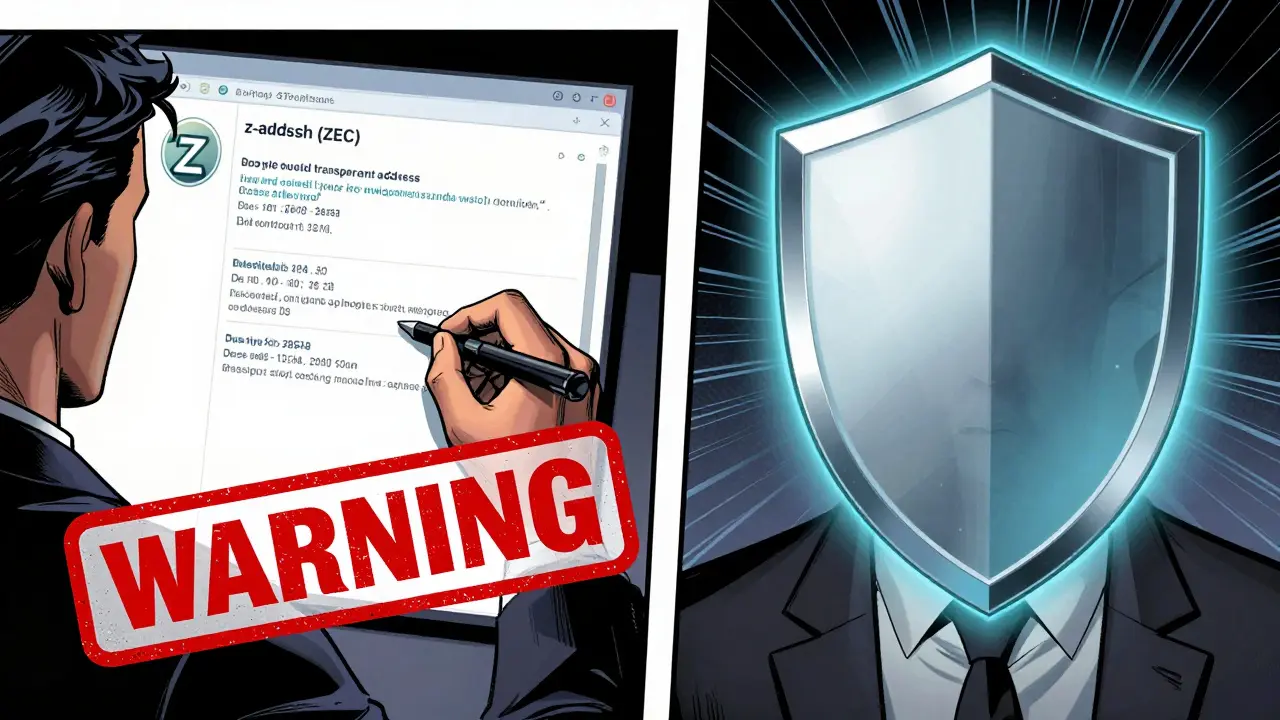
Zcash uses zk-SNARKs, a type of zero-knowledge proof that lets the network verify a transaction without revealing the sender, receiver, or amount. When you use a shielded address (starting with ‘z’), your transaction is completely hidden. But if you use a transparent address (starting with ‘t’), it’s just like Bitcoin - fully visible.
The problem? Most users don’t know the difference. Many exchanges default to transparent addresses. Wallets often don’t make shielded transactions easy. As a result, a large portion of ZEC transactions are public. That means if you’re relying on Zcash for privacy, you have to be careful. One mistake, and your history is exposed.
Still, Zcash is the only major privacy coin that works with some regulated platforms. That’s why institutions and compliance-focused users still use it. Just don’t assume your transactions are private unless you actively choose shielded mode.
Firo (FIRO): Erasing Your Transaction History
Firo doesn’t just hide your transactions. It erases them. Its Lelantus Spark protocol lets you take your old coins and ‘burn’ them - then receive brand-new ones with no link to your past activity. Think of it like taking cash to a bank, having them destroy your bills, and giving you fresh ones from their vault. No one can trace those new bills back to you.
This is a major upgrade over older privacy coins that only mask transaction details. Firo breaks the chain entirely. Even if someone tracked your wallet for months, once you use Lelantus Spark, that history is gone.
Firo also uses Dandelion++ to hide your IP address when broadcasting transactions. That means even if someone monitors the network, they can’t tell where the transaction came from. It’s not just about the blockchain - it’s about the network too.
And unlike Monero, Firo supports masternodes for faster confirmations. That makes it more usable for everyday payments. If you want true anonymity without the complexity of Monero, Firo is one of the cleanest options in 2025.
Dash (DASH): Fast Payments, Optional Privacy
Dash started as a Bitcoin alternative for fast, low-cost payments. Privacy came later. Its CoinJoin implementation, called PrivateSend, mixes your coins with others to obscure the trail. But here’s the catch: you have to pay extra fees to use it. And it’s not automatic.
Dash’s privacy isn’t as strong as Monero’s. CoinJoin only works if enough users participate at the same time. If the network is quiet, your mix might be weak. Plus, the blockchain still shows transaction amounts and addresses - just not perfectly linked.
Dash is best if you care more about speed than total anonymity. Its InstantSend feature confirms transactions in under two seconds. That’s useful for buying coffee or paying a freelancer. But if your goal is to stay completely off the radar, Dash falls short.
Horizen (ZEN): Privacy for Businesses
Horizen isn’t just a privacy coin. It’s a platform. Built on Zcash’s zk-SNARK tech, Horizen lets developers create custom blockchains - called sidechains - that can be private, public, or hybrid. That makes it popular with enterprises needing confidential supply chain records, voting systems, or secure financial ledgers.
For regular users, Horizen offers ZEN tokens with shielded transactions. But the real power is in its scalability. While Monero handles about 18 transactions per second, Horizen’s sidechain architecture can support tens of thousands. That’s why banks and governments are testing it.
But here’s the trade-off: Horizen’s complexity makes it less user-friendly. You won’t find a simple wallet for everyday use. It’s designed for developers and institutions, not casual users.
Verge (XVG): Privacy Through the Network
Verge doesn’t hide your transaction details on the blockchain. Everything is visible. But it hides your IP address using Tor and I2P networks. That means if someone is watching the network, they can’t link your transaction to your location.
This approach is simple and effective for avoiding geo-tracking. But it doesn’t stop blockchain analysis. If you send 10,000 XVG to one address, anyone can see it. They just don’t know it was you.
Verge is the most basic privacy solution on this list. It’s good if you’re worried about your location being exposed - like if you’re in a country where crypto use is monitored. But if you want real financial anonymity, Verge won’t cut it.
What About Worldcoin?
Worldcoin isn’t a privacy coin. It’s an identity project. It uses zero-knowledge proofs to verify you’re a real human - without revealing who you are. That’s useful for preventing bots and fraud. But it doesn’t hide your transactions. If you send WLD, the amount and addresses are public.
Don’t confuse identity privacy with transaction privacy. They’re not the same thing.
How to Choose
Here’s a quick guide:
- Want total, automatic anonymity? Use Monero. No setup. No choices. Just privacy.
- Need to comply with regulations or use exchanges? Use Zcash - but only if you know how to use shielded addresses.
- Want to erase your past transaction history? Try Firo.
- Need fast payments with some privacy? Dash works, but don’t rely on it for secrecy.
- Worried about your IP being tracked? Verge helps, but it’s not enough alone.

Wallets That Protect You
Using a privacy coin doesn’t mean anything if your wallet leaks data. Here are the best wallets in 2025:
- Monero: Feather Wallet (lightweight, Tor-enabled) or Monero GUI (full-node, maximum privacy)
- Zcash: ZecWallet (supports shielded transactions)
- Firo: Firo Wallet (official, supports Lelantus Spark)
- Dash: Dash Core Wallet (has PrivateSend option)
- Bitcoin users wanting privacy: Sparrow Wallet with Whirlpool CoinJoin
Always enable Tor in your wallet settings. And never reuse addresses. Even with privacy coins, reusing an address can create weak links.
Regulation and Risks
Some exchanges have delisted Monero and Zcash because regulators say they’re too anonymous. That’s why peer-to-peer platforms like Bisq and LocalMonero are growing. You can trade directly with others without going through a centralized exchange.
Don’t assume privacy coins are illegal. They’re not. But using them on regulated platforms might be restricted. Know your local laws. But also know your rights. Privacy is a tool - not a crime.
Final Word
Monero is still the best. It’s the only coin that doesn’t ask you to trust the system. It forces privacy. Everything else is a compromise.
If you care about true anonymity, don’t settle for optional features. Don’t rely on IP masking alone. Don’t use Bitcoin with CoinJoin and call it private. If you want real anonymity, use Monero. It’s the only one that delivers.
Frequently Asked Questions
Are privacy coins illegal?
No, privacy coins are not illegal in most countries. However, some exchanges have delisted them due to regulatory pressure. Using them for legal purposes - like protecting your financial privacy - is perfectly lawful. The issue isn’t the technology. It’s how regulators view anonymity.
Can I mine Monero on my phone?
Yes. Unlike Bitcoin, which requires expensive ASICs, Monero can be mined with standard CPUs - even on smartphones. While you won’t earn much, it helps keep the network decentralized. Apps like Monerujo let you mine on Android while your phone is idle.
Is Zcash safer than Monero?
Not if you’re looking for guaranteed privacy. Zcash only protects you if you actively use shielded addresses. Most users don’t. Monero protects everyone, every time. That’s why security experts consider Monero far more reliable for true anonymity.
Can I buy privacy coins on Coinbase?
No. Coinbase and most major U.S. exchanges have delisted Monero and Zcash due to compliance concerns. You’ll need to use peer-to-peer platforms like Bisq, LocalMonero, or decentralized exchanges like Swapzone to buy them.
Do privacy coins have high fees?
No. Monero fees are typically under $0.10, even during peak times. Zcash and Firo are similar. Dash charges more for PrivateSend, but that’s optional. Privacy doesn’t have to cost more - Monero proves that.
Can I convert Bitcoin to Monero anonymously?
Yes, but you need to avoid centralized exchanges. Use a non-custodial swap service like Swapzone or a peer-to-peer platform. Never send Bitcoin directly to a Monero address - they’re incompatible. Always use a trusted swap tool that doesn’t require KYC.
What’s the biggest mistake people make with privacy coins?
Assuming privacy is automatic. Many users think Zcash or Dash protect them by default. They don’t. Monero is the only one that works without user input. Also, reusing addresses or connecting to the network without Tor can leak your identity. Privacy isn’t magic - it’s discipline.
Daniel Verreault
December 28, 2025 AT 22:14Jacky Baltes
December 29, 2025 AT 21:02alvin mislang
December 31, 2025 AT 10:32Alexandra Wright
December 31, 2025 AT 16:07Jackson Storm
December 31, 2025 AT 21:50Raja Oleholeh
January 2, 2026 AT 12:14Prateek Chitransh
January 3, 2026 AT 17:59Michelle Slayden
January 4, 2026 AT 06:34christopher charles
January 5, 2026 AT 18:17Vernon Hughes
January 6, 2026 AT 17:18Alison Hall
January 7, 2026 AT 03:12Amy Garrett
January 8, 2026 AT 16:54Ian Koerich Maciel
January 8, 2026 AT 17:50Andy Reynolds
January 9, 2026 AT 14:44Alex Strachan
January 11, 2026 AT 13:29Antonio Snoddy
January 12, 2026 AT 08:23Rajappa Manohar
January 12, 2026 AT 11:39nayan keshari
January 14, 2026 AT 07:42Johnny Delirious
January 16, 2026 AT 00:08Bianca Martins
January 16, 2026 AT 13:15Monty Burn
January 17, 2026 AT 12:33Kenneth Mclaren
January 18, 2026 AT 08:04