
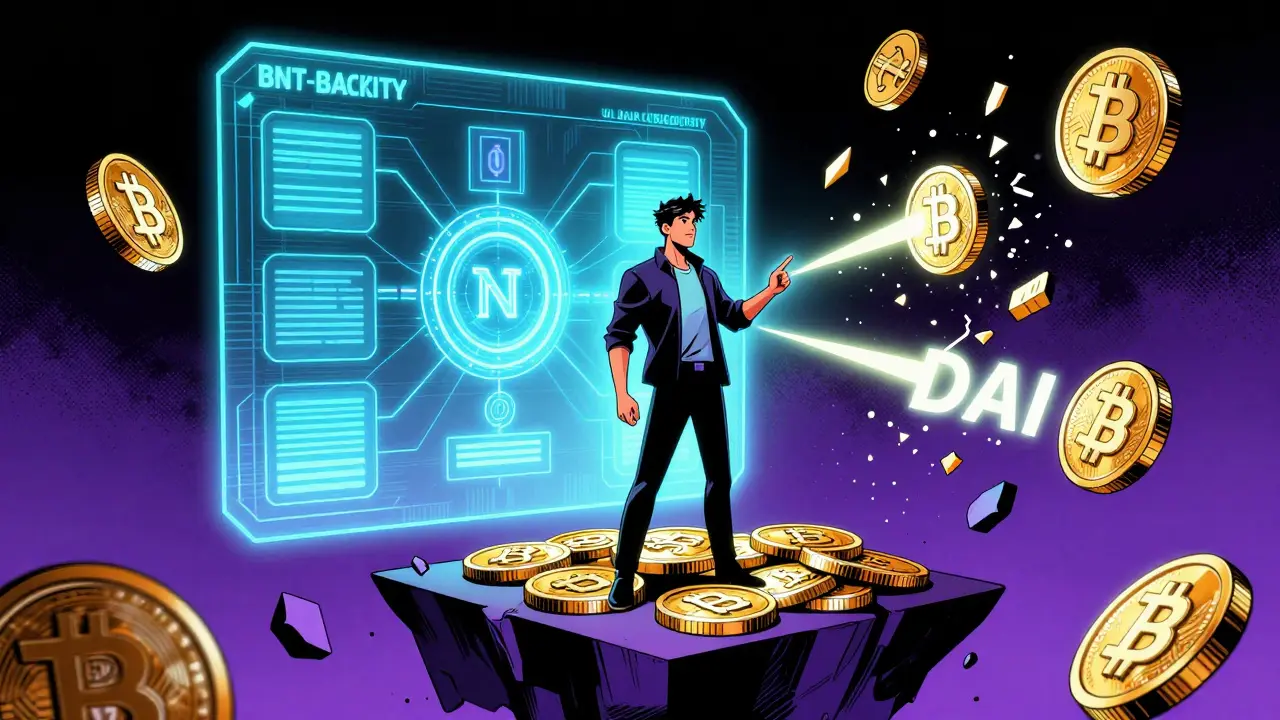
Most crypto users think you need two tokens to trade on a decentralized exchange. That’s not true on Bancor Network. You can swap any token for any other token with just one click - and even provide liquidity using only one coin. This isn’t magic. It’s smart contract engineering built to fix the biggest pain points in DeFi: high slippage, impermanent loss, and the hassle of managing two tokens in a liquidity pool.
Launched in June 2017, Bancor was one of the first protocols to ditch order books entirely. Instead of matching buyers and sellers, it uses automated market makers (AMMs) powered by smart contracts. The result? A system where liquidity never runs out. Even obscure tokens can be traded because Bancor’s pools are always active, always available, and always priced in real time.
How Bancor Works: No Order Books, Just Smart Pools
Traditional DEXs like Uniswap require you to deposit two tokens - say, ETH and USDC - into a liquidity pool. If the price of ETH moves, you get hit with impermanent loss. Bancor flips this. With its single-token liquidity model, you only need to deposit one asset. The protocol automatically converts your deposit into a BNT-backed pool, balancing the exposure for you. This means you’re not stuck holding a volatile pair. You’re just holding your original token, with protection.
The secret sauce? Bancor’s constant product formula (x * y = k) is enhanced with BNT as the base token in every pool. When you swap USDT for DAI, you’re not trading directly. You’re selling USDT to a pool that holds BNT and DAI, and the protocol handles the rest. This creates a seamless bridge between tokens that otherwise wouldn’t have direct liquidity.
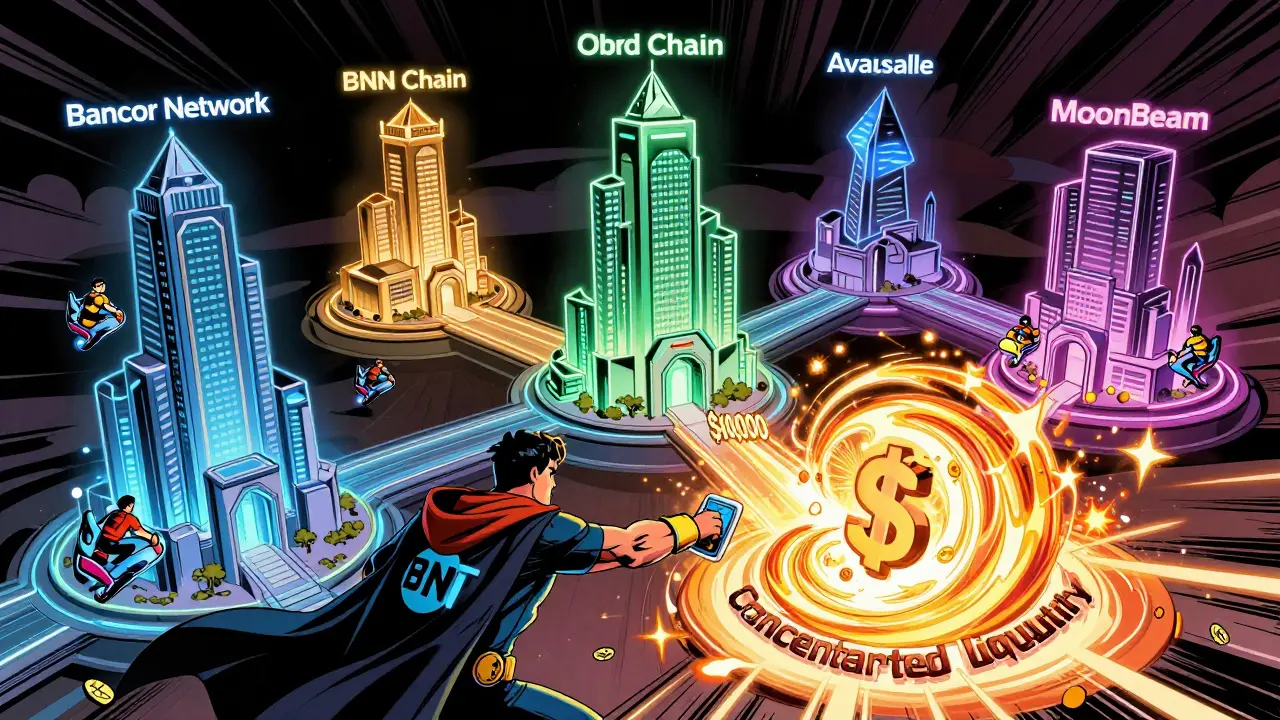
Version 3.0, launched in March 2022, made this even smarter. It introduced concentrated liquidity - similar to Uniswap V3 - letting liquidity providers set custom price ranges. Instead of spreading your capital across a wide range, you can lock it where the price is most likely to stay. This boosts capital efficiency by up to 4,000x, according to Bancor’s own whitepaper. A $10,000 deposit can now act like $40 million in traditional liquidity.
Supported Chains and Token List
Bancor isn’t stuck on Ethereum. As of 2025, it runs on five major blockchains: Ethereum, BNB Chain, Polygon, Avalanche, and Moonbeam. This multi-chain approach lets users avoid Ethereum’s gas spikes. On BNB Chain, swaps confirm in under 5 seconds. On Polygon, fees are under $0.10. This flexibility matters. If you’re trading daily, waiting 30 seconds and paying $3 in gas gets old fast.
The protocol supports over 81 cryptocurrencies, including all the big ones: BTC, ETH, USDT, USDC, BNB, XRP, and ADA. That’s 7 of the top 30 assets by market cap. You won’t find every meme coin, but you’ll find everything you need for serious DeFi trading. The full list is updated regularly on Bancor’s official token page.
Fees and Liquidity Depth
Trading fees are low: 0.10% for standard pairs, 0.05% for stablecoin pairs. Compare that to Uniswap’s 0.30% or Sushiswap’s 0.25%. For frequent traders, this adds up. A $10,000 trade on Bancor costs $10. On Uniswap? $30. That’s a $20 difference - every single time.
But fees aren’t everything. Liquidity depth is where Bancor struggles. According to 3Commas’ August 2023 analysis, Bancor’s order book depth is 63% lower than Uniswap V3’s. That means big trades - say, over $50,000 - can suffer slippage. For trades under $10,000, slippage averages 0.35%. That’s acceptable. For larger trades? You’ll see more than 2.5% slippage, which is risky.
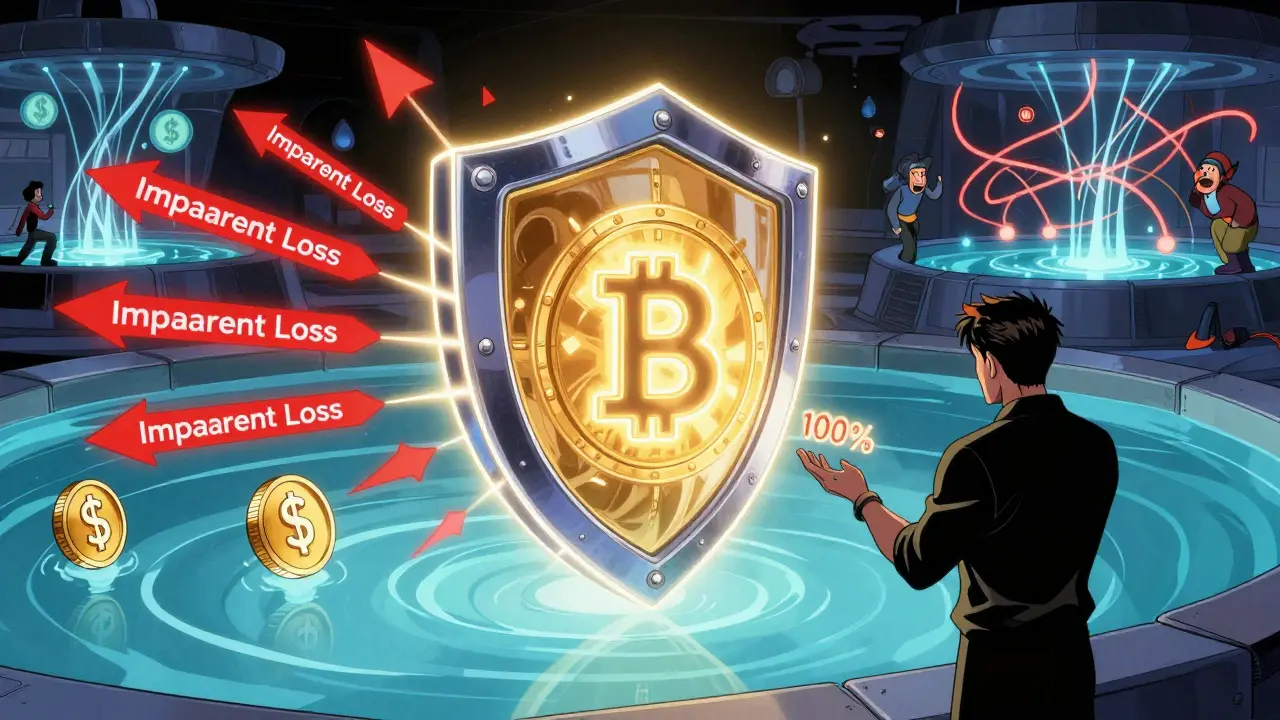
Stablecoin swaps are where Bancor shines. Its impermanent loss protection covers up to 100% of losses for stablecoin pools. If USDC and DAI drift apart, Bancor reimburses you. No other DEX offers this. It’s a game-changer for yield farmers who want to stake without fear.
Security, Gas, and Wallet Setup
Bancor uses time-locked governance upgrades and multi-sig wallets for its treasury. It’s not perfect - the protocol suffered a $23.5 million hack in April 2020 - but since then, security has improved dramatically. Version 3.0’s code was audited by CertiK and Hacken. No major exploits since.
Gas fees depend on the chain. On Ethereum, expect $1.20 to $3.50 per transaction. On Polygon, it’s $0.05. You’ll need an Ethereum-compatible wallet like MetaMask, Trust Wallet, or Coinbase Wallet. Setting up your wallet takes 15-20 minutes if you’re new. Connecting to Bancor is straightforward: just click “Connect Wallet” and approve the transaction.
Transaction times vary: 15-30 seconds on Ethereum, 3-5 seconds on BNB Chain. During Ethereum congestion, swaps can stall. That’s why using Polygon or Avalanche is smarter for daily trading.
Who Is Bancor For?
Bancor isn’t for everyone. If you’re a beginner looking for a simple interface, you’ll find it confusing. The liquidity provision dashboard has too many toggles. Reddit user CryptoN00b called it “a maze for first-timers.” But if you’ve used Uniswap or Sushiswap before, Bancor’s power becomes clear.
It’s perfect for:
- Users who want to provide liquidity without holding two tokens
- Stablecoin traders who want loss protection
- Multi-chain traders avoiding Ethereum gas spikes
- Long-term holders of BNT who believe in its utility
It’s not ideal for:
- High-volume traders doing $100K+ swaps
- People who want a mobile-first experience
- Those who prefer centralized exchange speed and support
BNT Token: Value and Outlook
The BNT token is the backbone of the network. It’s used as the base asset in all liquidity pools and earns a share of trading fees. Holders also vote on protocol upgrades.
Price predictions are all over the place. WalletInvestor forecasts $0.82 by December 2025. CoinPedia says $38.07 by 2030 - a 5,900% jump. That’s speculative. TradingBeast expects a 20% drop in ROI by 2025. Reality? BNT’s value is tied to adoption. If more users start using its single-token pools, demand rises. If Uniswap or Curve steals its market share, it stagnates.
As of September 2023, Bancor had $1.2 billion in total value locked (TVL). That’s 1.8% of the DEX market. Uniswap has 42.3%. But Bancor’s growth is steady. With its 3.1 upgrade coming in early 2024 - featuring gasless swaps and support for Solana, Polkadot, and Cosmos - TVL could hit $2.8 billion by 2025.
Pros and Cons Summary
| Feature | Bancor Network | Uniswap V3 | PancakeSwap |
|---|---|---|---|
| Liquidity Model | Single-token pools with BNT backbone | Two-token pairs | Two-token pairs |
| Impermanent Loss Protection | Yes (up to 100% for stablecoins) | No | No |
| Trading Fees | 0.10% (standard), 0.05% (stablecoins) | 0.30% | 0.25% |
| Supported Chains | Ethereum, BNB Chain, Polygon, Avalanche, Moonbeam | Ethereum | BNB Chain |
| TVL (Sept 2023) | $1.2B | $4.2B | $1.8B |
| Best For | Single-sided LPs, stablecoin swaps, cross-chain | High-volume ETH trading | BNB Chain users |
Final Verdict
Bancor Network isn’t the biggest DEX. It’s not the fastest. But it’s the most clever. Its single-token liquidity model solves a real problem: the complexity of DeFi liquidity provision. If you’re tired of juggling two tokens just to earn fees, Bancor is the answer. Its impermanent loss protection is unmatched. Its fee structure beats the competition. And its multi-chain support makes it future-proof.
It’s not perfect. The interface still feels clunky. Big trades suffer slippage. And BNT’s price is volatile. But for users who value innovation over hype, Bancor delivers something rare: a truly elegant solution to a messy problem.
If you’re already in DeFi, give it a test. Swap a small amount of USDT to DAI. Provide liquidity with just your ETH. See how it feels. You might not go back.
Can I use Bancor without owning BNT?
Yes. You can swap tokens on Bancor without holding BNT. BNT is only required if you want to provide liquidity or vote on governance proposals. For simple trades, you only need the tokens you’re swapping.
Is Bancor safer than centralized exchanges?
Bancor is decentralized, so you hold your own keys - unlike on centralized exchanges where you trust the platform with your funds. However, it’s still vulnerable to smart contract bugs. It’s safer than CEXs in terms of custody, but not risk-free. Always start with small amounts.
What happens if I lose money due to impermanent loss?
Bancor protects liquidity providers in stablecoin pools against impermanent loss - up to 100%. If the price of USDC drops relative to DAI, Bancor compensates you with BNT. This protection does not apply to volatile token pairs like ETH/USDT. Only stablecoin pools are covered.
Can I stake BNT for rewards?
Yes. You can stake BNT in Bancor’s liquidity pools to earn a share of trading fees. Staking also gives you voting power in governance. Rewards vary based on pool activity and total locked value. Historically, annual yields range from 5% to 15%, depending on market conditions.
Why isn’t Bancor more popular than Uniswap?
Uniswap has more liquidity, better branding, and a simpler interface. Bancor’s innovations - single-token liquidity, loss protection - are powerful but complex. Most users don’t understand them. Also, Uniswap supports more tokens and has deeper pools. Bancor is growing, but it’s still playing catch-up in user adoption.
precious Ncube
February 22, 2026 AT 22:18And don't get me started on BNT. Another useless governance token. Who even uses this? The 0.1% of crypto bros who think they're smarter than everyone else.
Amita Pandey
February 23, 2026 AT 18:36Jan Czuchaj
February 25, 2026 AT 12:39Most DEXs treat users like accountants. Bancor treats them like humans. The slippage issue? Real. But if you're doing $100K trades on a DEX, you're doing it wrong. This isn't for whales. It's for people who just want to move money without stress. And that's revolutionary.
George Suggs
February 26, 2026 AT 15:28Dianna Bethea
February 27, 2026 AT 02:13And the stablecoin protection? Game changer. I staked $5K in USDC/DAI and got reimbursed $300 when they drifted. No other DEX does that. You don't need to understand the math. Just trust the system. It's built to protect you.
KingDesigners &Co
February 27, 2026 AT 21:05TVL is $1.2B? Uniswap has $4.2B. You're not a solution. You're a footnote. And BNT? Worthless. I'd rather hold dogecoin than this. 🤡
Felicia Eriksson
February 28, 2026 AT 19:53Didn't even need to read the whitepaper. Sometimes the best tech is the one you don't have to think about.
aaron marp
March 1, 2026 AT 05:03That's not innovation. That's emotional design. And in crypto, where stress is the default state, that’s priceless.
Patrick Streeb
March 2, 2026 AT 18:07Phillip Marson
March 3, 2026 AT 22:33And yeah the interface is clunky. So what? It's not supposed to be TikTok. It's supposed to work. And it does. I've lost more money on Uniswap trying to 'optimize' than I ever lost on Bancor.
Tracy Whetsel
March 5, 2026 AT 12:59Also I staked BNT. It's cute. I feel like I'm part of something. 🌈💖
Alyssa Herndon
March 6, 2026 AT 09:51It's not flashy. It's not loud. But it's honest.
Ifeanyi Uche
March 7, 2026 AT 04:34precious Ncube
March 7, 2026 AT 09:17