

As of 2025, crypto payments are completely illegal in mainland China. There are no exceptions. No gray areas. No loopholes. If you're in China and you try to pay for anything with Bitcoin, Ethereum, or any other cryptocurrency, you're breaking the law. This isn't a rumor or a policy in progress - it's active, enforced, and getting stricter every year.
How China Got Here
China didn't wake up one day and ban crypto. It was a slow, deliberate process that started over a decade ago. In 2013, banks were told they couldn't process Bitcoin transactions. That was the first crack in the door. By 2017, the government shut down all domestic cryptocurrency exchanges and banned Initial Coin Offerings (ICOs). Mining got banned in 2021, forcing thousands of operations out of the country. But the real turning point came on May 30, 2025, when the People's Bank of China (PBOC) issued a final, sweeping order.Effective June 1, 2025, the ban became absolute. It didn't just stop trading. It didn't just stop mining. It made it illegal to even own cryptocurrency. That means if you have Bitcoin in a wallet, even if you never traded it, you're now at risk. Authorities can seize assets. Companies can be fined. Individuals can face criminal charges, especially if they're seen as moving money out of the country.
What Exactly Is Banned?
The 2025 rules cover every single part of the crypto ecosystem:- Buying or selling crypto on any platform - even offshore ones
- Using crypto to pay for goods or services
- Mining cryptocurrency within China's borders
- Holding crypto assets as an individual or business
- Operating crypto-related services like wallets, exchanges, or payment gateways
- Using stablecoins like USDT or USDC for transactions
Enforcement is handled by multiple agencies - the Cyberspace Administration, the Ministry of Industry, and local financial regulators. They monitor bank transfers, internet traffic, and even mobile apps for signs of crypto activity. If you're using a VPN to access an overseas exchange, that alone can trigger an investigation. In 2024, over 1,200 people were arrested for crypto-related offenses. The number only went up in 2025.
But What About Blockchain? Isn't China Into That?
Yes - and that's where things get confusing. China doesn't hate blockchain. In fact, it's one of the biggest investors in the technology. The difference? China only supports blockchain that it controls.The government is heavily backing the e-CNY (digital yuan). This isn't Bitcoin. It's not decentralized. It's not anonymous. It's a state-run digital currency that gives the PBOC full visibility into every transaction. Every time you use e-CNY, the government knows who you paid, how much, and when. It's the opposite of crypto - it's financial surveillance built into the payment system.
China is also running cross-border blockchain pilots like the mBridge project. This involves China, Hong Kong, Thailand, and the UAE testing CBDC (Central Bank Digital Currency) settlements for international trade. These projects use blockchain tech - but only with official digital currencies, not private ones. The goal isn't freedom. It's control. It's about bypassing the U.S. dollar system, not replacing it with Bitcoin.
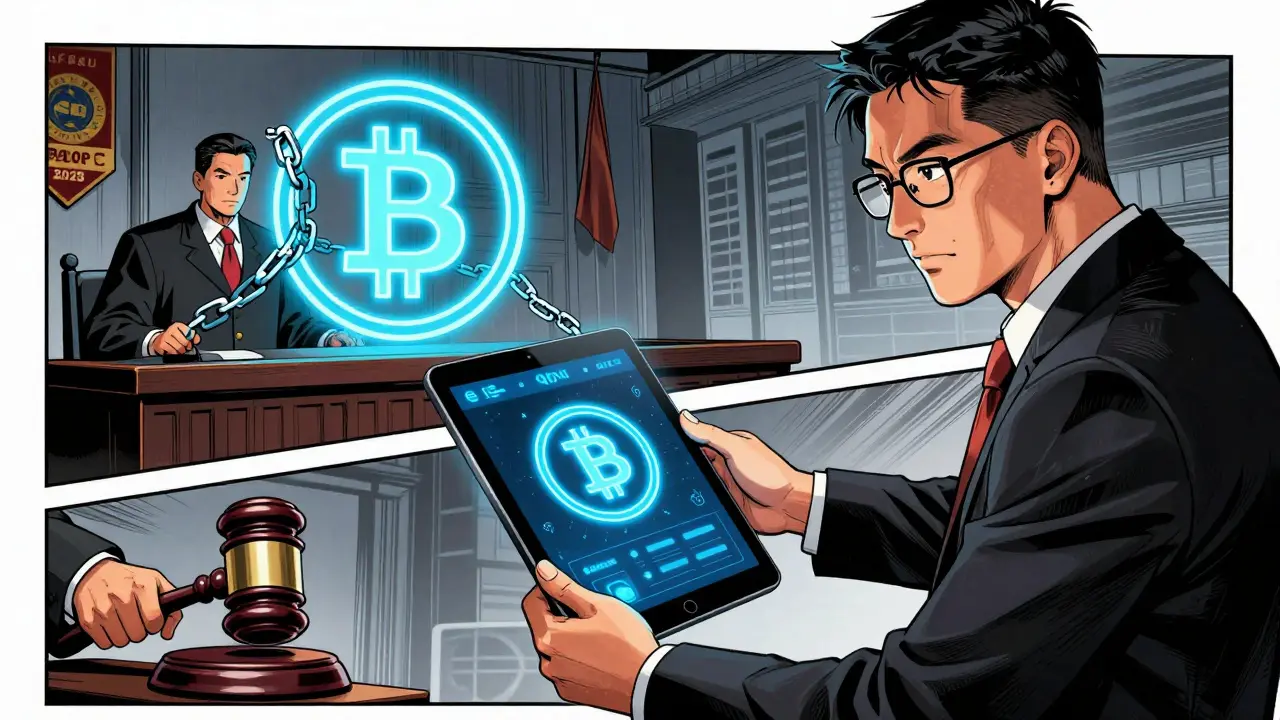
What Happens If You Try to Use Crypto in China?
If you're a tourist and you try to pay for a hotel with Bitcoin? The hotel won't accept it. They'd be breaking the law. If you're a local business owner and you start accepting crypto? You could face fines, asset seizures, or even jail time. The penalties are real.There's still some underground activity - OTC traders, peer-to-peer transfers, crypto ATMs in border cities like Shenzhen. But these are risky. In 2025, Chinese courts ruled that crypto-related contracts have no legal protection. If someone steals your Bitcoin or doesn't pay you back after a crypto deal, you can't sue. The courts won't hear your case. Your money is gone, and you have no recourse.
How Does This Compare to Other Countries?
China's approach is extreme - even compared to its neighbors.| Region | Crypto Payments Allowed? | Regulatory Body | Key Conditions |
|---|---|---|---|
| China (Mainland) | No | People's Bank of China | Complete ban on all crypto activity since June 2025 |
| Hong Kong | Yes | Securities and Futures Commission | Licensed exchanges, strict KYC, no retail leverage |
| Singapore | Yes | Monetary Authority of Singapore | Regulated stablecoins, licensed service providers |
| Japan | Yes | Federal Financial Services Agency | Registered exchanges, tax reporting required |
China is the only major economy that outright bans ownership. Everywhere else, crypto is regulated - not outlawed. That’s why companies like Binance and Coinbase don’t operate in mainland China. They can’t. Even if they wanted to, the law doesn’t let them.

Is There Any Way Around It?
Not legally. Some try using foreign wallets, offshore exchanges, or crypto-to-cash services. But these aren’t loopholes - they’re traps. The Chinese government monitors cross-border financial flows closely. If you send crypto to an overseas wallet and then cash out in USD, that’s flagged as capital flight. That’s a serious offense.The only legal path is through the e-CNY. If you're a business looking to accept digital payments in China, your only option is to integrate with the e-CNY system. It’s not glamorous. It’s not decentralized. But it’s the only thing the government will allow.
What Does This Mean for the Future?
There’s no sign that China will loosen its stance. The e-CNY is expanding. More cities are rolling it out. More merchants are adopting it. The government is spending billions to make it the default digital payment method. Crypto doesn’t fit into that vision. It threatens control. It threatens surveillance. It threatens the state’s monopoly on money.Experts in Shanghai did meet in July 2025 to discuss how to handle stablecoins and CBDCs. But those talks weren’t about legalizing crypto. They were about how to contain it. The message was clear: blockchain yes, crypto no.
For international businesses, this means China is effectively closed off as a market for crypto payment providers. No one can legally operate there. No one can legally accept crypto there. The door is shut.
What Should You Do If You're in China?
If you're living in or visiting mainland China:- Don’t use crypto to pay for anything
- Don’t hold crypto in any wallet - even as a long-term investment
- Don’t use apps or websites that promote crypto trading
- Use e-CNY for digital payments - it’s safe, legal, and growing fast
- If you have crypto already, consider moving it out before it becomes harder
There’s no middle ground. The law is clear. The enforcement is real. And the penalties are getting worse.
Can I use Bitcoin to pay for goods in China?
No. Since June 1, 2025, it has been illegal to use Bitcoin or any other cryptocurrency to pay for goods or services in mainland China. Businesses that accept crypto risk fines, asset seizure, or criminal charges. Even if a vendor says they’ll take Bitcoin, they’re breaking the law.
Is owning cryptocurrency illegal in China?
Yes. The 2025 PBOC ban explicitly includes holding cryptocurrency as a prohibited activity. Authorities can seize digital assets, freeze wallets, and investigate individuals who own crypto - even if they never traded it. Ownership is no longer a gray area - it’s a legal violation.
What about using crypto on overseas websites while in China?
Technically, using crypto on foreign platforms isn’t explicitly illegal - but it’s still risky. If you’re transferring funds out of China using crypto, that’s considered capital flight, which is a serious offense. The government monitors cross-border transactions closely. Even if you’re just buying a subscription, you could trigger a financial investigation.
Can I mine cryptocurrency in China?
No. Mining was banned nationwide in 2021, and enforcement intensified in 2025. Power companies are required to report suspicious energy use, and local governments actively shut down mining operations. Equipment can be confiscated, and operators face criminal penalties.
Is the digital yuan (e-CNY) the same as cryptocurrency?
No. The e-CNY is a state-controlled digital currency issued by the People’s Bank of China. Unlike Bitcoin or Ethereum, it’s not decentralized. The government tracks every transaction, controls supply, and can freeze accounts. It’s designed to replace cash and card payments - not to compete with crypto.
Can foreign companies offer crypto payment services in China?
No. Any company offering crypto payment services within mainland China is operating illegally. The PBOC ban applies to all entities - domestic or foreign. Even if the service is hosted overseas, if it’s accessible to Chinese users, it violates Chinese law. Companies like Coinbase, Binance, and Kraken are blocked in China for this reason.
Will China ever allow crypto payments again?
It’s extremely unlikely. China’s entire financial strategy revolves around control - and crypto is the opposite of that. The government is doubling down on the e-CNY, which gives it full visibility into every transaction. Crypto’s anonymity and decentralization directly conflict with this goal. Unless China completely changes its monetary policy, crypto payments won’t return.
China’s stance on crypto isn’t about fear of technology. It’s about control. The state doesn’t want decentralized money. It wants digital money it can track, limit, and stop at any moment. That’s why the e-CNY is growing - and why crypto is vanishing.
jack carr
March 4, 2026 AT 11:32Man, this whole thing is wild. I get that China wants control, but banning ownership? That’s next level. I’ve got some ETH sitting in a wallet I haven’t touched since 2021… now I’m sweating. Not because I think they’ll come for me, but because it just feels so final. Like, we’re not talking regulation anymore-we’re talking digital erasure.
Jane Darrah
March 6, 2026 AT 08:59Let’s be real-this isn’t about crypto. It’s about power. China doesn’t want decentralized money because decentralized money means decentralized control. And that’s terrifying to a regime built on surveillance, compliance, and total visibility. The e-CNY? It’s not a currency-it’s a leash. Every transaction tracked, every purchase logged, every sip of coffee monitored. They’re not banning Bitcoin because it’s dangerous. They’re banning it because it’s free. And freedom? That’s the real threat.
Meanwhile, the West is still arguing about tax forms and KYC. We’re playing checkers while they’re playing 4D chess with human behavior. We think crypto is about finance. They know it’s about sovereignty. And they won.
Denise Folituu
March 6, 2026 AT 09:41I just cried reading this. Like… I have a friend in Shenzhen who mined Bitcoin in 2020. Her whole life savings were in LTC. They raided her apartment. Took her rig. Took her phone. Took her laptop. And then they told her she owed taxes on the ‘unlawful income.’ She’s in debt now. For something that wasn’t even illegal when she started. This isn’t policy. This is cruelty wrapped in bureaucracy.
Eva Gupta
March 7, 2026 AT 12:28As someone from India, I find this so fascinating. We’re going the opposite way-trying to figure out how to make crypto work with our economy. But China’s clarity? It’s terrifyingly efficient. No confusion. No loopholes. Just: ‘This is not allowed.’ I admire the control, even if I don’t agree with it. It’s like they built a digital wall-and made sure no one could climb it.
Still, I wonder… what happens when the next generation grows up with e-CNY as their only digital money? Will they even understand why anyone would want Bitcoin?
Nancy Jewer
March 7, 2026 AT 22:36From a regulatory architecture standpoint, this is a textbook example of sovereign monetary sovereignty enforcement. The PBOC has effectively neutralized the threat vector of decentralized finance by eliminating all attack surfaces: custody, settlement, liquidity provision, and even passive ownership. This isn’t just a ban-it’s a systemic deplatforming of non-state-aligned financial primitives. The e-CNY isn’t just a CBDC-it’s a state-sponsored financial firewall. And it’s working.
Ken Kemp
March 9, 2026 AT 20:43Hey, just wanted to say-don’t panic if you have crypto in China. I know people are scared, but most of the time, enforcement is targeted at businesses, not individuals. I’ve got a cousin who lives in Guangzhou and he still has some BTC. He just doesn’t talk about it. And he uses e-CNY for everything. It’s not ideal, but it’s survivable. Stay low, stay smart.
Julie Potter
March 10, 2026 AT 16:49OMG I CAN’T BELIEVE PEOPLE ARE STILL ARGUING ABOUT THIS. IT’S 2025. CHINA HAS WON. THEY’RE NOT ASKING PERMISSION. THEY’RE NOT PLAYING NICE. THEY TOOK THE GAME AND BURNED THE BOARD. YOU THINK YOU’RE A ‘CRYPTO INVESTOR’? YOU’RE A GHOST IN A MACHINE THAT’S BEEN SHUT OFF. WAKE UP. THE FUTURE IS E-CNY. AND IT’S NOT EVEN A DEBATE. IT’S OVER.
Ian Thomas
March 12, 2026 AT 10:18It’s ironic, isn’t it? The same government that crushed crypto is now building the most advanced blockchain infrastructure on earth. They’re not anti-technology. They’re anti-anarchy. Blockchain? Fine. Decentralization? No. Control? Absolutely. The real question isn’t ‘Why ban crypto?’ It’s ‘Why did the rest of the world ever think decentralization could win against a state that treats data like oxygen?’
Austin King
March 13, 2026 AT 06:54Just wanted to say thanks for laying this out so clearly. It’s scary, but also kind of… logical. China’s not being irrational. They’re being consistent. And maybe that’s the lesson: if you want to live under a system that values order over freedom, this is what it looks like.
Bryanna Barnett
March 13, 2026 AT 23:09Let’s be honest-the e-CNY is basically a socialist surveillance tool dressed up as innovation. And yet, people in the West still romanticize crypto like it’s some libertarian utopia. Meanwhile, China just… built the future. And it’s cold. And efficient. And terrifying. I’m not saying I agree. I’m saying I respect the execution. The West is still debating whether to allow NFTs as art. They’ve already erased money.
Josh Moorcroft-Jones
March 15, 2026 AT 07:08Okay, so let me get this straight: you’re telling me that after a decade of crypto evangelism, after all the memes, after the moon boys, after the ‘decentralized future’ speeches… the single largest economy on the planet just… shut it down? Like, not ‘regulated,’ not ‘restricted’-but outright outlawed? And not just trading-OWNERSHIP? That’s not a ban. That’s a cultural extinction event. And we didn’t even see it coming. We were too busy posting ‘to the moon’ on Twitter.
Meanwhile, the PBOC is quietly rolling out e-CNY to 500 million people. The crypto dream? Dead. The state’s dream? Alive and kicking.
Rachel Rowland
March 16, 2026 AT 11:05I know this sounds harsh, but if you’re holding crypto in China right now, you’re playing with fire. Not because the government is evil-but because they’re not bluffing. They’ve got the tech, the infrastructure, and the will. This isn’t about ideology. It’s about survival. And if you’re a business owner? You don’t have a choice. You use e-CNY or you get shut down. Period. No second chances. No appeals. Just compliance.
Bonnie Jenkins-Hodges
March 17, 2026 AT 03:18AMERICA IS SO WEAK. WE LET PEOPLE DO WHATEVER THEY WANT. CHINA? THEY JUST SAY NO. AND IT WORKS. NO MORE CRYPTO. NO MORE CHAOS. NO MORE PEOPLE LOSING MONEY ON MEME COINS. JUST CLEAN, CONTROLLED MONEY. I LOVE IT. LET’S DO THIS IN THE US TOO. #E-CNYFORALL #CRYPTOISBAD
Melissa Ritz
March 17, 2026 AT 18:22I read this and just… sighed. It’s not that I’m pro-crypto. I’m just tired of all this. The drama. The moralizing. The ‘this is the future’ nonsense. The truth? Money is power. And power doesn’t care about your blockchain dreams. China just took it back. And honestly? I don’t blame them.
Cerissa Kimball
March 17, 2026 AT 23:36It is noteworthy that the People's Bank of China has implemented a comprehensive regulatory framework that effectively eliminates all non-state sanctioned financial intermediaries from the domestic digital economy. This represents a significant consolidation of monetary authority and aligns with long-standing strategic objectives regarding financial sovereignty. The e-CNY serves not merely as a payment instrument but as a foundational pillar of a new financial architecture. The implications for global monetary systems are profound.
Basil Bacor
March 19, 2026 AT 11:14lol china banning crypto. funny. theyre still using usdt to pay for oil and stuff. hypocrites. the whole thing is a show. they just dont want their citizens to get rich outside the system. its not about control. its about keeping the peasants poor.
Emily Pegg
March 19, 2026 AT 18:38I just feel so bad for the people in China. I mean, imagine being told you can’t even own something you bought legally. It’s like they’re stealing your future. I know it’s not my place to judge… but I just… I can’t stop thinking about it. I sent a small donation to a crypto charity last week. I wish I could help them somehow.
Ethan Grace
March 20, 2026 AT 13:50There’s a quiet tragedy here. Not in the ban-but in the silence. No protests. No riots. No Twitter storms. Just… acceptance. People in China didn’t fight this because they were never given the tools to fight. No open internet. No free press. No platform. The real victory isn’t the ban. It’s that no one even tried to stop it.
Jamie Hoyle
March 22, 2026 AT 07:15Oh wow. So China banned crypto. Big whoop. Let me guess-next they’ll ban oxygen and gravity. You think this is about control? Nah. It’s about panic. They’re terrified because their entire economic model is built on debt, exports, and fake growth. Crypto exposes that. It says: ‘You’re not in charge. The market is.’ So they shut it down. Because they can’t compete. They can’t innovate. So they erase. Classic authoritarian move. The future doesn’t belong to the censors. It belongs to the builders. And China? They’re just burying their head in the sand.
jack carr
March 22, 2026 AT 23:08Yeah, I’ve been thinking about this too. I mean, if you’re in China and you’ve got crypto… you’re basically living in a parallel economy. One that’s invisible, illegal, and completely unenforceable unless you’re loud about it. The system works because people don’t talk. They just… adapt. And that’s the scariest part. Not the law. The silence.