
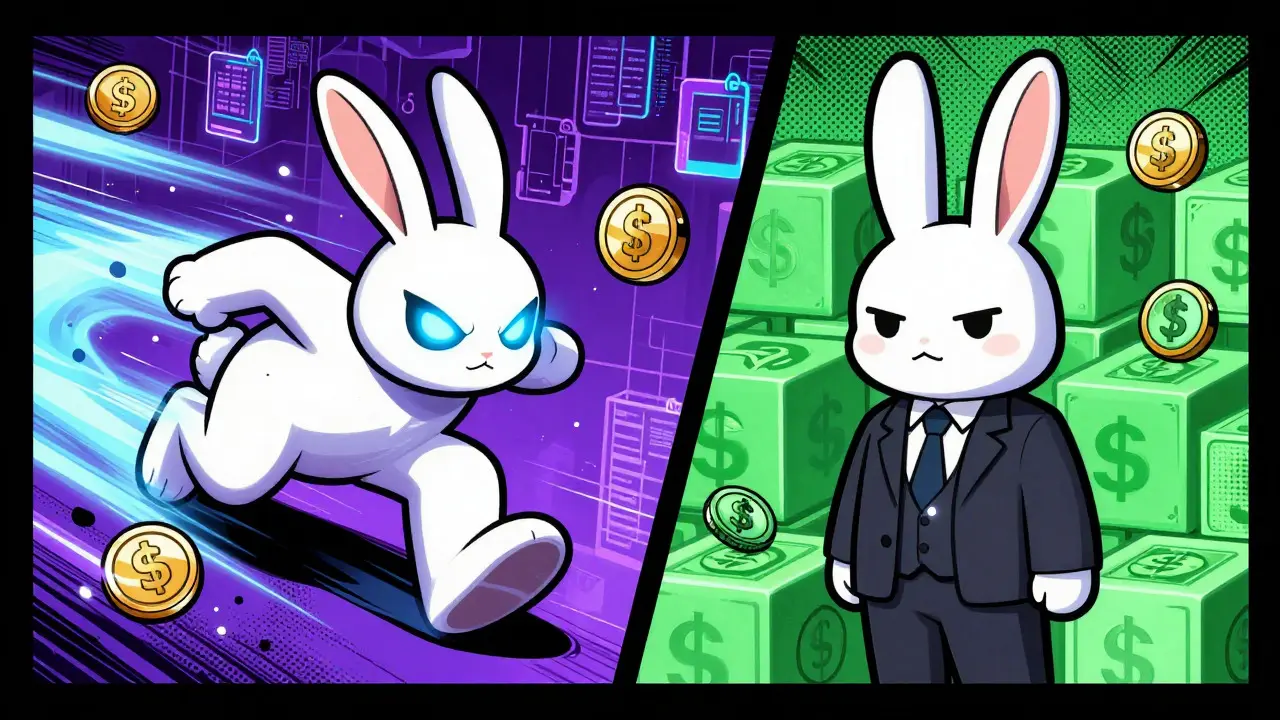
So you’ve heard the name Tuki and seen the ticker TUKI floating around on social media or a price tracker. You probably want to know if it’s the next big thing or just another random coin that will vanish in a week. Here is the short answer: Tuki isn’t one single project. It’s actually two completely different tokens sharing the same name, living on different blockchains, with very different purposes. One is a chaotic bunny-themed meme coin on Solana, and the other is a quiet mascot for a stablecoin ecosystem on BNB Chain. Mixing them up could cost you your money.
If you are looking at this from Wellington or anywhere else in the world, the first rule of crypto safety applies: never buy a token without checking its contract address. Because "Tuki" is a common enough word, scammers love to create fake versions. But even among the legitimate ones, the confusion is real. Let’s break down exactly what these coins are, where they trade, and why you need to be extremely careful before clicking "swap."
The Two Faces of Tuki
The biggest problem with researching Tuki is that data aggregators often get confused. You might see a price on one site and a totally different price on another. This happens because there are two distinct entities using the TUKI ticker.
1. The Solana Memecoin
This is the version most people stumble upon when browsing decentralized exchanges like Raydium. It’s a classic memecoin built around a mischievous bunny character. The project started as an art-driven community effort, inspired by earlier Solana memes like fwog. It doesn’t have a complex utility or a whitepaper full of technical jargon. Its value comes entirely from community hype, social media buzz, and the sheer randomness of the meme culture. If you’re buying this, you’re betting on whether the internet finds the bunny funny enough to keep trading it.
2. The BNB Chain Mascot
Then there is the Tuki on BNB Chain. This one is quieter. It serves as the official mascot for the USD1 stablecoin ecosystem. Think of it less as a speculative asset and more as a brand symbol-a rabbit that "plants dollars" in the blockchain. As of mid-2026, this token has a fixed supply of 1 billion TUKI but hasn’t seen significant trading volume or wide exchange listings. It’s part of a broader financial narrative rather than a pump-and-dump scheme, though it lacks the liquidity to do much of anything right now.
Tokenomics and Supply Details
Understanding how many tokens exist is crucial for valuing any crypto. For both versions of Tuki, the total supply hovers around the 1 billion mark, but the details matter.
| Feature | Solana TUKI (Meme) | BNB Chain TUKI (Mascot) |
|---|---|---|
| Blockchain | Solana | BNB Chain (BEP-20) |
| Total Supply | ~999,998,374 TUKI | 1,000,000,000 TUKI |
| Circulating Supply | ~998.97 million TUKI | Self-reported as 1 billion (low/no active trading) |
| Purpose | Community speculation / Meme | Ecosystem branding for USD1 |
| Primary Trading Venue | Raydium (DEX) | Not widely listed / No major markets |
| Risk Level | Extreme (Micro-cap) | High (Illiquid / Unproven) |
For the Solana version, nearly the entire supply is already in circulation. There are only about 3,000 tokens left that can ever be minted, which means inflation isn’t a concern here. The scarcity is fixed. However, having a large circulating supply with a tiny market cap is a red flag for volatility. If someone buys just $500 worth of TUKI, they might move the price by 10% or more because the pool is so shallow.
Market Reality: Price, Volume, and Liquidity
Let’s talk numbers, because this is where most new investors get hurt. Tuki is what we call a micro-cap cryptocurrency. In fact, it’s ultra-micro.
In mid-2025 and into 2026, data from trackers like CoinGecko, CoinPaprika, and DexScreener shows the Solana TUKI trading at fractions of a cent-often between $0.000006 and $0.000025 USD. The market capitalization rarely exceeds $25,000. To put that in perspective, top-tier memecoins like Dogecoin or Bonk have market caps in the billions. Tuki is five to six orders of magnitude smaller.
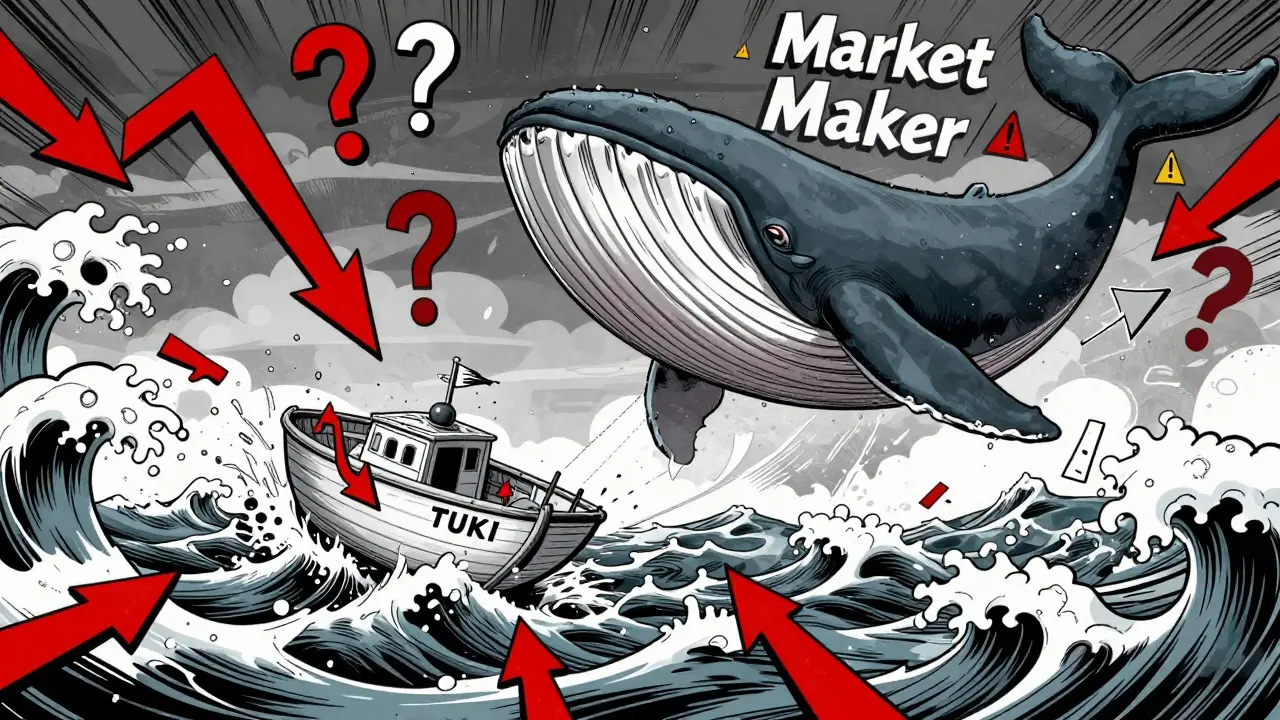
Liquidity is even worse. On days when things are going well, the 24-hour trading volume might hit $1,000. On quiet days, it can drop to under $10. What does this mean for you? It means slippage. If you try to sell $100 worth of TUKI, you might not get $100 back. You might get $80, or $60, because there aren’t enough buyers in the order book to absorb your sale without crashing the price. This is normal for micro-caps, but it’s dangerous if you don’t expect it.
Data inconsistencies are also rampant. One site might show a price of $0.000016 while another shows $0.000023 for the exact same time. This isn’t necessarily fraud; it’s just a sign that the market is too thin for accurate, unified pricing. Always check multiple sources, and always look at the actual transaction history on-chain if you can.
Where and How to Trade Tuki
If you decide to take the plunge, you need to know where to go. There is no "Buy Tuki" button on Coinbase or Binance. You won’t find it on Kraken either. These tier-one exchanges require rigorous audits and high liquidity, which Tuki currently lacks.
For the Solana TUKI:
You’ll need a Solana wallet like Phantom or Solflare. Once you have some SOL in your wallet, you connect to Raydium, the primary decentralized exchange for this token. You’ll swap your SOL for TUKI. Be prepared to adjust your slippage tolerance settings-sometimes you need to set it higher than usual to get the trade through, but this also makes you vulnerable to front-running bots. Use a tool like DexScreener to monitor the live chart and liquidity depth before you swap.
For the BNB Chain TUKI:
This is trickier. Since it’s not widely listed, you’d likely need to use a BEP-20 compatible wallet like Trust Wallet or MetaMask. You’d need to manually add the token using its specific contract address: 0x3AaA4B954C17Da357EDB9E18fD3EaE8293ef4200. Without a major exchange listing, swapping it for BNB or USDT might be difficult or impossible unless there’s a private pool or over-the-counter arrangement, which is rare for retail users.
A Note on LBank:
Some data feeds, like those from Investing.com, reference a Tuki pair on LBank, a centralized exchange. However, prices here can differ wildly from the DEX price due to arbitrage delays or different trading pairs. Always verify which chain the exchange is listing before depositing funds.
Risks You Can’t Ignore
Investing in Tuki is not investing in technology; it’s investing in attention. And attention is fickle. Here are the specific risks you face:
- Rug Pull Potential: Many micro-cap memecoins are launched by anonymous teams who hold a large portion of the supply. While the Solana TUKI has a mostly distributed supply, the lack of formal audits means the smart contract code hasn’t been verified by reputable security firms. A hidden function could theoretically allow developers to drain liquidity or halt transfers.
- Zero Utility: Unlike Bitcoin (store of value) or Ethereum (smart contracts), Tuki does nothing. It doesn’t earn yield, it doesn’t govern a protocol, and it doesn’t provide access to a service. Its only value is if someone else pays more for it tomorrow.
- Data Noise: As mentioned, price data is messy. You might think you’re making a profit based on one aggregator’s data, only to find out the real market price is lower when you try to sell.
- Confusion with Similar Names: Don’t mix up TUKI with Tsuki (TSUKI), another meme token with a different narrative, or Touki Blockchain (TOUKI), which is a separate Layer-1 network launched in July 2026. They are unrelated projects.
Is Tuki Worth Your Time?
If you are a seasoned degens trader who enjoys hunting for gems in the dirtiest corners of DeFi, Tuki might offer a small thrill. The entry price is low, and the potential for a 10x or 100x return exists in the meme world-if the community catches fire. The bunny narrative has a dedicated, albeit small, following on Twitter and Telegram.
But if you are looking for a serious investment, Tuki is likely not for you. The BNB Chain variant is tied to the USD1 ecosystem, which sounds promising, but without liquidity or widespread adoption, it’s hard to gauge its future value. The Solana variant is pure speculation. Treat any money you put into Tuki as money you are willing to lose completely. Never borrow to buy it, and never allocate more than a tiny fraction of your portfolio to it.
In the grand scheme of the 2026 crypto market, Tuki remains a niche curiosity. It’s a case study in how easy it is to launch a token and how hard it is to build lasting value. Keep your eyes on the contract addresses, watch the liquidity pools closely, and stay skeptical.
Which blockchain is Tuki (TUKI) on?
There are two main tokens using the TUKI ticker. The most traded version is a memecoin on the Solana blockchain. There is also a second version on BNB Chain that serves as a mascot for the USD1 stablecoin ecosystem. Always check the contract address to ensure you are looking at the correct one.
How do I buy Tuki (TUKI)?
You cannot buy Tuki on major exchanges like Coinbase or Binance. For the Solana version, you need a Solana wallet (like Phantom) and must swap SOL for TUKI on a decentralized exchange like Raydium. For the BNB Chain version, you may need to manually add the token to a BEP-20 wallet using its specific contract address, as it is not widely listed.
Is Tuki a good investment?
Tuki is considered an extremely high-risk, speculative asset. It is a micro-cap token with very low liquidity and no fundamental utility. Prices can swing wildly, and there is a risk of losing your entire investment. It should only be approached by experienced traders who understand meme coin dynamics and are willing to lose their capital.
What is the difference between Tuki, Tsuki, and Touki?
They are three different projects. Tuki (TUKI) is the Solana/BNB meme/mascot token discussed here. Tsuki (TSUKI) is a separate meme token with a different community and narrative. Touki (TOUKI) is the native coin of the Touki Blockchain, a distinct Layer-1 network launched in 2026. Do not confuse their tickers or contract addresses.
Why is the price of Tuki different on different websites?
Because Tuki is a micro-cap asset with very low trading volume, liquidity is thin. Different exchanges or data aggregators may have slightly different order books or update frequencies. Additionally, some sites might be tracking the Solana version while others track the BNB Chain version, leading to massive price discrepancies.