
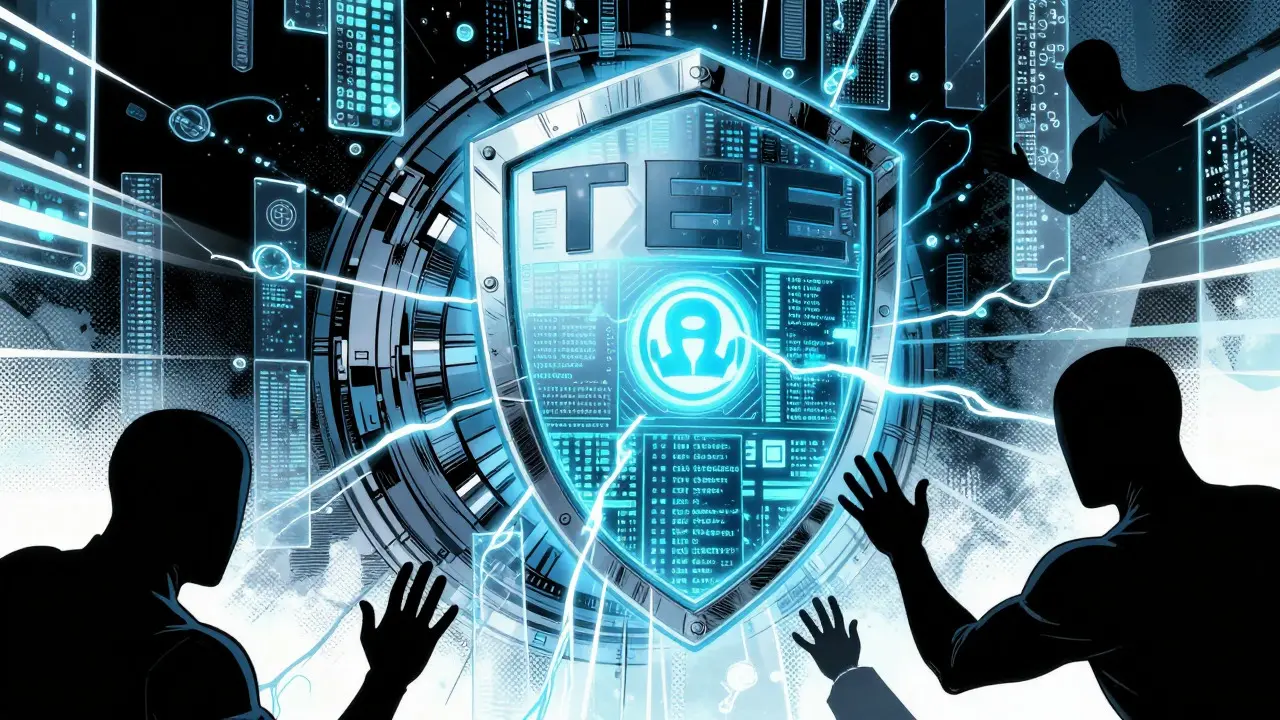
Imagine processing sensitive user data on a public blockchain without anyone-even the network administrators-being able to peek at it. That sounds impossible, right? Public blockchains are designed to be transparent. But what if you could have your cake and eat it too? What if you could maintain that transparency for verification while keeping the actual data locked away in a digital vault?
This is exactly the problem Integritee Network (TEER) aims to solve. It is not just another cryptocurrency hoping for a price pump; it is an infrastructure project trying to bridge the gap between strict data privacy laws like GDPR and the open nature of decentralized applications.
Key Takeaways
- Core Function: Integritee uses Trusted Execution Environments (TEE) to process private data securely on public blockchains.
- Architecture: Built on Polkadot, it combines blockchain security with hardware-level encryption.
- Market Status: As of mid-2026, TEER is a micro-cap asset trading around $0.10, showing high volatility after significant declines from its 2022 peak.
- Use Case: Ideal for enterprises needing GDPR compliance while utilizing decentralized apps (dApps).
The Problem: Privacy vs. Transparency
Let’s break down why this matters. If you build a decentralized finance (DeFi) app or a social media platform on Ethereum or Polkadot, everything is visible. Transactions, balances, and often metadata are public record. This is great for trust but terrible for privacy. Companies operating in Europe face heavy fines under the General Data Protection Regulation (GDPR) if they mishandle personal data. Storing raw personal data on a public ledger is basically inviting those fines.
Traditional solutions involve taking data off-chain, which breaks the "trustless" promise of blockchain. You end up trusting a centralized server again. Integritee steps in here by offering a way to keep data private *while* it is being processed on-chain. It doesn’t hide the fact that computation happened; it hides the content of the computation itself.
How Integritee Works: The Role of TEE Hardware
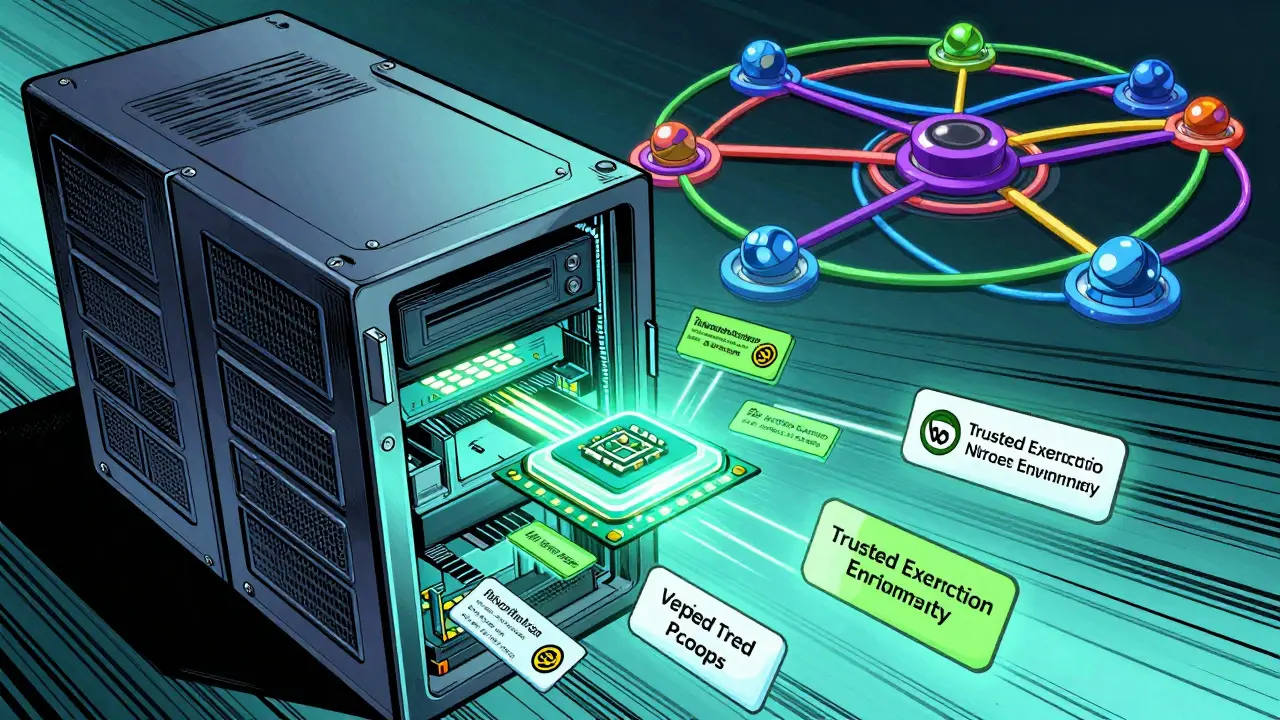
The secret sauce behind Integritee is something called a Trusted Execution Environment (TEE). Think of a TEE as a secure room inside a computer’s processor. Even if someone hacks the main operating system or has physical access to the machine, they cannot see what is happening inside that secure room.
Here is how Integritee utilizes this technology:
- Data Encryption: User data is encrypted before it ever leaves the user’s device.
- Secure Processing: The encrypted data is sent to a node running on Integritee’s network. This node contains a TEE enclave.
- Computation: Inside the TEE, the data is decrypted, processed according to smart contract logic, and then re-encrypted.
- Verification: A proof of this computation is published to the blockchain. The blockchain verifies that the correct code ran, but never sees the actual data.
This means you get the immutability and auditability of a blockchain without exposing sensitive information. For developers, this opens up a world of possibilities for identity verification, private voting systems, and confidential medical records storage.
Integration with Polkadot and Sidechains
Integritee didn’t build its blockchain from scratch in isolation. It is deeply integrated into the Polkadot ecosystem. Polkadot is known for its interoperability, allowing different blockchains to talk to each other. Integritee leverages this by acting as a specialized layer that adds privacy capabilities to any parachain or dApp connected to Polkadot.
Additionally, Integritee uses second-layer sidechains. Why? Because processing data inside a TEE can be computationally expensive and slower than standard blockchain transactions. By offloading these heavy privacy computations to sidechains, Integritee maintains scalability. The main chain handles the final settlement and verification, while the sidechains do the heavy lifting of secure data processing. This hybrid approach ensures that the network doesn’t clog up when handling large volumes of private transactions.
TEER Token Utility and Economics
So, what does the TEER token actually do? In many crypto projects, tokens are just speculative assets. In Integritee’s case, TEER has specific utility within the network:
- Payment for Services: Developers and users pay TEER to use the privacy-preserving computation services. The more complex the data processing, the more TEER is required.
- Staking and Security: Node operators stake TEER to participate in the network. This aligns their incentives with the health of the network-if they act maliciously, they lose their stake.
- Governance: Holders can vote on proposals regarding the future development and parameter changes of the Integritee protocol.
The total supply of TEER is capped at 10 million tokens. As of recent data, approximately 3.97 million tokens are in circulation, meaning roughly 40% of the total supply is actively available in the market. This relatively low circulating supply compared to major coins like Bitcoin or Ethereum means that even moderate buying pressure can lead to significant price swings.
Market Performance and Volatility
If you are looking at TEER from an investment perspective, you need to understand its current market reality. Cryptocurrencies are volatile, but micro-cap privacy tokens are particularly wild.
At its all-time high in January 2022, TEER traded near $5.09. Since then, it has experienced a dramatic decline, dropping over 98% from that peak. This mirrors the broader crypto winter that followed the bull run of 2021-2022, where speculative assets took the hardest hit. By September 2025, the token hit a new low of around $0.091, reflecting continued selling pressure and limited adoption.
As of August 2026, TEER is trading in a narrow range around $0.096 to $0.10. The market capitalization hovers under $400,000, classifying it firmly as a micro-cap asset. This small size indicates two things: high risk and high potential reward. With only about 25 active holders reported on some metrics, the liquidity is thin. A single large trade can move the price significantly.
| Metric | Value / Detail |
|---|---|
| Current Price Range | $0.096 - $0.10 USD |
| All-Time High | $5.09 (Jan 2022) |
| Total Supply | 10 Million TEER |
| Circulating Supply | ~3.97 Million TEER |
| Primary Exchanges | Gate.io, Kraken, Uniswap V4 |
| Underlying Tech | Polkadot, TEE Hardware |
The volume-to-market cap ratio is relatively high at around 9%, suggesting that despite the low holder count, there is active speculation. Most trading happens in TEER/USDT pairs, indicating that traders are primarily speculating on price movements rather than using the token for its intended utility in daily operations.

Who Is Integritee For?
Integritee isn’t really aimed at the average retail investor looking for a quick flip. Its value proposition is strongest for:
- Enterprise Developers: Companies building dApps that handle personal identifiable information (PII). If you are building a decentralized healthcare app or a financial KYC (Know Your Customer) service, Integritee offers a compliant path.
- Privacy-Conscious Users: Individuals who want to use Web3 services without leaving a permanent, public trail of their activities.
- Regulatory Compliance Officers: Teams tasked with ensuring their blockchain initiatives meet GDPR or similar global privacy standards.
For the everyday crypto trader, TEER represents a high-risk bet on the future of privacy tech. If regulatory pressure on blockchain data increases, projects like Integritee could see massive demand. Conversely, if quantum computing advances threaten TEE security, or if ZK-Rollups (Zero-Knowledge Proofs) become cheaper and easier to implement, Integritee’s niche could shrink.
Challenges and Risks
No technology is perfect, and Integritee faces several hurdles. First, there is the complexity barrier. Setting up nodes with TEE hardware is not as simple as running a standard Ethereum validator. This limits the number of participants and centralizes control among those with technical expertise.
Second, there is competition. Other projects like Secret Network and various ZK-based solutions are also tackling the privacy problem. ZK-proofs offer mathematical guarantees of privacy without relying on hardware enclaves, which some experts argue is a more robust long-term solution since hardware can potentially be hacked via side-channel attacks.
Finally, the low holder base is a red flag for liquidity risk. With so few hands holding the token, price stability is fragile. Large withdrawals or sales by early investors could crash the price further, making it difficult for new buyers to enter at fair valuations.
Future Outlook
The intersection of blockchain and privacy is only going to grow. As governments worldwide tighten data protection laws, the demand for verifiable privacy will increase. Integritee’s integration with Polkadot gives it a strong foothold in one of the most active multi-chain ecosystems. If they can simplify the developer experience and expand their node network, they could capture a significant share of the enterprise blockchain market.
However, success depends on execution. They need to prove that TEE-based privacy is scalable and secure enough for real-world enterprise adoption. Until then, TEER remains a speculative asset with a compelling technological thesis but uncertain market traction.
Is Integritee Network safe for storing private data?
Integritee uses Trusted Execution Environments (TEE) to create secure enclaves within processors, protecting data from external access. While highly secure, no system is 100% immune to risks like side-channel attacks. However, for most blockchain applications, it offers a significantly higher level of privacy than standard public ledgers.
What is the difference between TEER and other privacy coins like Monero?
Monero focuses on hiding transaction details for currency transfers. TEER focuses on enabling private computation for decentralized applications. Monero hides the money; TEER hides the data processing logic and inputs for dApps, making it more suitable for enterprise software than peer-to-peer payments.
Can I buy TEER on Coinbase or Binance?
Currently, TEER is not listed on major centralized exchanges like Coinbase or Binance. It is primarily traded on platforms like Gate.io, Kraken, and through decentralized exchanges like Uniswap V4 on Ethereum. Always verify the contract address before trading to avoid scams.
How does Integritee ensure GDPR compliance?
By processing data within TEE enclaves, Integritee ensures that personal data is never exposed in plaintext on the public blockchain. This allows companies to demonstrate that data was handled securely and privately, meeting key requirements of GDPR regarding data minimization and security during processing.
Why is the TEER token price so volatile?
TEER is a micro-cap cryptocurrency with a low circulating supply and a small number of active holders. This lack of liquidity means that relatively small buy or sell orders can cause large percentage swings in price. Additionally, sentiment around privacy tech heavily influences its value.
OLIVER CHRISTIAN
August 14, 2026 AT 16:30Great breakdown of the TEE mechanics. It is wild to think that hardware enclaves are becoming the standard for privacy on public chains. Most people just assume ZK is the only way, but Integritee’s approach with Polkadot sidechains actually solves the latency issue better than pure software solutions right now.
Sonia Gomez Gomez
August 16, 2026 AT 03:29Ugh, another crypto project trying to sell us 'privacy' while hiding behind complex jargon? :/ They always say it's for GDPR compliance but really they just want your data too. Typical corporate greed wrapped in blockchain buzzwords. I bet the founders are already cashing out while we chase this micro-cap dream. Trust no one!!
Kelsey Anne
August 16, 2026 AT 22:42TEE security relies on hardware integrity which is a massive single point of failure compared to mathematical proofs.
Mike Baca
August 18, 2026 AT 21:21man i feel like everyone is sleeping on this tech because its boring as hell but honestly? thats exactly why it works. you dont need flashy marketing when you have actual utility for enterprise stuff. the volatility is scary tho... dropped 98% from ATH? wow. just wow. maybe give it time?
Calliope Clio
August 19, 2026 AT 20:04Please. 🙄 This is barely even a token at this point. Micro-cap status means it is basically a casino chip. The liquidity is so thin that one whale sneezes and the chart looks like a heart attack monitor. Save your money and buy something with actual volume unless you enjoy watching your portfolio burn. 🔥💸
Ashley Snyder
August 21, 2026 AT 11:19I think there is value here if you look past the price action. The integration with Polkadot is smart because it leverages existing infrastructure instead of building a siloed chain. It feels like a solid play for long-term enterprise adoption rather than quick flips.
Marco Maldonado
August 22, 2026 AT 20:39typical european regulation nonsense ruining blockchain transparency. we dont need gdpr compliant blockchains we need freedom. integritee is just a bandaid for bad code. american devs wouldve solved this with better encryption years ago without all this polkadot bloatware. stick to btc or go home.
Darren Moon
August 24, 2026 AT 10:25The entire premise is fundamentally flawed due to the reliance on proprietary silicon. Intel SGX has been plagued by side-channel attacks for years. Relying on a Trusted Execution Environment is akin to trusting a bank vault lock that can be picked with a hairpin. The academic consensus is shifting towards Zero-Knowledge Proofs precisely because hardware trust models are inherently fragile and centralized. A lazy critique would ignore this, but an informed observer sees the writing on the wall.
Abigail Sparks
August 26, 2026 AT 00:01Stop listening to the haters! If you want real privacy for dApps, this is one of the few projects actually delivering working tech. The team is grinding hard on the sidechain scalability. Don't let the dip scare you away from potential upside. Load up and hold!
Jade Brown
August 26, 2026 AT 19:12Let's cut through the noise. The liquidity trap is real. With only ~25 active holders, this isn't an investment; it's a hostage situation. The volume-to-market cap ratio screams speculation, not utility. Unless you're an insider playing the pump-and-dump game, stay far away from this toxic asset class.
Tasha Davis
August 28, 2026 AT 16:59Wow, reading about the TEE process was so cool! It's like having a secret room inside your computer where nobody can peek. I love how it helps keep medical records private. That could save lives! We should all support projects that care about our safety and privacy. Let's make web3 safe for everyone!
Rod Sidoroff
August 30, 2026 AT 06:35You amateurs clearly don't understand the nuance of cryptographic verification. While ZK-Rollups are trendy, they are computationally prohibitive for complex logic. TEEs offer a pragmatic middle ground for now. The fact that you dismiss this based on theoretical vulnerabilities shows a lack of practical engineering experience. Read some whitepapers before commenting.
Niall O'Rourke
August 31, 2026 AT 16:07oh sure lets trust intel again after all those meltdown spectre nightmares. hilarious. polkadot is already a graveyard of failed parachains adding more complexity wont fix the fundamental issue that blockchains suck at privacy. just use monero if you want privacy stop pretending dapps matter
Phelan Deihl
September 1, 2026 AT 11:30I appreciate the detailed explanation of how the data flows. It makes sense that offloading computation to sidechains is necessary for performance. I wonder if the average user will ever truly understand what is happening under the hood though. It seems very abstract.
Jennifer Ulmer
September 3, 2026 AT 02:01It is interesting how this bridges the gap between strict laws and open tech. I think many developers are waiting for a clear path to compliance. If Integritee can simplify the setup for nodes, it might finally see the adoption it needs. Simple solutions often win in the end.
Teri W
September 3, 2026 AT 08:21This is absolutely tragic! 😱 Another day, another crypto disaster waiting to happen. The moral decay of this industry is staggering. People throwing money at micro-caps while ignoring basic economic principles. It is a shame that technology meant to liberate is being used to exploit the gullible. Truly heartbreaking.
Stephanie Millar
September 3, 2026 AT 17:58As someone who follows the European regulatory landscape closely, this is fascinating!!! The GDPR angle is genuinely compelling for enterprises struggling with on-chain data storage. However, the execution risk remains high. Will they meet the stringent requirements? Only time will tell!!!
Dianne Ritter
September 4, 2026 AT 06:36I see both sides here. The tech is promising for specific use cases like healthcare dApps. But the market reality is harsh. Low liquidity means high risk. It is important to balance optimism with caution when looking at these kinds of assets.
Kate Staab
September 6, 2026 AT 05:43What a mess! The price action is disgusting and the holder count is pathetic. It is almost insulting that anyone takes this seriously as an investment. The drama surrounding these privacy coins never ends. Just terrible timing and worse fundamentals. Pathetic.
Nikki keller
September 8, 2026 AT 00:15It is worth noting that the distinction between TEER and Monero is crucial. One hides transactions, the other hides computation. For businesses needing auditability without exposing PII, this is a unique niche. Whether it survives the competition from ZK-tech remains to be seen, but the thesis is sound.