
Remember that time in late 2021 when every coin with "green" or "energy" in its name seemed to skyrocket? If you bought into the hype back then, you might still be holding a bag of Crypto Carbon Energy (CYCE). It was supposed to be the bridge between blockchain technology and saving the planet. Today, it’s a cautionary tale about liquidity, market cycles, and the difference between a good idea and a working product.
You’re probably looking at your portfolio right now, wondering if this is dead money or if there’s a hidden comeback story. The short answer? It’s complicated. The token exists, but trading it is like trying to buy water in a desert-technically possible, but practically impossible without paying an arm and a leg or getting stuck with nothing.
The Origin Story: Ambition vs. Reality
Crypto Carbon Energy Inc. is a Turkey-based company that launched the CYCE token as its first digital asset. Their pitch was straightforward: use cryptocurrency to fund renewable energy solutions and reduce carbon emissions. On paper, it sounds like exactly what the world needs. In reality, execution is everything.
The token launched on the Ethereum blockchain as an ERC-20 token, meaning it relies entirely on Ethereum’s infrastructure for security and transactions. It doesn’t have its own chain, its own validators, or its own consensus mechanism. It’s just a smart contract sitting on Ethereum, waiting for someone to move it.
Back in November 2021, during the peak of the bull market mania, CYCE hit an all-time high (ATH) of around $2.10 USD. People were buying it not because they understood the technicals, but because they liked the narrative. Climate change is bad; crypto is hot; therefore, climate crypto must be valuable. That logic drove the price up. But narratives don’t pay bills, and neither do they sustain token value long-term without actual utility.
Tokenomics: What You Need to Know About Supply
Let’s look at the hard numbers, because these don’t lie even when the marketing does. The total supply of CYCE is capped at exactly 42,000,000 tokens. This is a fixed number written into the code. No new tokens can be minted. In theory, scarcity drives value. In practice, if no one wants to buy, scarcity means nothing.
| Metric | Value | Implication |
|---|---|---|
| Total Supply | 42,000,000 CYCE | Fixed cap; non-inflationary |
| Circulating Supply | ~20.27 million CYCE | Roughly 48% of total supply is in circulation |
| All-Time High (ATH) | $2.10 USD (Nov 2021) | Peak speculative interest |
| Current Price Range | $0.0000006 - $0.0004 USD | Extreme devaluation from ATH |
| Market Cap | $93 - $8,000 USD | Micro-cap status; extremely illiquid |
About half the tokens are circulating, while the rest are locked or held by the team/investors. The problem isn’t the supply itself; it’s the demand. When the market cap drops to under $10,000, you’re not investing in a company; you’re gambling on whether anyone else remembers this token exists.
The Liquidity Trap: Why You Can’t Sell
This is the most critical part of this article. Read it twice. Liquidity is king. Without liquidity, a token is worthless, regardless of how great its mission statement is.
As of mid-2025 and into 2026, major data aggregators like CoinMarketCap report 24-hour trading volumes of $0 USD for CYCE. Zero. Not low. Not slow. Zero. Coinbase lists it but explicitly states it is not tradable on their centralized exchange. Binance provides instructions on how to buy it via decentralized exchanges (DEXs), but their internal tracking shows zero purchases by their clients in recent periods.
What does this mean for you? If you hold CYCE, you likely cannot sell it. Even if you find a DEX pair, the spread will be so wide that selling a small amount might crash the price further, leaving you with pennies. Buying it is equally dangerous. You might send ETH to a swap pool, get some CYCE back, and realize there’s no buyer on the other side to take it off your hands later.
Technical Security: Audited, But Is It Safe?
Security-wise, CYCE has one checkmark in its favor: CER.live notes that the smart contract has undergone at least one security audit. This is better than many meme coins that launch with no review. However, an audit is a snapshot in time. It checks the code for obvious vulnerabilities like reentrancy attacks or overflow errors. It does not guarantee the project won’t abandon development, nor does it ensure the team won’t rug pull if they still hold significant unlocked tokens.
The GitHub repository for "cycecoin" hosts three repositories. Three. For a project claiming to revolutionize global energy markets, three repos suggest minimal ongoing development activity. Compare this to active DeFi protocols with hundreds of commits per month. The silence is loud.
The "Old" Contract Confusion
Here’s where it gets messy. Some platforms list a "Crypto Carbon Energy [OLD]" token with a significantly higher market cap (around $10.5 million) and a price of ~$0.54. This suggests a contract migration or a fork happened at some point. Did the team move users to a new contract? Was the old one abandoned? Or is this a scam clone trying to trick people?
If you’re looking to buy or sell, you must verify the exact contract address. Using the wrong address means you’re buying a ghost token that no one else recognizes. This fragmentation destroys trust and makes accurate valuation impossible.
How to Buy CYCE (If You Really Want To)
I’m not recommending you buy it. I’m telling you how it’s done, because knowledge is power. Since CYCE is not listed on major centralized exchanges like Coinbase Pro or Binance Spot, you have to go through the decentralized route. Here is the step-by-step process:
- Get a Web3 Wallet: Download Trust Wallet or MetaMask. These are compatible with Ethereum ERC-20 tokens.
- Buy ETH: Purchase Ethereum (ETH) on a major exchange like Binance or Coinbase. You need ETH to pay for gas fees and to swap for CYCE.
- Transfer ETH to Your Wallet: Send the ETH from the exchange to your Trust Wallet/MetaMask address.
- Connect to a DEX: Use a decentralized exchange like Uniswap or PancakeSwap (if bridged). Connect your wallet.
- Paste the Contract Address: Do NOT search for "CYCE" by name. There are too many scams. Paste the official verified contract address directly into the swap field.
- Swap: Set your slippage tolerance high (maybe 5-10%) because the liquidity is so thin. Confirm the transaction.
Notice how complex this is? Most retail investors aren’t comfortable doing this. That’s why volume is zero. Friction kills adoption.
Is CYCE a Scam?
Calling it a "scam" implies malicious intent from the start. While we can’t prove intent, the outcome looks similar to one. The project failed to deliver tangible utility. It didn’t tokenize real carbon credits like Toucan Protocol or KlimaDAO. It didn’t build a marketplace for renewable energy certificates. It just existed as a ticker symbol.
The drop from $2.10 to less than $0.001 represents a loss of over 99.9% of value. Whether this was due to poor management, lack of funding, or simply being outcompeted by better projects, the result is the same: investor capital has been erased. Be wary of any "new roadmap" announcements from the team. In crypto, actions speak louder than whitepapers.
Better Alternatives in Green Crypto
If you care about environmental impact and want exposure to that sector, look at projects with actual traction:
- KlimaDAO: Aggregates carbon credits on-chain and uses bonding curves to maintain a reserve.
- Toucan Protocol: Bridges traditional carbon markets to the blockchain, allowing verifiable credit transfers.
- Algorand: A proof-of-stake blockchain known for its near-zero carbon footprint and partnerships with sustainability initiatives.
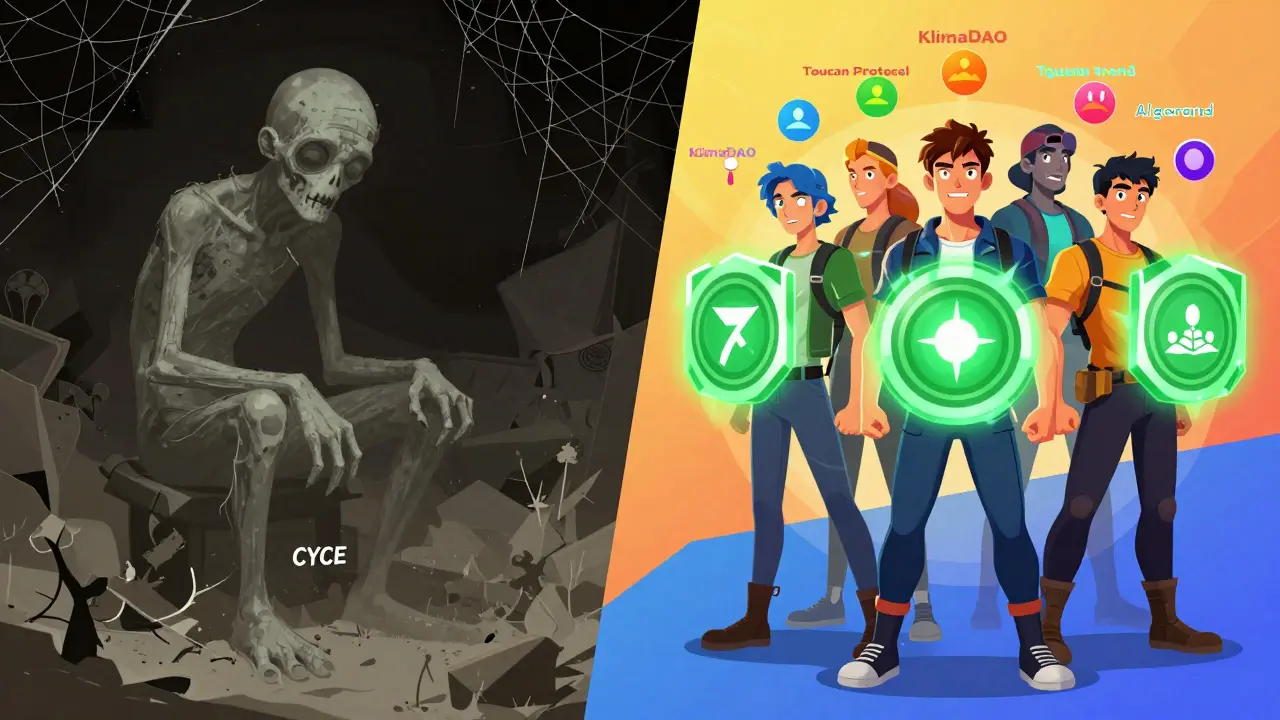
These projects have active communities, transparent governance, and measurable economic models. CYCE has none of these.
Is Crypto Carbon Energy (CYCE) still active?
Technically yes, the token exists on the Ethereum blockchain. However, it is effectively dormant with near-zero trading volume, minimal development activity, and no presence on major centralized exchanges. It should be considered a legacy or zombie asset.
Can I sell my CYCE tokens?
It is extremely difficult. With 24-hour trading volumes often reported as $0, finding a buyer is nearly impossible. Even if you find a decentralized exchange pair, the lack of liquidity means you would likely suffer massive slippage, receiving far less value than the quoted price suggests.
Why did CYCE lose so much value?
CYCE peaked during the 2021 bull run based on speculative hype around "green crypto." As the market corrected, the token failed to demonstrate real-world utility, such as tokenized carbon credits or revenue-generating mechanisms. Without fundamental value drivers, the price collapsed alongside broader market sentiment.
Is there a difference between CYCE and Crypto Carbon Energy OLD?
Yes. Data aggregators show a separate listing for "Crypto Carbon Energy [OLD]" with different pricing and market cap metrics. This indicates a past contract migration or split. Users must verify which contract address corresponds to the current intended version of the token to avoid holding obsolete assets.
Where can I buy CYCE in 2026?
CYCE is not available on major centralized exchanges like Coinbase or Binance. It can only be acquired via decentralized exchanges (DEXs) on the Ethereum network, such as Uniswap, by swapping ETH for CYCE using the correct smart contract address. Due to extreme illiquidity, this carries high risk.