
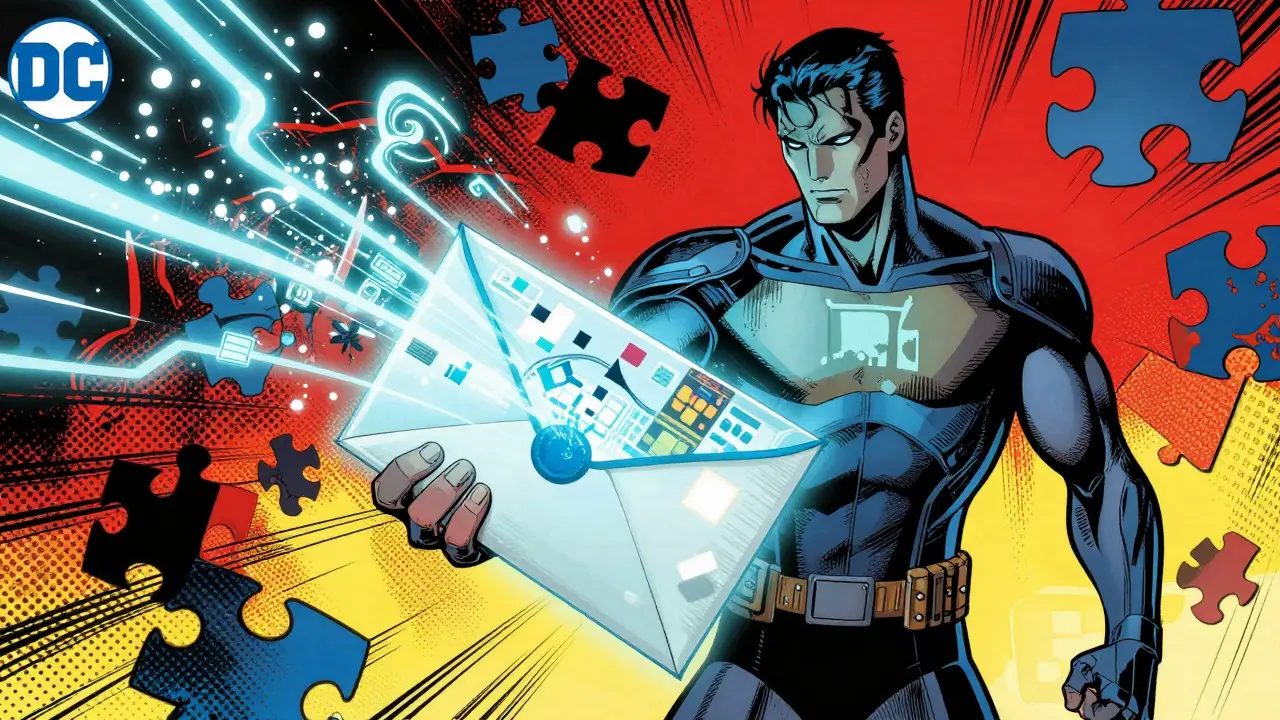
Imagine trying to mail a letter without an envelope. You could just hand it over, but how would the post office know where it goes, who sent it, or even that it’s a letter and not a receipt? In the world of blockchain, NFT token standards are those envelopes. They are the predefined sets of rules that tell blockchains how to create, track, and transfer unique digital assets.
Without these standards, every Non-Fungible Token (NFT) would be a custom-built puzzle piece that fits nowhere else. Your wallet wouldn’t recognize your art, marketplaces couldn’t list your collectibles, and developers would spend months building bridges between incompatible systems. These protocols ensure that whether you’re buying a digital pet on Ethereum or trading in-game gear on Solana, the underlying technology speaks a common language regarding ownership and value.
The Origin Story: Why We Needed Standards
To understand why these rules matter, we have to look back at 2017. The crypto world was obsessed with fungible tokens-coins like Bitcoin or Ethereum that are identical and interchangeable. One Bitcoin equals another Bitcoin. But what if you wanted to represent something unique, like a deed to a house or a one-of-a-kind digital painting?
Enter CryptoKitties. This game allowed users to buy, sell, and breed virtual cats. Each cat was unique, coded with different traits. When CryptoKitties launched on Ethereum, it was so popular that it clogged up the entire network. People realized quickly that the existing tools weren’t built for unique items. This chaos led Dieter Shirley, then CTO of Axiom Zen, to propose a solution in January 2017. By June 2018, this proposal became ERC-721, the first official standard for non-fungible tokens on Ethereum.
This wasn’t just about fixing a bug; it was about creating a framework for digital scarcity. Before ERC-721, proving you owned a specific digital file was messy and unreliable. The standard provided a cryptographic proof of ownership that anyone could verify, laying the groundwork for the multi-billion dollar NFT industry we see today.
ERC-721: The Original Blueprint
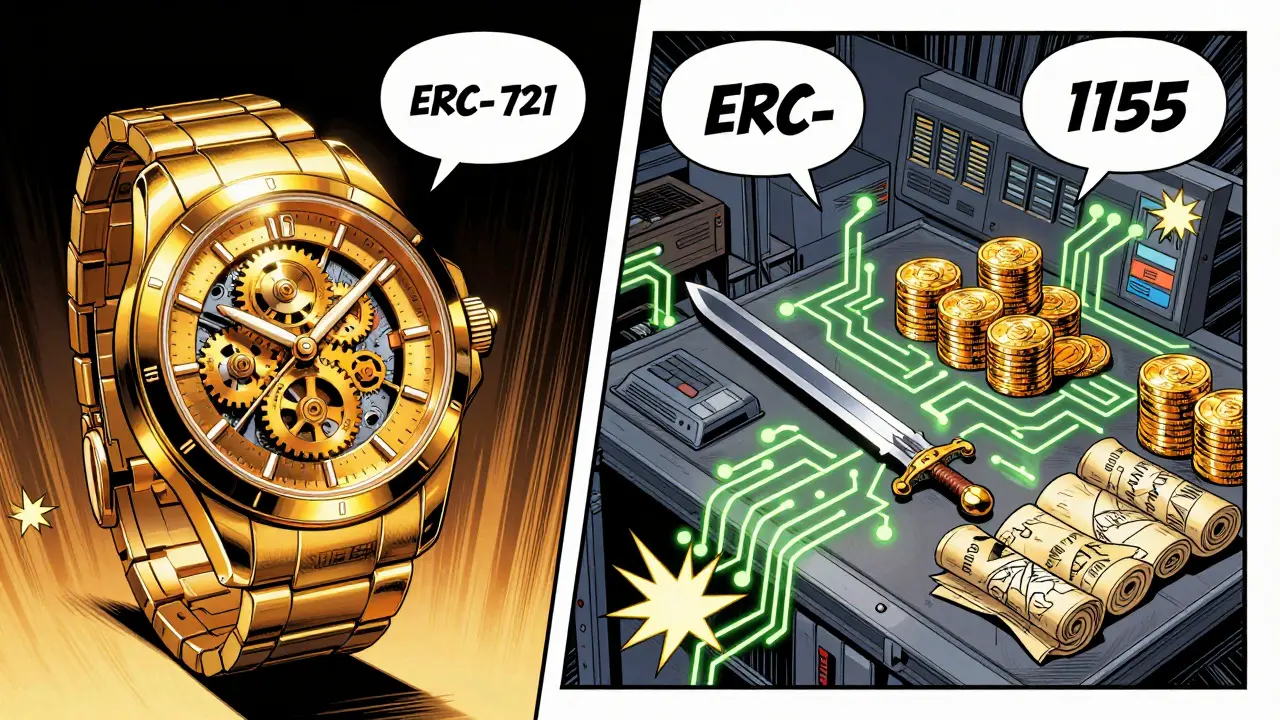
ERC-721 is the most famous NFT standard. It acts as the blueprint for single, unique tokens. Think of it like a serial number on a luxury watch. Every watch has a unique ID, and that ID proves its authenticity and history.
Technically, ERC-721 requires smart contracts to implement specific functions. For example, the contract must know who owns a specific token ID (`ownerOf`) and how many tokens an address holds (`balanceOf`). Crucially, each token within an ERC-721 contract has a unique identifier that cannot be duplicated. If you mint Token #1, no other token in that same collection can ever be Token #1 again.
This simplicity is its greatest strength. Because it’s the original, almost every major marketplace-OpenSea, Rarible, LooksRare-supports it out of the box. However, this simplicity comes with a cost. ERC-721 treats every token as an individual entity. If you want to send ten different ERC-721 NFTs to a friend, you need to execute ten separate transactions. On a congested network like Ethereum, this means paying gas fees ten times over, which can get expensive fast.
ERC-1155: The Multi-Token Powerhouse
If ERC-721 is a serial number, ERC-1155 is a warehouse inventory system. Proposed by Witek Radomski from Enjin in 2018, this standard was designed to solve the inefficiency of handling multiple types of tokens.
With ERC-1155, a single smart contract can manage thousands of different token types. Some might be unique (like a rare sword), while others might be semi-fungible (like 1,000 gold coins). The magic happens during transfers. Instead of sending ten separate transactions for ten different items, ERC-1155 allows you to batch them into one transaction. This can reduce gas costs by up to 90% compared to ERC-721.
This makes ERC-1155 incredibly popular for gaming. Imagine a game where you own a character skin (unique), some ammo (fungible), and a rare map (semi-fungible). Managing all these assets under one standard simplifies the backend for developers and saves players money. However, because it’s more complex, fewer wallets and marketplaces support it fully compared to ERC-721, though adoption is growing rapidly.
Beyond Ethereum: Solana, Flow, and Tezos
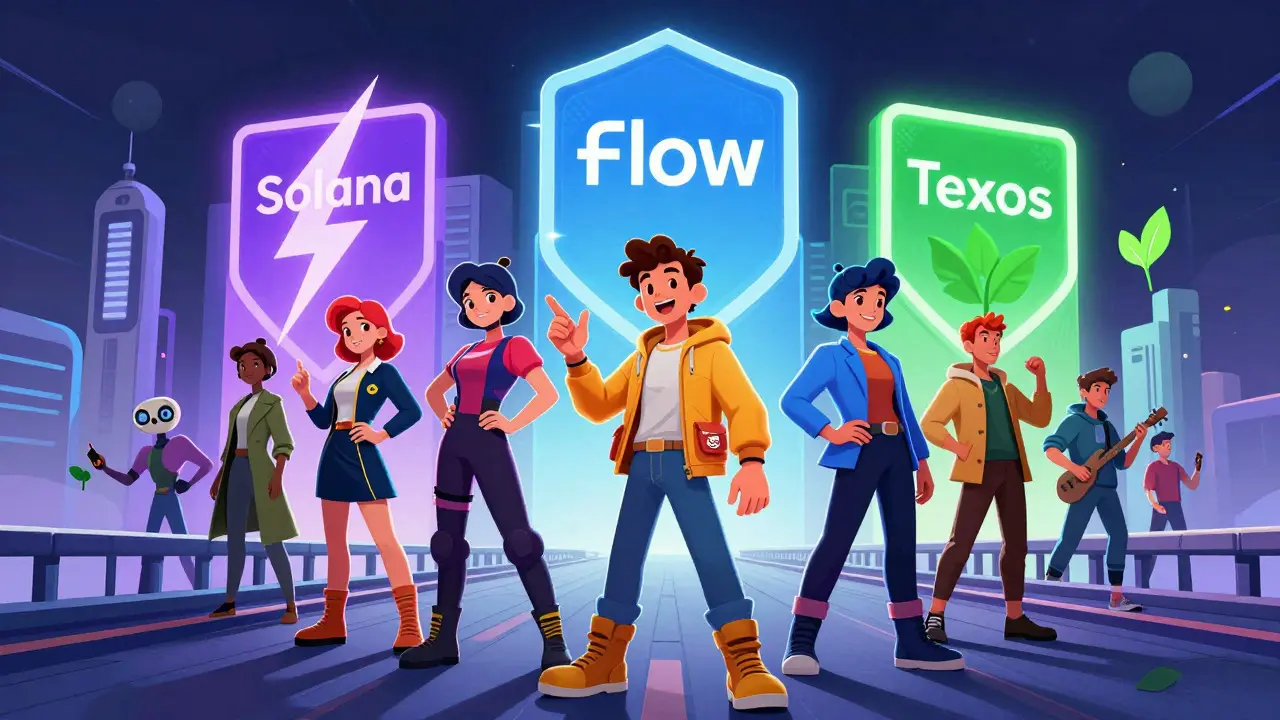
Ethereum isn’t the only player in town. Other blockchains have developed their own standards to address speed, cost, and environmental concerns.
Solana uses a model based on accounts rather than traditional smart contracts. Its NFTs are stored in separate accounts linked to the main wallet. This approach allows for sub-second finality and transaction costs often less than a penny. While incredibly fast, this account-based structure can sometimes cause compatibility issues with certain wallets that expect the Ethereum-style contract model.
Flow, created by Dapper Labs (the team behind NBA Top Shot), uses a programming language called Cadence. Flow’s standard focuses heavily on user experience. It eliminates the need for users to hold native cryptocurrency to pay for gas fees when receiving NFTs, removing a major friction point for new users. Flow processes thousands of transactions per second, making it ideal for high-volume consumer applications.
Tezos offers the FA2 standard, which emphasizes formal verification-a mathematical method to prove code is secure. Tezos is also known for its eco-friendly proof-of-stake consensus, attracting artists concerned about the carbon footprint of blockchain activity. While smaller in market share, Tezos has a strong community focused on digital art and sustainability.
| Standard | Best For | Transaction Cost | Key Advantage | Main Limitation |
|---|---|---|---|---|
| ERC-721 | Unique Art & Collectibles | High (on Ethereum) | Universal Compatibility | No Batch Transfers |
| ERC-1155 | Gaming & Virtual Goods | Low (via batching) | Multi-Token Support | Complex Metadata |
| Solana NFT | High-Volume Trading | Very Low (<$0.01) | Speed & Finality | Wallet Interoperability |
| Flow NFT | Consumer Apps | Low ($0.001) | User Experience | Limited Marketplace Support |
Emerging Trends: Composable and Account-Bound NFTs
The technology isn’t standing still. Newer standards are addressing limitations of the early models. ERC-998 introduced "composable NFTs," allowing one NFT to own other tokens. Imagine a digital spaceship NFT that contains fuel (ERC-20 tokens) and weapons (other ERC-721 NFTs). You can transfer the whole ship in one go, maintaining the hierarchy of assets.
Even more revolutionary is ERC-6551, proposed in 2023. This standard gives NFTs their own blockchain wallet. Previously, an NFT was just a static image or video. With ERC-6551, your NFT can hold funds, sign transactions, and interact with other smart contracts. This turns NFTs into active agents in the digital economy, capable of earning rewards or accessing services independently of their owner’s main wallet.
Choosing the Right Standard for Your Project
If you’re a developer or creator, picking the right standard depends on your goals. Ask yourself these questions:
- Do you need maximum visibility? If yes, stick with ERC-721 on Ethereum. It has the largest audience and most robust infrastructure.
- Are you building a game with many items? Use ERC-1155. The gas savings and ability to handle both unique and common items will save you and your users significant resources.
- Is speed and low cost critical? Look at Solana or Polygon. These networks offer faster confirmations and lower fees, essential for high-frequency interactions.
- Do you care about environmental impact? Consider Tezos or Flow. Both use energy-efficient consensus mechanisms, appealing to eco-conscious communities.
Remember, interoperability is becoming easier. Tools now exist to bridge NFTs between chains, but starting with the right native standard reduces technical debt and improves user experience from day one.
Common Pitfalls to Avoid
One major issue across all standards is metadata storage. Many creators store the image link on centralized servers. If that server goes down, the NFT points to nothing. Always use decentralized storage solutions like IPFS or Arweave to ensure your asset remains accessible forever.
Another pitfall is ignoring gas optimization. Poorly written smart contracts can cost users significantly more to interact with. For Ethereum projects, auditing your code for gas efficiency is not optional-it’s essential for competitiveness.
Finally, don’t underestimate legal clarity. While the tech defines ownership on-chain, real-world rights depend on the terms of service you provide. Make sure your smart contract includes clear licensing information so buyers know exactly what they are purchasing.
What is the difference between ERC-721 and ERC-1155?
ERC-721 is designed for unique, individual tokens where each token has a distinct identity. ERC-1155 is a multi-token standard that allows a single contract to manage both unique and fungible tokens, enabling batch transfers that significantly reduce transaction costs.
Which NFT standard is best for gaming?
ERC-1155 is generally considered the best for gaming because it efficiently handles large numbers of items, such as weapons, skins, and currency, within a single contract. Solana’s NFT standard is also popular for gaming due to its high speed and low transaction fees.
Can I transfer NFTs between different blockchains?
Yes, through bridging protocols. However, this process involves wrapping the NFT on the destination chain, which creates a representation of the original asset rather than moving the actual token. Cross-chain interoperability is improving but still carries some technical risks.
Why do NFT standards matter for regular users?
Standards ensure that your NFTs are compatible with wallets and marketplaces. Without standards, you might buy an NFT that you can’t view, sell, or transfer because your software doesn’t understand how to read it. They provide security, predictability, and liquidity.
What is ERC-6551 and why is it important?
ERC-6551 introduces token-bound accounts, giving NFTs their own wallets. This allows NFTs to hold other assets, earn yield, and interact with decentralized applications autonomously, transforming them from static images into functional digital entities.
Phil Babb
July 27, 2026 AT 02:17Great breakdown! The envelope analogy really clicked for me. It's wild how much infrastructure we take for granted now. I remember the early days of CryptoKitties clogging the network, and it was chaos. Standards like ERC-721 saved us from that mess. Keep up the good work explaining these complex topics!
Dominic Greco
July 28, 2026 AT 19:47They want you to think these standards are about 'efficiency' but it's all about control. 🚩 The big tech bros behind Ethereum and Solana are just building a new walled garden. ERC-1155? Sounds like a way to track every single digital asset you own so they can tax you later. Wake up sheeple! 🐑💸
Sean Rowland
July 28, 2026 AT 22:30The semantic implication of your 'envelope' metaphor is fundamentally flawed. An envelope implies privacy, whereas blockchain is inherently transparent. Furthermore, suggesting that ERC-721 is merely a 'serial number' ignores the ontological shift in property rights. You are oversimplifying a complex cryptographic protocol into a mere logistical tool. It is reductive.
Sus Sawyer
July 28, 2026 AT 23:47Yo, this is super helpful! I've been tryna figure out why my gas fees were so high when moving items in-game. Turns out ERC-1155 is the way to go for batching. Thanks for clarifying the diff between the two. Makes sense now. Gotta love how tech evolves to save us cash. 🙌
Aryan MISHRA
July 29, 2026 AT 08:35Incorrect assumptions. ERC-721 is not obsolete; it is foundational. However, if you are building on L2s, the gas difference is negligible. Stop focusing on mainnet costs. Focus on composability. ERC-6551 is the future. Learn it.
Ryan Robinson
July 30, 2026 AT 06:01i mean its cool stuff but honestly who cares about the technical specs? just make sure the art looks good lol. most people dont even know what a smart contract is let alone an erc standard. keep it simple peeps.
Earl Kott65
August 1, 2026 AT 05:41Oh, look at you, trying to be educational! 😂 But seriously, did you mention Polygon? Because if you're talking about low fees, you can't ignore them. And don't get me started on the environmental impact of PoW vs PoS. It's a whole drama fest out there. 🎭✨
Ethan Yuwono
August 2, 2026 AT 00:18It makes one wonder about the nature of ownership itself. If an NFT has its own wallet via ERC-6551, does it have agency? Or is it just a clever trick? We are blurring the lines between tool and entity. Interesting times.
Jack Delasquez
August 3, 2026 AT 05:19so basically if u r a dev use 1155 for games and 721 for art. got it. thanks for the info. hope this helps everyone else too. no more confusion hopefully.
Harman Singh
August 3, 2026 AT 16:17I feel like nobody understands the real pain here. My collection is stuck on a chain with high fees and now I have to bridge it. It's exhausting. Why can't things just work seamlessly? I'm tired of reading about standards that change every month. Just give me my assets back.
Qolbina Islami
August 4, 2026 AT 06:25America built the internet! America should build the blockchain standards! Why are we looking at Tezos or Flow? Stick to Ethereum, the American standard! Don't let foreign chains dilute our digital sovereignty! 🇺🇸🇺🇸🇺🇸
SUBHAM CHOUDHURY
August 5, 2026 AT 12:22Nice article. Very informative. Good luck to all developers choosing their stack. Hope you find the right fit for your project. Peace.
Joy Kwant
August 7, 2026 AT 07:55You forgot to mention how these standards contribute to the carbon footprint crisis. It's selfish to promote NFTs without addressing the environmental damage. Until then, it's all just vanity projects for the rich. Disappointing.
amy miranda
August 7, 2026 AT 09:06This is utterly lacking in depth. A 'clear guide'? Please. You skimmed the surface. Where is the discussion on metadata pinning failures? Where is the legal precedent analysis? Sloppy journalism at its finest. I expected better.
Pernelia Wahkan
August 7, 2026 AT 23:40The concept of composable NFTs is fascinating. Imagine a digital spaceship that owns its fuel. That’s a paradigm shift in how we view digital assets. It’s not just a picture anymore; it’s a functional unit. Great insight on ERC-998.
Subhash Kashyap Dm
August 9, 2026 AT 08:25ERC-1155 is a trap. Centralization vector. Single point of failure if the contract is hacked. Stick to 721. Decentralization purists know this. Don't be fooled by the gas savings narrative. It's a honeypot.
Billy Cunningham
August 10, 2026 AT 15:03Boring. 🥱