
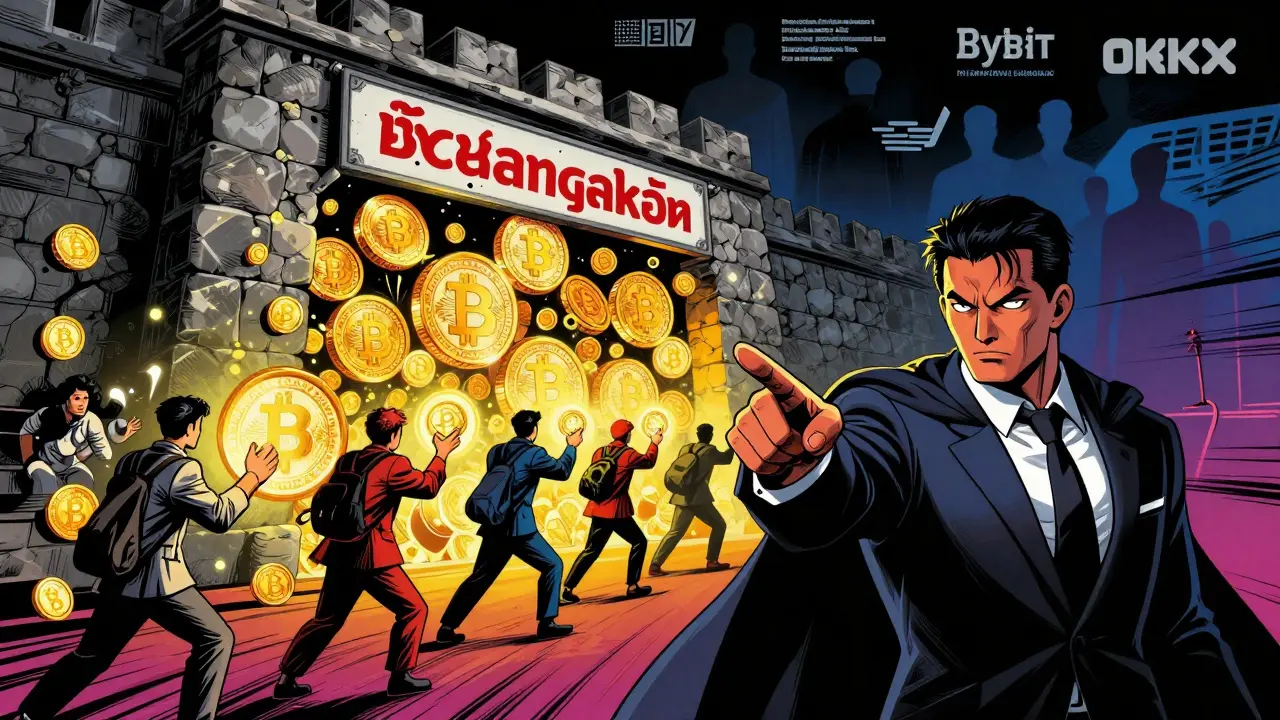
If you are trying to trade cryptocurrency in Thailand using your favorite global app, you might have noticed a sudden wall. The days of unrestricted access to international platforms like Bybit or OKX are over for Thai residents. As of mid-2025 and continuing into 2026, the Thailand Securities and Exchange Commission (SEC) has tightened its grip on the industry with some of the strictest rules in Southeast Asia. This isn't just about taxes; it is about total control over who can offer services to Thai citizens.
The core of this crackdown comes from the amended Digital Asset Business Act, specifically updated through emergency decrees in April 2025. The goal? To stop money laundering, crush online fraud, and protect local investors. But for traders, the result is a fragmented market where liquidity has dropped, fees have risen, and choice has shrunk. If you are operating an exchange or trading as an individual, understanding these specific restrictions is no longer optional-it is mandatory to avoid heavy fines or blocked assets.
How the SEC Defines "Serving" Thai Users
The biggest shift in the 2025 regulations is how the Thai SEC determines if a foreign platform is doing business in Thailand. You don't need a physical office in Bangkok to be considered a local operator. The SEC uses a seven-point test to decide if you are targeting Thai users. If your platform hits even one of these criteria, you must apply for a license.
- Your website or app interface is displayed in the Thai language, even partially.
- You use a domain name ending in ".th" or ".ไทย" or any other Thailand-specific naming convention.
- You accept payments in Thai Baht (THB) or allow deposits from Thai bank accounts and electronic money wallets.
- Your terms of service specify Thai law as the governing jurisdiction or Thai courts for dispute resolution.
- You pay search engines or marketing channels to appear in results for users located in Thailand.
- You establish customer support offices or hire personnel specifically to assist Thai users.
- Any other characteristics defined by subsequent SEC notifications.
This extraterritorial reach means that simply blocking IP addresses from Thailand is not enough if you still facilitate transactions via Thai banks or use Thai-language marketing. The Ministry of Digital Economy and Society (MDES) has been given the power to block unlicensed platforms instantly, without needing a court order. This rapid enforcement mechanism was used effectively in late 2025 to shut down several major offshore peer-to-peer networks.
Licensing Requirements for Exchanges
If you fall under the definition of serving Thai users, you cannot operate without a license. The process is rigorous and expensive. According to SEC Notification No. TorJor.12/Aor.123/2568, applicants must submit documentation within 30 days of starting operations that target Thai users. The financial barrier to entry is high, designed to filter out small or unstable operators.
| Requirement | Detail / Value |
|---|---|
| Application Fee | ฿1,000,000 (approx. $27,400) |
| Annual License Fee | ฿500,000 (approx. $13,700) |
| Minimum Operational Capital | ฿50 million (approx. $1.37 million) |
| Compliance Standards | FATF-aligned AML/CFT systems required |
| Technical Audit | Source code audit by SEC-approved firms |
| Approval Timeline | 90-120 days average |
Beyond the money, the technical requirements are steep. Operators must prove they have Anti-Money Laundering (AML) and Counter-Financing of Terrorism (CFT) systems that meet Financial Action Task Force (FATF) standards. This includes real-time transaction monitoring. Bitkub Exchange, Thailand's largest licensed portal, reported spending six months implementing full compliance after the new rules took effect. For smaller exchanges, this timeline and cost structure often lead to withdrawal from the Thai market entirely.

Operational Restrictions for Licensed Platforms
Getting a license doesn't mean you can do whatever you want. The Thai SEC imposes strict operational boundaries on licensed digital asset business operators. These restrictions are designed to keep crypto strictly as an investment asset, not a currency for daily life.
- No Privacy Coins: Licensed exchanges are prohibited from listing or providing services for privacy-focused cryptocurrencies like Monero or Zcash. The rationale is transparency for anti-fraud efforts.
- No Payment Facilitation: Exchanges cannot promote digital assets as payment for goods and services. They are also banned from facilitating transfers for payment purposes.
- No Lending or Deposit-Taking: Offering staking services with promised fixed returns or lending facilities is restricted. While some staking is allowed, it must not resemble traditional banking deposits with guaranteed yields.
- Limited Token Selection: Only tokens approved by the SEC can be listed. As of June 2025, only 35 tokens were approved for trading on local exchanges, compared to hundreds on international platforms.
- Ban on Speculative Assets: Meme tokens, fan tokens, and Non-Fungible Tokens (NFTs) are explicitly prohibited from being traded on local exchanges.
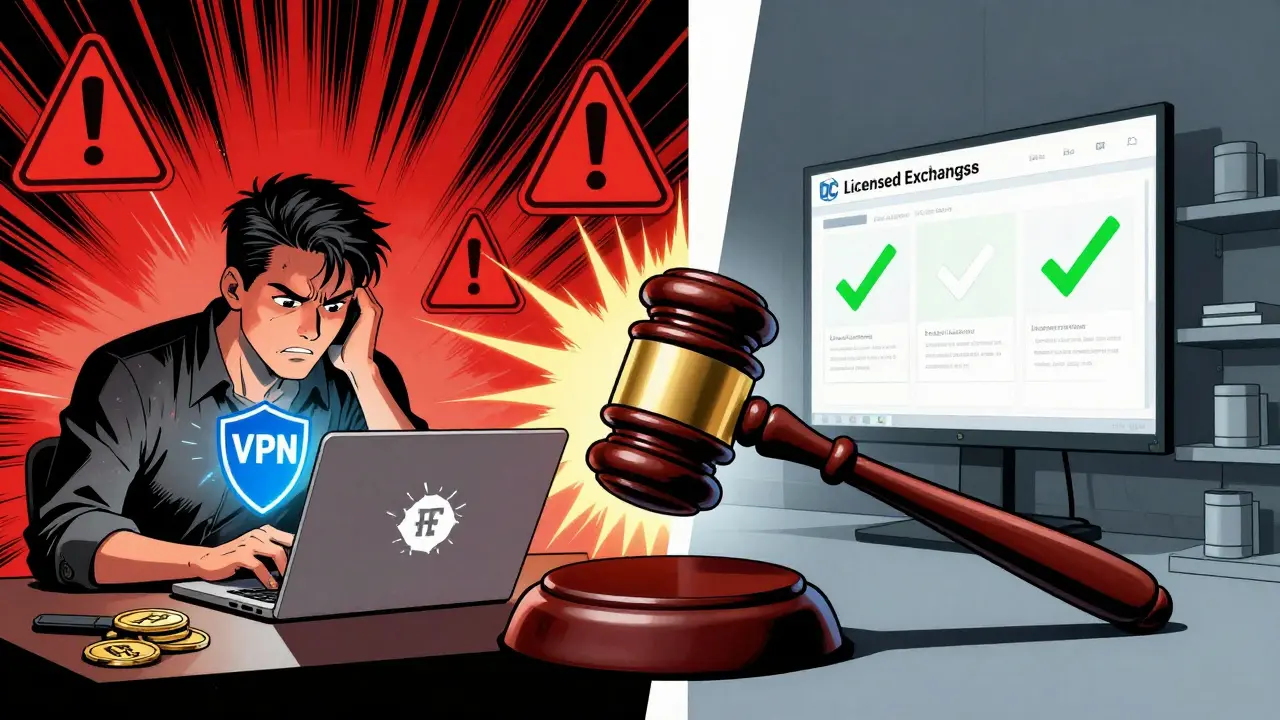
These rules create a sanitized but limited trading environment. Investors looking to diversify into altcoins or engage with Web3 culture find themselves locked out of the regulated domestic ecosystem. This has led to a phenomenon known as "regulatory arbitrage," where users turn to Virtual Private Networks (VPNs) to access foreign platforms. Chainalysis estimates that 35% of Thai crypto activity migrated offshore via VPNs shortly after the April 2025 changes.
Impact on Traders and Market Liquidity
For the average Thai trader, the impact has been mixed. On one hand, security has improved significantly. The Royal Thai Police Cybercrime Investigation Division reported a 37% decrease in crypto-related fraud cases in Q2 2025 compared to the previous quarter. Scams involving fake ICOs and phishing links have become harder to execute when major fraudulent platforms are blocked at the ISP level.
However, the cost of trading has gone up. With fewer competitors, the remaining licensed exchanges like Bitkub, Zipmex (restructured), and CoinGeek have less pressure to lower fees. Average transaction fees on local platforms sit around 0.25%, whereas international giants offered rates closer to 0.1%. Furthermore, liquidity is thinner. Wider spreads mean you buy higher and sell lower than you would on a global exchange.
User sentiment on Pantip.com, Thailand's largest discussion forum, reflects this divide. One highly upvoted thread praised the "more secure trading environment" since foreign scams vanished. Another, with even more votes, complained about "reduced liquidity and wider spreads." Serious traders face another hurdle: withdrawal limits. Bitkub, for instance, caps daily withdrawals at ฿500,000 (approx. $13,700), which is restrictive for institutional or high-volume retail traders.
Comparison with Regional Frameworks
To understand why Thailand's approach feels so rigid, it helps to compare it with neighbors. Singapore's Monetary Authority (MAS) allows significant foreign participation and has a clearer path for stablecoin regulation. Japan's Financial Services Agency requires local licensing similar to Thailand but does not apply the same aggressive extraterritorial tests to foreign apps. China, of course, has a complete ban.
Thailand sits in a unique middle ground: stricter than Singapore on consumer protection and fraud prevention, but more open than China. However, it lacks the clarity of the European Union's MiCA framework regarding stablecoins and cross-border passporting. This means a company licensed in Thailand cannot easily expand to other ASEAN countries, and vice versa. The lack of harmonization creates friction for regional fintech companies.
Future Outlook: DeFi and CBDCs
The regulatory landscape is not static. The SEC has outlined a roadmap for further amendments in Q4 2025 focusing on Decentralized Finance (DeFi). Currently, DeFi protocols operate in a gray area, but the government intends to bring them under scrutiny, likely requiring developers to register or face blocking. Additionally, a pilot project integrating a Central Bank Digital Currency (CBDC) with licensed exchanges is expected in Q2 2026. This could fundamentally change how fiat enters the crypto market, potentially bypassing traditional banking rails entirely.
Despite the restrictions, the market is growing. Thailand's digital asset market was valued at $1.2 billion in Q1 2025, with 4.7 million active users. Analysts project a 22% compound annual growth rate through 2028. The government remains committed to blockchain innovation, allocating ฿2.1 billion for development projects through 2027. The challenge will be balancing this innovation drive with the intense desire to protect citizens from financial harm.
Can I still use Bybit or OKX in Thailand?
No, not legally. These platforms were shut down in the Thai market following the April 2025 regulatory changes because they did not hold a local license. Using them via VPN may work technically, but it violates Thai regulations and carries risks of account freezing or legal penalties.
Which crypto exchanges are licensed in Thailand?
As of early 2026, there are nine licensed entities. The most prominent include Bitkub, CoinGeek, and others. You can verify the current list on the official SEC Thailand licensing database at market.sec.or.th.
Why are meme coins banned in Thailand?
The SEC considers meme coins, NFTs, and fan tokens to be highly speculative and lacking intrinsic value, posing a high risk of fraud and loss for retail investors. Therefore, they are prohibited from being listed on licensed domestic exchanges.
What happens if I run an unlicensed exchange?
Penalties are severe. They include heavy fines and potential prison terms. Additionally, the Ministry of Digital Economy and Society can block your website instantly without a court order, making your service inaccessible to all Thai users.
Is Bitcoin ETF trading available in Thailand?
Yes, but currently only for Bitcoin and Ethereum. The SEC has approved ETF products for these two assets. Altcoin ETFs are planned for expansion in 2026, which could unlock significant new investment capital.