
Quick Takeaways
- MEXC Global currently offers the lowest entry point with 0.00% maker fees.
- Binance remains the gold standard for balance between liquidity and cost, especially for BNB holders.
- Kraken is more expensive but provides significantly better security and regulatory compliance for US users.
- Using limit orders instead of market orders can cut your costs by 20% to 100% depending on the exchange.
- Holding a platform's native token (like BNB or KCS) is the fastest way to trigger a fee discount.
How Spot Trading Fees Actually Work
Before comparing numbers, you need to understand the Maker-Taker Model is a pricing structure where users are charged different rates based on whether they provide or remove liquidity from the order book. If you place a limit order-meaning you set a specific price and wait for someone to hit it-you are a "maker." You're adding liquidity to the market, so exchanges reward you with lower fees.
On the flip side, if you use a market order to buy an asset immediately at the current price, you are a "taker." You are removing liquidity, and the exchange charges you a premium for the convenience. This distinction is why some exchanges can advertise "zero fees" while still making money from the majority of their users who prefer the speed of market orders.
Comparing the Top Exchanges by the Numbers
Not all exchanges are created equal. Some focus on aggressive growth by slashing fees to zero, while others charge a premium for institutional-grade security. For instance, MEXC Global is a cryptocurrency exchange known for its aggressive low-fee strategy and a wide variety of available trading pairs. They currently lead the pack with a 0.00% maker fee, making them a magnet for high-frequency traders.
Then you have Binance, the world's largest cryptocurrency exchange by trading volume, offering a tiered fee structure with significant discounts for native token holders. Their standard rates start at 0.08% for makers and 0.10% for takers. While not as low as MEXC, the massive liquidity means you're less likely to suffer from slippage on large orders.
For those prioritizing safety, Kraken is a US-based exchange focused on security and regulatory compliance, often utilizing SOC 2 Type 2 certifications. You'll pay more here-starting at 0.25% for makers and 0.40% for takers-but you get the peace of mind that comes with strict regulatory adherence.
| Exchange | Maker Fee | Taker Fee | Native Token Discount |
|---|---|---|---|
| MEXC Global | 0.00% | 0.05% | Available (MX) |
| Binance | 0.08% | 0.10% | Up to 25% (BNB) |
| KuCoin | 0.10% | 0.10% | Up to 20% (KCS) |
| Bybit | 0.10% | 0.10% | Volume Based |
| OKX | 0.14% | 0.23% | Tiered |
| Kraken | 0.25% | 0.40% | Volume Based |

The Hidden Cost of "Free" Trading
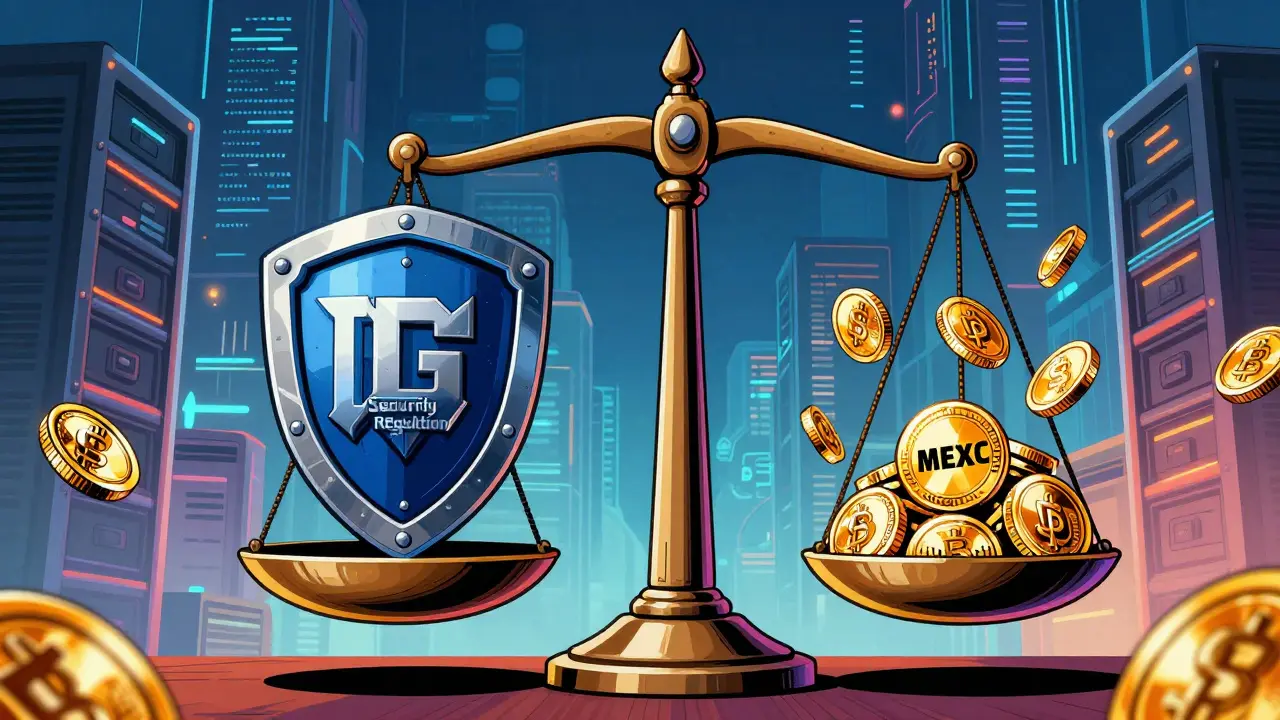
It is tempting to jump to the platform with the 0.00% fee, but you should always ask: where is the catch? Often, ultra-low-fee exchanges have higher withdrawal fees or less stringent security protocols. There is a documented history of users chasing the lowest fees only to lose everything in a hack. For example, the BitKRX incident saw 3,200 BTC stolen from a platform that prioritized zero fees over robust security.
Another hidden cost is liquidity. If an exchange has a low liquidity score, you might face "slippage." This happens when there aren't enough sellers at your target price, forcing the exchange to fill your order at a higher price. This "invisible fee" can easily outweigh the savings you get from a 0.00% maker fee. Kraken, despite higher stated fees, often has better liquidity on major pairs, which can actually make the total trade cheaper for whales.
Pro Strategies for Fee Optimization
If you want to stop leaking profits to the exchange, you need a system. Spot trading fees aren't set in stone; you can actively manipulate them to your advantage using these three methods:
- Switch to Limit Orders: Never use "Market Buy" or "Market Sell" if you aren't in a rush. By setting a limit price, you move from being a taker to a maker, instantly slashing your fee on platforms like Kraken or OKX.
- Leverage Native Tokens: Buy the platform's own coin. Using BNB on Binance or KCS on KuCoin allows you to pay your fees using those assets, triggering a discount of 20-25%.
- Monitor Your 30-Day Volume: Most exchanges use a tiered system. If you trade over $1 million in a month, you move into VIP tiers where fees drop significantly. For example, Binance's VIP 1 tier can bring fees down to 0.06%/0.08%.
CEX vs DEX: Where is the Real Value?
We can't talk about fees without mentioning Decentralized Exchanges (DEXs), which are peer-to-peer marketplaces where trades happen via smart contracts on a blockchain without a central intermediary. Platforms like Uniswap or PancakeSwap usually charge a flat fee around 0.25% to 0.30%.
At first glance, 0.30% looks expensive compared to Binance's 0.10%. However, the real killer on DEXs is the gas fee. On the Ethereum network, you might pay $1.50 to $5.00 just to execute the trade, regardless of the trade size. For someone trading $100, a $5 gas fee is a massive 5% loss. For someone trading $100,000, it's negligible. This is why centralized exchanges still handle about 92% of spot volume-they are simply more efficient for the average user.
The Future of Trading Costs
We are currently seeing a "race to the bottom." Competition from new entrants is forcing established giants to lower their rates. Analysts predict that average maker fees could drop to 0.05% across the board by mid-2026. However, don't expect this in the US. Regulatory pressure and the cost of compliance (like the SEC's Digital Asset Market Structure rules) mean that US-compliant exchanges will likely always be 15-25% more expensive than global alternatives.
What is the difference between a maker and a taker fee?
A maker fee is charged to users who provide liquidity to the order book by placing a limit order that isn't filled immediately. A taker fee is charged to users who "take" liquidity by executing a market order that fills immediately. Maker fees are almost always lower than taker fees because exchanges want to attract more limit orders to make their market look active and stable.
Which exchange has the absolute lowest fees in 2026?
Currently, MEXC Global offers the lowest standard fees with 0.00% for makers and 0.05% for takers. However, if you hold native tokens like BNB on Binance, the effective cost can be very similar, while offering much higher liquidity and better security.
Do native tokens actually save me money?
Yes, but only if the token's value stays stable. Using BNB on Binance can reduce fees by up to 25%. The risk is that you have to hold the token to get the discount; if the token price crashes by 30%, your fee savings are wiped out by the loss in the token's value.
Why are US-based exchanges more expensive?
US exchanges like Kraken or Coinbase face much higher operational costs due to strict KYC (Know Your Customer) and AML (Anti-Money Laundering) regulations. They pass these compliance costs onto the user through higher trading fees to avoid massive fines from the SEC and other regulators.
Are DEX fees better than CEX fees?
It depends on your trade size. CEXs (Centralized Exchanges) have lower percentage fees and no gas costs. DEXs (Decentralized Exchanges) have flat fees but require you to pay blockchain gas fees. For small trades, CEXs are far cheaper. For very large trades where privacy is a priority, DEXs may be preferable despite the gas costs.
Next Steps for Traders
If you are a beginner, start by simply switching from market orders to limit orders. It is the easiest way to save money without needing to buy extra tokens or hit high volume tiers. Use the fee calculators on the exchange's website to estimate your cost before hitting the buy button.
For professional traders, it's time to audit your monthly volume. If you are crossing the $1 million mark, contact the exchange's VIP support to ensure you are placed in the correct tier. Also, consider diversifying your liquidity across two platforms-one for ultra-low fees (like MEXC) and one for maximum security and fiat off-ramps (like Kraken)-to balance cost and risk.
Eric Raines
April 20, 2026 AT 14:44Honestly, anyone still using market orders in 2026 is just begging to lose money. It's basic math. You're literally paying a convenience tax for being too lazy to set a limit price. I've been telling people for years that the maker-taker gap is where the house wins. Most of you just don't get how the order book actually functions, but hey, keep donating your profits to the exchange if that's your vibe.
Benjamin Forg
April 21, 2026 AT 23:42all these platforms just different ways to steal your keys man the fees are just a distraction to keep you from noticing the backdoors in the code its all a game played by the elites to keep us in the loop while they exit liquidly into gold
jill huyo-a
April 23, 2026 AT 20:00It's really helpful to see the comparison between CEX and DEX costs. I think for those of us just starting out, the gas fee explanation is the most important part because it's so easy to overlook when you're just looking at the percentage fee on a screen. Maybe we could all share which native tokens we've found most stable for fee discounts?
Jagdish Sutar
April 24, 2026 AT 21:36For my friends in India, remember that local regulations might affect which of these exchanges are most accessible. I always suggest starting with a small amount to test the withdrawal process specifically, as that's where the real cost often hides.
Hannah Rubia
April 26, 2026 AT 18:32I would like to provide some additional context regarding the SOC 2 Type 2 certifications mentioned. This certification ensures that a service provider manages its data securely to protect the interests of the organization and the privacy of its clients. While the fees at Kraken are indeed higher, the institutional-grade security framework provides a level of risk mitigation that is not present in ultra-low-fee alternatives.
Matthew Morse
April 28, 2026 AT 13:53just use limit orders and stop complaining
Yvette P
April 29, 2026 AT 01:11Oh sure, let's all just trust the "institutional-grade security" while we're getting absolutely slaughtered by 0.40% taker fees because we're in the US. It's just so adorable that people think paying a premium for a SOC 2 certificate actually stops a sophisticated hot-wallet drain. If you're not optimizing your delta-neutral strategies and leveraging tiered volume rebates, you're basically just playing a very expensive game of pretend with your portfolio. Honestly, the slippage on these high-compliance platforms can be absolutely legendary if you're trying to move any real size without a sophisticated algorithm, so enjoy your "peace of mind" while your actual alpha gets eaten by the spread and the regulatory overhead. It's a masterclass in inefficiency, really.
Mary Tawfall
April 30, 2026 AT 18:04I'm sure there's a middle ground here! We can definitely prioritize security without feeling like we're losing everything to fees. It's all about finding that sweet spot for your own risk tolerance.
Keith Garcia
May 1, 2026 AT 21:32Imagine actually believing that a 0.05% difference is the hill to die on while ignoring the sheer lack of sophistication in most of these platforms 🙄. It's truly quaint. The plebeian obsession with "cheap" fees over actual execution quality is just... chef's kiss 🤌. Get some real software or just keep clicking buttons on a website like it's 2014 💅.
Miranda Jamieson
May 3, 2026 AT 05:37Most of you are just too scared to use a DEX. If you can't handle a bit of gas, get out of the market. Stop whining about CEX fees when you're too incompetent to manage your own private keys.
Candace Sherrard
May 4, 2026 AT 19:01It's interesting how we quantify value in these digital spaces. We spend so much time analyzing the minuscule fractions of a percent, yet we ignore the psychological toll of constant monitoring. Perhaps the real cost of a "cheap" exchange is the time we spend stressing over the order book rather than just holding and letting the technology evolve around us in a more natural cadence.
Jennifer L
May 6, 2026 AT 05:09Oh my goodness!! I am just so heart-broken for the people who lost everything in the BitKRX incident!! It is truly a tragedee when greed blinds us to the safety of our assets. Please, please be carefull everyone!!
Charlie Queen
May 7, 2026 AT 17:33Love the breakdown! 🚀 Really helps clear up the confusion for the newcomers. Let's keep the vibes positive and just keep stacking! 💎🙌
Paige Raulerson
May 8, 2026 AT 06:24This list is barely exhaustive. There are dozens of offshore platforms with even lower fees, but I suppose for the average user, this basic overview is sufficient. I find it tedious that we have to keep explaining the concept of liquidity to people who barely trade a hundred dollars a month.
Guy Bianco
May 8, 2026 AT 12:38I appreciate the detailed comparison. For those who are cautious, I would suggest using hardware wallets in conjunction with any exchange you choose. (^_^) It is the only way to truly mitigate the risks mentioned in the "hidden costs" section.
Findlay Duncan Lyon
May 8, 2026 AT 15:15Spot on. Use limit orders. Save money. Simple.
Larry Yang
May 8, 2026 AT 15:53the math on the dex section is a bit oversimplified but whatever. most people dont even know what a gwei is anyway so why bother with precision when the target audience is just trying to buy some meme coin with their stimulus check lol
Sara Ellis
May 9, 2026 AT 04:50i just buy what i like and dont look at the fees it doesnt really matter in the long run if the coin goes to the moon right
Jennifer Taylor
May 10, 2026 AT 06:34They want you using these exchanges so they can track your every move. The "fee discounts" are just bribes to get you to hold their tokens so they can manipulate the price and rug pull you when the government gives the signal.
Tara Aman
May 10, 2026 AT 15:37This is such a great guide! I'm definitely going to try the native token route to see how much I can save. Let's all try to be more mindful of these small leaks in our profits!
debashish sahu
May 11, 2026 AT 09:05I believe focusing on the lowest fee might lead some to overlook the quality of the platform's user interface and customer support, which are also very important for a peaceful trading experience.