
Trading perpetuals with up to 100x leverage sounds like a dream for aggressive traders. You want the speed of centralized exchanges but the security of keeping your keys. That is exactly what KTX.Finance promises. Built on the BNB Chain, this decentralized exchange (DEX) markets itself as a capital-efficient hub where you can trade without counterparty risk. But does it actually deliver on that promise, or is it another high-risk DeFi protocol waiting to break?
In this review, we cut through the marketing hype. We look at how the single multi-asset pool works, why the native KTC token has seen wild volatility, and whether the backing from investors like Hashed Fund means anything for your safety. If you are thinking about connecting your wallet to KTX.Finance in 2026, you need to understand the mechanics before you risk your capital.
How KTX.Finance Works: The Single Pool Model
Most decentralized derivatives exchanges use isolated pools for each trading pair. This creates liquidity fragmentation. If you want to trade BTC/USDT, you need liquidity there. If you want ETH/USDT, you need separate liquidity there. KTX.Finance takes a different approach.
The platform uses a single multi-asset pool design. Instead of siloed markets, all assets feed into one massive liquidity reservoir. When you open a leveraged position, you are essentially borrowing against this collective pool. For liquidity providers (LPs), this means their capital works harder. They earn fees from all trading activity across the platform, not just one specific pair.
This model offers two main benefits:
- Higher Capital Efficiency: LPs don't have to guess which pairs will be popular. Their assets are utilized wherever demand exists.
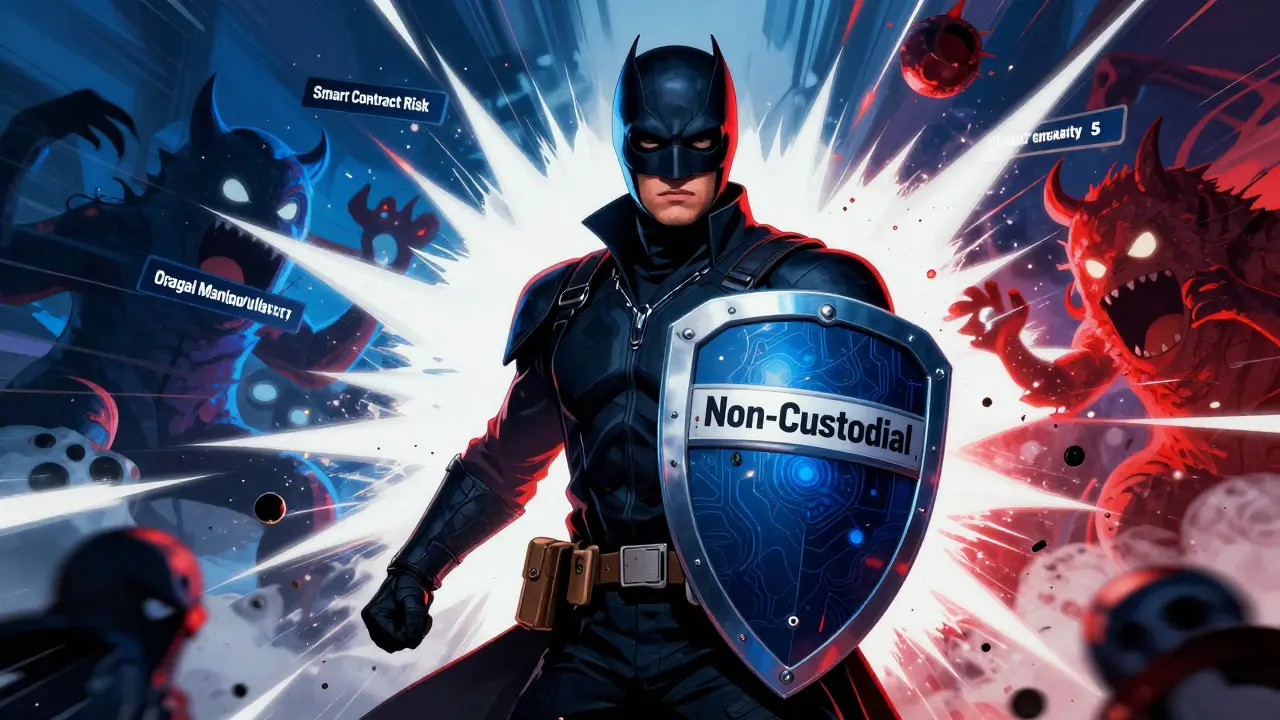
- No Counterparty Risk: Unlike centralized exchanges (CEXs) where the house holds your funds, here you trade against the smart contract's pool. There is no middleman who can freeze your account or go bankrupt with your money.
However, this efficiency comes with complexity. The smart contracts managing this single pool must handle intricate accounting to ensure solvency during market crashes. If the pool becomes undercollateralized due to extreme volatility, the mechanism for liquidating positions needs to be flawless. One bug in this logic could drain the entire pool.
Trading Features and User Experience
KTX.Finance supports spot trading, margin trading, and perpetual futures. The headline feature is the leverage. You can trade with up to 100x leverage. Let’s be clear: 100x leverage is not for beginners. A 1% move against your position wipes out your entire margin. It is a tool for professionals who manage risk tightly.
The platform operates entirely on-chain via the BNB Chain. Why BNB Chain? Because it offers low transaction fees and fast block times compared to Ethereum Mainnet. In derivatives trading, speed matters. Slippage kills profits. By building on BNB Chain, KTX.Finance aims to provide an experience closer to CEXs while remaining non-custodial.
Here is what you get when you connect your wallet:
- Advanced Order Types: Limit orders, stop-losses, and take-profits are essential for managing leveraged trades. KTX.Finance includes these features natively.
- Social Trading Elements: The team views trading as social. While full copy-trading features may still be evolving, the interface is designed to show community trends and sentiment.
- No KYC Required: You do not need to upload your passport. Your identity is your wallet address. This preserves privacy but also means zero recourse if you lose your private keys.
The user interface is clean, but remember: you are interacting with smart contracts. Every action costs gas. While BNB Chain fees are low, they are not zero. Factor this into your small trade calculations.
KTC Tokenomics: Value or Vaporware?
Every DeFi project has a governance or utility token. For KTX.Finance, that is KTC. Understanding the token is crucial because its stability often correlates with the health of the protocol.
| Metric | Value |
|---|---|
| Total Supply | 100 Million KTC |
| Circulating Supply | ~1.25 Million KTC |
| Volatility Rate | 49.44% |
| Primary Utility | Governance, Fee Discounts, Staking |
The circulating supply is tiny compared to the total supply. Only 1.25% of tokens are in circulation. This usually indicates that a massive amount of tokens are locked in vesting schedules for investors and the team. When those locks unlock, selling pressure can crash the price. Always check the vesting schedule on sites like TokenUnlocks before buying governance tokens.
Price data for KTC is messy. Different aggregators show vastly different prices. CoinGecko might list it around $0.016, while CoinCodex shows fractions of a cent. This discrepancy suggests low liquidity and potential issues with how the token is being tracked or traded across fragmented pools. High volatility (nearly 50%) means the token value can swing wildly in hours. Do not treat KTC as a stable store of value.
Investment Backing and Credibility
Is KTX.Finance backed by reputable entities? Yes. The investor roster includes names like Hashed Fund, KuCoin Ventures, Sky9 Capital, and Caladan. Having Tier 2 leads like Hashed Fund provides some level of due diligence assurance. These firms typically vet technical teams and business models before investing.
However, VC backing does not guarantee safety. Many highly funded DeFi projects have suffered hacks or rug pulls. The presence of KuCoin Ventures is interesting because it ties the project loosely to the broader Binance ecosystem, potentially aiding in future integrations or listings. But remember: these investors exit eventually. Their goal is profit, not necessarily long-term protocol stability for retail users.
Risks You Must Consider Before Trading
Decentralized finance is not "free money." It is high-risk finance. Here are the specific dangers associated with KTX.Finance:
- Smart Contract Risk: The single pool architecture is innovative but complex. Complex code has more surface area for bugs. Has the protocol been audited by top-tier firms like CertiK or Trail of Bits? Check their latest audit reports. An audit is not a guarantee, but the absence of one is a red flag.
- Liquidity Risk: If the pool lacks depth, large trades will suffer from slippage. During market crashes, liquidity dries up fast. You might not be able to close your position at the price you expect.
- Oracle Manipulation: Perpetual swaps rely on oracles to determine the fair price of assets. If the oracle feeds bad data, your liquidation engine might trigger incorrectly. Ensure KTX.Finance uses robust, decentralized oracle networks like Chainlink.
- Regulatory Uncertainty: As of 2026, regulators globally are cracking down on unregistered derivatives platforms. While DeFi is hard to regulate, access points (like fiat on-ramps) are vulnerable. Be aware of your local laws regarding crypto leverage.
Comparison: KTX.Finance vs. Competitors
How does KTX stack up against other decentralized derivatives giants?
| Feature | KTX.Finance | dYdX | GMX |
|---|---|---|---|
| Base Chain | BNB Chain | StarkNet / Ethereum L2 | Avalanche / Arbitrum |
| Max Leverage | 100x | Varies (up to 100x) | Up to 50x |
| Pricing Model | Single Multi-Asset Pool | Order Book | Liquidity Providers (GLP/GM) |
| Gas Fees | Low (BNB Chain) | Very Low (L2) | Medium (L1/L2) |
| Counterparty | Pool | Other Traders | Pool |
KTX.Finance competes on cost and simplicity within the BNB ecosystem. If you already hold BNB and want to avoid bridging assets to Ethereum L2s, KTX is a convenient option. However, dYdX offers a more traditional order book experience, and GMX has established deeper liquidity in its GLP vault. Choose based on where your assets are and which UX you prefer.
Final Verdict: Who Should Use KTX.Finance?
KTX.Finance is a legitimate attempt to bring efficient, high-leverage derivatives to the BNB Chain. Its single-pool model is clever for liquidity providers, and the lack of KYC appeals to privacy-focused traders. The backing from serious VCs adds a layer of credibility.
But it is not for everyone. If you are new to crypto, stay away from 100x leverage. If you cannot afford to lose your entire position in minutes, this platform is too risky. Use it only if you understand smart contract risks, have done your own research on the KTC token vesting schedule, and are comfortable operating within the BNB Chain ecosystem. Start small. Test the withdrawal process with a tiny amount before committing significant capital.
Is KTX.Finance safe to use?
No DeFi platform is 100% safe. KTX.Finance reduces counterparty risk by using a non-custodial model, meaning you control your funds. However, it carries smart contract risk. If the code has bugs, hackers can exploit them. Always verify recent audits and start with small amounts to test the system.
What is the minimum deposit for KTX.Finance?
There is no fixed minimum deposit set by the protocol. However, you need enough funds to cover initial margin and gas fees. Due to the high leverage available, even small deposits can open positions, but low balances are prone to rapid liquidation during minor price fluctuations.
Can I trade KTX.Finance on mobile?
Yes, KTX.Finance is web-based and responsive. You can access it through any mobile browser. Alternatively, you can use a mobile wallet like Trust Wallet or MetaMask to connect directly to the site. There is currently no dedicated standalone app, which is common for many DeFi protocols.
Why is the KTC token price so volatile?
KTC has a very low circulating supply relative to its total supply, making it sensitive to buy/sell pressure. Additionally, discrepancies between data aggregators suggest fragmented liquidity. Governance tokens in early-stage DeFi projects often experience high volatility as markets adjust to news and unlocks.
Does KTX.Finance require KYC verification?
No. KTX.Finance is a decentralized exchange. You connect via a Web3 wallet (like MetaMask or Trust Wallet). There is no central authority collecting your ID documents. This preserves anonymity but also means there is no customer support to recover lost funds if you make a mistake.