
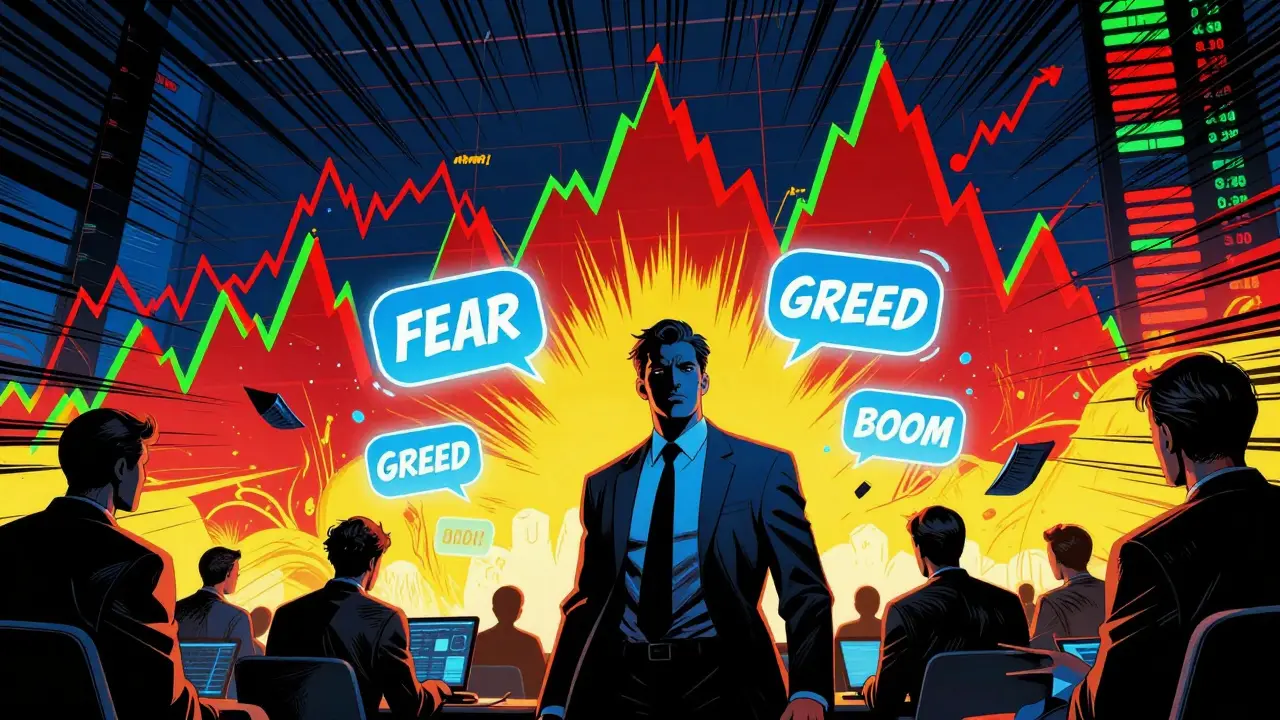
Prices don't move in a vacuum. They react to how people feel. When investors get scared, assets drop. When they get greedy, prices soar. This is the core idea behind Sentiment Analysis, which is a computational process that determines whether text data conveys positive, negative, or neutral opinions about financial assets. For traders, this isn't just academic theory; it's a way to generate actionable signals before price charts even reflect the shift.
You might be wondering if reading Twitter posts can really beat traditional technical analysis. The short answer is yes, but with major caveats. Sentiment analysis provides a behavioral dimension that often precedes price action. While moving averages lag behind history, sentiment captures the present psychology of the market. However, treating it as a crystal ball is a recipe for disaster. It works best when you understand its limits and combine it with other data points.
The Core Concept: Turning Words into Numbers
At its simplest, sentiment analysis takes unstructured text-news articles, social media posts, earnings call transcripts-and converts it into structured data. The system looks for entities (like "Bitcoin" or "Tesla") and assigns them a sentiment score. Positive numbers mean bullish feelings; negative numbers mean bearish fear.
This technology gained traction around 2010-2012, driven by the rise of platforms like Twitter and advances in Natural Language Processing (NLP), which is the branch of AI that helps computers understand human language. Today, vendors like Sentdex analyze roughly 4,000 news sources and 10 million social media posts daily. They generate scores for over 5,000 U.S. equities with a latency of under five minutes. That speed matters because in trading, information decays fast.
The value proposition is clear: identify potential market inflection points before they become evident in price action. For example, if retail investor sentiment on Reddit spikes to extreme bullish levels, it might signal an impending correction. Conversely, extreme fear can indicate a buying opportunity. The goal isn't to predict the future perfectly but to gauge the current mood of the crowd.
Why Sentiment Beats Traditional Indicators Sometimes
Traditional technical indicators like Relative Strength Index (RSI) or Moving Average Convergence Divergence (MACD) rely entirely on historical price data. By definition, they are lagging. Sentiment analysis attempts to be leading. It measures the psychological state of the market participants.
Consider the CNN Fear & Greed Index. Historical data shows that when this index reads above 80 (extreme greed), the S&P 500 has corrected by at least 5% within 30 days in 83% of cases since 2015. Similarly, the American Association of Individual Investors (AAII) sentiment survey has shown that bullish readings above 55% coincided with market tops in 78% of cases between 2000 and 2022. These aren't guarantees, but they are strong statistical correlations that pure price charts miss.
Sentiment analysis shines in capturing events that fundamentals ignore. Take the 2021 GameStop short squeeze. Retail investor sentiment on Reddit’s WallStreetBets forum reached extreme bullish levels 14 days before the stock surged 1,700%. Traditional fundamental analysis would have missed this entirely because the company's financials didn't justify the move. Sentiment analysis caught the momentum early.
Building Your Strategy: Tools and Data Sources
If you want to use sentiment analysis, you need access to reliable data. You have two main paths: using third-party vendors or building your own pipeline.
| Vendor | Primary Focus | Data Sources | Key Feature |
|---|---|---|---|
| Sentdex | News & Social Media | 4,000+ news sources, 10M+ social posts | Sector-specific scores, low latency |
| PsychSignal | Social Media Emotion | Twitter, Reddit, Forums | Proprietary emotion classification |
| Accern | Real-time News | Global news wires, blogs | Industry-specific models, generative AI integration |
For retail traders, platforms like thinkorswim offer built-in tools such as the Volatility Index (Vol Index). A Charles Schwab survey found that 68% of active traders using these tools reported improved trade timing. If you're more technical, you can build custom pipelines using Python libraries like NLTK, spaCy, or TensorFlow. This requires significant effort-QuantStart estimates 200+ hours of development time-but gives you full control over the model.
In the crypto space, sentiment analysis is even more prevalent. According to CryptoCompare, sentiment accounts for approximately 30% of algorithmic trading signals in cryptocurrency markets, compared to just 15% in traditional equities. This makes sense because crypto markets are highly driven by community hype and social media trends.
Common Pitfalls and How to Avoid Them
Sentiment analysis is not foolproof. In fact, it can fail spectacularly if you don't account for context. Here are the biggest traps:
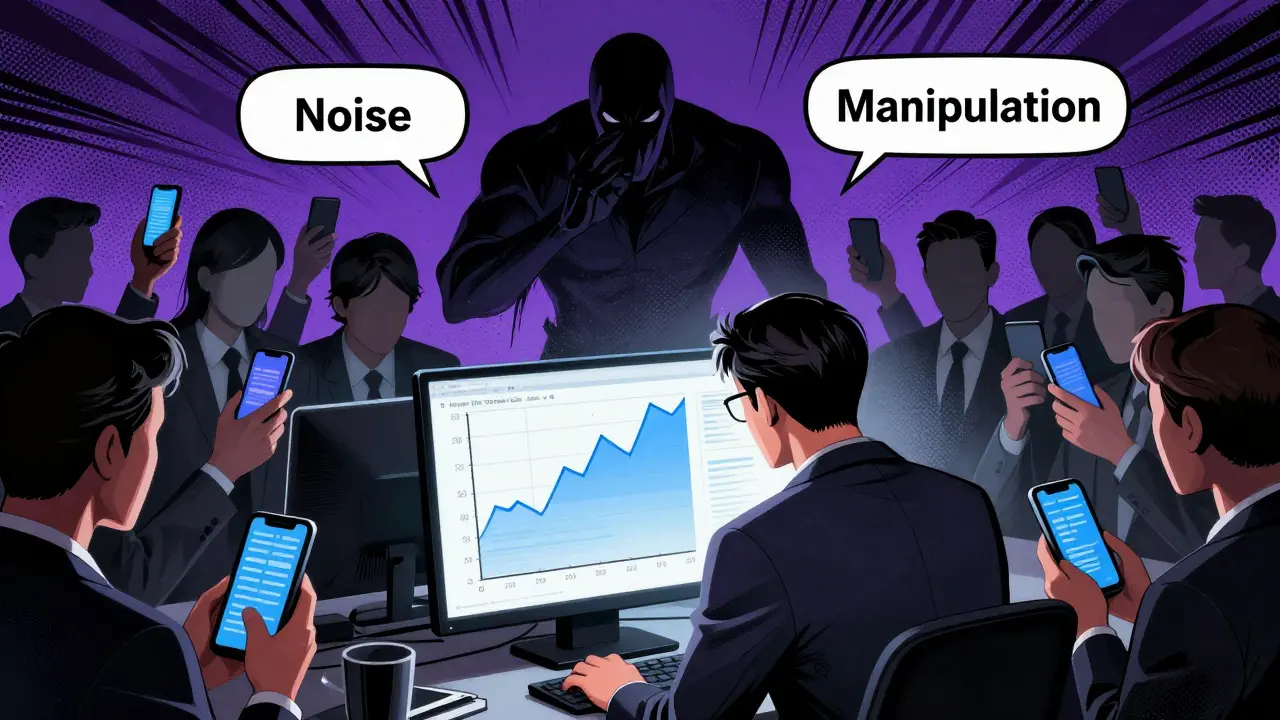
- Noise and Sarcasm: Algorithms struggle with irony. A post saying "Great job, Tesla, burning cash again" might be classified as positive by a basic NLP model because of the word "Great." Advanced systems use contextual understanding to mitigate this, but errors still happen.
- False Signals in Crises: During major macroeconomic shocks, sentiment indicators can mislead. In March 2020, while the VIX spiked above 80, retail investor sentiment remained cautiously optimistic. Traders who relied solely on sentiment went short repeatedly as markets kept falling. Fundamental drivers overwhelmed sentiment during that period.
- Manipulation: A 2023 MIT study found that 41% of retail investor sentiment on social media is deliberately manipulated by coordinated groups. In crypto, "pump and dump" schemes rely on artificially inflating sentiment. You need fraud detection capabilities to filter out fake hype.
Expert Richard Peterson, CEO of MarketPsych, emphasizes that sentiment works best as a contrarian indicator at extremes. Don't buy just because sentiment is positive. Buy when sentiment is extremely negative and price starts to stabilize. This approach aligns with the principle that markets are most efficient when everyone agrees, and most inefficient when emotions run high.
Practical Implementation Steps
Ready to integrate sentiment into your trading? Follow this step-by-step approach:
- Define Your Universe: Decide which assets you're tracking. Are you focusing on large-cap stocks, small-caps, or cryptocurrencies? Each has different sentiment drivers.
- Choose Your Data Source: Start with a reputable vendor like Sentdex or Accern if you lack coding skills. If you're a developer, consider open-source models like FinBERT, though documentation quality varies.
- Combine with Price Action: Never trade sentiment alone. Look for divergence. For example, if Bitcoin hits a new high but sentiment fails to reach new bullish extremes, it's a warning sign. This "sentiment divergence" strategy has generated 62% win rates in S&P 500 futures trading from 2015-2022.
- Set Time Horizons: Sentiment signals work best over short-to-medium horizons (3-5 days). Long-term investing should rely more on fundamentals.
- Backtest Rigorously: Test your strategy against historical data. Ensure it performs well across different market conditions, not just bull markets.
Remember, the learning curve varies. Basic interpretation takes 20-30 hours of study. Building a custom system takes months. Start simple. Use existing indicators before trying to code your own NLP pipeline.
The Future of Sentiment Analysis
The field is evolving rapidly. We're moving beyond text. J.P. Morgan launched "Speech Analytics" in 2023, which analyzes CEO tone and speech patterns during earnings calls. This multimodal approach improved earnings surprise prediction accuracy by 12%. Imagine combining text sentiment with voice stress analysis and facial expressions.
Generative AI is also changing the game. Accern's SentimentGPT claims 28% higher accuracy in detecting nuanced sentiment compared to previous models. By 2026, we expect sentiment analysis to incorporate real-time geopolitical event mapping and cross-asset class sentiment contagion analysis. This will improve predictive power by 35-40%, according to the CFA Institute.
However, challenges remain. Regulatory scrutiny is increasing. The SEC noted that algorithmic strategies using sentiment data contributed to 17% of volatility spikes in small-cap stocks during 2021. Expect tighter rules on how sentiment-driven algorithms operate.
Is sentiment analysis profitable?
It can be, but not on its own. Studies show well-constructed sentiment signals achieve correlation coefficients of 0.65-0.75 with subsequent price movements over 3-5 day horizons. One trader documented 18.7% annualized returns from 2018-2022 using a contrarian sentiment strategy. However, many users report losses during high-volatility periods like March 2020. Profitability depends on combining sentiment with risk management and other indicators.
What is the best tool for sentiment analysis?
There is no single "best" tool. Sentdex is popular for its breadth of news and social media coverage. PsychSignal excels in emotion classification. Accern offers strong real-time news analysis. For developers, open-source models like FinBERT provide flexibility but require more setup. Choose based on your asset class and technical expertise.
Can sentiment analysis predict crypto crashes?
It can provide early warnings. Extreme bullish sentiment often precedes corrections. However, crypto markets are prone to manipulation. Coordinated groups can artificially inflate sentiment. Always verify sentiment signals with on-chain data and volume analysis. Don't rely on sentiment alone for crash predictions.
How does sentiment analysis differ from technical analysis?
Technical analysis uses historical price and volume data to identify patterns. It is lagging. Sentiment analysis uses textual data to gauge market psychology. It aims to be leading. Technical analysis tells you what happened; sentiment analysis hints at why it happened and what might happen next due to emotional shifts.
Is sentiment analysis legal?
Yes, analyzing public text data is legal. However, regulators are scrutinizing algorithmic trading strategies that use sentiment data. The SEC has noted that such strategies can contribute to market volatility. Ensure your trading practices comply with local regulations, especially regarding wash trading or market manipulation.
Daniel J. Cox
June 30, 2026 AT 07:47Interesting read. I've been watching the markets for years and it's wild how much noise there is on social media. The part about sarcasm detection really resonates with me because I see bots misinterpreting jokes all the time. It's like they have no soul. :)
Anyway, good luck to everyone trying to code their own pipelines.
Ryan Peters
July 2, 2026 AT 04:24This whole sentiment analysis thing is just another way for the elite to manipulate the little guy. You think a few tweets from some random guy in his mom's basement can move the market? Please. The real movers are the insiders who know things before the rest of us. This is just academic fluff designed to keep you busy while they print money. Wake up sheeple. The system is rigged against you no matter what algorithm you use.
ross harris
July 2, 2026 AT 12:04The human psyche is a labyrinth of contradictions, isn't it? We scream our fears into the digital void, hoping for validation, only to be harvested by cold, unfeeling machines. It's poetic in a tragic sort of way. The irony is that we are trying to quantify emotion, which is inherently unquantifiable. We are reducing the symphony of human anxiety to a binary score. Beautiful disaster.
Carl Belgrave
July 3, 2026 AT 13:13I've been trading since the 90s and let me tell you, this stuff is garbage. Real traders look at volume and price action, not some fluffy feelings index. But hey, if you want to waste your time analyzing Twitter posts, go ahead. Just don't come crying to me when you blow up your account chasing retail hype. Stick to the basics or get out of the way.
Carl Hanzel
July 3, 2026 AT 20:36Everyone here is so naive. Sentiment analysis is just a lagging indicator dressed up in fancy AI clothing. By the time the sentiment spikes, the smart money has already exited. You're just providing liquidity for the whales. Stop pretending you're beating the market with a spreadsheet and a prayer.
Emma Rémond
July 5, 2026 AT 17:46Your understanding of NLP models is superficial at best. While basic sentiment scoring is indeed noisy, modern transformer-based architectures like FinBERT have significantly reduced false positives through contextual embeddings. The issue isn't the technology; it's the lack of sophisticated feature engineering by amateur practitioners. One must consider the temporal decay of sentiment signals and cross-asset correlation matrices to derive any alpha. Most retail traders fail because they treat these tools as crystal balls rather than probabilistic inputs within a broader quantitative framework.
ELNORA JEFFERSON
July 7, 2026 AT 14:17Boring. Another long article about tech buzzwords. Nobody reads this stuff. I just want to know if I should buy Bitcoin or not. Why do you people make everything so complicated? It's exhausting.
Carol @minaszilda
July 8, 2026 AT 11:47It's important to remember that tools are only as good as the user. Start small. Don't try to build the perfect model overnight. Be patient with yourself. Learning curve is steep but rewarding. You got this.
John Curry
July 9, 2026 AT 02:43There is something profoundly dramatic about the idea that our collective emotional state dictates the value of tangible assets. It feels like a collective hallucination given numerical form. The market is a mirror, reflecting our deepest insecurities and greediest desires back at us in real-time charts. It’s terrifying and beautiful.
Trent Erman1
July 10, 2026 AT 06:53Hey guys! Great discussion here. I actually tried building a simple pipeline using Python and NLTK last week. It was super fun but also pretty frustrating when it couldn't handle sarcasm. 😅 If anyone wants tips on getting started with FinBERT, let me know! Happy to help. 🚀
Nicole Woessner
July 10, 2026 AT 20:22i find it interesting how different cultures express fear or greed online. in my experience western traders are more direct while asian markets might show sentiment through volume patterns instead of text. its a cool cultural nuance that algorithms often miss
Jon Milton
July 12, 2026 AT 13:25You need to combine this with geopolitical risk assessment. Sentiment doesn't exist in a vacuum. A tweet about Tesla means nothing if there's a war starting in Europe. Context is king. Always check the news wires first. Then maybe look at the social media noise. Order matters.
Sajjad Ghorbani Moghaddam
July 13, 2026 AT 01:55If you're new to this, just start with free tools. Don't pay for expensive subscriptions until you've proven you can make money manually. There are plenty of open-source libraries. Learn the basics first. No rush.
Rebecca Shoniker
July 14, 2026 AT 02:31The statistical significance of these correlations is often overstated.;; Correlation does not imply causation.;; Furthermore, the look-ahead bias in many backtests renders them useless for live trading.;; One must rigorously validate out-of-sample performance.;; Without proper risk-adjusted metrics like Sharpe ratio or Sortino ratio, these strategies are merely gambling with extra steps.;; Proceed with extreme caution.
Scott Miller
July 14, 2026 AT 18:53Come on people! This is exciting stuff! Yes, there are risks, but imagine the potential! We're living in the future! Embrace the change! Get out there and trade! You can do it! Don't let fear stop you! Go big or go home!
Abby Martin
July 15, 2026 AT 11:47I've seen too many people lose money following these 'gurus'. It's irresponsible to promote this without emphasizing the ethical implications of manipulating public sentiment. Some of these vendors are basically running pump-and-dump schemes legally. It makes me sick. Do better.
Ryan Peters
July 15, 2026 AT 18:16@2655 Oh please, spare me the jargon. You sound like a textbook written by someone who's never lost a dollar. The market eats academics for breakfast. Keep your 'transformer architectures' to yourself. I'll stick to common sense.
Emma Rémond
July 16, 2026 AT 06:41Common sense is precisely what is lacking in this discourse. My point stands: sophisticated modeling is required to filter signal from noise. Your dismissal of quantitative methods based on anecdotal frustration is intellectually lazy. Perhaps invest time in learning the mathematics behind the models rather than dismissing them outright.