
You hold the keys to your digital kingdom. But if those keys are a piece of paper hidden in a shoebox or a screenshot on your phone, you might as well be leaving them on a park bench. A crypto seed phrase, also known as a recovery phrase or mnemonic phrase, is the master key to your cryptocurrency wallet. It is a sequence of 12, 18, or 24 randomly generated words that grants complete control over your assets. Lose it, and your crypto is gone forever. Give it to someone else, and they own your money. According to Unchained Capital's 2024 analysis, approximately 20% of all Bitcoin-valued at over $150 billion-is permanently inaccessible simply because owners lost or improperly stored their seed phrases. This isn't just bad luck; it's a failure of basic security hygiene.
The Basics: What Is a Seed Phrase and Why Does It Matter?
To understand how to protect your wealth, you first need to understand what you are protecting. The concept of the seed phrase was standardized by BIP-39 (Bitcoin Improvement Proposal 39), created in 2013 by Marek Palatinus and Pavol Rusnak. Before this standard, recovering a wallet from a complex cryptographic private key was nearly impossible for the average user. BIP-39 converted these complex keys into human-readable word sequences using a predefined dictionary of 2,048 words. Each word represents 11 bits of entropy, creating a security level between 128 and 256 bits depending on whether you use a 12-word or 24-word phrase.
Today, this format is the industry norm. As of Q2 2024, 98% of top cryptocurrency wallets implement BIP-39 standards. The critical rule here is precision. The order of the words matters. The spelling matters. If you swap word number three with word number four, the wallet will not open. If you misspell one letter, the wallet will not open. There is no "forgot password" link. There is no customer support team to call. You are your own bank, which means you are also your own security guard.
The Digital Trap: Why Screens Are Enemies
The most common mistake beginners make is treating their seed phrase like a regular password. They type it into a notes app, save it in an email draft, or store it in a cloud document. This is dangerous. DataRecovery.com’s 2024 security assessment states that storing seed phrases digitally exposes them to 'virtually all forms of remote hacking.' In fact, 37% of cryptocurrency thefts in 2023 originated from compromised digital storage of seed phrases.
Consider the case of u/SatoshiLost on Reddit, who detailed losing $75,000 after storing his seed phrase in a Gmail draft. He thought it was secure because he had a strong email password. He didn't account for phishing attacks, malware, or simple account breaches. Dr. Agustin Solano, Chief Security Officer at Ledger, put it bluntly in a CoinDesk interview: 'The only truly secure seed phrase is one that exists solely in physical form, offline, with controlled physical access.'
Even password managers, often praised for general cybersecurity, are risky for seed phrases. John Smith, CISO at DataRecovery.com, warned that 'storing seed phrases in password managers concentrates all risk in a single digital location.' In 2023 alone, 22 high-profile losses totaling $87 million resulted from compromised password manager vaults. If your goal is to keep hackers out, keep your seed phrase off the internet entirely.
Paper vs. Metal: Choosing Your Physical Backup
If digital is out, what is left? Paper and metal. These are the two primary methods for physical storage, but they have vastly different lifespans and costs.
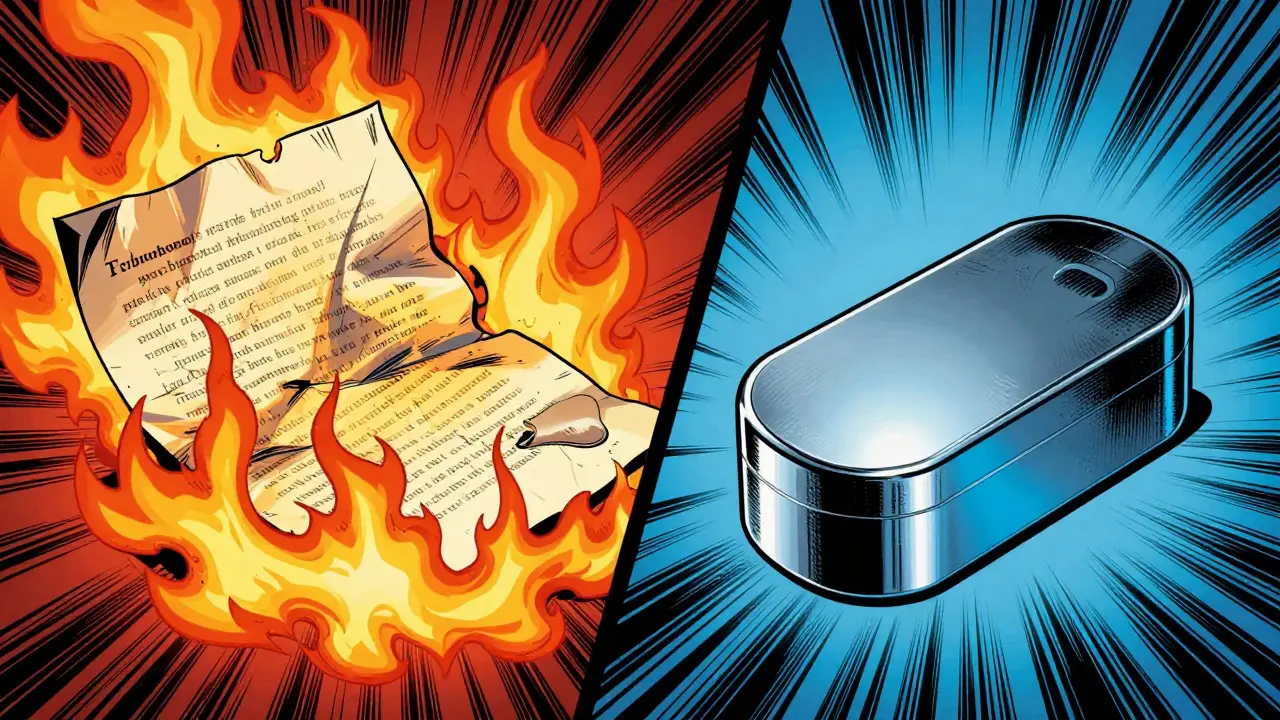
Paper Storage: This is the default method recommended by most wallet providers. It is free and easy. However, it is fragile. Vault12’s 2023 testing revealed that paper backups degrade significantly after just 18 months under normal storage conditions. Ink fades in 67% of tested samples, and physical damage occurs in 42% due to moisture, handling, or accidental destruction. Unchained Capital documented that 61% of paper backups fail within five years. If you choose paper, use archival-quality paper and indelible ink, but know that it is a temporary solution at best.
Metal Storage: For long-term holding, metal is superior. Solutions like Cryptosteel Capsule Solo (priced at $119) and Billfodl (priced at $99.99) offer durability against fire, water, and corrosion. Cryptosteel’s stainless steel construction is rated to withstand temperatures up to 1,400°C for 15 minutes. Billfodl’s titanium plates resist corrosion even after 72 hours of saltwater immersion. While they cost 20-50 times more than paper, the peace of mind is worth it for significant holdings. One user, u/CryptoHodler87, reported that his Billfodl survived a house fire that destroyed everything else in his safe, allowing him to recover $250,000 in crypto without issue.
| Method | Durability | Cost | Risk Factors |
|---|---|---|---|
| Digital (Cloud/Email) | High (until hacked) | Free | Hacking, Phishing, Malware |
| Paper | Low (degrades in ~18 months) | Free | Fire, Water, Accidental Disposal |
| Metal (e.g., Cryptosteel) | Very High (fire/water resistant) | $100 - $150 | Physical Theft, Loss |
| Hardware Wallet Backup | Medium | $150+ per device | Device Failure, Dual-location risk |
Location, Location, Location: Where to Hide Your Keys
Having a durable backup is useless if you lose it. The biggest threat to physical backups isn't hackers; it's household accidents. Unchained Capital documented 217 cases in Q1 2024 where seed phrases stored in kitchen containers (like coffee cans or flour jars) were accidentally discarded during routine cleaning. Another common error is hiding them in places that are too obvious, like a desk drawer, making them vulnerable to burglars.
For singlesig wallets holding less than $50,000, Unchained Capital recommends keeping a metal storage device in a permanently installed home safe, with a second backup in a bank safe deposit box. This dual-location strategy protects against both house fires and bank closures. However, be aware of the risks of safe deposit boxes: if the bank seizes assets or goes bankrupt, accessing your box can become legally complicated. Ensure you understand local regulations.
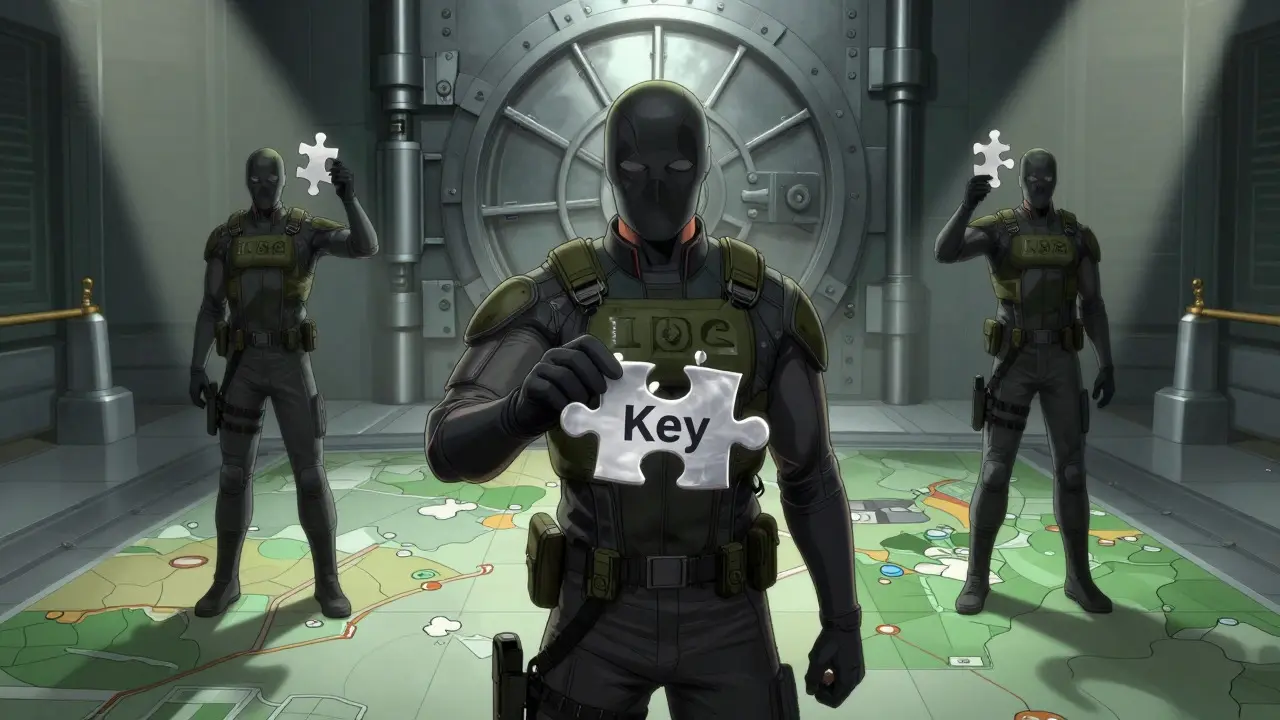
For higher-value holdings, consider geographic distribution. The Zcash Community Forum suggests storing individual seed phrases across trusted locations, minimum 50 miles apart. This reduces single-point failure risk by 78%. Just ensure that no single person has access to all parts of the phrase unless necessary.
Advanced Strategies: Multisig and Shamir's Secret Sharing
If you are holding life-changing amounts of cryptocurrency, a single seed phrase might feel too risky. This is where multisignature (multisig) setups come in. Instead of one key controlling everything, you require multiple signatures to move funds. For example, a 2-of-3 setup means you have three keys, and you need any two of them to authorize a transaction. If one key is lost or stolen, your funds remain safe.
Another advanced technique is Shamir's Secret Sharing Scheme (SSSS). This splits your seed phrase into multiple fragments. You might split it into three parts, requiring any two to reconstruct the original phrase. Chainalysis’ Senior Security Researcher Dr. Evelyn Chen argued that properly implemented SSSS with geographically distributed fragments can provide superior security for holdings exceeding $1 million. However, this requires significant technical expertise. Unchained Capital rates this approach as 'not suitable for 95% of users' due to the complexity and potential for user error during reconstruction.
Common Pitfalls and How to Avoid Them
Even with the right tools, implementation errors are common. Here are the top mistakes to avoid:
- Improper Assembly: 33% of Billfodl user support tickets in Q2 2024 involved incorrect plate assembly. Take your time. Follow the instructions meticulously.
- Inadequate Testing: Never assume your backup works. After writing down your seed phrase, test it by restoring a small amount of crypto to a new wallet instance. If it fails, start over before you lose everything.
- Over-Sharing: Do not show your seed phrase to anyone. Legitimate support staff will never ask for it. If they do, it is a scam.
- Single Point of Failure: Don't keep your only copy in one place. Fire, flood, or theft could wipe it out instantly.
The Future of Seed Phrase Storage
The landscape is evolving. Ledger launched Ledger Recover in July 2024, a service that splits and encrypts seed phrases into fragments stored across tamper-resistant Hardware Security Modules globally. While this eliminates single points of failure, it introduces a custodial element that purists dislike. Meanwhile, Keystone is testing tablet-based secure storage with biometric controls. Despite these innovations, the core principle remains unchanged: your seed phrase must remain offline and physically secure. As DataRecovery.com noted in July 2024, there was a 200% increase in malware variants specifically targeting seed phrases in cloud services. The safest place for your keys is still in your hand, written on metal, hidden in a safe.
Can I write my seed phrase on a piece of paper?
Yes, but it is risky long-term. Paper degrades quickly due to moisture, fading ink, and physical damage. Vault12 found that 67% of paper backups suffer ink fading within 18 months. For permanent storage, metal solutions like Cryptosteel or Billfodl are highly recommended.
Is it safe to store my seed phrase in a password manager?
Generally, no. Password managers are convenient but create a single point of failure. If your password manager account is breached, all your seeds are exposed. Experts recommend keeping seed phrases completely offline and physical.
What should I do if I think my seed phrase has been compromised?
Move your funds immediately to a new wallet with a fresh seed phrase. Once a seed phrase is compromised, it is no longer secure. Treat it like a lost credit card: cancel the old one and get a new one.
Do I need a metal backup for small amounts of crypto?
It depends on your risk tolerance. For very small amounts, paper might suffice if stored safely. However, metal backups are becoming affordable ($100-$150) and offer peace of mind against fire and water damage, which can destroy paper instantly.
Can I take a photo of my seed phrase and store it in the cloud?
No. This is one of the most common ways people lose crypto. Cloud services are vulnerable to hacking, phishing, and data breaches. Keep your seed phrase offline and physical.