
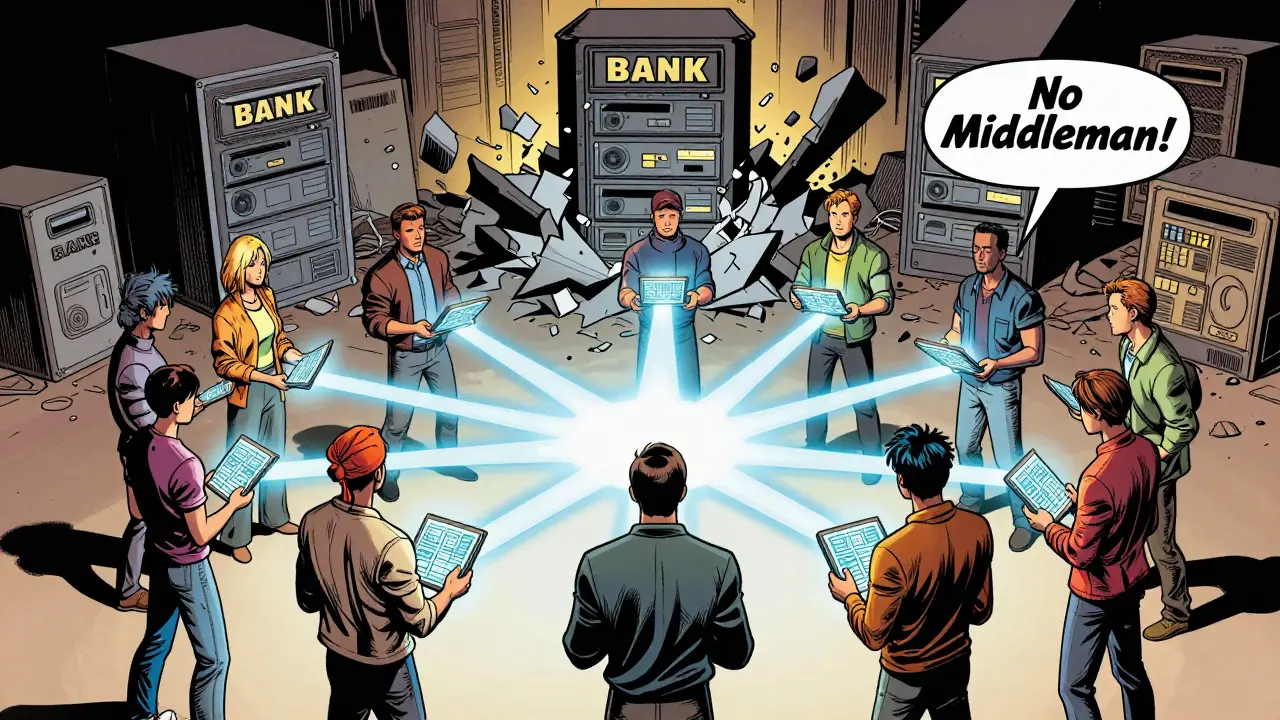
Imagine sending money to someone on the other side of the world without a bank, a payment processor, or any middleman checking your balance. It sounds like magic, but it’s actually engineering. At the heart of this technology lies a simple yet radical concept: P2P networks. These peer-to-peer architectures are the invisible backbone that allows cryptocurrencies like Bitcoin and Ethereum to function as trustless, decentralized systems.
When Satoshi Nakamoto published the Bitcoin whitepaper in 2008, they didn’t just invent a new currency; they revived an old networking model and applied it to finance. Before you can understand why crypto is secure or why transactions sometimes take time, you need to understand how these computers talk to each other. This isn't just about code; it's about creating a system where no single entity holds the keys to the kingdom.
The Anatomy of a Decentralized Network
To grasp how P2P networks power cryptocurrency, you first have to look at what they aren't. Traditional internet services use a client-server model. Think of Netflix or Amazon. You (the client) request data from their massive central servers. If those servers go down, the service stops. In a P2P network, there are no central servers. Every participant, known as a node, acts as both a client and a server simultaneously.
Bitcoin Full Nodes are independent computers that maintain a complete copy of the blockchain ledger and validate all transactions according to consensus rules. As of late 2023, there were approximately 14,000 publicly reachable full nodes running globally. Each node requires specific hardware resources: a minimum of 2GB RAM, over 50GB of storage space (which grows by roughly 144MB daily), and a stable broadband connection. These nodes connect via TCP port 8333 using Bitcoin's proprietary protocol.
In this flat structure, when you send a Bitcoin transaction, it doesn't go to a headquarters. It broadcasts to your connected peers, who then broadcast it to theirs. This "gossip protocol" ensures that within seconds, the entire network knows about your transaction. According to a 2022 Cornell University study, under optimal conditions, a transaction propagates to 95% of nodes in just 8.6 seconds. During peak congestion, this can stretch to over 40 seconds, but the message still gets through without a central dispatcher.
This redundancy is the secret sauce. Because every full node stores the entire history of the blockchain, there is no single point of failure. If one node crashes, goes offline, or tries to cheat, the thousands of others simply ignore the bad data. This creates what experts call a "trustless" environment. You don't need to trust the person sending you money; you trust the mathematical consensus of the network.
Why P2P Beats Client-Server for Money
You might wonder why we don't just use faster, centralized systems for everything. After all, Visa processes around 65,000 transactions per second on its centralized infrastructure. Bitcoin, by comparison, handles only 4 to 7 transactions per second. Ethereum manages slightly more, between 15 and 30. On paper, P2P looks slow and inefficient. But speed isn't the primary goal here; resilience and censorship resistance are.
| Feature | Centralized (e.g., Visa, Banks) | P2P Cryptocurrency (e.g., Bitcoin) |
|---|---|---|
| Control | Single entity controls the ledger | Distributed among all participants |
| Censorship Resistance | Low (transactions can be blocked/reversed) | High (impossible to stop valid transactions) |
| Throughput | Very High (thousands of TPS) | Low (single digits to low double digits TPS) |
| Resilience | Vulnerable to server outages/hacks | Extremely resilient; no single point of failure |
| Trust Model | Requires trust in institution | Trustless; relies on cryptographic proof |
Consider the 2020 Twitter API outage. Many centralized crypto exchanges went offline because they relied on third-party infrastructure. Bitcoin kept working. Its P2P network didn't care if Twitter was down; it only cared if its own nodes could communicate. For cross-border remittances, where the World Bank reported $640 billion in flows in 2022 with average fees of 6.15%, this independence is crucial. Users in unstable regions cannot afford to have their funds frozen by a local bank or a distant corporation. P2P architecture guarantees that if you control your private keys, you control your assets.
The Hidden Costs of Decentralization
Nothing comes for free, and P2P networks are no exception. The biggest challenge is the "tragedy of the commons." Running a full node costs money. You pay for electricity, bandwidth, and storage. Yet, individual node operators receive no direct financial compensation for this work. They do it because they believe in the network's security and want to verify transactions themselves rather than relying on others.
This economic friction has real consequences. Data from Bitnodes.io shows that Bitcoin's publicly reachable nodes dropped from 12,000 in 2017 to around 5,000 in 2020 before recovering to 14,000 in 2023. Why the dip? As hardware requirements grew and block sizes increased, casual users couldn't keep up. Today, syncing a new node can take days. A user on Reddit's r/Bitcoin community noted in October 2023 that syncing took 72 hours on a high-speed 1Gbps connection with a fast SSD. That’s a significant barrier to entry.
There’s also the energy question. Critic like NYU Stern professor Nouriel Roubini have pointed out that Bitcoin’s Proof-of-Work consensus mechanism, which secures the P2P network, consumes massive amounts of electricity-estimated at 121.49 TWh annually by the Cambridge Bitcoin Electricity Consumption Index. While proponents argue this energy cost is the price of ultimate security, it remains a major environmental and scalability debate. Ethereum addressed this by switching to Proof-of-Stake in 2022, reducing its energy consumption by 99.95%, showing that P2P networks can evolve to become more efficient without sacrificing decentralization entirely.
Security Risks and Network Attacks
While P2P networks are robust, they aren't invincible. The lack of a central authority means attackers target the weakest links: the nodes themselves. One common threat is the "eclipse attack." Vitalik Buterin documented in a 2022 research paper that on Ethereum’s network of approximately 8,000 full nodes, an attacker could isolate a victim node using as few as 11 strategically placed malicious nodes. By surrounding the victim with fake peers, the attacker can feed them false information about the state of the blockchain, potentially allowing them to spend coins twice.
Another risk is network congestion leading to delayed confirmations. During periods of high demand, users must pay higher transaction fees to get their transactions prioritized by miners or validators. A post on Bitcoin Stack Exchange in March 2023 highlighted user frustration, documenting delays exceeding 72 hours during fee market congestion. This isn't a failure of the P2P network itself, but a limitation of its design choices favoring stability over speed.
Despite these risks, the network’s "immune system," as Andreas Antonopoulos calls it, generally works. When malicious blocks are proposed, honest nodes reject them based on predefined consensus rules. The collective intelligence of the network polices itself. However, as quantum computing advances, new threats loom. The National Institute of Standards and Technology (NIST) warns that current cryptographic implementations could be compromised by quantum computers as early as 2035, necessitating a transition to post-quantum cryptography to keep P2P networks secure.
Scaling the Unscalable: Layer 2 Solutions
If base-layer P2P networks are slow, how do we make them usable for everyday coffee purchases? The answer lies in Layer 2 solutions built on top of the P2P foundation. The most prominent example is the Bitcoin Lightning Network. This second-layer protocol allows users to open payment channels between each other, conducting millions of micro-transactions off-chain. Only the final settlement is recorded on the main Bitcoin blockchain.
As of October 2023, the Lightning Network processed $1.2 billion monthly across 18,000 nodes. This demonstrates how P2P architecture enables scalability without compromising the core security model. The main chain provides the security and finality, while the Layer 2 handles the volume. Similarly, Ethereum’s sharding proposals and PeerDAS (Data Availability Sampling) research aim to improve data throughput across its P2P network, allowing more transactions to be processed in parallel.
These innovations show that P2P networks are not static. They are evolving ecosystems. The Bitcoin Taproot upgrade, activated in November 2021, optimized P2P transaction relay efficiency by 25%, proving that even mature networks can improve their performance. Future protocols like Erlay promise to reduce bandwidth requirements by 80%, making it easier for more people to run nodes and participate in the network.
Running Your Own Node: A Practical Guide
Want to experience the P2P network firsthand? You can run your own node. It’s not as hard as it sounds, but it does require some technical know-how. According to Bitcoin Core’s official documentation, initial setup takes about 8 to 12 hours. Here is what you need to know:
- Hardware Requirements: A computer with at least 2GB RAM, 50GB+ of SSD storage (NVMe recommended for faster syncs), and a reliable internet connection.
- Software: Download Bitcoin Core from the official website. Ensure you are using the latest version (v24.0 or newer as of early 2023).
- Network Configuration: You may need to configure UPnP or manually forward TCP port 8333 on your router. A 2022 survey found that 43% of new node operators struggled with this step.
- Syncing Time: Be patient. Initial block download can take several days depending on your internet speed and disk write speeds.
Once synced, your node will independently verify every transaction since Bitcoin’s inception. You won't rely on a wallet provider to tell you if your balance is correct. You’ll know for sure. Resources like Bitcoin Stack Exchange, with over 24,500 P2P-related questions, and community forums like Bitcointalk.org offer extensive support for troubleshooting issues like firewall errors or sync stalls.
The Future of P2P Cryptocurrency Networks
The trajectory for P2P networks points toward greater maturity and integration. Gartner’s 2023 Hype Cycle predicts that P2P cryptocurrency networks will reach the "plateau of productivity" by 2027. This means they will move from experimental tech to reliable infrastructure. Institutional adoption is already accelerating, with Fidelity Investments reporting a 37% year-over-year growth in institutional crypto holdings.
Regulatory frameworks are also catching up. The EU’s MiCA framework, effective December 2024, recognizes P2P network participants as "distributed ledger technology service providers," bringing clarity to legal status. While the U.S. regulatory landscape remains fragmented, the SEC’s guidance acknowledges that decentralized networks may still fall under securities laws if sufficient centralization exists, highlighting the importance of true P2P distribution.
Looking ahead, the survival probability of P2P networks beyond 2030 is estimated at 82% by a University of Cambridge meta-study. The key challenges remain balancing decentralization with usability and addressing quantum threats. But the core value proposition remains unchanged: a system where individuals, not institutions, control their financial destiny. As long as that desire persists, P2P networks will continue to power the future of money.
What is the difference between a P2P network and a client-server network?
In a client-server network, clients request data from a central server, creating a single point of failure. In a P2P network, every participant (node) acts as both client and server, sharing data directly with peers. This eliminates central control and increases resilience against outages and censorship.
Why are P2P networks slower than traditional banking systems?
P2P networks prioritize decentralization and security over speed. Every transaction must be validated by multiple independent nodes across the globe, which takes time. Centralized systems like Visa can process transactions instantly because a single entity makes the decision, but this requires trusting that entity not to fail or censor.
Do I need to run a full node to use cryptocurrency?
No, most users interact with wallets that connect to third-party nodes. However, running your own full node allows you to verify transactions independently, enhancing your privacy and security. It also contributes to the overall health and decentralization of the network.
Can P2P networks be hacked?
While the underlying protocol is highly secure, individual nodes can be targeted via eclipse attacks or DDoS attacks. Additionally, smart contracts on platforms like Ethereum can have vulnerabilities. However, altering the historical ledger of a major P2P network like Bitcoin would require controlling 51% of the network's computational power, which is practically impossible for large networks.
How does the Lightning Network relate to P2P networks?
The Lightning Network is a Layer 2 solution built on top of Bitcoin’s P2P network. It uses P2P principles to create payment channels between users, allowing for instant, low-cost transactions off-chain. The final settlement occurs on the main P2P blockchain, combining the speed of direct transfers with the security of the decentralized ledger.
Matthew Malone
June 9, 2026 AT 05:23Another day, another article trying to convince you that your slow, energy-wasting digital rocks are the future of finance. Please.
Sylvia Mossman
June 9, 2026 AT 07:30I hate how everyone here acts like P2P is some revolutionary utopia. It's just a glorified ledger with worse UX than a spreadsheet from 1995. The whole 'trustless' narrative is a cope for people who can't handle traditional banking fees because they're too lazy to open a real account.
Dinesh Pattigilli
June 10, 2026 AT 08:00The average reader of this piece probably thinks Satoshi was a person and not a collective pseudonym for a group of MIT grads who got bored during a seminar. Typical populist drivel. You claim decentralization but rely on centralized cloud providers for node hosting. Hypocrisy at its finest. Also, ur spelling is terrible.
Madhu Menon
June 10, 2026 AT 09:13Is it truly freedom if the network itself becomes the censor through consensus? We trade one master for many. :/
JEVON HALL
June 10, 2026 AT 23:31Hey guys! Just wanted to add that running a node is super easy actually 🚀 I did it on my old laptop and it works great! Don't listen to the haters 😂
Narendra Kulkarni
June 11, 2026 AT 00:10Nice post mate. I think the part about eclipse attacks is really interesting stuff. Maybe we should look into more ways to protect nodes though?
verna kennedy
June 12, 2026 AT 10:38You clearly don't understand the basics of network topology. This is elementary computer science, not magic. Stop pretending you've discovered something new when you haven't.
Kelly Tenney
June 13, 2026 AT 14:14It is wonderful to see so much interest in self-sovereign finance. Remember, every step towards understanding your own keys is a step towards true autonomy. You are doing great by even reading this!
Caralee Robertson
June 14, 2026 AT 11:21i totally get what u mean about the energy usage tho. its kinda scary how much power it takes. maybe we shld switch to proof of stake everywhere? just a thought lol
Greg Lewis
June 14, 2026 AT 15:44so why do you trust your bank then? they steal from you via inflation. at least crypto is transparent. wake up sheeple
Dr Lynea LaVoy
June 14, 2026 AT 23:38Let's break down the technical aspect here. The gossip protocol mentioned is fascinating because it relies on probabilistic consistency rather than strict synchronization. This allows for scalability but introduces latency. It is a trade-off we must accept for censorship resistance.
aaliyah zahid
June 16, 2026 AT 18:58Sure, Visa is faster, but have you tried getting your money back after a fraudulent charge? Good luck with that. At least with Bitcoin, if you mess up, it's on you, which is honestly more honest.
Erik Kirana
June 16, 2026 AT 23:27This article is superficial at best. It fails to address the centralization risks of mining pools. Furthermore, the assumption that individuals will run full nodes is naive given the hardware requirements. 🙄
dan kaffeman
June 18, 2026 AT 00:33Foreigners trying to undermine our financial sovereignty with their magic internet money. Disgusting. Stick to dollars.
Meg Gran
June 18, 2026 AT 08:41Oh please. Another tech bro fantasy. The environment is dying and you care about 'trustless' transactions? Priorities are messed up. And your grammar is awful too.
Alexander DeVries
June 20, 2026 AT 06:03Stay focused on the benefits. Decentralization is hard work but rewarding. Keep learning and stay strong against the FUD.
Mark Corpuz
June 22, 2026 AT 02:30The comparison table is accurate. However, one might argue that the resilience of centralized systems has improved significantly with redundancy protocols. Still, the single point of failure remains a theoretical risk.
Steven Jacobowitz
June 23, 2026 AT 06:20Why is nobody talking about the mempool congestion issues? The TPS argument is weak because L2 solutions are still fragmented. We need better interoperability between these layers before claiming victory over banks.
Yogendra Dwivedi
June 24, 2026 AT 18:22I appreciate the detailed guide on running a node. It seems daunting but perhaps manageable with the right resources. Thank you for sharing this information.
Alexis Abster
June 25, 2026 AT 05:23This gives me chills! Imagine a world where no one can stop you from sending value. It is beautiful and terrifying all at once. We are living in history right now!
Brad Ranks
June 26, 2026 AT 03:56My node crashed last night and I lost three days of sync time. I am furious. Why does it have to be so difficult? I just want to buy coffee without waiting an hour for confirmation.