
Imagine you are trying to prove that a specific document existed at a certain time, but you cannot trust the person holding it. You need a system where the record itself is unchangeable and visible to everyone, yet secure from tampering. This is exactly what blockchain solves. But how does it actually work under the hood? How does a digital ledger ensure that once a transaction is written, it stays there forever without being altered by hackers or lazy administrators?
The answer lies in the structure of the blockchain block, which is a fundamental unit of data storage in distributed ledger technology that groups transactions together with cryptographic references to previous blocks. It’s not just a simple list; it’s a complex package of data, hashes, and timestamps designed to create an immutable chain of history. Understanding this mechanism is crucial for anyone looking to build on blockchain or simply understand why Bitcoin and Ethereum function the way they do.
Anatomy of a Block: More Than Just Transactions
When people talk about blockchain, they often visualize a long line of boxes connected by arrows. Each box is a block. But if you open one up, you’ll find it’s divided into two main parts: the block header and transaction data. The header acts like the metadata tag on a photo file-it tells you when it was taken, who took it, and links it to the previous photo in the album. The body contains the actual content-the transactions.
In networks like Bitcoin, the block header is precisely 80 bytes long. It contains several critical pieces of information:
- Previous Block Hash: A 32-byte cryptographic fingerprint of the immediately preceding block. This is what creates the "chain." If someone changes data in Block 100, the hash of Block 100 changes. Consequently, the "Previous Block Hash" stored in Block 101 no longer matches. The entire chain breaks, alerting every node in the network that tampering has occurred.
- Merkle Root: Another 32-byte value. This is a single hash that represents all the transactions inside the current block. We will dive deeper into how this works shortly, as it is the magic behind efficient verification.
- Timestamp: The time the block was created, usually accurate to the second.
- Nonce: A random number used in Proof-of-Work consensus mechanisms (like Bitcoin) to solve the mathematical puzzle required to mine the block.
- Version Number: Indicates which version of the protocol rules were used to create the block.
Ethereum’s headers are slightly different because its protocol is more flexible. Instead of a fixed size, Ethereum uses a dynamic gas limit. As of the London hard fork in August 2021, the base block gas limit sits around 30 million units. This allows Ethereum to process roughly 15 to 30 transactions per second, compared to Bitcoin’s stricter 1MB block size limit (expandable to 4MB with SegWit), which caps throughput at about 7 transactions per second.
The Merkle Tree: Efficient Verification
Here is a common problem: If a block contains thousands of transactions, how can a lightweight device-like your phone-verify that a specific transaction is included in that block without downloading the entire gigabyte-sized blockchain database? Enter the Merkle tree, invented by Ralph Merkle in 1979 and patented in 1982.
A Merkle tree is a binary tree structure where each leaf node is a hash of a transaction. These pairs of hashes are combined and hashed again to form parent nodes. This process repeats until only one hash remains at the top: the Merkle Root. This root hash is then stored in the block header.
Why does this matter? Because of a property called proof of inclusion. To verify that Transaction A is in a block, you don’t need all other transactions. You only need the hash of Transaction A and the sibling hashes along the path to the root. For a block with 1,000 transactions, you might only need to download a tiny fraction of that data to mathematically prove your transaction is part of the set. This efficiency is why mobile wallets can operate securely without storing the full ledger.
If even a single bit of data in any transaction changes, the resulting Merkle Root changes completely due to the avalanche effect of cryptographic hash functions like SHA-256 (used by Bitcoin) or Keccak-256 (used by Ethereum). This makes tampering instantly detectable.

On-Chain vs. Off-Chain Storage Strategies
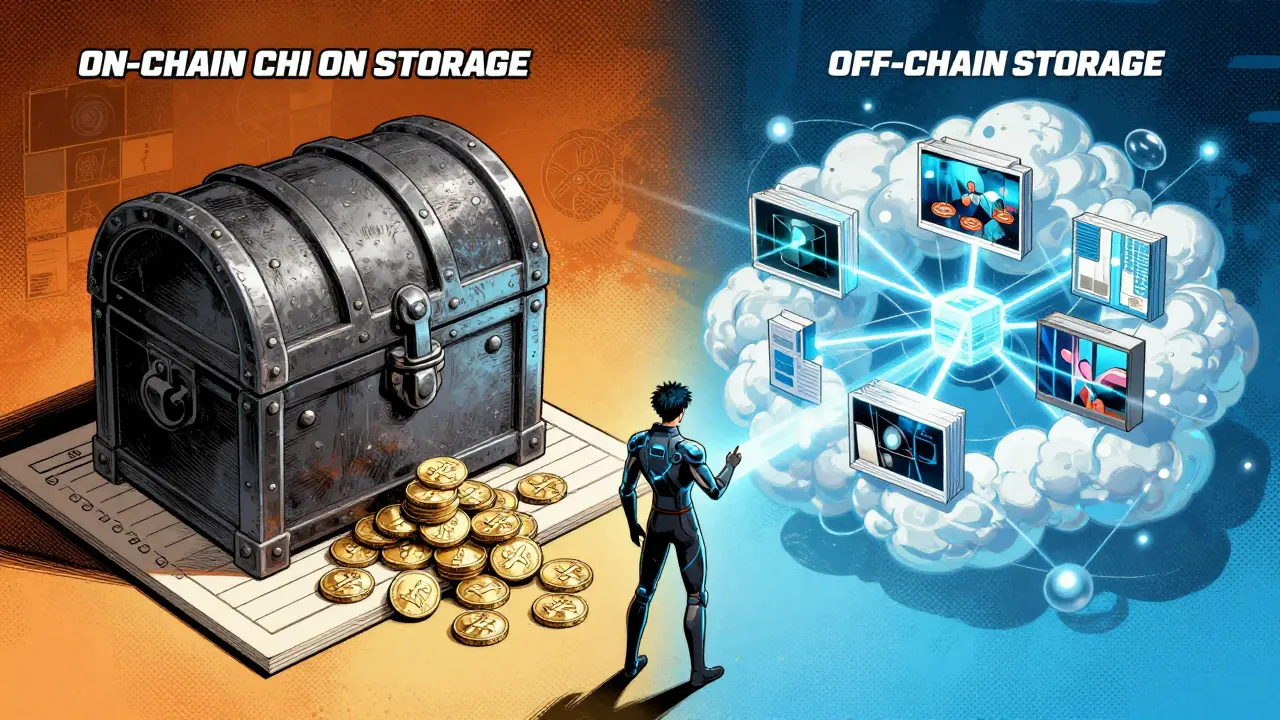
Storing data directly on the blockchain-known as on-chain storage-is incredibly secure but also expensive. Every byte of data stored on-chain must be replicated across thousands of nodes worldwide. This redundancy ensures decentralization but drives up costs.
| Feature | On-Chain Storage | Off-Chain Storage (e.g., IPFS) |
|---|---|---|
| Cost Efficiency | High cost (e.g., ~$10 per KB on Ethereum during peak times) | Very low cost (fractions of a cent per MB) |
| Data Size Limit | Limited by block size/gas limits | Practically unlimited |
| Immutability | Cryptographically guaranteed | Dependent on external pinning services |
| Retrieval Speed | Slow (requires node synchronization) | Fast (direct HTTP/IPFS gateway access) |
| Best Use Case | Financial transactions, smart contract state | Large files, images, documents, backups |
Consider the case of NFTs. When Beeple sold his famous artwork "Everydays" for $69 million, the actual JPEG image (which is large) was not stored on the Ethereum blockchain. Storing a high-resolution image on-chain would have cost tens of thousands of dollars in gas fees alone. Instead, the blockchain only stored a hash pointing to the location of the image on centralized servers or decentralized storage networks like IPFS (InterPlanetary File System). This hybrid approach balances security with practicality. However, it introduces a risk: if the off-chain server goes down, the link breaks, even though the blockchain record remains intact.
For enterprise applications, private blockchains like Hyperledger Fabric take a different route. They use channel-based partitioning, where only authorized participants see specific transaction data. This allows for higher throughput-up to 3,500 transactions per second according to 2022 reports-compared to public chains, while maintaining privacy.
The Cost of Immutability
One of the most misunderstood aspects of blockchain storage is immutability. Once data is written to a confirmed block, it cannot be deleted or modified without re-mining all subsequent blocks, which is computationally infeasible on major networks. This is a feature, not a bug, for financial ledgers. But it becomes a liability when mistakes happen.
Recall the Parity Multisig Wallet incident in July 2017. A coding error allowed a user to freeze approximately $300 million worth of Ether permanently. Because the code was deployed on the blockchain, it could not be patched or rolled back. The funds remain inaccessible to this day. This highlights a critical trade-off: the security that prevents bad actors from stealing funds also prevents good actors from fixing errors.
Furthermore, the National Institute of Standards and Technology (NIST) noted in Special Publication 800-208 that public blockchains suffer from "inefficient data redundancy." Storing identical data across 10,000+ nodes consumes significant energy and storage space. By late 2023, the Bitcoin blockchain had grown to over 475GB, while Ethereum exceeded 1.2TB. Running a full archive node for Ethereum now requires 2TB of SSD storage, 16GB of RAM, and a robust internet connection, costing between $800 and $1,200 in hardware alone.
Future Trends: Scaling and Modular Architectures
The industry is actively working to solve these storage inefficiencies. One major development is Ethereum’s Dencun upgrade, which introduced proto-danksharding (EIP-4844). This innovation allows "blob-carrying transactions" to store temporary data off-chain while keeping verification data on-chain. Early benchmarks suggest this could reduce data storage costs by up to 90% and increase throughput significantly.
Another shift is toward modular blockchains. Projects like Celestia and Avail separate the consensus layer from the data availability layer. Celestia, for instance, focuses solely on ensuring data is available and verifiable, allowing other execution layers to build on top of it efficiently. This architecture claims to handle 10,000 transactions per second with 10MB block sizes, offering a scalable alternative to monolithic designs.
Zero-knowledge proofs are also changing how we think about storage. Networks like Aleo and StarkNet allow users to prove that a transaction is valid without revealing the underlying data. Only the cryptographic proof is stored on-chain, keeping sensitive details private while maintaining the integrity of the ledger. This is particularly relevant for healthcare and finance, where privacy regulations like HIPAA and GDPR conflict with the transparency of public blockchains.
What happens if I change a transaction in an old block?
If you alter even a single character in a transaction within an old block, the Merkle Root of that block changes. This invalidates the "Previous Block Hash" stored in the next block, breaking the chain. All subsequent blocks would also need to be recalculated and re-mined. Since this requires immense computational power, it is practically impossible on established networks like Bitcoin or Ethereum.
Is it cheaper to store data on Bitcoin or Ethereum?
Generally, Bitcoin is cheaper for simple data inscription due to its simpler scripting language, but Ethereum offers more flexibility through smart contracts. However, both are expensive for large amounts of data. During peak congestion, storing 1KB on Ethereum can cost over $10. For bulk data, off-chain solutions like IPFS or Arweave are significantly more cost-effective.
Can blockchain store large files like videos or images?
Technically yes, but it is highly inefficient and prohibitively expensive. Most projects store only a hash (a unique identifier) of the file on the blockchain, while the actual file resides on decentralized storage networks like IPFS or Filecoin. This ensures the file’s integrity can be verified without clogging the blockchain.
What is the role of the nonce in a block?
In Proof-of-Work systems like Bitcoin, the nonce is a random number that miners adjust repeatedly to produce a block hash that meets the network’s difficulty target. It is essentially the key to solving the mathematical puzzle that secures the block and earns the miner a reward.
How does the Merkle tree help mobile wallets?
The Merkle tree allows lightweight clients (like mobile wallets) to verify that a specific transaction is included in a block without downloading the entire blockchain. They only need the Merkle Root from the block header and a small subset of hashes (the Merkle proof) to confirm validity.