
You might have heard of Fraxswap, a decentralized exchange built on the Frax Finance ecosystem known for its algorithmic stablecoins and innovative trading mechanisms. But when you look specifically at the Fraxswap (Fantom) deployment, the picture changes drastically. As of mid-2026, this specific version of the protocol is essentially ghost town quiet. While the Ethereum-based Fraxswap gets attention for its advanced features, the Fantom iteration struggles with near-zero volume and limited user engagement. If you are looking to swap tokens on Fantom, you need to know exactly what you are getting into before you connect your wallet.
The Core Problem: Ghost Town Liquidity
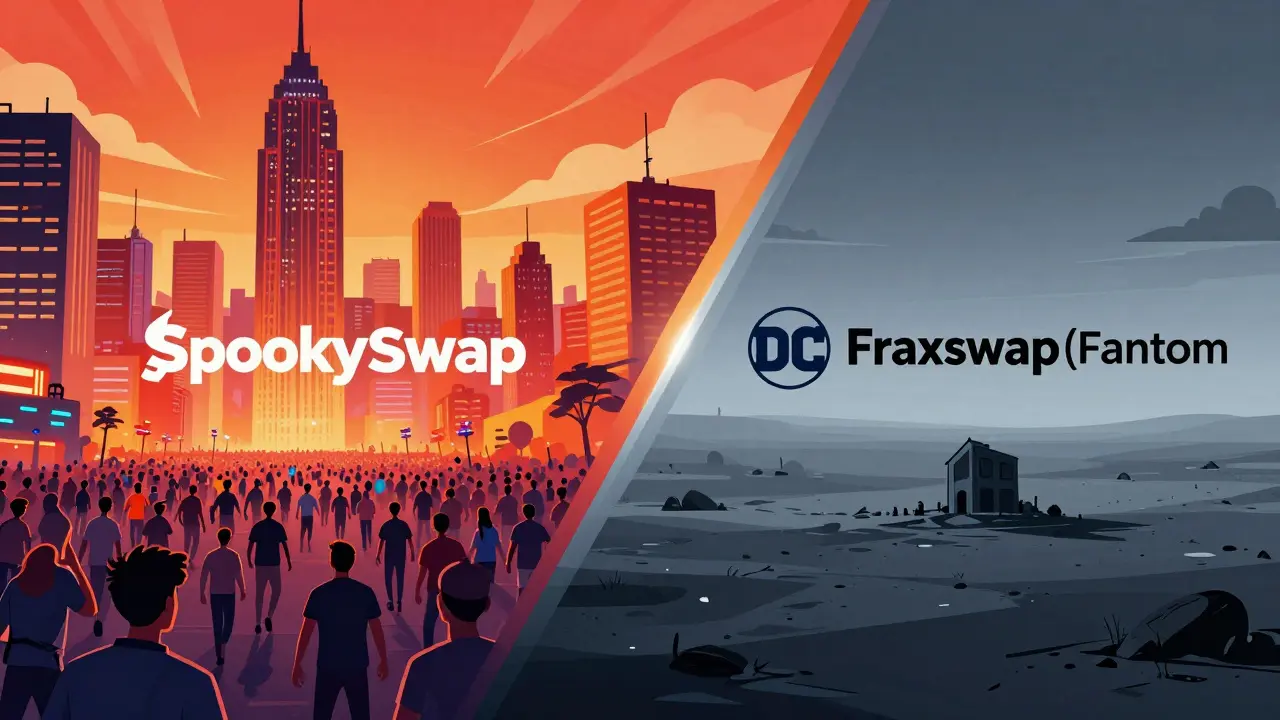
Let’s cut straight to the chase. The biggest issue with Fraxswap (Fantom) right now is that nobody is using it. When you check data aggregators like CoinMarketCap or CoinCodex, you will often see it listed as an "Untracked Listing" or show volumes so low they barely register. We are talking about daily trading volumes measured in single digits-sometimes less than one dollar across all pairs combined. Compare that to established competitors on the Fantom network like SpookySwap or SpiritSwap, which process millions of dollars every day, and the difference is staggering.
Why does this matter? In decentralized finance (DeFi), liquidity is king. Low liquidity means high slippage. If you try to swap a significant amount of FTM for FRAX on Fraxswap (Fantom), you might end up receiving far fewer tokens than expected because there simply aren’t enough assets in the pool to fill your order at a fair price. For small, experimental trades, this might be negligible. For any serious trading strategy, it is a dealbreaker.
What Is Fraxswap Anyway?
To understand why this platform exists despite its lack of users, we need to look at the technology behind it. Fraxswap is an automated market maker (AMM) protocol developed by Frax Finance. Unlike traditional exchanges where buyers and sellers match orders, AMMs use mathematical formulas to set prices based on the ratio of tokens in a liquidity pool. The standard model used here is the constant product formula ($x \times y = k$), similar to what Uniswap uses.
However, Fraxswap distinguishes itself with a feature called TWAMM (Time-Weighted Average Market Maker). This is not just a gimmick; it solves a real problem for large traders. Normally, if a DAO or institution wants to sell a massive amount of tokens all at once, they crash the price due to slippage. TWAMM allows them to schedule a trade that executes slowly over time. Instead of dumping everything instantly, the protocol sells small chunks continuously, averaging out the price impact. This makes Fraxswap theoretically superior for treasury management and institutional flows.
Fantom vs. Ethereum: A Tale of Two Deployments
Here is where things get confusing for new users. Fraxswap operates on multiple blockchains, primarily Ethereum and Fantom. The Ethereum version has seen more adoption and marketing push, often being cited as a top platform for swapping crypto in recent years. The Fantom version, however, was deployed to leverage Fantom’s speed and low costs but failed to gain traction.
| Feature | Fraxswap (Fantom) | SpookySwap | SpiritSwap |
|---|---|---|---|
| Daily Volume | < $1 (Negligible) | Millions USD | Millions USD |
| Liquidity Depth | Very Low | High | High |
| Unique Features | TWAMM | Yield Farming | Staking Rewards |
| User Base | Minimal | Large | Large |
| Best For | Institutional/Treasury | Retail Trading | Retail Trading |
The table above highlights the stark reality. If you are a retail trader looking for ease of use and fair prices, SpookySwap or SpiritSwap are objectively better choices on the Fantom network. They have deep liquidity pools, meaning your swaps execute close to the market rate. Fraxswap (Fantom) lacks this depth entirely.
Who Actually Uses Fraxswap (Fantom)?
If regular people aren’t using it, who is? The answer lies in the TWAMM feature mentioned earlier. This tool is designed for DAOs (Decentralized Autonomous Organizations) and institutional treasuries. Imagine a DAO holding 1 million FXS tokens that needs to convert them to FRAX over the course of a month without crashing the market. They would use Fraxswap’s TWAMM to automate this process.
This explains the lack of retail activity. Retail traders want instant gratification and tight spreads. Institutional users care about minimizing market impact over time. Fraxswap (Fantom) is built for the latter, but since most Fantom users are retail investors seeking yield farming opportunities or quick swaps, the platform remains underutilized. It is a Ferrari engine installed in a car that only drives around empty parking lots.
Security and Trust Factors
When dealing with smart contracts, security is paramount. The core Fraxswap protocol has undergone audits and is open-source, which is a good sign. However, specific audit reports for the Fantom deployment are harder to find in public documentation. Always remember that "audited" does not mean "unhackable." New deployments can introduce bugs unique to that blockchain environment.
Additionally, the lack of community feedback is a red flag for some. On platforms like Reddit or Twitter, discussions about Fraxswap focus heavily on the Ethereum version. There is very little chatter about the Fantom instance. In DeFi, community sentiment often correlates with project health. Silence usually indicates stagnation.
How to Use Fraxswap (Fantom) If You Must
Despite the warnings, you might still want to interact with Fraxswap (Fantom) for testing purposes or if you are part of a DAO using its TWAMM features. Here is how you do it safely:
- Connect a Web3 Wallet: You will need a wallet compatible with Fantom, such as MetaMask, Trust Wallet, or SafePal. Ensure your network settings are switched to Fantom Opera.
- Hold FTM for Gas: Even though transactions are cheap, you still need native FTM tokens to pay for gas fees. Keep a small amount in your wallet.
- Approve Tokens: Before swapping, you must approve the Fraxswap contract to spend your tokens. This is a standard step in DeFi but always verify the address you are interacting with.
- Check Slippage Tolerance: Due to low liquidity, you may need to increase your slippage tolerance setting. Start with a small test transaction to see how much price impact you incur.
- Use TWAMM Carefully: If using the Time-Weighted Average Market Maker, ensure you understand the duration and total amount being traded. Once started, these trades are difficult to cancel mid-execution.
Alternatives on the Fantom Network
If Fraxswap (Fantom) isn’t meeting your needs, you have plenty of other options. The Fantom ecosystem is mature and offers robust alternatives:
- SpookySwap: The oldest and most liquid DEX on Fantom. Great for general trading and yield farming.
- SpiritSwap: Known for its user-friendly interface and competitive yields. Often rivals SpookySwap in volume.
- Beethoven X: A concentrated liquidity AMM (similar to Uniswap V3). Ideal for professional liquidity providers who want to maximize capital efficiency.
- Curve Finance (Fantom): Best for swapping stablecoins with minimal slippage.
Each of these platforms has active communities, regular updates, and significantly higher trading volumes. Unless you have a specific need for Fraxswap’s TWAMM functionality, these alternatives will likely provide a smoother experience.
Future Outlook: Will It Recover?
As of June 2026, there is no clear roadmap or major announcement suggesting a revival of Fraxswap (Fantom). The broader Frax ecosystem continues to develop, focusing on its Ethereum mainnet and other high-value chains. The Fantom deployment appears to be maintained rather than actively promoted. Without a surge in institutional adoption or a strategic partnership with major Fantom projects, it is unlikely to regain significant market share. Users should monitor official Frax Finance channels for any updates, but currently, the platform sits in a state of limbo.
Is Fraxswap (Fantom) safe to use?
While the underlying smart contracts are open-source and audited, the low liquidity poses a financial risk rather than a security one. You are unlikely to lose funds to a hack, but you may suffer significant losses due to high slippage on trades. Always start with small amounts to test the waters.
What is TWAMM and why is it important?
TWAMM stands for Time-Weighted Average Market Maker. It allows large token sales to be executed gradually over time instead of all at once. This minimizes price impact and slippage, making it ideal for DAOs and institutions managing large treasuries. It is a key differentiator from standard AMMs like Uniswap.
Why is the trading volume on Fraxswap (Fantom) so low?
The low volume is due to limited adoption. Most retail traders prefer established DEXs like SpookySwap or SpiritSwap which offer deeper liquidity and better prices. Fraxswap (Fantom) caters more to niche institutional use cases, resulting in minimal everyday trading activity.
Can I earn rewards by providing liquidity on Fraxswap (Fantom)?
Technically, yes. Liquidity providers earn a share of the swap fees. However, given the extremely low trading volume, the fees generated are negligible. Additionally, low liquidity increases the risk of impermanent loss. It is generally not recommended for retail users compared to other Fantom DEXs.
Which is better: Fraxswap on Ethereum or Fantom?
Fraxswap on Ethereum has significantly higher adoption, liquidity, and usage. The Fantom version is largely inactive. If you are interested in the Frax ecosystem, the Ethereum deployment is the primary hub. Use Fantom-based DEXs like SpookySwap for activities on the Fantom network.
Does Fraxswap (Fantom) support fiat on-ramps?
No. Fraxswap is a pure decentralized exchange (DEX). It does not offer credit card purchases, bank transfers, or any fiat gateway services. You must already hold cryptocurrency (like FTM or ETH) to use the platform.