
You log into your favorite cryptocurrency exchange to check your portfolio, and suddenly, the screen goes red. "Access Denied." Or worse, a message pops up asking you to verify your identity because the system thinks you are logging in from a suspicious location. If you use a Virtual Private Network (VPN) to protect your privacy or access restricted trading pairs, this scenario is likely familiar. There is a persistent rumor in online forums that crypto exchanges detect and block between 70% and 80% of VPN users. Is this number accurate? Does it mean your privacy tools are useless?
The short answer is: it depends entirely on what kind of VPN you are using and which exchange you are trying to reach. The 70-80% figure isn't a hard scientific law; it is more of a rough estimate of how many *low-quality* or *free* VPN connections get flagged immediately. Premium services with dedicated infrastructure often slip through unnoticed. However, the gap is closing. As regulations tighten globally, exchanges are investing heavily in detection technology. Understanding how these systems work-and how to navigate them without losing your account-is critical for any serious trader.
Why Exchanges Hate VPNs (And Why They Track Them)
To understand why your connection gets blocked, you have to look at the problem from the exchange's perspective. Platforms like Binance, Coinbase aren't just tech companies; they are financial institutions under intense scrutiny. They operate under strict Know Your Customer (KYC) and Anti-Money Laundering (AML) regulations. These laws require exchanges to know exactly who their users are and where they are located.
When you connect via a standard VPN, your IP address changes to one shared by thousands of other users, often in a different country. To an exchange's security team, this looks like fraud. It mimics the behavior of bad actors trying to:
- Bypass geographic sanctions (e.g., users from restricted regions accessing global markets).
- Create multiple accounts to exploit sign-up bonuses or liquidity mining rewards.
- Hide their true location to evade tax authorities or local bans.
Consequently, exchanges don't just block VPNs randomly. They flag them for additional verification. If you are a legitimate user, this might mean uploading a photo of your ID again. If you are trying to game the system, it means a permanent ban. The detection rate varies because not all VPN traffic looks the same.
How Detection Actually Works: Beyond Simple IP Blocks
In the early days of crypto, blocking a VPN was as simple as maintaining a list of known VPN IP addresses. If your IP matched the list, you were out. Today, that method is obsolete. Sophisticated platforms use a multi-layered approach to identify masked connections. Here is what they are actually looking at:
1. IP Reputation Databases
Exchanges subscribe to real-time databases that categorize IP addresses. Data center IPs (where most cheap VPNs host servers) are easily distinguished from residential IPs (assigned by ISPs to homes). If your connection comes from a data center in Panama but your browser language is set to Japanese, the system flags the inconsistency.
2. Behavioral Analysis
This is where the "70-80%" detection myth gains some traction. Advanced algorithms monitor your login patterns. If you logged in from New York yesterday, London today, and Singapore tomorrow, the system triggers a risk alert. Even if each individual IP is clean, the rapid geographic shifting is a hallmark of VPN usage or compromised accounts.
3. WebRTC and DNS Leaks
Many users think their IP is hidden, but their browser tells a different story. WebRTC leaks can expose your real local IP address even when a VPN is active. Similarly, if your DNS requests go through your ISP instead of the VPN tunnel, the exchange sees your true location. Modern detection systems scan for these leaks automatically.
4. Traffic Fingerprinting
Premium exchanges analyze the metadata of your connection. They look at packet sizes, timing intervals, and encryption handshakes. Standard OpenVPN or WireGuard protocols have distinct signatures. Some advanced platforms use machine learning to spot the subtle differences between organic user traffic and tunneled VPN traffic.
The Free vs. Premium VPN Divide
If you are using a free VPN service, you are almost guaranteed to be detected. In fact, your chances of being blocked approach 100%. Free services rely on overcrowded servers and low-tier IP addresses that are blacklisted by nearly every major platform. They also lack the resources to rotate IPs frequently, meaning once one IP is banned, every user on that server is stuck.
Premium providers like NordVPN or ExpressVPN operate differently. They maintain vast networks of servers and invest in "obfuscation" technologies. For example, NordVPN offers features specifically designed to bypass deep packet inspection (DPI), a technique used by censors and exchanges to peek inside encrypted traffic. By masking the fact that you are using a VPN altogether, these services significantly lower the detection rate.
| Feature | Free / Budget VPNs | Premium VPNs (e.g., NordVPN, ExpressVPN) |
|---|---|---|
| Detection Rate | Very High (70-90%) | Low (Varies by Exchange) |
| IP Type | Shared Data Center IPs | Dedicated & Residential Options Available |
| Leak Protection | Often Poor (DNS/WebRTC Leaks Common) | Robust Kill Switches & Leak Tests |
| Server Rotation | Rarely Updated | Frequent IP Rotation |
| Support for Crypto Payments | No | Yes (Bitcoin, Ethereum, etc.) |

Strategies to Minimize Detection Risks
If you need a VPN for legitimate privacy reasons-or to access services unavailable in your region-here is how to stay under the radar. Note that violating an exchange's Terms of Service can still lead to account closure, so proceed with caution.
- Stick to One Server Location: Do not hop around the globe. Choose a server in a jurisdiction friendly to crypto (like Switzerland or Singapore) and stick to it. Consistency builds trust with the exchange's algorithm.
- Use Dedicated IP Addresses: Many premium VPNs offer a paid add-on for a static IP. This gives you a unique address that doesn't change, making you look like a regular home user rather than a shared tunnel.
- Disable WebRTC: Ensure your browser settings disable WebRTC to prevent IP leaks. Extensions like "WebRTC Leak Prevent" can help automate this.
- Avoid Peak Hours for Sensitive Actions: If you must change locations, do it during off-peak hours and avoid making large trades immediately after switching servers.
- Clear Browser Cookies: Old cookies may contain location data that conflicts with your new IP address, triggering fraud alerts.
The Regulatory Tightrope: What's Changing in 2026
The landscape shifted dramatically in recent years. With the implementation of stricter global standards, such as the EU's MiCA regulation and ongoing SEC actions in the US, exchanges are no longer willing to take chances. A report by Chainalysis highlighted that while VPN usage creates noise in transaction analysis, the sheer volume of data allows firms to attribute activity accurately in most cases. However, they noted that sophisticated obfuscation remains a challenge.
For traders, this means the "wild west" era is over. Exchanges are implementing tiered access. You might be allowed to view prices via a VPN, but attempting to deposit fiat currency or withdraw assets will trigger immediate KYC checks. If your IP suggests you are in a sanctioned country, no amount of technical tweaking will save you. The detection systems are now integrated with government watchlists.
Security vs. Privacy: The Real Trade-Off
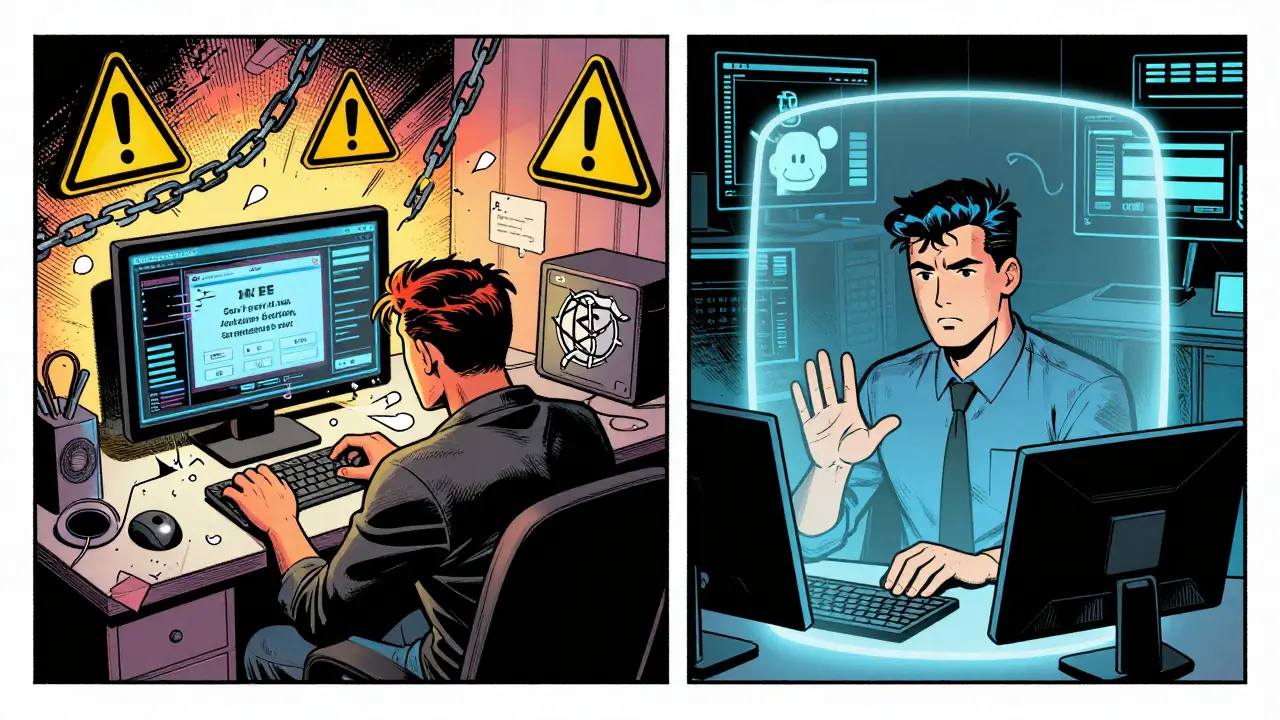
It is important to remember why you are using a VPN in the first place. While avoiding detection is a goal, protecting your assets is paramount. Public Wi-Fi at cafes or airports is a goldmine for hackers targeting crypto wallets. A VPN encrypts your connection, preventing man-in-the-middle attacks where thieves intercept your login credentials.
Services like NordVPN provide dark web monitoring and malware protection, which are arguably more valuable than hiding from an exchange's bot. The risk of having your private keys stolen far outweighs the inconvenience of occasional KYC verification. Use the VPN to secure your connection, but be honest about your location when the exchange asks for verification.
Conclusion: Play Smart, Not Hard
The idea that 70-80% of VPN users are caught is a half-truth. It applies largely to those using free tools or behaving erratically. With a premium service, consistent behavior, and an understanding of how detection works, you can navigate the system safely. However, never use a VPN to deceive an exchange regarding your legal residency. The penalties for violating AML laws are severe, and the technology exists to catch you eventually. Use privacy tools for security, not for evasion.
Can Binance detect if I am using a VPN?
Yes, Binance employs sophisticated detection methods including IP reputation checks, behavioral analysis, and traffic fingerprinting. While premium VPNs can sometimes bypass initial blocks, frequent location changes or use of known data-center IPs will likely trigger a security review or temporary suspension.
Is it illegal to use a VPN for crypto trading?
Using a VPN itself is legal in most countries. However, using it to circumvent financial sanctions, hide your identity from KYC requirements, or trade in a prohibited jurisdiction may violate local laws and exchange terms of service, potentially leading to account bans or legal action.
Which VPN is best for avoiding crypto exchange detection?
Premium providers like NordVPN and ExpressVPN are generally recommended due to their large server networks, obfuscation technologies, and dedicated IP options. These features make it harder for exchanges to distinguish your traffic from regular residential internet usage compared to free or budget VPNs.
Why does my crypto account get suspended when I switch servers?
Rapid changes in geolocation are a primary indicator of fraud or account sharing. If you log in from the US and then from Russia within minutes, the exchange's risk engine flags this as suspicious activity, triggering an automatic suspension pending identity verification.
Do free VPNs work for accessing restricted crypto exchanges?
Rarely. Free VPNs use crowded, well-known IP addresses that are frequently blacklisted by major exchanges. They also lack advanced leak protection, making your real IP visible. Using a free VPN increases the likelihood of detection and potential security risks.