
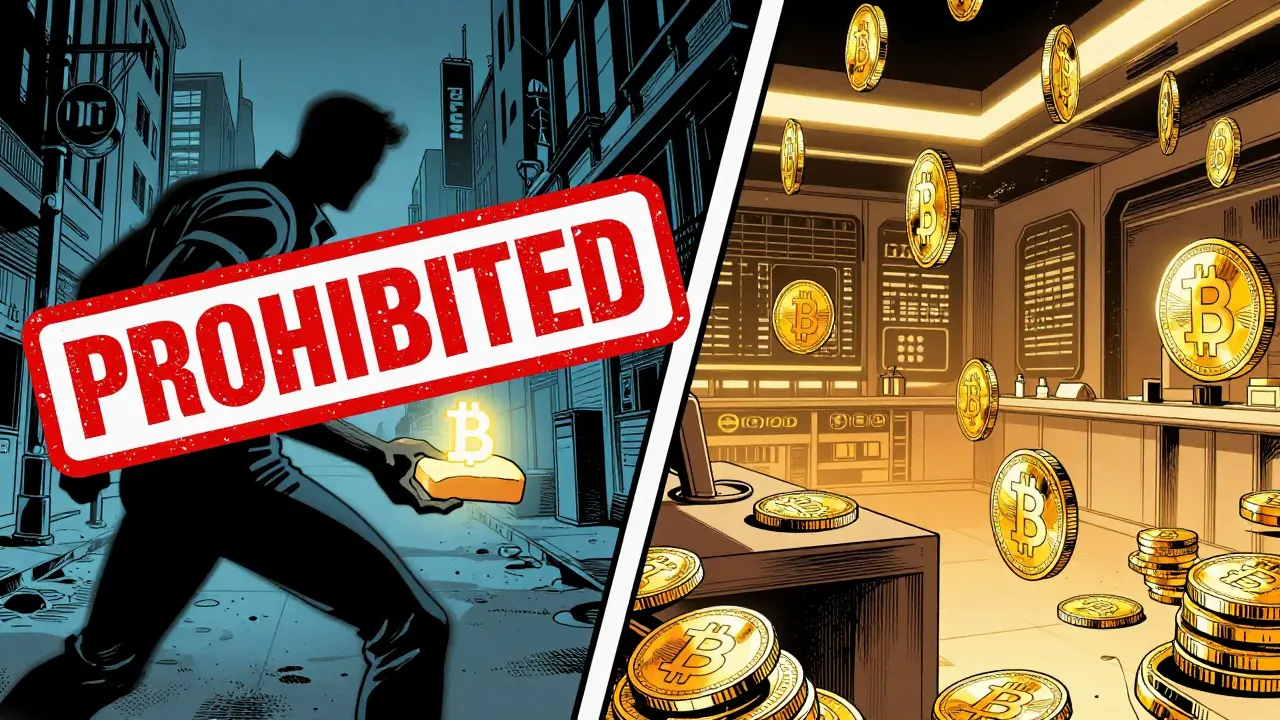
You can own Bitcoin in Russia. You can even mine it. But if you try to buy a loaf of bread or pay for a taxi with it, you are breaking the law. This is the stark reality of the current regulatory landscape in the Russian Federation. The government has drawn a hard line in the sand: cryptocurrency is treated as a digital asset for investment and international trade, but it is strictly prohibited as a means of payment for domestic goods and services.
This dual-track system creates a confusing maze for users and businesses alike. On one side, you have a strict ban on using crypto at your local grocery store. On the other, there is a newly opened door for using digital currencies to bypass Western sanctions in international trade. Understanding this split is critical for anyone operating in or with the Russian market today.
The Legal Foundation: From Ambiguity to Strict Bans
To understand where things stand now, we have to look at how the rules evolved. For years, the status of cryptocurrency in Russia was ambiguous, leaving users in a gray area until clear legislation was passed. That changed significantly in July 2020 when President Vladimir Putin signed Federal Law No. 114-FZ. This law legalized cryptocurrency transactions but explicitly banned their use for domestic payments starting January 1, 2021.
The key takeaway from this law is the definition of crypto. It is not legal tender. It is a "digital asset." This distinction matters because it strips Bitcoin and Ethereum of their function as money within the country’s borders. You can hold them, trade them on exchanges, and profit from price changes, but you cannot hand them over to a merchant in exchange for shoes or software services.
Then came another major shift. In summer 2024, responding to intensifying Western economic sanctions, Russia passed Law No. 382-FZ. This legislation created an exception to the ban. It permitted digital currency payments specifically for international trade. So, while you still can’t pay your neighbor for lawn care with Bitcoin, a Russian exporter might be able to get paid by a Chinese importer using it. This nuance is the core of the current "domestic vs. international" dynamic.
Domestic Usage: What Is Allowed and What Is Not
For the average Russian citizen, the restrictions are tight. The Bank of Russia, led by Chair Elvira Nabiullina, has been vocal about its stance. They argue that cryptocurrencies are not issued or guaranteed by any jurisdiction, rely on mathematical algorithms, and are too volatile to serve as stable money. Because of this, the central bank maintains that they should not be used for everyday transactions.
Here is what you can and cannot do domestically:
- Allowed: Buying, selling, and holding cryptocurrency on licensed exchanges.
- Allowed: Mining cryptocurrency (provided you register with Roskomnadzor and stay under energy limits).
- Allowed: Using crypto as an investment vehicle.
- Prohibited: Paying for goods or services within Russia using crypto.
- Prohibited: Issuing your own tokens for fundraising without specific authorization.
The enforcement of these rules is getting teeth. Starting January 1, 2026, new fines will kick in. Individuals caught using crypto for domestic payments face penalties of 100,000 to 200,000 rubles (roughly $2,500 to $5,000). Legal entities face much steeper fines, ranging from 700,000 to 1,000,000 rubles ($8,750 to $12,500). Crucially, the cryptocurrency involved in the illegal transaction will also be confiscated. This bill, drafted by the Bank of Russia and the Ministry of Finance, aims to close the "gray area" that existed previously.
International Trade: The Experimental Legal Regime (EPR)
If domestic use is closed off, the door for international business is ajar-but only for those who can meet high barriers to entry. The mechanism for this is the Experimental Legal Regime (EPR), detailed in the Central Bank’s March 2025 submission. This framework allows companies to use crypto for cross-border settlements, primarily to facilitate trade with countries not subject to Western sanctions.
However, this is not a free-for-all. To participate in the EPR, entities must undergo rigorous registration with the Central Bank. They need to implement real-time transaction monitoring systems capable of processing at least 1,000 transactions per second with 99.9% uptime. These technical requirements are designed to ensure full transparency and prevent money laundering.
| Feature | Domestic Use (Inside Russia) | International Use (Cross-Border) |
|---|---|---|
| Purpose | Investment, Trading, Mining | Trade Settlements, Export Payments |
| Legal Status | Banned as payment method | Permitted under EPR framework |
| Participants | Individuals and Businesses | Registered Entities Only |
| Monitoring | Standard AML checks | Real-time API integration with Tax Service |
| Fines (from Jan 2026) | Up to 1M RUB + Confiscation | N/A (if compliant with EPR) |
The catch? Access is heavily restricted. The Central Bank requires participants to qualify as "especially qualified investors." This means individuals must have financial assets exceeding 100 million rubles (about $1.2 million) or an annual income above 50 million rubles ($580,000). For most small and medium-sized enterprises, this threshold is impossible to clear. As of July 2025, only 1,842 entities had registered under the EPR, and 92% of them were large financial institutions, not commercial exporters.

Taxation and Compliance Burdens
Even if you navigate the legal bans, the tax implications are significant. As of January 1, 2025, the Tax Code officially recognized cryptocurrency as property. This brings several obligations:
- Capital Gains Tax: You must pay a 13% tax on profits from crypto transactions. This is lower than the global average of 20%, but it is mandatory.
- Quarterly Reporting: Traders must report their activities every quarter to the Federal Tax Service.
- Mining Registration: Miners must register with Roskomnadzor. There are also strict energy consumption limits, capped at 150 MW per facility.
For businesses looking to join the EPR for international payments, the compliance cost is staggering. Moscow-based consultancy BitLegal reports that companies spend an average of 220 staff hours and 1.8 million rubles ($22,500) just to achieve full compliance. You need to maintain seven years of transaction records with blockchain forensic analysis capabilities. You also need to integrate APIs with the Federal Tax Service’s new CryptoTrack system. With only 37 approved compliance consultants nationwide, the bottleneck is real. Many businesses report taking over 11 weeks to set up, leading some to abandon crypto payments entirely despite the theoretical allowance.
Global Comparison: How Does Russia Stack Up?
Russia’s approach is unique because of its sharp dichotomy between domestic prohibition and international permission. Let’s look at how this compares to other major economies.
In contrast to El Salvador which adopted Bitcoin as legal tender in 2021, allowing citizens to pay for everything from taxes to coffee, Russia maintains an absolute ban on domestic payments. Unlike China, which implemented a comprehensive ban on all crypto transactions in 2021, Russia permits ownership and trading. Its model is somewhat similar to India’s 2022 framework, which allows ownership but imposes a heavy 30% capital gains tax. However, Russia’s investor qualification thresholds are far higher than India’s.
Compared to the European Union’s Markets in Crypto-Assets (MiCA) regulation, fully implemented in June 2024, Russia’s stance is more restrictive. MiCA allows crypto payments with robust consumer protections. Russia’s experimental regime resembles Singapore’s Payment Services Act in allowing cross-border trade, but again, the entry barriers in Russia are exponentially higher. While Singapore requires S$50,000 for certain licenses, Russia demands proof of assets worth 100 million rubles for individual investors.

User Reality: The Underground Shift
While the laws exist on paper, user behavior tells a different story. According to Chainalysis’ 2025 Geography of Crypto report, Russia ranks 15th globally in crypto adoption, with an estimated 18 million users. That is 12.3% of the population. Despite the domestic payment ban, people find ways to use their assets.
A July 2025 survey by the Russian Crypto Association found that 68% of users now employ non-custodial wallets to avoid Know Your Customer (KYC) requirements associated with centralized exchanges. Forty-two percent reported difficulties converting crypto back into rubles due to bank restrictions. Many users turn to peer-to-peer (P2P) markets, but the Bank of Russia has tightened the noose here too. Financial institutions are now required to monitor P2P transactions and report anything exceeding 600,000 rubles ($7,500).
The friction is evident in user complaints. On forums like Reddit’s r/CryptoRussia, users frequently cite the extra time and fees involved in moving money offshore to bypass domestic bans. One user noted that using offshore exchanges adds 3-5 business days and 2.5% in fees to transactions. Meanwhile, banks remain reluctant to process crypto-related fiat conversions, with 82% of respondents in a National Settlement Depository study citing this as a major hurdle.
Future Outlook: Tightening the Screws?
Looking ahead, the trend points toward stricter control rather than liberalization. The Central Bank’s September 2025 roadmap includes plans to expand transaction monitoring to include non-custodial wallets by Q2 2026. Biometric verification for all crypto transactions above 500,000 rubles ($6,250) is slated for Q4 2026.
Furthermore, the Ministry of Finance is drafting legislation to extend the domestic payment ban to include all stablecoins by 2027, citing systemic risks following collapses like TerraUSD. While international crypto-facilitated exports are projected to grow-forecasted to reach $8.5 billion in 2026-the domestic market remains suppressed. Only 2.1% of Russian merchants accept crypto, according to DataInsight’s July 2025 retail survey.
Experts are divided on the long-term viability. Dr. Ivan Sidorov of HSE University argues that restricting access to the ultra-wealthy creates dangerous market distortions. Conversely, the IMF commends Russia’s clear distinction between domestic and international use but warns that high thresholds may drive activity entirely underground. As the three-year experimental period for the EPR runs through 2027, all eyes will be on whether the government lowers these barriers or doubles down on restriction.
Can I use Bitcoin to buy goods in Russia?
No. Since January 1, 2021, it has been illegal to use cryptocurrency as a means of payment for goods and services within Russia. Doing so can result in fines of up to 200,000 rubles for individuals and confiscation of the crypto assets starting January 1, 2026.
Is cryptocurrency legal in Russia?
Yes, owning, trading, and mining cryptocurrency is legal. However, it is classified as a "digital asset" rather than legal tender. You can hold it as an investment, but you cannot use it as money for domestic transactions.
How can Russian businesses use crypto for international trade?
Businesses can use crypto for international payments by registering under the Experimental Legal Regime (EPR). This requires Central Bank registration, implementation of real-time monitoring systems, and meeting strict investor qualification criteria, such as having assets over 100 million rubles.
What are the taxes on cryptocurrency in Russia?
As of January 1, 2025, cryptocurrency is taxed as property. Individuals must pay a 13% capital gains tax on profits from crypto transactions and file quarterly reports with the Federal Tax Service.
Will the crypto payment ban be lifted?
It is unlikely in the near future. The Bank of Russia remains opposed to crypto as a payment method due to volatility and lack of state guarantee. Current trends suggest further tightening, including potential bans on stablecoin payments domestically by 2027.