
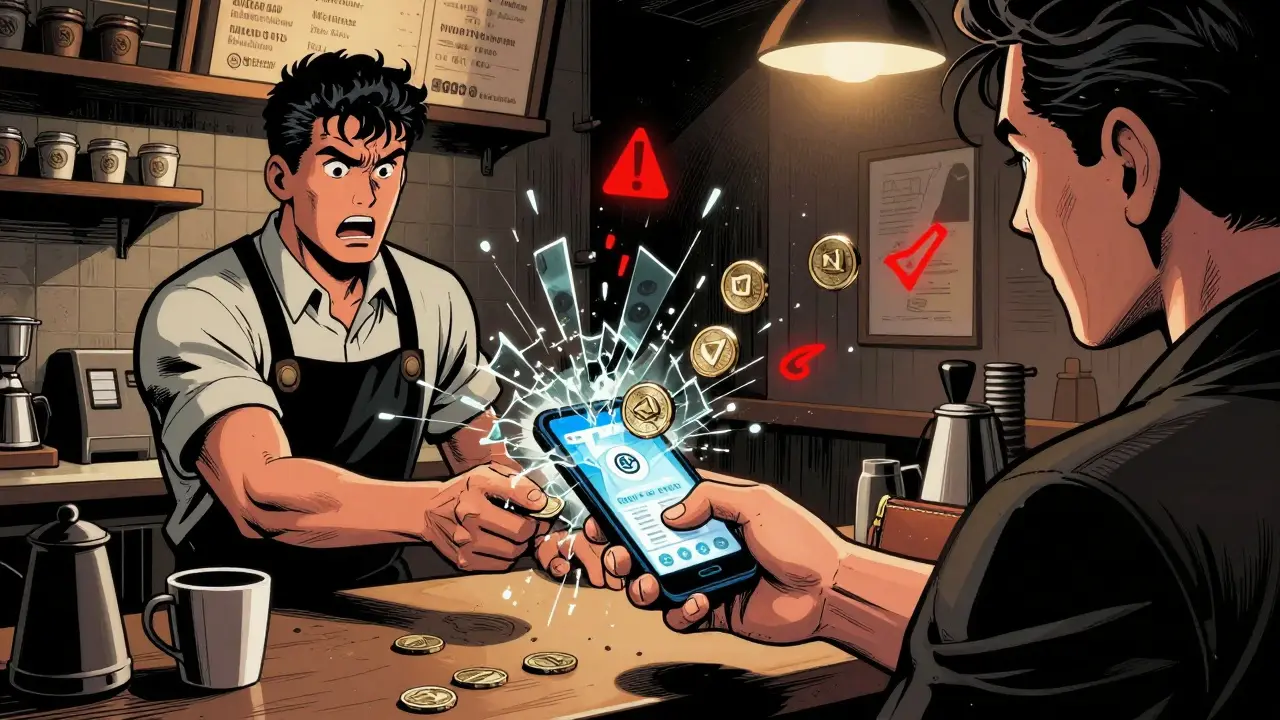
Imagine buying a coffee with cryptocurrency. You hand over the digital coins, the barista sees the transaction confirm on their phone, and you walk away. Ten minutes later, that same transaction vanishes from the ledger. The coins are back in your wallet. The barista is out of luck. This isn't a glitch; it's a 51% attack, and for small cryptocurrencies, it is not just a theoretical nightmare-it is a daily reality.
If you hold altcoins outside the top tier of market capitalization, you need to understand how this threat works. While Bitcoin remains largely immune due to its massive computational shield, smaller networks face a perfect storm of vulnerability. In 2026, with cloud mining services making hash power accessible to anyone with a credit card, the barrier to entry for attackers has never been lower. Understanding this risk is essential for protecting your assets and choosing which chains deserve your trust.
What Exactly Is a 51% Attack?
To grasp the danger, we first need to look at how blockchains agree on truth. Most secure cryptocurrencies use a mechanism called Proof of Work (a consensus algorithm where miners compete to solve complex mathematical puzzles to validate transactions and create new blocks). Think of it as a global voting system. Every miner contributes computing power, or "hashrate," to vote on the next valid block of transactions. Whoever solves the puzzle first gets to add the block and earn a reward.
The network accepts the longest chain of blocks as the true history. This is known as Nakamoto Consensus (the protocol rule that the longest valid chain represents the accepted state of the blockchain). Now, imagine one entity controls more than 50% of the total computing power. They can now outvote everyone else combined. They don't need to hack the code; they just need to overpower the democracy.
With majority control, an attacker gains several dangerous capabilities:
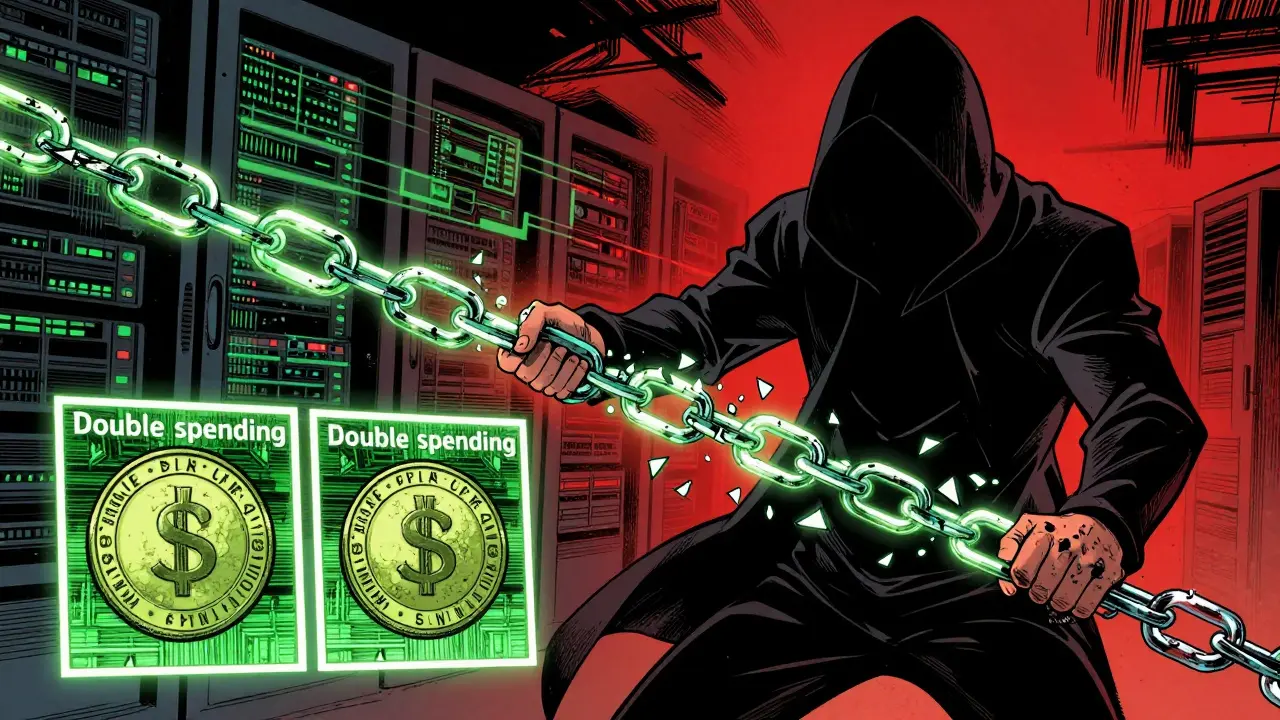
- Double Spending: They can send coins to an exchange, sell them for fiat currency, and then reverse the transaction on the blockchain, keeping both the coins and the cash.
- Transaction Censorship: They can refuse to include specific transactions in blocks, effectively freezing funds for targeted users.
- Block Reorganization: They can rewrite recent history, undoing confirmed transactions.
It is crucial to note what an attacker cannot do. They cannot steal funds directly from a private wallet because they do not have your keys. They cannot create new coins out of thin air beyond the protocol's issuance rules. Their power is limited to manipulating the order and validity of transactions they initiate themselves.
Why Small Cryptocurrencies Are Sitting Ducks
You might wonder why this doesn't happen to Bitcoin every day. The answer lies in economics and scale. Attacking Bitcoin would require acquiring enough specialized hardware to match the entire global network's hashrate. This would cost billions of dollars in equipment and electricity, likely exceeding any potential profit from double-spending. It is economically irrational.
Small cryptocurrencies tell a different story. Many of these networks have minimal mining participation. If a coin has a low market cap and few active miners, the total hashrate is tiny. An attacker might only need a few rented graphics cards or a modest cloud contract to surpass the 50% threshold.
Consider the case of Bitcoin Gold (a Bitcoin fork created to allow GPU mining, which suffered devastating 51% attacks in 2018 and 2020). In May 2018, attackers compromised the network, double-spending approximately $18 million worth of tokens. They did this by renting hashpower from a cloud service. The cost of the rental was a fraction of the stolen amount. By 2020, the network was attacked again, leading to permanent reputational damage and delisting from major exchanges. This pattern repeats across the ecosystem.
Other victims include Ethereum Classic (a continuation of the original Ethereum blockchain that has faced multiple 51% attacks due to relatively low hashrate) and obscure coins like Feathercoin. These incidents prove that technical design alone does not guarantee security if the economic incentives are misaligned.
The Mechanics of Modern Attacks
In 2026, executing a 51% attack is less about building a farm of ASICs and more about financial engineering. The rise of Cloud Mining Services (platforms that allow users to rent hashing power without owning physical hardware) has democratized access to attack vectors. Platforms exist specifically to rent out hashrate on demand. An attacker can lease power for a few hours, execute a series of double-spend transactions against exchanges, and then terminate the contract before the network detects the anomaly.
The strategy typically follows a precise playbook:
- Scout the Target: Identify a small-cap coin with low liquidity and weak mining distribution.
- Acquire Power: Rent sufficient hashrate via cloud providers or coordinate with existing pools to achieve majority control.
- Execute Double-Spend: Send a large volume of coins to an exchange that supports the token. Wait for the standard confirmation time (often just a few blocks).
- Cash Out: Immediately sell the received coins for stablecoins or fiat currency on the exchange.
- Reorganize the Chain: Use the majority hashrate to mine a secret, longer chain that excludes the deposit transaction. Release this longer chain to the network.
- Disappear: The public ledger reverts. The deposit is gone. The attacker keeps the cashed-out funds.
Research from the MIT Digital Currency Initiative highlights a critical shift in this dynamic. Scholars Gert-Jaap Glasbergen, James Lovejoy, and Anne Ouyang demonstrated that 51% attacks can be break-even or profitable unless miners face substantial fixed costs that cannot be recouped. For small chains, the "fixed cost" of renting cloud power is low, while the potential payout from exploiting exchange withdrawal limits is high.
Real-World Case Studies: Lessons from Monero and Beyond
While Proof-of-Work coins are the primary targets, no network is entirely safe. Even Monero (a privacy-focused cryptocurrency using the RandomX proof-of-work algorithm designed to resist ASIC mining) faced a significant incident. Reports indicated that the Qubic mining pool achieved majority hashrate control. Despite Monero's RandomX algorithm, which favors CPU mining to prevent centralization, economic incentives drove miners to concentrate their power in a single pool. This allowed for deep blockchain reorganizations, threatening the integrity of the network.
This case illustrates a vital point: protocol-level defenses, like ASIC-resistant algorithms, do not eliminate 51% attack risks. They merely shift the vector. If the economic reward for concentrating hashrate outweighs the penalty for decentralization, attackers will find a way.
Another notable example is the attack on Krypton (a small cryptocurrency that suffered a 51% attack resulting in significant loss of confidence and value). The network was overwhelmed, transactions were reversed, and the community lost faith. The coin's value plummeted, and development stalled. This demonstrates that the impact extends beyond immediate financial loss; it destroys the social contract necessary for a cryptocurrency to function.
How to Protect Yourself as an Investor
If you are interested in investing in or using small cryptocurrencies, you must adopt a defensive mindset. Here are practical steps to mitigate your exposure to 51% attack risks:
| Factor | High Risk Indicator | Low Risk Indicator |
|---|---|---|
| Market Cap | Below $10 million | Top 50 by Market Cap |
| Mining Distribution | Top pool holds >30% hashrate | No single pool exceeds 10% |
| Confirmation Time | Fast finality (1-3 blocks) | Longer wait times recommended |
| Exchange Support | Listed on unregulated or small exchanges | Listed on major, regulated platforms |
Check the Hashrate: Use blockchain explorers to monitor the network's total hashrate and pool distribution. If one pool dominates, the network is vulnerable. Tools like Hashrate Index provide real-time data on this.
Wait for More Confirmations: For high-value transactions on smaller chains, do not rely on the standard number of confirmations. Wait for significantly more blocks to pass. Each additional block makes it exponentially harder for an attacker to reorganize the chain.
Avoid Small Exchanges: Exchanges are often the target of double-spending attacks. Stick to reputable platforms with robust fraud detection systems. Be wary of exchanges offering instant withdrawals for obscure tokens.
Diversify Holdings: Do not store significant wealth in low-market-cap altcoins. Treat them as high-risk speculative assets, not savings accounts.
The Future of Blockchain Security
As we move further into 2026, the landscape is evolving. The proliferation of Attack-as-a-Service (underground offerings that provide tools and infrastructure for executing 51% attacks on demand) models means that even non-technical actors can compromise networks. Industry analysts predict that only cryptocurrencies maintaining rigorous decentralization and substantial hashrate distribution will survive.
Developers are responding with new mitigation strategies. Some projects are implementing checkpointing systems, which hard-code certain blocks into the software, preventing deep reorganizations. Others are exploring hybrid consensus mechanisms that combine Proof of Work with other layers of security. However, these solutions often introduce trade-offs, potentially sacrificing some degree of decentralization for safety.
For the average user, the lesson is clear: decentralization is not guaranteed by code alone. It requires active participation, vigilant monitoring, and economic sustainability. When evaluating a cryptocurrency, look beyond the whitepaper. Look at the miners, the pools, and the incentives. If the math doesn't add up in favor of security, assume an attack is inevitable, not just possible.
Can a 51% attack steal my private key?
No. A 51% attack does not give the attacker access to your private keys or wallet contents. They can only manipulate the blockchain ledger to reverse transactions that you initiated, such as sending coins to an exchange. Your stored coins remain safe in your wallet unless you actively try to spend them during an attack.
Is Bitcoin safe from a 51% attack?
Yes, practically speaking. Bitcoin's hashrate is so immense that acquiring 51% control would require billions of dollars in hardware and energy costs, far exceeding any potential profit from double-spending. It is economically unfeasible for any current entity to attempt such an attack.
How can I check if a cryptocurrency is vulnerable?
You can check the network's hashrate and mining pool distribution using blockchain explorers or sites like Hashrate Index. If the total hashrate is low and a single mining pool controls more than 30-40% of the network, the coin is at higher risk. Also, consider the market cap; coins under $10 million are particularly vulnerable.
What happens to the price after a 51% attack?
The price typically crashes immediately. Loss of confidence leads to mass selling, and major exchanges often delist the affected cryptocurrency to protect their own users. This can render the asset illiquid and worthless, as seen with Bitcoin Gold and Ethereum Classic following their respective attacks.
Do Proof-of-Stake networks face 51% attacks?
Proof-of-Stake (PoS) networks face a similar threat called a "long-range attack" or stake accumulation attack, but the mechanics differ. Instead of buying computing power, an attacker would need to acquire 51% of the staked tokens. This is generally more expensive and slower to execute than PoW attacks, but it is still a theoretical risk for smaller PoS networks.